NIGHTMARE
TALES
A
Compilation of Stories
By
H P Blavatsky
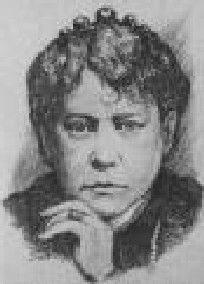
H
P Blavatsky
Return to Nightmare Tales index
An Unsolved Murder
By
H. P. Blavatsky
The circumstances
attending the sudden death of M. Delessert, inspector
of the Police de Surete, seem to have made such an
impression upon the Parisian authorities that they were recorded in unusual
detail. Omitting all particulars except what are necessary to explain matters,
we produce here the undoubtedly strange history.
In the fall of 1861
there came to Paris a man who called himself Vic de Lassa, and was so inscribed
upon his passports. He came from
He was a small man, aged
thirty-five, with pale and mysterious face, long blonde hair, a vague,
wandering blue eye, and a mouth of singular firmness. He dressed carelessly and
unaffectedly, and spoke and talked without much empressement.
His companion,
presumably his wife, on the other hand, ten years younger than himself, was a
strikingly beautiful woman, of that dark, rich, velvety, luscious, pure
Hungarian type which is so nigh akin to the gipsy blood. At the theatres, on
the Bois, at the cafes, on the boulevards, and everywhere that idle Paris
disports itself, Madame Aimee de Lassa attracted great attention and made a
sensation.
They lodged in luxurious
apartments on the Rue
How did it happen then,
that the Prefect of Police saw fit to suspect Monsieur and Madame de Lassa, and
detailed Paul Delessert, one of the most ruse
inspectors of the force, to "pipe" him? The fact is, the
insignificant man with the splendid wife was a very mysterious personage, and
it is the habit of the
police to imagine that mystery always hides either the
conspirator, the adventurer, or the charlatan.
The conclusion to which
the Prefect had come in regard to M. de Lassa was that he was an adventurer and
charlatan too. Certainly a successful one, then, for he was singularly
unobtrusive and had in no way trumpeted the wonders which it was his mission to
perform, yet in a few weeks
after he had established himself in
Delessert did not find it very difficult to get an introduction and
admission to De Lassa's salon. The receptions occurred every other day -- two
hours in the forenoon, three hours in the evening. It was evening when
Inspector Delessert called in his assumed character
of M. Flabry, virtuoso in jewels and a convert to
Spiritualism. He found the handsome parlours
brilliantly lighted, and a charming assemblage gathered of well-pleased guests,
who did not at all seem to have come to learn their fortunes or fates, while
contributing to the income of their host, but rather to be there out of
complaisance to his virtues and gifts.
Mme. de Lassa performed
upon the piano or conversed from group to group in a way that seemed to be
delightful, while M. de Lassa walked about or sat in his insignificant,
unconcerned way, saying a word now and then, but seeming to shun everything
that was conspicuous. Servants handed about refreshments, ices, cordials,
wines, etc., and Delessert could have fancied himself
to have dropped in upon a quite modest evening entertainment, altogether en regle, but for one or two noticeable circumstances which
his observant eyes quickly took in.
Except when their host
or hostess was within hearing the guests conversed together in low tones,
rather mysteriously, and with not quite so much laughter as is usual on such
occasions. At intervals a very tall and dignified footman would come to a
guest, and, with a profound bow, present him a card on a silver salver. The
guest would then go out, preceded by the solemn servant, but when he or she
returned to the salon -- some did not return at all -- they invariably wore a
dazed or puzzled look, were confused, astonished, frightened, or amused.
All this was so
unmistakably genuine, and De Lassa and his wife seemed so unconcerned amidst it
all, not to say distinct from it all, that Delessert
could not avoid being forcibly struck and considerably puzzled.
Two or three little
incidents, which came under Delessert's own immediate
observation, will suffice to make plain the character of the impressions made
upon those present. A couple of gentlemen, both young, both of good social
condition, and evidently very intimate friends, were conversing together and tutoying one another at a great rate, when the dignified
footman summoned Alphonse. He laughed gaily, "Tarry a moment, cher Auguste," said he,
"and thou shalt know all the particulars of this
wonderful fortune!" "Eh bien!"
A minute had scarcely elapsed when Alphonse returned to the salon. His face was
white and bore an appearance of concentrated rage that was frightful to
witness.
He came straight to Auguste, his eyes flashing, and bending his face toward his
friend, who changed colour and recoiled, he hissed out "Monsieur Lefebure, vous etes un lache!" "Very
well, Monsieur Meunier," responded Auguste, in the same low tone,
"tomorrow
morning at
A diplomatist of
distinction, representative at Paris of a neighbouring
state, an elderly gentleman of superb aplomb and most commanding appearance,
was summoned to the oracle by the bowing footman. After being absent about five
minutes he returned, and immediately made his way through the press to M. de
Lassa, who was standing not far from the fireplace, with his hands in his
pockets and a look of utmost indifference upon his face. Delessert
standing near, watched the interview with eager
interest.
"I am exceedingly
sorry," said General Von --, "to have to absent myself so soon from
your interesting salon, M. de Lassa, but the result of my seance
convinces me that my dispatches have been tampered with." "I am
sorry," responded M. de Lassa, with an air of languid but courteous
interest; "I hope you may be able to discover which of your servants has
been unfaithful." "I am going to do that now," said the General,
adding, in significant tones, "I shall see that both he and his
accomplices do not escape severe punishment." "That is the only
course to pursue, Monsieur le Comte." The ambassador stared, bowed, and
took his leave with a bewilderment in his face that
was beyond the power of his tact to control.
In the course of the
evening M. de Lassa went carelessly to the piano, and, after some indifferent
vague preluding, played a remarkably effective piece
of music, in which the turbulent life and buoyancy of bacchanalian strains
melted gently, almost imperceptibly away, into a sobbing wail of regret, and
languor, and weariness, and despair. It was beautifully rendered, and made a
great
impression upon the guests, one of whom, a lady, cried, "How
lovely, how sad!
Did you compose that
yourself, M. de Lassa?" He looked towards her absently for an instant, then replied: "I? Oh, no! That is merely a reminiscence, madame."
"Do you know who did compose it, M. de Lassa?" enquired a virtuoso
present. "I believe it was originally written by Ptolemy Auletes, the father of Cleopatra," said M. de Lassa,
in his indifferent musing way; "but not in its present form.
It has been twice
re-written to my knowledge; still, the air is substantially the same."
"From whom did you get it, M. de Lassa, if I may ask?" persisted the gentleman. "Certainly,
certainly! The last time I heard it played was by Sebastian Bach; but
that was Palestrina's -- the present -- version. I think I
prefer that of Guido of
after the manner of Mr. Twemlow,
"Mon Dieu! that was in Anno Domini 1022." "A
little later than that -- July, 1031, if I remember rightly," courteously
corrected M. de Lassa.
At this moment the tall
footman bowed before M. Delessert, and presented the
salver containing the card. Delessert took it and
read: "On vous accorde
trente-cing secondes, M. Flabry, tout au plus!" Delessert
followed; the footman opened the door of another room and bowed again,
signifying that Delessert was to enter. "Ask no
questions," he said briefly; "Sidi is
mute." Delessert entered the room and the door
closed behind him. It was a small room, with a strong smell of frankincense
pervading it; the walls were covered completely with red hangings that
concealed the windows, and the floor was felted with a thick carpet. Opposite
the door, at the upper end of the room near the ceiling was the
face of a large clock,
under it, each lighted by tall wax candles, were two small tables, containing,
the one an apparatus very like the common registering telegraph instrument, the
other a crystal globe about twenty inches in diameter, set upon an exquisitely
wrought tripod of gold and bronze intermingled. By the side of the door stood a
man jet black in colour, wearing a white turban and
burnous, and having a sort of wand of silver in one hand. With the
other he took Delessert by the right arm above the
elbow, and led him quickly up the room. He pointed to the clock, and it struck
an alarum; he pointed to the crystal. Delessert bent
over, looked into it, and saw -- a facsimile of his own
sleeping-room, everything photographed exactly. Sidi
did not give him time to exclaim, but still holding him by the arm, took him to
the other table. The telegraph-like instrument began to click-click. Sidi opened the drawer, drew out a slip of paper, crammed
it into Delessert's hand, and pointed to the clock,
which struck again, The thirty-five seconds were expired. Sidi,
still retaining hold of Delessert's arm, pointed to
the door and led him towards it. The door opened, Sidi
pushed him out, the door closed, the tall footman stood there bowing -- the
interview with the oracle is over. Delessert glanced
at the piece of paper in his hand. It was a printed scrap, capital letters, and
read simply: "To M. Paul Delessert: The
policeman is always welcome, the spy is always in danger!"
Delessert was dumbfounded a moment to find his disguise detected, but
the words of the tall
footman, "This way if you please, M. Flabry,"
brought him to his senses. Setting his lips, he returned to the salon, and
without delay sought M. de Lassa. "Do you know the contents of this?"
asked he, showing the message. "I know everything, M. Delessert,"
answered De Lassa, in his careless way."
Then perhaps you are
aware that I mean to expose a charlatan, and unmask a hypocrite, or perish in
the attempt?" said Delessert. "Cela m'est egal,
monsieur," replied De Lassa. "You accept my challenge then?"
"Oh! it is a defiance, then?" replied De
Lassa, letting his eye rest a moment upon Delessert,
"mais oui, je 1'accepte! And thereupon Delessert
departed.
Delessert now set to work aided by all the forces the Prefect of
Police could bring to bear, to detect and expose this consummate sorcerer, who
the ruder processes of our ancestors would easily have disposed of -- by
combustion. Persistent enquiry satisfied Delessert
that the man was neither a Hungarian nor was named De Lassa; that no matter how
far back his power of "reminiscence"
might extend, in his present and immediate form he had been born
in this unregenerate world in the toy-making city of
celebrated Robert Houdin, the prestidigitateur. Houdin
recognizing the lad's talents, and being himself a maker of ingenious automata,
had taken him off to Paris and employed him in his own workshops, as well as
for an assistant in the public performances of his amusing and curious
diablerie. After staying with Houdin some years, Pflock Haslich (which was De
Lassa's right name) had gone
East in the suite of a
Turkish Pasha, and after many years' roving, in lands where he could not be
traced under a cloud of pseudonyms, had finally turned up in Venice, and come
thence to Paris.
Delessert next turned his attention to Mme. de Lassa. It was more difficult
to get a clue by means of which to know her past life; but it was necessary in
order to understand enough about Haslich. At last,
through an accident, it became probable that Mme. Aimee was identical with a
certain Mme. Schlaff, who had been rather conspicuous
among the demi-monde of Buda. Delessert
posted off to that ancient city, and thence went into
the wilds of
On his return, as soon
as he reached the telegraph and civilization, he telegraphed the Prefect from Kardszag: "Don't lose sight of my man, nor let him
leave
upon the side-walk of a street; and the message he received read
thus: "What you have seen will be, Delessert, in
three days. Prepare!" The detective, unspeakably shocked, retired from the
house at once and sought his own lodgings.
In the morning he came
to the office in a state of extreme dejection. He was completely unnerved. In
relating to a brother inspector what had occurred, he said "That man can
do what he promises, I am doomed!"
He said that he thought
he could make a complete case out against Haslich
alias De Lassa, but could not do so without seeing the Prefect and getting
instructions. He would tell nothing in regard to his discoveries in Buda and in
He time and again
averred his conviction that he was a doomed man, and showed himself both
vacillating and irresolute in his conduct, and extremely nervous. He was told
that he was perfectly safe, since De Lassa and all his
household were under constant surveillance; to which he replied, "You do
not know the man." An inspector was detailed to accompany Delessert, never to lose sight of him night and day, and
guard him carefully; and proper precautions were taken in regard to his food
and drink, while the guards watching De Lassa were doubled.
On the morning of the
third day, Delessert, who had been staying chiefly
indoors, avowed his determination to go at once and telegraph to M. le Prefect
to return immediately. With this intention he and his brother officer started
out. Just as they got to the corner of the Rue de Lanery
and the Boulevard, Delessert stopped suddenly and put
his hand to his forehead.
"My God!" he
cried, "the crystal! the picture!" and fell
prone upon his face, insensible. He was taken at once to a hospital, but only
lingered a few hours, never regaining his consciousness. Under express
instruction from the authorities, a most careful, minute, and thorough autopsy
was made of
Delessert's body by several distinguished surgeons, whose unanimous
opinion was, that the cause of his death was apoplexy, due to fatigue and
nervous excitement.
As soon as Delessert was sent to the hospital, his brother inspector
hurried to the Central Office, and De Lassa, together with his wife and
everyone connected with the establishment, were at
once arrested. De Lassa smiled contemptuously as they took him away. "I
knew you were coming; I prepared for it; you will be glad to release me
again."
It was quite true that
De Lassa had prepared for them. When the house was searched it was found that
every paper had been burned, the crystal globe was destroyed, and in the room
of the seances was a great heap of delicate machinery
broken into indistinguishable bits. "That cost me 200,000 francs,"
said De Lassa, pointing to the pile, "but it has been a good
investment." The walls and floors were ripped out in several places, and
the damage to the property was considerable. In prison neither De Lassa nor his
associates made any revelations.
The notion that they had
something to do with Delessert's death was quickly
dispelled, in a legal point of view, and all the party but De Lassa were
released. He was still detained in prison, upon one pretext, or another, when
one morning he was found hanging by a silk sash to the cornice of the room
where he was confined -- dead. The night before, it was afterwards discovered,
Madame
de Lassa had eloped with a tall footman, taking the Nubian Sidi with them. De Lassa's secrets died with him.
--------
"It is an
interesting story, that article of yours in to-day's Scientist. But is it a
record of facts, or a tissue of the imagination? If true, why not state the
source of it, in other words, specify your authority
for it."
The above is not signed,
but we would take the opportunity to say that the story, "An Unsolved
Mystery," was published because we considered the main points of the
narrative -- the prophecies, and the singular death of the officer -- to be
psychic phenomena, that have been, and can be, again produced. Why quote
"authorities"? The Scriptures tell us of the death of Ananias, under the
stern rebuke from Peter; here we have a phenomenon of a similar
nature. Ananias is supposed to have suffered instant
death from fear. Few can realize this power governed by spiritual laws, but
those who have trod the boundary line and know some few of the things that can
be done, will see no great mystery in this, nor in the
story published last week. We are not speaking in mystical tones.
Ask the powerful
mesmerist if there is danger that the subject may pass out of his control? -- if he could will the spirit out, never to return? It is
capable of demonstration that the mesmerist can act on a subject at a distance
of many miles; and it is no less certain that, the majority of mesmerists know
little or nothing of the laws that govern their powers.
It may be a pleasant
dream to attempt to conceive of the beauties of the spirit-world; but the time
can be spent more profitably in a study of the spirit itself, and it is not
necessary that the subject for study should be in the spirit-world.
Return to Nightmare Tales index
Find out more about
Theosophy
with these links
Cardiff Theosophical Society meetings
are informal
and there’s always a cup of tea afterwards
The Cardiff Theosophical Society Website
The National Wales Theosophy
Website
Theosophy
Cardiff’s Instant Guide to Theosophy
Theosophy
Cardiff’s Gallery of Great Theosophists
Dave’s Streetwise
Theosophy Boards
The Theosophy Website that
welcomes
If you run a Theosophy Study
Group, please
feel free to use any material on
this Website
Independent Theosophy Blog
The Most Basic Theosophy
Website in the Universe
A quick overview of
Theosophy
and the Theosophical Society
If you run a Theosophy Study
Group you
can use this as an introductory handout.
One liners and quick explanations
About aspects of Theosophy
The Voice of the Silence Website
An Independent
Theosophical Republic
Links to Free Online
Theosophy
Study Resources; Courses, Writings,
The main criteria for the
inclusion of
links on this site is that they
have some
relationship (however tenuous) to
Theosophy
and are lightweight, amusing or
entertaining.
Topics include Quantum Theory
and Socks,
Dick Dastardly and Legendary Blues Singers.
An entertaining introduction to Theosophy
For everyone everywhere, not just in Wales
It’s all “water under the
bridge” but everything you do
makes an imprint on the Space-Time
Continuum.
A selection of articles on
Reincarnation
Provided in response to the
large number
of enquiries we receive on this
subject
No
Aardvarks were harmed in the
National Wales Centre for Theosophy
Blavatsky Wales Theosophy Group
The
Spiritual Home of Urban Theosophy
The Earth Base for Evolutionary Theosophy
The Birmingham Annie Besant Lodge
_______________________
Tekels Park
to be Sold to a Developer
Concerns about the fate of the wildlife as
Tekels Park is to be Sold to a Developer
Concerns are raised about the fate of the wildlife as
The Spiritual Retreat, Tekels Park in Camberley,
Surrey, England is to be sold to a developer.
Tekels Park is a 50 acre woodland park, purchased
for the Adyar Theosophical Society in England in 1929.
In addition to concern about the park, many are
worried about the future of the Tekels Park Deer
as they are not a protected
species.
Confusion as the Theoversity
moves out of
Tekels Park to Southampton, Glastonbury &
Chorley in Lancashire while the leadership claim
that the Theosophical Society will
carry on using
Tekels Park despite its sale to a developer
Anyone planning a “Spiritual” stay at the
Tekels Park Guest House should be aware of the sale.
Tekels Park & the Loch Ness Monster
A Satirical view of the sale
of Tekels Park
in Camberley, Surrey to a
developer
The Toff’s Guide to the Sale of
Tekels Park
What the men in top hats have
to
say about the sale of Tekels Park
____________________
The Theosophy
The Theosophy
Cardiff Guide to
The Theosophy Cardiff
Guide to
The
Theosophy Cardiff Guide to
The Terraced Maze of Glastonbury Tor
Glastonbury and Joseph of Arimathea
The
Grave of King Arthur & Guinevere
Views
of Glastonbury High Street
The
Theosophy Cardiff Guide to
_____________________
A B C D EFG H IJ KL M N OP QR S T UV WXYZ
Complete
Theosophical Glossary in Plain Text Format
1.22MB
___________________________
Classic Introductory
Theosophy Text
A Text Book of Theosophy By C
What Theosophy Is From the Absolute to Man
The Formation of a Solar System The Evolution of Life
The Constitution of Man After Death Reincarnation
The Purpose of Life The Planetary Chains
The Result of Theosophical Study
_____________________
Preface to the American Edition Introduction
Occultism and its Adepts The Theosophical Society
First Occult Experiences Teachings of Occult Philosophy
Later Occult Phenomena Appendix
Try these if you are
looking for a
local
Theosophy Group or Centre
UK Listing of
Theosophical Groups
Pages About

General pages about Wales,
Welsh History
and The History of Theosophy in
Wales
Wales is a
Principality within the United Kingdom
and has an eastern
border with England. The land
area is just over
8,000 square miles. Snowdon in
North Wales is
the highest mountain at 3,650 feet.
The coastline is
almost 750 miles long.
The population of
Wales as at the