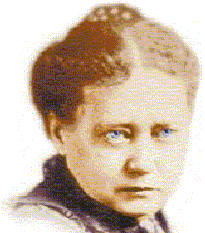
H
P Blavatsky
Astral Bodies or Doppelgangers
by
H. P. Blavatsky
This article is in the
form of a dialogue with an enquirer
M. C. Great confusion
exists in the minds of people about the various kinds of apparitions, wraiths,
ghosts, or spirits. Ought we not to explain once for all the meaning of these
terms? You say there are various kinds of "doubles" what are they?
H. P. B. Our occult
philosophy teaches us that there are three kinds of "doubles," to use
the word in its widest sense. First, man has his "double" or shadow,
properly so called, around which the physical body of the fetus -- the future
man -- is built. The imagination of the mother, or an accident which affects
the child, will affect also the astral body. The astral and the physical both
exist before the mind is developed into action, and before the Atma awakes.
This occurs when the
child is seven years old, and with it comes the responsibility attaching to a
conscious sentient being. This "double" is born with man, dies with
him, and can never separate itself far from the body during life, and though
surviving him, it disintegrates, pari passu, with the corpse. It is this which is sometimes seen
over the graves like a luminous figure of the man that was, during certain
atmospheric conditions. From its physical aspect it is, during life, man's vital
double, and after death, only the gases given off from the decaying body. But,
as regards its origin and essence, it is something more. This double is what we
have agreed to call Linga-sarira, but which I would
propose to call, for greater convenience, "Protean" or "Plastic
Body." M. C. Why Protean or Plastic?
H. P. B. Protean,
because it can assume all forms; e.g., the "shepherd magicians" whom
popular rumor accuses, perhaps not without some reason, of being
"were-wolves," and "mediums in cabinets," whose own
"Plastic Bodies" play the part of materialized grandmothers and
"John Kings." Otherwise, why the invariable custom
of the "dear departed angels" to come out but little further than
arm's length from the medium, whether entranced or not? Mind, I do not
at all deny foreign influences in this kind of phenomena. But I do affirm that
foreign interference is rare, and that the materialized form is always that of
the medium's Astral, or Protean body.
M. C. How is this astral
body created?
H. P. B. It is not
created; it grows, as I told you, with the man and exists in the rudimentary
condition even before the child is born.
M. C. And
what about the second?
H. P. B. The second is
the "Thought" body, or Dream body, rather; known among Occultists as the
Mayavi-rupa, or "Illusion-body." During
life this image is the vehicle both of thought and of the animal passions and
desires, drawing at one and the same time from the lowest terrestrial manas (mind) and
M. C. And
the third?
H. P. B. The third is
the true Ego, called in the East by a name meaning "causal-body," but
which in the trans-Himalayan schools is always called the "Karmic
body," which is the same. For Karma, or action, is the cause which
produces incessant rebirths or "reincarnations." It is not the Monad,
nor is it Manas proper; but is, in a way, indissolubly connected with and a
compound of the Monad and Manas in Devachan.
M. C. Then there are
three doubles?
H. P. B. If you call the
Christian and other Trinities "three Gods," then there are three
doubles. But in truth there is only one under three aspects or phases: the most
material portion disappearing with the body; the middle one surviving both as
an independent but temporary entity in the land of shadows; the third, immortal
throughout the Manvantara, unless Nirvana puts an end to it before.
M. C. But shall not we
be asked what difference there is between the Mayavi
and Kama-rupa, or as you propose to call them the "Dream body" and
the "Spook"?
H. P. B. Most likely,
and we shall answer, in addition to what has been said, that the
"thought-power" or aspect of the Mayavi or
"Illusion-body," merges after death entirely into the causal body or
the conscious, thinking Ego. The animal elements, or power of desire of the
"Dream body," absorbing after death that
which it has collected (through its insatiable desire to live) during life;
i.e., all the astral vitality as well as all the impressions of its material
acts and thoughts while it lived in possession of the body, forms the
"Spook" or Kama-rupa. Our Theosophists know
well enough that after death the higher Manas unites with the Monad and passes
into Devachan, while the dregs of the lower Manas or animal mind go to form
this Spook. This has life in it, but hardly any consciousness, except, as it
were, by proxy; when it is drawn into the current of a medium.
M. C. Is it all that can
be said upon the subject?
H. P. B. For the present
this is enough metaphysics, I guess. Let us hold to the "Double" in
its earthly phase. What would you know?
M. C. Every country in the
world believes more or less in the "double" or doppelganger. The
simplest form of this is the appearance of a man's phantom the moment after his
death, or at the instant of death, to his dearest friend. Is this appearance
the mayavi-rupa?
H. P. B. It is; because
produced by the thought of the dying man.
M. C. Is it unconscious?
H. P. B. It is
unconscious to the extent that the dying man does not generally do it
knowingly; nor is he aware that he so appears. What happens is this. If he
thinks very intently at the moment of death of the person he either is very
anxious to see, or loves best, he may appear to that person. The thought
becomes objective; the double, or shadow of a man, being nothing but the
faithful reproduction of him, like a reflection in a mirror: that which the man
does, even in thought, that the double repeats. This is why the phantoms are
often seen in such cases in the clothes they wear at the particular moment, and
the image reproduces even the expression on the dying man's face. If the double
of a man bathing were seen it would seem to be immersed in water; so when a man
who has been drowned appears to his friend, the image will be seen to be
dripping with water.
The cause for the
apparition may also be reversed; i.e., the dying man may or may not be thinking
at all of the particular person his image appears to, but it is that person who
is sensitive. Or perhaps his sympathy or his hatred for the individual whose
wraith is thus evoked is very intense physically or psychically; and in this
case the apparition is created by, and depends upon the intensity of the
thought. What then happens is this. Let us call the dying man A, and him who
sees the double B. The latter, owing to love, hate, or fear,
has the image of A so
deeply impressed on his psychic memory, that actual magnetic attraction and
repulsion are established between the two, whether one knows of it and feels
it, or not. When A dies, the sixth sense or psychic spiritual intelligence of
the inner man in B becomes cognizant of the change in A, and forthwith apprizes
the physical senses of the man by projecting before his eye the form of A as it
is at the instant of the great change. The same when the dying man longs to see
some one; his thought telegraphs to his friend,
consciously or unconsciously along the wire of sympathy, and becomes
objective.
This is what the "Spookical" Research Society would pompously, but none
the less muddily, call telepathic impact.
M. C. This applies to
the simplest form of the appearance of the double. What about cases in which
the double does that which is contrary to the feeling and wish of the man?
H. P. B. This is
impossible. The "Double" cannot act unless the key-note of this
action was struck in the brain of the man to whom the "Double"
belongs, be that man just dead, or alive, in good or in bad health. If he
paused on the thought a second, long enough to give it form, before he passed
on to other mental pictures, this one second is as sufficient for the objectivization of his personality on the astral waves, as
for your face to impress itself on the sensitized plate of a photographic
apparatus. Nothing prevents your form then
being seized upon by the surrounding Forces -- as a dry leaf
fallen from a tree
is taken up and carried away by the wind -- being made to
caricature or distort
your thought.
M. C. Supposing
the double expresses in actual words a thought uncongenial to the man, and
expresses it -- let us say to a friend far away, perhaps on another continent?
I have known instances of this occurring.
H. P. B. Because it then
so happens that the created image is taken up and used by a "Shell."
Just as in seance-rooms when "images" of
the dead -- which may perhaps be lingering unconsciously in the memory or even
the auras of those present -- are seized upon by the Elementals or Elementary
Shadows and made objective to the audience, and even caused to act at the
bidding of the strongest of the many different wills in the room. In your case,
moreover, there must exist a connecting link -- a
telegraph wire -- between the two persons, a point of psychic sympathy, and on
this the thought travels instantly. Of course
there must be, in every case, some strong reason why that particular
thought takes that direction; it must be connected in some way with the other
person. Otherwise such apparitions would be of common and daily occurrence.
M. C. This seems very
simple; why then does it only occur with exceptional persons?
H. P. B. Because the
plastic power of the imagination is much stronger in some persons than in
others. The mind is dual in its potentiality: it is physical and metaphysical.
The higher part of the mind is connected with the spiritual soul or Buddhi, the
lower with the animal soul, the
The idiosyncrasy of the
person determines in which "principle" of the mind the thinking is
done, as also the faculties of a preceding life, and sometimes the heredity of
the physical. This is why it is so very difficult for a materialist -- the
metaphysical portion of whose brain is almost atrophied -- to raise himself, or for one who is naturally spiritually-minded to
descend to the level of the matter-of-fact vulgar thought. Optimism and
pessimism depend on it also in a great measure.
M. C. But the habit of
thinking in the higher mind can be developed -- else there would be no hope for
persons who wish to alter their lives and raise themselves? And that this is
possible must be true, or there would be no hope for the world.
H. P. B. Certainly it
can be developed, but only with great difficulty, a firm determination, and
through much self-sacrifice. But it is
comparatively easy for those who are born with the gift. Why is it that one
person sees poetry in a cabbage or a pig with her little ones, while another
will perceive in the loftiest things only their lowest and most material
aspect, will laugh at the "music of the spheres," and ridicule the
most sublime conceptions and
philosophies? This difference depends simply on the innate power of the
mind to think on the higher or on the lower plane, with the astral (in the
sense given to the word by St. Martin), or with the physical brain. Great
intellectual powers are often no proof of, but are impediments to spiritual and
right conceptions; witness most of the great men of science. We must rather
pity than blame them.
M. C. But how is it that
the person who thinks on the higher plane produces more perfect and more
potential images and objective forms by his thought?
H. P. B. Not necessarily
that "person" alone, but all those who are generally sensitives. The
person who is endowed with this faculty of thinking about even the most
trifling things from the higher plane of thought has, by virtue of that gift which
he possesses, a plastic power of formation, so to say, in his very imagination.
Whatever such a person may think about, his thought will be so far more intense
than the thought of an ordinary person, that by this very intensity it obtains
the power of creation. Science has established the fact that thought is an energy. This energy in its action disturbs the atoms of
the astral atmosphere around us. I already told you; the rays of thought have
the same potentiality for producing forms in the astral atmosphere as the
sunrays have with regard to a lens. Every thought so evolved with energy from
the brain, creates, nolens volens
a shape.
M. C. Is that shape
absolutely unconscious?
H. P. B. Perfectly
unconscious unless it is the creation of an adept, who has a preconceived
object in giving it consciousness, or rather in sending along with it enough of
his will and intelligence to cause it to appear conscious. This ought to make
us more cautious about our thoughts.
But the wide distinction
that obtains between the adept in this matter and the ordinary man must be
borne in mind. The adept may at his will use his Mayavi-rupa,
but the ordinary man does not, except in very rare cases. It is called Mayavi-rupa because it is a form of illusion created for
use in the particular instance, and it has quite enough of the adept's mind in
it to accomplish its purpose. The ordinary man merely creates a thought-image,
whose properties and powers are at the time wholly unknown to him.
M. C. Then one may say
that the form of an adept appearing at a distance from his body, as for
instance Ram Lal in Mr. Isaacs, is simply an image?
H. P. B. Exactly. It is a walking thought.
M. C. In
which case an adept can appear in several places almost simultaneously.
H. P. B. He can. Just as
Apollonius of Tyana, who was seen in two places at
once, while his body was at
M. C. Then it is very
necessary for a person of any amount of imagination and psychic powers to
attend to their thoughts?
H. P. B. Certainly, for
each thought has a shape which borrows the appearance of the man
engaged in the action of which he thought. Otherwise how can
clairvoyants see in your aura your past and present?
What they see is a passing panorama of yourself represented in successive
actions by your thoughts. You asked me if we are punished for our thoughts. Not
for all, for some are still-born; but for the others, those which we call
"silent" but potential
thoughts yes. Take an extreme case, such as that of a person who is
so wicked as to wish the death of another. Unless the evil-wisher is a Dugpa, a high adept in black magic, in which case Karma is
delayed, such a wish only comes back to roost.
M. C. But supposing the
evil-wisher to have a very strong will, without being a
dugpa, could the death of the other be accomplished?
H. P. B. Only if the
malicious person has the evil eye, which simply means possessing enormous
plastic power of imagination working involuntarily,
and thus turned unconsciously to bad uses. For what is the power of the
"evil eye"? Simply a great plastic power of thought, so great as to
produce a current impregnated with the potentiality of every kind of misfortune
and accident, which inoculates, or attaches itself to any person who comes
within it. A jettatore (one with the evil eye) need
not be even imaginative, or have evil
intentions or wishes. He may be simply a person who is naturally fond
of witnessing or reading about sensational scenes, such as murder, executions,
accidents, etc., etc. He may be not even thinking of any of these at the moment
his eye meets his future victim. But the currents have been produced and exist
in his visual ray ready to spring into activity the instant they find suitable
soil, like a seed fallen by the way and ready to sprout at the first
opportunity.
M. C. But how about the
thoughts you call "silent"? Do such wishes or thoughts come home to
roost?
H. P. B. They do; just
as a ball which fails to penetrate an object rebounds upon the thrower. This
happens even to some dugpas or sorcerers who are not
strong enough, or do not comply with the rules -- for even they have rules they
have to abide by -- but not with those who are regular, fully developed
"black magicians"; for such have the power to accomplish what they
wish.
M. C. When you speak of
rules it makes me want to wind up this talk by asking you what everybody wants
to know who takes any interest in occultism. What is a principal or important
suggestion for those who have these powers and wish to control them rightly --
in fact to enter occultism?
H. P. B. The first and
most important step in occultism is to learn how to adapt your thoughts and
ideas to your plastic potency.
M. C. Why is this so
important?
H. P. B. Because
otherwise you are creating things by which you may be making bad Karma. No one
should go into occultism or even touch it before he is perfectly acquainted
with his own powers, and that he knows how to commensurate it with his actions.
And this he can do only by deeply studying the philosophy of Occultism before
entering upon the practical training. Otherwise, as sure as fate -- HE WILL
FALL INTO BLACK MAGIC.
Find out more about
Theosophy
with these links

Cardiff Theosophical Society meetings
are informal
and there’s always a cup of tea afterwards
The Cardiff Theosophical Society Website
The National Wales Theosophy
Website
Theosophy
Cardiff’s Instant Guide to Theosophy
Theosophy
Cardiff’s Gallery of Great Theosophists
Dave’s Streetwise
Theosophy Boards
The Theosophy Website that
welcomes
If you run a Theosophy Study
Group, please
feel free to use any material on
this Website
Independent Theosophy Blog
The Most Basic Theosophy
Website in the Universe
A quick overview of
Theosophy
and the Theosophical Society
If you run a Theosophy Study
Group you
can use this as an introductory handout.
One liners and quick explanations
About aspects of Theosophy
The Voice of the Silence Website
An Independent
Theosophical Republic
Links to Free Online
Theosophy
Study Resources; Courses, Writings,
The main criteria for the
inclusion of
links on this site is that they
have some
relationship (however tenuous) to
Theosophy
and are lightweight, amusing or
entertaining.
Topics include Quantum Theory
and Socks,
Dick Dastardly and Legendary Blues Singers.
An entertaining introduction to Theosophy
For everyone everywhere, not just in Wales
It’s all “water under the
bridge” but everything you do
makes an imprint on the Space-Time
Continuum.
A selection of articles on
Reincarnation
Provided in response to the
large number
of enquiries we receive on this subject
No
Aardvarks were harmed in the
National Wales Centre for Theosophy
Blavatsky Wales Theosophy Group
The
Spiritual Home of Urban Theosophy
The Earth Base for Evolutionary Theosophy
The Birmingham Annie Besant Lodge
_______________________
Tekels Park
to be Sold to a Developer
Concerns about the fate of the wildlife as
Tekels Park is to be Sold to a Developer
Concerns are raised about the fate of the wildlife as
The Spiritual Retreat, Tekels Park in Camberley,
Surrey, England is to be sold to a developer.
Tekels Park is a 50 acre woodland park, purchased
for the Adyar Theosophical Society in England in 1929.
In addition to concern about the park, many are
worried about the future of the Tekels Park Deer
as they are not a protected
species.
Anyone planning a “Spiritual” stay at the
Tekels Park Guest House should be aware of the sale.
Tekels Park & the Loch Ness Monster
A Satirical view of the sale
of Tekels Park
in Camberley, Surrey to a
developer
The Toff’s Guide to the Sale of
Tekels Park
What the men in top hats have
to
say about the sale of Tekels Park
____________________
The Theosophy
The Theosophy
Cardiff Guide to
The Theosophy Cardiff
Guide to
The
Theosophy Cardiff Guide to
The Terraced Maze of Glastonbury Tor
Glastonbury and Joseph of Arimathea
The
Grave of King Arthur & Guinevere
Views
of Glastonbury High Street
The
Theosophy Cardiff Guide to
_____________________
A B C D EFG H IJ KL M N OP QR S T UV WXYZ
Complete
Theosophical Glossary in Plain Text Format
1.22MB
___________________________
Classic Introductory
Theosophy Text
A Text Book of Theosophy By C
What Theosophy Is From the Absolute to Man
The Formation of a Solar System The Evolution of Life
The Constitution of Man After Death Reincarnation
The Purpose of Life The Planetary Chains
The Result of Theosophical Study
_____________________
Preface to the American Edition Introduction
Occultism and its Adepts The Theosophical Society
First Occult Experiences Teachings of Occult Philosophy
Later Occult Phenomena Appendix
Try these if you are
looking for a
local
Theosophy Group or Centre
UK Listing of
Theosophical Groups
Pages About

General pages about Wales,
Welsh History
and The History of Theosophy in
Wales

Wales is a
Principality within the United Kingdom
and has an eastern
border with England. The land
area is just over
8,000 square miles. Snowdon in
North Wales is
the highest mountain at 3,650 feet.
The coastline is
almost 750 miles long.
The population of
Wales as at the