Theosophical Society,
Miscellaneous
Letters (Part 2)
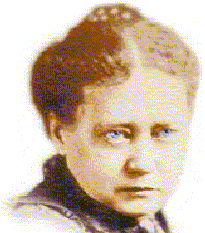
H P Blavatsky
THE LETTERS OF
H P BLAVATSKY
to
A P SINNETT
and other miscellaneous
letters transcribed, compiled,
with an
introduction
By
A. Trevor
Barker
Section 5
Miscellaneous Letters Page 304 – 365
Appendices Page 369 – 391
General Index Page 391 - 404
II.—A.
0. Hume
LETTERS
CLV-CLVII . . . . 304/311
Mr.
Hume is dissatisfied . . . 305
H.
P. B.’s Missing Principle . . . 307
Hume
blasphemes . . . . 309
Hume
knows better than Masters. . . 311
III.—William
Q. Judge
LETTERS
CLVIII-CLX . . . . 312/315
Judge
received Letters from K. H. . . . 313
Persecutions
and Trials in America . . . 315
IV.—T.
Subba Row
LETTERS
CLXI-CLXIV . . . . 316/323
The
Adepts of India . . . . 317
Why
it is impossible to teach Hume . . .
319
Subba
Row’s Knowledge. . . 321
A
Proficient in Occult Science . . . 323
V.—H.
S. Olcott
LETTERS
CLXV-CLXXI. . . . 324/334
Sancaracharya
an Initiate . . . 325
Hume
goes into Polities . . . 327
Col.
Olcott “goes” for H. P. B. . . . 329
About
Babajee . . . . 331
H.
P. B.’s Expenses. . . 333
VI.—Babajee
D. Nath
LETTERS
CLXXII-CLXXIX . . . 335/344
Babajee
loyal to Theosophy . . . 337
The
“Mystic” Name of D. N. . . . 339
Brahman
Customs . . . . . 341
A
Letter through Babajee . . . 343
VII.—The
Gebhards.—Ernst Schutze.—Mohini.—Damodar.—Elliott Coues.— Anna
Kingsford.—Eglinton
LETTERS
CLXXX-CXCIV . . . . 345/362
Babajee’s
Influence . . . 347
The
Handwriting Expert’s Testimony. . . 349
H.
P. B.’s Health . . . 351
How
Hume received Letters . . . 353
Damodar
is indignant . . . 355
Elliott
Coues and H. P. B . . . 357
Anna
Kingsford and K. H. . . . 359
Puja
made to a personal God . . . 361
VIII.—Mahatma
Letters
LETTERS
CXCV-CCVIII . . . 363/366
Relative
and Absolute Truth . . . 365
APPENDIXES
I.—Death.
By Eliphas Levi. With Marginal Notes of K. H. . . . . 369—375
II.—Cosmological
Notes. From A. P. Sinnett’s MS. Book . . . .
. 376—386
III.—Cures
effected by Col. Olcott in Calcutta by Mesmeric Passes . . . .
387—389
INDEX
391—404
A
Typical Specimen of Mme. Blavatsky’s Handwriting
SECTION II
MISCELLANEOUS LETTERS
II.
—A. O.
HUME
LETTER
No. CLV I
Extracts
of a letter from A. O. Hume to K. H.
.
. .”I not only do not dislike your exercise of this right, but I crave for
it—and
should be glad indeed if you were always to speak your mind far more
freely
than you do. I object to rudeness—some people are rude [1] -- and this
without
offending me,
1
Does he call his letters to M. and H. P. B. polite?
grates
against my feelings as a gentleman, just as a bad smell offends my
olfactory
nerves.
.
. . “As to the particular point that you urge, viz. my great changeableness—I
quite
think you have a prima facie ground for attack; but yet the case is not
exactly
as you think. I am not really so very changeable!! . . . I cannot rely
solely
on you—you have too little time and the only manner in which you appear
able
to teach me, by letter, is so slow and so unsatisfactory, that it would not
be
right for me to look nowhere else.” 2
2
C. C. M. would perhaps call this “candid”?
.
. . “Circumstances have prevented . . . your placing me in such a position
that
I could feel certain you were correct in what you teach. Very probably you
are—but others of the highest learning who have
apparently gone over a good deal the same ground as yourself—traverse your
views to a great extent. In the first place they seem to hold that you Arhats
all are on the wrong road—that you are but refined and highly cultured
tantrikists striving for the Upasana of Shakti
or
Kamarupa instead of that of Pranava or Brahman!! . . .”
They
equally disagree as to your view that there is no God. 3
3
Vedantin Adwaitas?
.
. . Now I do not pretend to say which of you are right. As far as I can judge
their
learning and yog powers are not inferior to yours. 4
4
His “good old Swami” having no powers whatever—the logical inference would be that
we have none at all?
I
The passages printed in bold type are K. H.’s comments, while those in
bold
type italics have been underlined by K. H.—ED.
—•—
305 MR.
HUME IS DISSATISFIED
—•—
But
my dear friend . . . supposing that you are right—then I greatly fear that a
philosophy
crowned by the bald, crude atheism, that you insist on in your notes
(for
you would not have my veiled enunciation of this), 5 will not be accepted
even
in this sadly
5
Is this candid? And should we accept such a policy?
materialistic
age. Europe will not have it neither will Asia. . . . But moreover
even
could we diffuse it, would it be productive of good in the present state of
the
world? . . . To you and men of your purity and elevation of character—even
to men low down in the scale like myself, pure
atheism may do no harm—but to the untaught and spiritually wholly unawakened
classes it would I fear bring evil.
6
And can a superstitious fiction, belief in a pure myth, be ever productive of
good?
We are called by him Jesuits and yet his policy would be purely—Loyolian.
.
. . . . . but the effect of early training as you will say, intuition as I
claim,
does not allow me to accept your view as proved. . . . . .
.
. . . . I cannot truly say that I believe that there is no God. I believe
rather
that there is a God. 7
7
“I am more of an Adwaitee than M. or K. H.” he wrote but yesterday.
.
. . I do not think you are correct in the view that you take of my
changeableness—I
am manysided and as I travel on I revolve and you see different sides at
different times—but you will find that my orbit barring minor mutations is
direct enough, and any apparent retrogressions are optical delusions due to your
standpoint.—At any rate that is an extremely ingenious explanation.
Yours ever sincerely,
A. O. HUME.
Of
course, no doubt he is very “ingenious.”
LETTER
No. CLVI I
SIMLA,
Jan.
4th, 1881.
MY
DEAR OLD LADY,
And
tho’ I am desperately inclined at times to believe that you are an impostor
I
believe I love you more than any of them.
I
have just got off the last pages of a pamphlet I am preparing.
I Marginal comments in M.’s handwriting are
printed in bold type. Passages
printed
in bold type italics have been underlined by M. The numbers in brackets
in
bold type refer to M.’s comments at the end of the letter.—ED.
—•—
306 MISCELLANEOUS LETTERS
—•—
These
last pages are an extract from your letter about Madame * Thekla
Lebendorff † But your explanation in this case is not
intelligible—so after
trying
to make out what you meant—I have entirely rewritten this out of my inner
consciousness—Buddha knows if I have
got on the right scent—I do not—but you will see the proofs and you or the
Brothers,? must correct any blunders.
*
As there are perverted natures which come to love physical deformity as a
contrast
to beauty, so also there are those who find a rest in the moral
depravity
of vitiated persons. Such would consider imposture as cleverness.
†
Mr. Sinnett has to use his influence to forbid such breach of trust. Her
letter
to Mr. Hume was a private one. The case may be given fully. The
publishing of names—names of persons whose kin
survive and live to the present day in
This
pamphlet consists of (1) a long letter denouncing theosophy as a sham, and
setting
forth all the objections to it and the Brothers, put forward by the more
intelligent
men who do not disbelieve in the facts of spiritualism.
Such
as Mr. Chatterjei—for instance?
(2)
A very much longer letter alas, an awfully long letter, picking the first to
pieces
and turning it inside out.
I
have in this done my very best. I think it reads fairly well—it is not
conclusive
-- (for that you must thank the Brothers) (1) but it puts the very
best
face possible on every awkward fact, and gives the fullest view of all the
favourable
ones. The facts being as they are I defy anyone to do more. I mean
anyone
short of a brother, and my hope is that if there are brothers, some of
them may when the proofs are before you favour us
with some hints by which I may strengthen the case. I have taken this
opportunity to let in a lot of light upon
the principles of Esoteric Theosophy and on matters
connected with the Brothers and their modi operandi etc. etc. There is a great
deal in this letter (2).
But
tho’ I think I have made out a good case; though I may convince others—I
have
almost unconvinced myself (3). Never till I came to defend it, did I
realise
the extreme weakness of our position. You, you dear old sinner (and
wouldn’t you have been a reprobate under normal
conditions?) are the worst
breach
of all—your entire want of control of temper—your utterly un-Buddha and un-Christlike
manner of speaking of all who offend you—your reckless statements form together
an indictment that it is hard to meet—I have I think got round it
(4).
But though I may stop others’ mouths, I personally am not satisfied. Now
perhaps
you will say “Are you any better?” “I shall reply at onc
—•—
307 H.P.B.’S MISSING
PRINCIPLE —•—
certainly not—probably in other ways ten times
worse.” But then I am not the
chosen messenger of the embodiment of all purity and
virtue—I am a mudstained soul that, though a cat may look at a king, may not
even look at a Brother.
(5)
Now I know all about the Brothers’ supposed explanation (6), that you are a
psychological cripple, one of your
seven principles being in pawn in
It
ain’t the Hoola sariram, the body—that’s clear for you might truly say with
Hamlet
“Oh that this too solid flesh would melt!”
And
it can’t be the linga sariram, as that can’t part from the body, and it
ain’t
the kama rupa and if it were, its loss would not account for your
symptoms.
Neither
assuredly is it the Jivatma, you have plenty of life in you. Neither is
it
the fifth principle or mind, for without this you would be “quo ad” the
external
world, an idiot. Neither is it the sixth principle for without this you
would
be a devil, intellect without conscience, while as for the seventh that is
universal
and can be captured by no Brother and no Buddha, but exists for each
precisely
to the degree that the eyes of the sixth principle are open.
Therefore
to me this explanation is not only not satisfactory—but its having
been
offered—throws suspicion on the whole thing.
Very
clever—but suppose it is neither one of the seven particularly but all?
Every
one of them a “cripple” and forbidden the exercise of its full powers? And suppose
such is the wise law of a far foreseeing power!
And
so in many cases the more one looks into things, the less they seem to hold
water.
The more they bear the look of contrivances thrown out on the spur of the moment
to meet an immediate difficulty.
If
as is quite possible, everything could be explained—then I only deplore the
fatuity
of the superior beings who send you to fight the world armed with only a
part
of your faculties, and carefully surround you with a network of such
contradictory
and compromising facts, as to render it impossible for your most
loving
and by no means least intelligent friend to avoid at times grave doubts
not
only as to their existence but also as to your good faith. (7)
In
letter No. 2 I have doubtless answered
every objection—after a fashion—but
if
I was to write a No. 3 on the other side couldn’t I make mincemeat of some at
least
of No. 2’s arguments. No one outside can perhaps.
—•—
308 MISCELLANEOUS LETTERS
—•—
As
said before—a good reason for it. For the arguments on both sides are faulty
and
easily made “mincemeat” of.
All
I can say is—if as I still believe on the balance of evidence the Brothers
do
exist—entreat and pray them so to strengthen you as to make you more what a great
moral reformer—should be—and so strengthen our hands to defend you and advance
their cause.
(8)
Well No. 3 is Olcott’s letter from Ceylon—with one passage left out and a few words
modified—to me an excellent letter—the passage which the world would at once
hit upon as pointing to a transcendental flirtation between Morier and his “most
exquisite specimen of perfect womanhood” K. H.’s sister, I have naturally elided—also
the one about his supposed exit from the body in New York, which is weak and
explicable as simple somnambulism. I Mr.
Hume acted judiciously in eliding that passage in O.’s letter though the writing
of the three words would not be covered by the theory of somnambulism, as
somnambulists do not pass through solid walls. As for the sentence about my
brother’s
sister, no one with any delicacy would have thought of giving it to
the
public. The public, represented so brutally indecent in thought, that even
one
of its most accomplished leaders could not read of the pure sisterly
friendship
of a holy woman for her brother’s lifelong brother in occult research
without
descending to the grovelling thought of a sensual relationship, must be
but
a herd of swine. And still that same leader wonders that we do not come to
his
study and prove we are not fictions of a mad fancy!
No.
4 is your story about Thekla—rewritten—I only hope it is quite true—and that when
it gets round to
not
contradict.
There
is a preface in big type which anyone who likes may suppose to be written
by
the Brothers—or by you or the President, saying that these letters though by
no
means entirely free from errors and misconceptions are yet published as
throwing
some light upon difficulties which have been felt by many interested in
Theosophy.
The proofs will come to you in due course—strengthen the defence if you or they
can—don’t attempt to weaken the attack—the strongest position is always gained,
by putting out yourself all that can possibly be said against
you.
By
the way how many copies should be printed of the Bengali translation of the
Ladies
Rules etc. Sinnett only printed 100 of the English and there appear to be
none
left now! It is no use printing more of the Bengali rules than are likely
to
be of use—but I think 100 too few. Please tell me how many—I am paying for the
printing of this, and S. K. Chatterjee who is
I This passage is scored through in red
ink in the original by M.—ED.
—•—
309 HUME BLASPHEMES
—•—
going
down to Calcutta—and who has taken great pains with the translation, will
see
it through the press, and I have to write to him there to say how many
copies,
so please, don’t forget to answer sharp, how many copies.
Chatterjee
is a very clever fellow but though he does not disbelieve in
spiritualism,
or spiritual science, I can’t get him to swallow the Brothers
nohow!
I have just sent him on Olcott’s letter and Ramaswamier’s certificate
with
Morier’s postcript—to the effect that you are all dzing dzing. Most people
are
dzing dzing in the opinion of the illustrious.
If
they don’t exist what a novel writer you would make! (9A) You certainly make
your
characters very consistent. When is our dear old Christ—I mean K. H., again to
appear on the scene—he is quite our favourite actor (9B) -- well I suppose they
know their own business best, but humanly speaking they make a mistake in crippling
my energies by leaving me without any certainty of their existence, and thus
harassing me with doubts whether I may not be preaching doctrines which however
pure in themselves may be founded on a fraud—and which if so founded can never
do any good—by doubts whether I am not wickedly wasting my time and brains over
a chimera, time and energies that I might devote to some humbler but possibly
truer and more good producing cause (9C). However I engaged for one year—and
during that shall do all I can, honestly and fairly—but if within that period I
can acquire no certainty I shall retire from the Society feeling that true or
false, it is no truth for me. I shall not give up the life (10) for that imperfectly
perhaps as I may as yet have succeeded in living it, commends itself wholly to
me—but I shall withdraw from the Society; if founded on truth I shall at least
have done it some good by all I have written and done—if not so, I cannot have
done much harm and I have not so far as I know gone beyond what I do believe.
You
will say that this is nicely complimentary [to] you—but between you and I
there
must be no euphemisms if put into a witness box to-morrow. I could swear, that
as at present advised—I believe you to be a perfectly true woman—but I could
not swear that the whole story about the Brothers was not a fiction,
though
I could swear that on the whole I believed it to be more likely to be
true
than false.
Sinnett
however—lucky fellow, has no shade of doubt—and with his
conviction—position
and abilities he will be a tower of strength to you—and to
Theosophy—so
that I shall have less compunction in washing my hands of the
business than I should have had were you left
without a champion in the hands of the Philistines.
—•—
310 MISCELLANEOUS LETTERS
—•—
I
shall take up Terry’s letter next and see what I can make of it. I have not
had
time to consider it yet properly.
I
wish you would put me in communication with your Triplicane Pundit, and induce him
to favour me with a few more letters like that last. If I had only had that before
I wrote that Fragments!
Love
to Olcott.
Ever
yours affectionately,
A. O. HUME.
(1)
Who refuse to send their portrait—photos to illustrate the forthcoming
revised
and corrected edition of Hume’s “Essays on Miracles.”
(2)
So there is. But great intellectuality does not always go hand in hand with
great
discernment of right and wrong.
(3)
Quite so. There are natures also so much psychologised with their own
eloquence,
so completely subjugated by their own great oratorial powers that
they
are the first to fall under the charm. Mr. Hume will as easily bamboozle
himself
into as out of any belief, provided he is allowed to take all the points
himself.
(4)
Yes—but at what a price!
(5)
Hypocrisy is not always “the necessary burden of villainy—“ but often the
outcome
of vain coquetry with one’s own nature. The inner Hume assuming
attitudes
before the mirror of the outer Hume.
(6)
He is mistaken—he does not.
(7)
Never for those who know her well.
(8)
Nor shall we fail to do so when the time comes.
(9A)
Yes; and what a sculptor and painter she must be as she justly remarked.
(9B)
The man blasphemes! K. H. will never be an actor for the gratification of
anyone.
Let him doubt it, he will not doubt much longer but soon find out his
mistake.
(9C)
If he has the slightest doubt and yet does so he is no honest man.
(10)
Let me draw your attention to a sentence in my letter to Scott in which I
allude
to certain implied threats. The date of Mr. Hume’s letter is Jan. 4th. I
projected
myself before Scott on the 5th and wrote to tell him that I was glad I
could
do so without appearing to yield to implied threats. Whoever else will see
us
it will never be Mr. Hume. He can retire but Mr. Sinnett need not break with
him.
Finally
we do not approve in its present form of Mr. Hume’s pamphlet.
Comparatively
few of the members of the Society
—•—
311 HUME KNOWS
BETTER THAN MASTERS
—•—
occupy
themselves with Occult study or believe in our existence. His pamphlet
commits
the whole body to both. Therein he errs as plainly as Wyld of London in giving
out his private views and his preface suggesting us as its authors must
but
compromise the Society the more.
Your
proposal to compile a manual for the instruction of young members is
approved
by K. H. Consult with Moorad Ali and Olcott. K. H. desires me to say
that
he has no objection to your bringing out 2nd edition provided you include
[in]
an appendix and the different proofs that have since accumulated. He
desires
you to stay here as long as you possibly can. He will write through the
Disinherited.
M.
LETTER
No. CLVII
Original
Telegraph Form
To:
A. O. Hume:
Rothney
Castle, Jakko, Simla.
From:
H. P. Blavatsky:
Bombay,
Byculla.
SIMLA, 5.9.82.
Our
ways not their ways. Brothers may not care but dare not go against oldest
rules.
Two Chohans Chelas protested and ten more signed Subba Row first.
Dangerous
experiments.
Letter
Written on Back of Above.
DEAR
OLD LADY,
Just
received this—not sure if I understand it—if the Brothers understand things
so
little that they allow not only you, but all their Chelas to misconceive
wholly
alike the purport, spirit and practical bearing of a thing, so that they
protest
against what they ought to give thanks for—I really think the thing is
hopeless—and
I give it up—no ship can make anything of a voyage unless the
captain
knows navigation—his being a great chemist will not help the matter and
the
great powers and virtues of the Brothers will not help the Society, if they
the
Captains are so ignorant as this incident seems to indicate of the
navigation
of the ocean of worldly life. Ta-ta.
Yours
ever,
A. O. Hume.
—•— III. —WILLIAM Q.
JUDGE —•—
312
LETTER
No. CLVIII
71, BROADWAY, N.Y.,
Augt. 1st,
1881.
A.
P. SINNETT, ESQ.
MY
DEAR SIR—AND BROTHER,
I
have had great pleasure in reading your Occult World, and in this country so
far
away from India, it has been for me a source of great profit as well as
encouragement.
I never have had the pleasure of speaking to you, but hope one
day
I shall; but there is, for me at least, between us a close bond of sympathy
in
that we both have been in the same current. Although I never had the name
given me I have when Mme. Blavatsky was here had the
honor of hearing from him viva voce, I
mean Koot Hoomi and also from others. And I would give much to see some of the
handwriting of those letters to you if it were only one word, because I have a handwriting here in a certain blue material with which I
would like to compare it.
You
certainly have been exceptionally honored, and why, they must have some
reason.
While H. P. B. was here, they came many and many a time and spoke with Olcott and
myself. But their identity was secure because neither of us at that
time
could pierce the wall of matter and see the true occupant. We had to depend entirely
upon changes of expression.
I
thank you for the book; it will be so much on the way, and will aid to
establish
the counter current now so much needed. For myself it serves to keep
vivid
and green the facts I once witnessed and which time perhaps might without
it,
render weak and maybe incredible.
I
am, fraternally yours,
because
“there is a spirit in man.”
WILLIAM Q. JUDGE,
N.Y.
Rec. Secy. T.S.
LETTER
No. CLIX
Feby. 5, 1886.
MY
DEAR H. P. B.,
So
they have reported on you. You are a corpse. You are squelched, you are a
mere
Mahatma fabrication. But they
—•—
313 JUDGE RECEIVED
LETTERS FROM K.H.
—•—
praise
you too, for you must ever remain the chief, the most interesting, the
hugest,
the most marvellous and the most able impostor and organiser of great
movements,
who has appeared in any age either to bless or to curse it. Not
Caglistro
had such honour as this! Well you deserve honour; I only wish it were
not
accompanied by such vile lies and trash as they put on you. You revisit
these glimpses of the moon, and these madmen
forthwith assail you and while they admit you have no motive they will not if
they can help it permit you to do the great work which without you, might have
waited longer yet for its beginning.
I
shall have written before you get this a letter to the Boston Index which
reprinted
the report. You must have observed that Hodgson has left me out. And yet I am
an important factor. I was there. I examine all, I had all in charge,
and
I say there was no aperture behind the shrine. Then as to letters from you
know
I have many that came to me which resemble my writing. How will they
explain
that? Did I delude myself? And so on.
You
can rely on me at this point for all the help that may be thought necessary.
You
will remember that I was at Enghien with you the day of one of the
phenomena.
They did not get those times when I got letters from the postman with messages
inside. I have here some old letters, and one of them relates to the
cremation
of De Palme.
But
people here are not distressed by this report. They see that truth runs
through
our whole movement and they are not so hidebound by reports and
authority
as in other places.
Gebhard
is my pupil! He and I have been crowding the mourners, and in
believer
and still explaining away what they call your “impostures.”
Mr.
and Mrs. E. Forbes Waters of Boston, have returned to the field. I
reinitiated
them the other night. They control many intellectual people and we
expect
to do something in Boston, great. We had meetings there night after night
and
you can imagine them plying poor Gebhard with questions who referred to me when
they desired to know all the laws of Occultism, the residences of Mahatmas, how
they appear, all the fine “ramifications” of Karma etc. etc. Well, as they know
nothing the little I do know seemed much to them. By the time they find themselves
with the same amount of knowledge perhaps I will have acquired more.
Now
as to me will you ask if there be
anything to say to me. I work all the
time.
How does he explain the meaning of his message through you that I “showed intuition
by leaving
—•—
314 MISCELLANEOUS LETTERS
—•—
India”?
If you do not care to bother with [it] it will not make any difference.
If
10 years have not made any change certainly failure to get this will not.
As ever yours,
WILLIAM Q. JUDGE.
LETTER
No. CLX I
May. 22, 1886.
DEAR
H. P. B.,
I
called on Bouton the other day and arranged that henceforth he should send you the
money in regular drafts on
The
explanation of the Holloway matter is, that you in 1884, appointed her your
attorney
and agent in writing to attend to Bouton. When she came back she
employed
a lawyer, and thus so far as that is concerned you are bound by your
own
acts. I thoroughly agree with what you say about her.
I
understand that she is writing a book on the theosophical movement, to be
embellished
with pictures. She is great on catching the passing emotions of the
people,
for a sale.
Now
will you do me the favour of sending me an authoritative letter stating that
you
do not send ambiguous telegrams to W. Q. J., and that any such message to
have
any effect on W. Q. J. will contain a sign he will understand. For some
person
has been sending me telegrams from various parts of U.S. signed “H. P.
B.”
with ridiculous orders in them. The last was the other day from Baltimore
reading
“Your enemy is a woman; now as then she has betrayed you. Now you know why the
Master did not cure you in
know!) I shall certainly expect from you an article
for my Magazine, The Path. It is going to create a buzz here, and if H. P. B.
redivivus appeared there, great
benefit
would result to the Cause. This journal will help the Theosophist and
all
theos. literature. So look kindly on it and take higher advice.
The
“Oregon” sunk off this coast the other day and I think had some letters of
mine
on board.
I
will write again soon regarding Bouton and duly inform you.
Your
Secret Doctrine ought to be protected here. As you are an
American citizen that can be done. Have Sinnett attend to that from his
side. If you do not he may neglect it.
I The passages printed in bold type are
comments in H. P. B.’s handwriting;
those
printed in bold type italics have been underlined by her.—ED.
—•—
315 PERSECUTIONS AND
TRIALS IN AMERICA
—•—
The
Mohini affair is not good. I do not know the facts and refrain from any
judgment.
Is he at fault?
Can’t understand Babajee unless in carrying out
orders to suppress phenomena he has erred in his method. I notice he does NOT
say you are in with Dugpas. But that accusation about money is the most
reprehensible part of it.
Well
I stick to what I do know and let the rest slide.
As ever yours,
WILLIAM Q.
Persecutions
and trials are now beginning in America. Poor Judge and poor Coues.
May
Masters help them!
H.
P. B.
Send
me back both those letters.
—•— IV. —T.
SUBBA ROW —•—
316
LETTER
No. CLXI I
TRIPLICANE,
MADRAS,
3rd
February, 1882.
To
Madame H. P. Blavatsky.
RESPECTED
MADAME,
I
thank you for your letter of the 28th ultimo. I think it is highly desirable
that
you should come here, if circumstances permit, by the time Colonel Olcott
comes
here from Calcutta. No doubt, I individually am very anxious to see you;
but
that is not the important reason for asking you to come here. Though no
Branch
Theosophical Association has yet been established here, there are a good many
gentlemen here who sincerely sympathise with your aims and objects and who would
be very glad to see you. They know very little of Colonel Olcott except what
they have gleaned from his public speeches. But your “Isis Unveiled” has made a
very strong impression on their minds. I have already informed some of these
gentlemen that Col. Olcott would be coming here before the end of this month
and they have earnestly asked me to write to you requesting you to come here
also. I am very glad to hear that you have almost succeeded in converting Mr.
R. Raghunatha Row to theosophy. He is a man of very strong convictions and an
earnest seeker of truth and he is likely to prove very useful in course of time,
in promoting the cause of theosophy. There are, I believe, some Europeans also,
here, who are very anxious to see you. Please see therefore, if you cannot spare
a few days to gratify the expectations of these gentlemen.
To
tell you the truth, it is my “sincere belief” that India has not yet lost its
adepts
and its “INEFFABLE NAME”—the lost Word!
I The passages in bold type are comments in the
handwriting of Mahatma M.;
those
in bold type italics have been underlined by M.—ED.
—•—
317 THE
ADEPTS OF INDIA
—•—
have
almost reached the shores of the ocean of Nirvana. We still have the clue
in
our hands to understand the teaching of our old Rishis and the doctrines of
every other system of Philosophy which has sprung up
from the Ancient Wisdom Religion. And I venture to affirm (though you may doubt
it) we still have the clue to find out the “LOST FORMULA,”—if it is indeed
already lost. This is not a vain boast, I assure you. The real truth will come
to light when the proper time arrives for it. It should be strongly impressed
on the minds of the English theosophists that these men are not very anxious to
get their existence
recognised
by them. It is of very little importance to them whether India is
governed
well or ill by English officials, whether natives are treated with
haughty
contempt by Europeans or not, and whether the truth of Yoga Vidya is
admitted
by modern sceptics or not. They have, I believe, adopted every
conceivable
precaution to conceal their existence. It is only to sincere
believers
in Yoga Vidya and the existence of Adepts that these stern mystics are
accessible.
Even if an English theosophist like Mr. Hume were to catch hold of
one
of these men by accident, he will soon put his philosophy to the proof. His
external
appearance will be revolting to the refined taste of an English
gentleman.
Apparently—his behaviour will be that of a madman or an idiot, and he will talk
unintelligible nonsense purposely to drive away the visitor.
If,
however, the visitor still believes that the madman before him is an adept,
the
mystic will certainly ask him to give up his family, wealth and position,
clothe
himself in rags and follow him into the midst of the forest before he
consents
to have him as his chela. Is there a single English Theosophist who is
prepared
to do so?
But,
it is almost impossible, Madame, to induce any of these mystics to come
before
the public and clear the doubts which the sceptics entertain as regards
the
reality of Yoga Vidya and the existence of Adepts. I am afraid they cannot
be
persuaded to do as much, at least even as Koot Hoomi and M. have done already for
the English theosophists: and the reason for it is not far to seek. The
Himalayan
Adepts are not afraid that they would be in any way molested by
Englishmen
if their existence is known to them. But the Adepts in India are I
suspect,
really afraid that if their existence is known to the public there
would
be an end to their peaceful Samadhi and seclusion.
Not
physically “afraid” but justly fearing to see their secure retreats
desecrated
and themselves surrounded by an antipathetic crowd.
It
will take some time before these mystics can be asked to do anything for the
theosophists.
—•—
318 MISCELLANEOUS LETTERS
—•—
I
do not know to which you are referring in your letter when you say that one of
the
two adepts in India whom you know is not far from me now.
The
little of occultism that still remains in India is centred in this Madras
Presidency;
and this fact you will be able to find out for yourself in course of
time.
The great revival of Yoga Vidya in the time of our great Sankarachariar
had
its origin in this part of India; and from that time up to the present day,
Southern
India never had the misfortune of being deserted by all its initiates.
As
the few initiates that still remain here cannot live in small communities as
your
Himalyan Adepts do, they are, therefore, living as solitary hermits in a
few
sacred places in this Presidency.
We
can in course of time, adopt some ritualistic system of Initiation for the
IInd
Section; and I do not see any reason why we should not be able in future to
have
a certain amount of systematic occult training for those who are admitted
into
the said Section. I shall lay before you hereafter my scheme for doing so.
I
shall be very glad to see this section in future as a section composed of real
initiates
acting under the instructions given by the Adepts of the 1st Section.
IOne
might do worse than consult the young man about the proposed manual also.
M.
LETTER
No. CLXII 2
.
TRIPLICANE,
MADRAS,
10th August, 1882.
To
Madam H. P. Blavatsky, etc. etc. etc.
RESPECTED
MADAM,
On
account of heavy professional work I have been unable to send you a reply to your
letter of the 1st inst. up to this time, and now I
heartily thank you for
your
kind letter and the photo you were good enough to send me. I have forgotten to
inform you in my last letter that I had already despatched a reply to Mr. Hume.
Of course, I said nothing in my answer about “giving him a place in my heart”
or about his sympathy and kindness toward my countrymen; nor did I say anything
about his coming here.
I This letter is unsigned, but it is in the
writing of T. Subba Row.—ED.
2 Passages in bold type are comments by K. H.;
those in bold type italics have
been
underlined by him.—ED
—•—
319 WHY
IT IS IMPOSSIBLE
TO TEACH HUME
—•—
(So
deep is the prejudice you see, that he will hardly believe M. or myself,
when
we assure him of your sincerity.) *
*
(I have erased the sentence for I have no right to place him in a false
position.
He does not know you.)
It
will not be a very easy thing to make me believe that any Englishman can
really
be induced to labour for the good of my countrymen without having any
other
motive but sincere feeling and sympathy towards them. For the sake of M.
and
K. H. and for your sake, I consented to help Mr. Hume and Mr. Sinnett in
their
occult studies.
Under
present circumstances, the assistance of some influential Englishman is
certainly
necessary for the Cause. Hindus are as yet, helpless, dispirited,
disorganised
and almost stupified by their own misfortunes. The countenance and support of
some men at least of the ruling race seem to be absolutely necessary for
initiating any movement or reform. Nevertheless it is quite clear to my mind,
that the real work of reform or regeneration must be commenced by Hindus themselves.
But until the people are roused up from their present condition of lethargy, we
must somehow or other pull on with the few Englishmen we have got.
But
there are formidable difficulties in our way. These gentlemen do not consent
to
obtain occult knowledge in the way in which ordinary chelas do. If one or two
of
them whom the Brothers may be pleased to select were to go to Tibet as other chelas
do and acquire some knowledge of Occult Science in the manner permitted and
prescribed by the rules of the Himalayan or Tibetan brotherhood, come back to
this wretched world when they are allowed to do so, and preach to their own countrymen
and labour for the good of humanity, there would be no difficulty in the
matter. But now the Brothers cannot teach them as the chelas in
proposition,
however plain it may be,
—•—
320 MISCELLANEOUS LETTERS
—•—
must
be supported by reasons thrown into the proper syllogistic form before it
can be accepted by those who are supposed to have
received the so-called liberal education. If a Guru for instance, were to tell
his disciple that he should not commit murder or theft, the disciple is sure to
turn round and ask him “Well
sir,
what are your reasons for saying so.” Such is the attitude of modern mind,
and
you can see that it is so from Bentham’s works.
Under
such circumstances, you may very easily perceive how difficult it is to
give
reasons for any of the truths (they are mere assertions to sceptics) of
occult
science. Suppose I tell Mr. Hume that an adept can project his astral
body to any place which he may wish to see, he is
sure to turn round and ask me “How do you know it? How can you prove it?” In
the case of an adept teaching his chela, he will either prove his proposition
by actually projecting his astral body to any particular spot or by teaching
him the practical method of doing it himself. Supposing these two ways of
proving the statement are not open to you, see, how difficult it will be to
give a priori reasons in support of the
proposition
in question. Such reasons, even if given can never be satisfactory
to
one acquainted only with the methods of reasoning and proof adopted in the
so-called
modern Science; hence arises the difficulty of teaching Occult Science
to
men in the position of Mr. Hume and Sinnett. And in my case the difficulty is
considerably
enhanced for two reasons: --
(1)
Because I do not dare show a thing of Occult Science practically, and (2)
Because
You now see what he fears. Promise him in writing not to question him or press
him to answer your questions about us and he will give you instructions
with
pleasure and as you see he is not altogether wrong.—I am constrained to act as
if I did not know the Brothers when I really only refused to speak about
them.
Hence there is some danger of these people getting disappointed in course
of
time and relapsing into their former state of scepticism, if there is no
danger
of their turning out our enemies when they find that practical
instruction
will not be given to them. It was for these reasons that I was very
reluctant
to undertake the work of instructing them in our ancient philosophy
and
science. But as M. and K. H. have asked me to do so, I cannot but obey their commands;
and I am fully prepared to do my best in the matter. But the danger which I
expect in future will very soon overtake us if Mr. Hume comes here and sees me
personally.
(1)
From my present mode of life (a pleader) he is sure to think that I cannot
be
a proper chela of the Mahatmas.
(2)
He is sure to ask me one thousand and one questions about the Brothers; and
then
I will be forced to tell him that I would
—•—
321 SUBBA ROW’S
KNOWLEDGE —•—
not
be permitted to answer such questions. He may naturally say, “well, this is
not
giving me practical instruction; I am merely asking for some information;
you
see I am living according to the directions given me, and what harm is there
in
giving me some information about the Mahatmas when I am your brother
theosophist.”
And you are sure to say so.
(3)
Day and night I shall have to give him facts and explanations which may or
may not satisfy him (you know very well how he was
arguing with M. about P. G.) or tell him plainly I will not tell him anything
more etc. etc. etc.
Anyhow
the matter will not come to any satisfactory conclusion.
I
thank you sincerely for your kind advice and I shall try my best not to
deviate
from the course pointed out to me. But, Madame, you are certainly
magnifying
me and my abilities. As for adeptship, I know very well how far I am
from
it. I have not heard up to this time that any one placed in my position has
ever
succeeded in becoming an adept. Even practically I know very little of our
Ancient
Arcane Science. This is not quite so. He knows enough for any of you. My notions
about it are to a considerable extent vague and hazy. They are all so
many
dreams which may or may not be verified hereafter. It is a great misfortune
to
India that under such circumstances I should be considered its only “plank of
salvation.”
I am no doubt fully determined to do what I can for Theosophy and my country up
to the end of my life time. Your disinterested labours for the good of my
country imperatively demand such assistance from me and from every other Hindu
who loves his own country. It is enough for me to know that one of our Illustrious
Brothers has been kind enough to notice me and render me some assistance.
Please
ask Colonel Olcott to send a telegraph beforehand to Mr. Raghunatha Row and to
myself informing us of the date on which he would come here. And I hope you
will be pleased to do the same thing in case you should find it convenient to
come here. We cannot permit you to come here as mere strangers. Some of the most
prominent members of the native community will, I am sure, welcome you on your
arrival here.
Why
not consult him.
I
thank you for your information regarding the book I wanted concerning the
Great
Pyramid of Egypt. There is some mysterious connection between the plan on which
it was constructed and our Esoteric Sruchakram. But you have not yet
informed
me whether the information which I received regarding your . . . I
I The
remainder of this letter is missing.—ED.
—•—
322 MISCELLANEOUS LETTERS
—•—
LETTER
No. CXIII I
I This letter incomplete.—ED.
ADYAR
(MADRAS),
INDIA.
.
. . you to this country and giving you an unmistakable assurance of their
allegiance
and Esteem, will be in your hands. You need not be surprised at the
absence
of Mr. Muthuswamy Chittiar’s signature from the said communication. He did not
sign it, not because he had any doubts about phenomena or your honesty, but
because he had ceased to be a member of the Board, from its very
commencement,
as from domestic afflictions his own morose temper and other
causes
he came to the conclusion that he should not take any active part in the
affairs
of the Society.
Mr.
Raghunatha Row’s signature is there; and I am very sorry that you are so
much
disgusted with Hindoos in general on account of his hasty resignation. Let
me
inform you, Madame, that belief in Madame C.’s statements is not the
principal
reason by which he was actuated in doing so. He was offended at some remarks of
a personal nature made by Dr. Hartman and Mr. Lane Fox within his hearing.
Madame C.’s statements might have disturbed his mind a little, but you must kindly
remember that even Colonel Olcott, who is not a Hindoo, and who has had,
besides, the advantage of knowing you and the Mahatmas for a long time has also
been misled by the woman’s allegations. If you recall to your mind the past history
of the Association you will perhaps be able to see, if the excitement of the
moment were to subside a little, that more harm has
been done to the Society by Europeans than by Hindoos. Please kindly read
Damodar’s letter fully before you come to the conclusion that the Hindoo nation
should be denounced on account of the momentary folly of a single Hindoo.
For
the foregoing reasons I see no objection whatever to your coming here and I
hope
you will not come to the conclusion that you can now safely give up your
work
in India or postpone your arrival here indefinitely.
The
Society cannot afford to lose you. As for myself I feel very lonely and
miserable
in your absence, and I hope you will soon let us know the date of your
starting
as soon as possible. After receiving the orders of our Master, I think
it
will be advisable to send Colonel Olcott here a few days in advance. You may
enter
into the contract referred to in your letter with the Russian paper. You
will
have plenty of leisure even after coming here to write to the Russian
papers
as there will be many contributors to the Theosophist.
Our
prospects here are not at all gloomy in spite of Madame C.’s residence at
Mylapur.
Yours
sincerely,
T. SUBBA ROW.
—•—
323 A
PROFICIENT IN OCCULT
SCIENCE —•—
LETTER
No. CXIV
TRIPLICANE, MADRAS,
16th August, 1882.
To
MAHATMA
KOOTHOOMI
LAL SINGH, etc., etc., etc.
HONOURED
SIR,
Mr.
Hume informs me in his reply to the letter which I addressed to him in
accordance
with your instructions, that, in as much as I am not in a position to
come to Simla, he intends coming here to see me and
to study the Ancient Aryan philosophy with my assistance. However willing I may
be to render him such assistance as he requires in this matter as far as it
lies in my power, I cannot fail to see that his coming here will not in any way
be more advantageous to him than merely corresponding with me from Simla,
though it may cause me some amount of inconvenience. All that I can teach him
here, he can learn from my communications sent to Simla. I need hardly say that
I can never teach him the whole mystery of our ancient science and philosophy
as I do not know the whole of it myself. And even if I am in possession of some
of the Secrets which are revealed only to initiates and proper candidates for
initiation, I shall not be
permitted to communicate such secrets to him
either orally or by any other means of communication. Moreover, in my present
condition I have very little time for my own investigations in Our Ancient
Arcane Science and I am afraid I shall not be able to spare even two hours a
week for giving him instructions in Occult Science, even if he takes the
trouble of coming here. For obvious reasons, I cannot sit with him in my closet
and I will be under the necessity of going to the place where he may put up. In
addition to this, his arrival here for my sake is likely to produce an impression
on the minds of my friends and acquaintances that I am a proficient in Occult
Science; and almost every day, I shall have to deal with a concourse of idle
visitors, enquirers and curiosity-seekers and waste my time in answering their
questions, if the public were to entertain any such belief. I beg to request,
therefore, you will be kind enough to give such advice to Mr. Hume, in this
matter, as you may deem proper under the
circumstances.
If Mr. Hume desires to see me in my material form, he can
conveniently
come here after the removal of the Head Quarters of the
Theosophical
Association to this place, and have the satisfaction of seeing me
if
that can be of any use to him.
I
beg to remain,
Your most obedient and
humble servant.
T. SUBBA ROW.
—•— V—H.S.
OLCOTT —•—
324
LETTER
No. CLXV I
H.
P. B.
THE
Hume—Niblett—Adityaram—Lane-Fox—Salzu party now make their opening move. My belief
is that their “Karma” will not hurt us—nor help them. They can’t break our hold
upon the nation. Their paper may get a small circulation among Anglo-Indians
and a much smaller one among natives, and after a while die out.
Their
notion would probably be to give us a few hundred rupees or perhaps a
thousand
or two, but seeing that it already gives an average profit of Rs. 200
per
month, that would be no object to us. If L. F. will wait to get your answer
the
VIIth vol. will be fairly launched before any sale could be effected anyhow,
even
though we should be ready to come to terms. Do you think now that Dr. H. H. has
anything to do with this scheme? And that they count upon him as Editor? Send
me at once your answer, that I may add mine and send it to L. F.
Tell
dear Bowaji that all has gone right so far and I shall finish my long tour
on
the 1st Oct. and reach home. We will have many delegates this year—but little money
to entertain them.
LETTER
No. CLXVA
Copy.
Sep. 7th, ‘85.
DEAR
COL. OLCOTT,
I
have been asked by some friends to assist in the issue at Allahabad of a new
journal
under the title of “Karma.” Now as it appears to me very desirable to
avoid
anything like rivalry or competition with the Theosophist I have thought
that
it might be possible to enter into some arrangement by which the
Theosophist
could be purchased by the new journal without the Supplement or
Journal
of the T.S. It is proposed that the new journal should be published at a
much
lower rate than the Theosophist so as to obtain a wider circulation.
If
you think the scheme at all feasible (sic) I should be glad to hear your
views
on the subject. If an arrangement was (sic)
I
LETTERS CLXV , A and B are all in Col. Olcott’s writing.—ED.
—•—
325 SANCARACHARYA AN
INITIATE —•—
come
to and you thought it best there would be no need to make the transaction
public.
Yours very truly,
(Sd.) ST. G. LANE FOX.
LETTER
No. CLXVB
Copy.
H.
S. O.’s Reply.
SECUNDERABAD,
16/9/85.
DEAR
MR. LANE FOX,
Yours
of the 7th inst. has just reached me.
Your
proposal to buy the Theosophist is so serious an one that I should not be
willing to give you an answer before consulting
Madam Blavatsky, whose interest in it you know. I shall therefore send on your
note by the outgoing mail and—if you will kindly give me a permanent
address—communicate her decision and my own in due course.
Yours,
etc.,
H. S. OLCOTT
LETTER
No. CLXVI I
Private.
YOU
remember Subba Row’s great project for a national Adwaita Society to be
secretly
moved by certain Initiates and to be fathered by Sancaracharya, the
High
Priest, and act in harmony with the Theosophical Society; well it has just
been
born, meetings have been held, rules have been drafted, Sancaracharya’s
Presidency
is agreed to by him, some 400 or 500 Pundits alone in this Presidency will
join.
Money
is offered to put up a lecture Hall in
Preachers
going all over India. Subba Row means to work it so that it will
strengthen
existing Theosophical Societies, T.S. Branches, and hatch new ones
where there are none—so you see he is especially
anxious that there should be no new scandals or rows in connection with the
T.S. for fear Sancaracharya (an
Initiate)
and the whole orthodox party should get frightened and set themselves
to
break us up.
Now
do keep quiet, for God’s sake do keep cool—you know who Sancaracharya is!!!
We
shall get things around after a while so that you can return with honour.
Copy
Private.
(Signed)
OLCOTT.
I Written to H. P. B.—ED.
—•—
326 MISCELLANEOUS LETTERS
—•—
LETTER
No. CLXVII
ADYAR,
19 Jan., ‘86
DEAR
CHUM,
You
may send the MSS. in instalments: Subba Row will go over it with Oakley and it
will be returned to you. He asked if he should be free to add or amend, to
which
I answered of course, it was for that he was requested to edit it. He then
consented.
I
have thought of a better plan than the others for publishing. Thick volumes
like
“Isis” are too heavy to hold for reading and too expensive for poor people;
the
issue in monthly parts makes a constant nuisance of posting, collecting
money,
buying money orders etc. There is also the risk of having a lot of broken
sets
left on your hands by many subscribers taking 2, 3, 4 or a half-dozen parts
and
then stopping, while we, counting on their continuing, print whole sets for
them,
and find ourselves with that number of odd parts that can’t be sold and
are
only fit to use as packing for book parcels or to sell for old paper. My
idea
is to split the entire work into four volumes, each half as thick as a
volume
of “Isis,” to issue them (as Herbert Spencer does his works) seriatim, at
what
will be a moderate cost when paid for separately, and in the first volume
to
put a “Table of Contents” showing what Vols. I, II, III and IV are to
contain.
This will induce the subscriber or buyer of Vol. I to buy all the
others.
To do this, you must have (a) a skeleton plot of the whole book; (b) the
matter
so arranged as to progressively lead the reader on to the end; (c) and no
recurring
to a topic after it is once passed: should you think of anything
important
later, it may be added in a Supplement, with references back in each
case
to the vol. and pp. when the subject was discussed. In short to do the very
opposite
of what we did in “Isis,” which was a sort of literary rag-bag, with
contents
higgledy-piggledy.
Now
another thing. Subba Row is getting keen on a collation of Indian and
Egyptian
esoteric philosophy and symbolism. He has broken ground in “The Virgin of the
World.” A. K. and E. M. have—of course—sent a rejoinder that will go in next
month, and this has stirred him up to replying. He keeps coming here and always
asks for books which deal with Egyptian Mythology etc. Now do this: through
Borj, or Twitit B: or Ill: or someone, arrange to organise at Cairo a couple
like Subba Row and Oakley, who would keep in regular correspondence with these
two, and exchange ideas, questions, and answers. S. R. is laziness and selfishness
incarnate but with anybody to do the writing and plodding he will talk ad
libitum. Now Maspero is anxious to
—•—
327 HUME GOES
INTO POLITICS —•—
make
just such a correspondence, but he is too thundering busy. If there were an
Oakley
there to go at him, hunt up the books he would indicate, and write the
letters, enormously good results would follow
all around, for Maspero would put it all in his books and Reports, and we would
put it into the Th. and books.
Would
Gregoire d’Elias be any good? I think not. Would Isurenus B. help you?
Another
thing: Begin putting away in a stocking shillings, francs, and thalers,
towards
paying your expenses here in case the coast becomes clear between this
and
Oct. or Nov. and you are ordered to come. I shall do the same. I have just
repaid
the Rs. 750 lent to Mary upon my guarantee, but little by little I shall
scrape
all I can towards your return tickets. The Th. circulation is slowly
creeping
up to its usual figure and probably we will all end the year at that.
The
book sales are also increasing. But the rupee is worth only 1/6 now and
daily
going lower. What it will end in no one knows. I am sending £50 to
Hartmann
writes that he has “received instruction through an occult source that
my
going to Ceylon or India at present would only be followed by
disappointment,”
so he is not coming. Thank the 33 crores of gods, their wives,
and
families for that! Now I take L—to see how he will rub on with them. He is
simply
a village curate out on a “bust” and never will expand beyond that. As
for
the qualification of statesmanship—i altro! However, as an ex-Padri he will
pass
there, and he certainly will not be scheming to upset the T.S. and found a
new
Dispensation.
Hume
will probably leave us alone now. He has his heart’s desire in being
Boss-General
in Native politics and is humbugging them with sweetness as he did us. He got
together about a 100 Delegates at the
—•—
328 MISCELLANEOUS LETTERS
—•—
Our
Dwaita Catm. is finished, and Sreenevas R. is now getting a certificate from
some
leading man of that sect to go with it. The Vishishthadvaita comes next.
When
the Sansk. Library is finished I mean to issue a host of useful handbooks,
compiled
from the Shastras, about religion, philosophy, sciences, arts, etc.
Don’t
you think this will do the T.S. a lot of good?
Bhawani
will stop here for several months to get himself up in Sansk.
I
wrote Selin last week.
I
know the scandal about Mohini: he has behaved like a soft fool. Your “Mrs.
Potiphar”
theory is capital. If he has not really played the goose and
manufactured
a Eurasian. Alas! poor Mademoiselle Theosophie, how
thy lovers do compromise thee—ange guardienne! What a d---l of a constitution
must thou not have! My respectable colleague, are there any more soiled
petticoats to be
washed
in front of the Chateau Grundy? If so let us have them all out at once
and
empty the buck-basket.
D’Assier
has given me authority to translate and annotate his “Humanite
Posthume.”
I hope to do it in Ceylon at odd times. I am also, with Dr. Cook’s
help
going to get out a “Handbook of Psychometry.” Lord! If I had nothing else
to
do, what a lot of useful books I could get out.
Send
the S. D. MSS. to Oakley’s address, as I sail for
Colombo
P.O. will reach me there.
Love
to the Countess and all friends.
Affy.
Yours,
H. S. O.
LETTER
No. CLXVIII I
COLOMBO,
15th
February,
‘86
DEAR
CORNELIA GRACIHUSJI (?!),
Such
a showing around of private letters that were meant to be kept secret, I
never
heard of in my life before! Mine to Hubbe and the Gebhards, to Hoffman,
and
others; my letter to the L.L. intended to brace up our Branches at a crisis
and
sent by Mrs. Cavell to a N.Y. paper! Leadbeater’s to Sinnett or Miss A.; and now
yours to Mme. de Morsier about “Mme. Potiphar.” Well, hang me, but I’m tempted
sometimes to vow that I’ll never write another letter save for print.
However,
perhaps it’s just as well that the hidden things in the heart should be
cleared
out
I Passages in bold type are comments by H. P
B.; those in
bold
type italics have been underlined by her.—ED.
—•—
329 COL. OLCOTT
“GOES” FOR H.P.B.
—•—
and
make the necessary row, for the storm will always clear the air.
So
A. P. S. is bent on giving you another perhaps sharper squeeze of the
thumb-screw,
by printing a Defence pamphlet.*
*
He has become mighty prudent now!! I wish you joy of your pamphlets and
articles,
and devil’s rows: You can never be satisfied without being mixed up in
one,
(?) and I believe the very agony they cause is an agreeable episode to
you—more
so, at any rate, than silence, quiet, and steady work. Gang your gait
then;
but since every sensible man in the T.S. abhors its being mixed up in
commotion
which at this stage, only do it enormous harm—just do your fighting
outside
our camp, and take your black eyes and bloody noses like a man. Our
“defence”
of you shall be done in the only non-lunatic way of solid work, and
dignified,
passionless action like that of the last Convention. What are all
your
pamphlets and Memoirs in contrast with the quiet loyalty of the Resolution
adopted
in December. Now your pamphlet is my FAULT!
The
S.P.R. stench threatens to break out here, and Samanyala has been thrown
into
a great funk about it by Andrew Perera who proves to be a champion of petty motive,
having been spewed out by the Colombo T.S. when he played his trump of “resignation”
the second time. The H.P. sent for me and I had a long, secret interview with
him on Saturday; C. W. L. present and Gomewardene interpreting.
The
H.P. is a good, but awfully weak-kneed man, and I may have trouble to keep him
to the mark when the report gets into circulation here. Fortunately just at the
nick of time there arrived here on his way around the world, a certain Mr.
Frank
Millar of California, who used to be in the War Department (Washington)
and
later was in my office. So I sent a Comtte. of Buddhists to “interview him”
as
to my antecedents, and he gave a splendid character. Our friends are jubilant
thereat.
They wrote out, and F. M. certified as accurate, a report of the
interview, sent it to the Observer—which of course
did not print it—and are now sending it to the Times (local), the Madras Mail,
Bombay Gazette, and Mirror. At a pinch like this every good thing helps, and whatever can be said in favour of either of us
strengthens the T.S.
The
“New Spiritual Ray” on which poor W. T. Brown is floating now is that
Rosicrucian
Society of America. Poor chiel! Well I’d rather they were
responsible
for his mental state than we. It’s a great relief to my mind.
Enclosed
your cheque for February. Love to all,
Affy. yours,
H. S. O.
—•—
330 MISCELLANEOUS LETTERS
—•—
LETTER
No. CLXIX I
.
. . your highly virtuous Soloviefs and id omne genus.
Let
the Countess write a good article about the composition of the book: it will
be
the best advertisement in the world to get such a story in circulation. Let
the
parallel be drawn between it and “Isis” (in the method of composition) this
is
better than any mere vulgar phenomena.
I
take Leadbeater to Ceylon via Tuticorin, starting hence on the 27th. Letters
will
probably reach me at Colombo until the latter part of April, when I shall
come
home and prepare for the Mysore trip. My work this year I intend to be
confined
to this Presidency and Ceylon.
On
the 23rd I am to lecture at the Saidapet Agricultural College on “What is
Practical
Agriculture?” and the Principal, Mr. Robertson will preside! “How is
that
for high?” The 17th, I lecture at Pacheappa’s on “National Education” and
shall
have two very clever Brahman boys of 10 and 12 years chant Vedic
hymns—which
they do grandly. There will be a crush at the Hall.
I
think the Jan. Theos. will delight you. To give full currency to the
Proceedings
I have bound it in as the Jany. Suppt. and it will then go the world
over.
I
send you the Jany. cheque this time to your own order as Bowaji is away. If
you are mad enough to throw its proceeds away upon
silly toys, so much the worse for you. You are great on “S.D.’s” but a
flapdoodle about “L.S.D.’s.”
Dr.
Cook is here and happy. He is translating parts of Kabbala Denudata for the
Theos.
Nivaran has gone home for a long visit to his old parents. Bharvani has
come
to an understanding with his family and they are to stop molesting him. No
news
from Damodar. Tell me exactly what you know about him, and how much I may repeat.
M. visited me on the night of the 17th Dec. (or I visited him?). I asked him if
he was satisfied with me. He said in his queer way “I have heard Maha Sahib say
he was satisfied”—thus answering me and giving me another
most precious information. I burst into tears of joy and “awoke”
sobbing. The
tremendous
strain that had been upon me for 18 months can be appreciated by
this.
The tightened cord was almost too suddenly relaxed. Since then I have had
the
heart of a lion in me, and now feel as if I could defy the world to do its
worst.
I
shall have E. C. watched and sounded and hope things will be propitious for
your
return this year. So far as the S.D. is concerned I think you will do
better
to stop quietly at Wurzburg, for at the best you will be subjected to
great
excitement, perhaps
I
This letter is incomplete.—ED.
—•—
331 ABOUT BABJEE
—•—
persecution,
here. I have got the convention to do the needful in your case, and
you
may now take your own time about returning.
Besides
the Oriental Library scheme I have formed a Modern Library of some 2,000 vols.
by massing together the books of the T.S., C.W.L. (some 800 vols.), A.J.C.O.,
yourself, and myself; arranging them by subjects in departments, and putting them
in the new (old occult) room, which I have finished and fitted with shelves
“all around.” It looks elegant and is a splendid convenience for all of us
writers. You will prize it highly. See if you can’t get everybody to give books
for it. Collect them and send them by steamer when you have a box-full.
Love
to Countess.
Yours,
H. S. O.
Baron
Wiber is charmed with everything and thinks the T.S. a wonder of wonders.
I
have sent him to look at the Castle!
LETTER
No. CLXX
COLOMBO: CEYLON.
2 March, 1886.
DEAR
COUNTESS,
I
can only send you a few words in acknowledgement of your several recent
letters.
I am convalescing from a severe attack of fever and have to use an
amanuensis.
The
terrible scene you witnessed at Elberfeld with Babajee was the outbreak of
an
epileptomania that had been developing in him since even before he left for
Europe.
His nervous excitable temperament was terribly strained by the
excitements
of 1884, and his most unwise departure with H. P. B. inevitably
resulted
in the maniacal scene in question. If you will simply consult any
standard
work in epilepsy and hysteria you will hardly feel like subjecting me
or
any other gentlemen through the mortifying indignity of applying to a third
party
for a certificate that he had not acted like a common swindler. Just
please
exchange places with me and see how you would like that yourself. A half
crazy
man makes a wild assertion unsupported by proof and incapable of being
proved
since it does not contain a word of truth, but is the very opposite of
the
facts, and on the strength of that the innocent accused is called upon to
supply
written documents in his defence. Why this is monstrous! Your letter
could
hardly have left you before you received the Convention Report and in it a
letter
from Prince H. himself flatly giving the lie to the childish accusations
brought
against us. Naturally I am now waiting for your further advices before
taking
any other step. I value your opinion sufficiently to keep it at almost
any
cost of self sacrifice,
—•—
332 MISCELLANEOUS LETTERS
—•—
and
if after reading the Prince’s letter you still say you wish me to address
him
I am ready even to do that. But do not be surprised if his reply show so
clearly
the unnecessary and cruel indignity put upon me as to make you sorry
that
you should have ever listened to that poor boy’s ravings as charges of
serious
import.
The
Pondicherry project is utterly impracticable. When H. P. B. quits Europe it
must
be for India and Adyar. I am giving the matter my most serious thought.
Miss
Leonard has appealed to me for redress, and I have sent her a quieting
letter
to suggest that she should allow me to arbitrate the case and keep it out
of
the Courts. Should she do this it will [be] best for all concerned. H. P. B.
has
unquestionably involved herself legally in this matter.
My
head is too bad to go on further so I must close with thanks for your
constant
attention to myself and your unremitting and unselfish devotion to H.
P.
B.
Affy. Yours,
H. S.
OLCOTT.
LETTER
No. CLXXI
COLOMBO,
17-3-86.
DEAR
CHUM,
I
should have sent your cheque by last mail, but was away lecturing. I now
enclose
it.
I
have not lost the Gebhards—your apprehensions notwithstanding—nor shall I.
Selin
seems to have hurt us badly when Hubbe felt forced to resign so as to save
the
“Sphinx.” However, it can’t be helped, and we must do the best we can under the
circumstances.
I
think you should bring both Mohini and Bowaji when you return home. I am not willing
to leave them in
They
will only bring scandal upon the T.S. in the long run by their
indiscretion.
As for Bowaji, his mental constitution will not bear the
excitement
any longer. The best medicine for him is perfect retirement for some
considerable
time. I have begun thinking of necessary arrangements in advance of your
coming. When I get back I shall have your roof reconstructed and the room made
habitable. To avoid the annoyance of being obliged to make constant trips from
my bungalow to your upstairs quarters I shall convert the little patch of a verandah
outside the library (the old occult room 1) into an office for myself and only
sleep at my bungalow. The Library is a most splendid convenience for all of us
writers, and it also serves for Council Meetings and for Subba Row’s semi-weekly
philosophical
—•—
333 H.P.B.” EXPENSES
—•—
“conversations,”
for which a private place is required. With Oakley’s, L.’s, the
T.S.’s,
mine, and your books we get a collection of over a thousand volumes,
accessible
to those who write for the Theos. You, Oakley, Dr. Cook, and I will
then
be on the one floor, within easy reach of each other.
The
one thing that distresses me is to know how to provide against your
expenses.
We no longer have the income to allow as much or more to be spent on your
establishment as on the whole maintenance of the staff, as it used to be.
We
are all—Europeans and Hindus—living on not more than an average of Rs. 5 each for
food, and there is a feeling in the Society that extravagance must no longer be
permitted. You may see the ear-marks of it in the Debate upon the Finance Com.’s
Report on the last convention. So when you come home just make up your mind
that the days of full-swing and the gratification of the least whim are gone
forever, and you must either live quietly like the rest of us, or depend upon
outside sources for the enjoyment of extras. There is also a grim
determination to have no more to do
(as the T.S.) with “phenomena,” nor to keep the Society in hot water with
attacks upon individuals. If it should be
attempted
many of our best men would at once resign. There is a very great
devotion to the T.S. and its platform, but the
most responsible men have been so harassed and compromised by our various
scandals that the situation will bear no more strain. This is the plain fact
underlying all the complimentary addresses, letters, and votes. If we keep
things quiet and go on steadily with useful work, we shall be stronger than
ever. If there is a return to sensationalism the defections will cripple us
beyond expression. Now, mark my words, my dear chum.
Adyar
is your only home, the only refuge you have upon earth, the only place
where
your every breath drawn is a breath of liberty. The proverb says “It’s an
ill
bird that fouls its own nest.” Don’t make yours uninhabitable.
Babula
writes me that he hears E. C. has been sending a man to his village to
enquire
his whereabouts. I believe this to be a pure lie. My last report about
E.
C. was (through Tukaram) that she was begging from door to door. No doubt she would
want to hound you to the death, but I think she has no more backing. The parties
think, talk, and write as though the question of your guilt were now so thoroughly
proven that it was no longer an interesting subject for discussion.
In
other words, having constructed their Fool’s Paradise, they are now enjoying
its
sweets! Your policy—I say it unceasingly—is useful work, and total
abandonment
of sensationalism. I know it’s equivalent to asking you to give the
breath
out of your body; yet there’s nothing else to be said. The other thing
three-fourths
ruined the T.S.: another
—•—
334 MISCELLANEOUS LETTERS
—•—
dose
will kill it dead as a door nail. And, in fact I shall only stop in the
T.S.
on those terms. The robes and a pansala are ready for me whenever I am
ready;
and go I will unless I can have things go on decently henceforth. If
ambition were my motive I can be the biggest man
among the Buddhists of either Burmah or
The
fever I had I now find was the cause of much alarm among our Colombo people.
They
kept their thoughts from me, but told them freely to Leadbeater. Well,
anyhow,
here I am again at work, getting back my strength rapidly, and going
about
in my cart to interior villages. L. and I have slept the last two nights
in
the cart, and reached home at 5-30 this morning. He is making a good
impression on the people—much better than Dr. H.
would have made: and he will not dream of trying to break off the Buddhists
from the T.S. and setting up a little Kingdom of his own. There was a great
crowd here on Saturday evening to hear his experiences. He goes the whole
figure for B[uddhis]m and against X t y ! Your friend
“Arracchi” has turned out a very bad lot: become bankrupt, ruined his old
father, the Muhandiram, taken to drinking and worse, and is now under an official
cloud for certifying to false bail-bonds of some criminal. Uncle Bill is
staunch and worthy as ever. During my sickness he was constantly thoughtful and
kind, sending me fresh milk, birds to eat, etc., etc.
Yours
affy.,
H.
S. O.
—•— VI. —BABAJEE
D. NATH —•—
335
LETTER
No. CLXXII I
ELBERFELD,
26/1/86.
RESPECTED
AND DEAR UPASIKA,
Kindly
permit me to offer a few words of assurance to you. I fully agree with
the
Gebhards in all that they have stated in their joint private letter to you.
You
know very well from the very fact of the effacement of my address from the envelope
sent by you, that Masters do not at all regard me as in the least
guilty
of any ill-feeling towards any one or of even a slight mistake in all
that
I have said and done. (including charge of forgery?!) And I can well
understand why They have not yet said anything
about me definitely to you; (they have now;) for, no one among the Theosophists
is really more devoted to Them than myself! But do not think I am bragging. I
would not have written so, had I not thought it necessary to emphasise the fact
for the sake of removing your doubts and suspicions, if any you have. My only
justification for all that I
have
done and said was that Masters’ names and philosophy have been so
desecrated
that in my opinion all I did was not strong enough. Now that you have at last
condescended to reform the existing state of affairs, no one could
worship you more and honor your nobleness of
heart and self-sacrifice more, than my humble self!! Masters would have pointed
out the least mistake I might have wilfully committed, if any. (They have.)
They only know all that tore my heart of late. So, Madame, permit me to assure
you that I am no traitor to any one and that my only wish is,
you would no longer interfere in any personal matter but go on with your noble
work on the Sec: Doctrine. If possible, Mohini will come to
Ever yours
affty.,
BABAJEE.
My
respects and fraternal regards to Countess if she cares to accept.
I
The passages in bold type are comments by H. P. B.; those in bold
type
italics have been underlined by her.—ED.
—•—
336 MISCELLANEOUS LETTERS
—•—
This
is a letter now sent after he had charged us with forgery and criminal
intent
to defraud. The dictatorial tone of it—fancy! Well I will evoke him with
Master’s
permission, I will produce the true Dharb. Nath—and show this one a
little
pretender, and you may suspect the truth and understand the hint you who
have
heard enough of it at Simla and elsewhere.
H. P. B.
The
Countess knows all, I am not yet permitted to tell you the whole truth—but
will
and I long for it believe me—when the work of the Karma is entirely
finished.
Pity me—for I am really made a terrible martyr!
LETTER
No. CLXXIII
A
true copy of Babajee’s letter to Madame Blavatsky made by
Countess
Constance Wachtmeister
ELBERFELD,
27-1-86.
DEAR
AND RESPECTED MOTHER,
I
got your telegram this afternoon. I assure you—swear to you by all that is
sacred to me and to you—that I had been so excited and
perfectly mad with rage against the desecration of Masters’ names that I spoke
to the Countess as though I would ruin the T.S. which so much desecrated Them.
Before I wrote that unfortunate and strong letter to the good Countess I
groaned all night after
—•—
337 BABAJEE LOYAL
TO THEOSOPHY —•—
If
ever I had any intention of going against the T.S. I assure you I have
changed
it. With unalterable love,
I am,
Yours affectionately,
BABAJEE.
P.S.
I beg you and the noble Countess to forgive and forget all.
P.S.
Sorcery, Grandmother idea will suit you best.
P.S.
Yes, I am and shall remain the best friend of Theosophy, and defend you
better
than you can ever do. Pray calm yourself, and I am calm as ever since the
receipt
of your explanations of phenomena, and all shall soon be well. You may
represent
to Mr. Sinnett that I had a fit of rage against desecration—anything
else
you like. If Mr. Sinnett or Mohini ask me I shall refuse to answer personal
questions
about me. Unconditionally I shall work for Theosophy and defend you.
I
do not wish to learn philosophy from you, for I am not interested in Philosophy
or Occultism as you call it. I will give you no trouble whatever, by making any
such stipulation. What I want for this life I have already got.
WURZBURG,
January 29th, 1886.
I
send you only the copy and in a few days will send you (according to
circumstances)
the original one now in the safe keeping of Countess
Wachtmeister.
H. P. B.
LETTER
No. CLXXIV
MADAME
BLAVATSKY,
LUDWIGSTRASSE
6,
WURZBURG.
Saturday evening,
31-1-86.
DEAR
AND RESPECTED UPASIKA,
I
was about to (but will not now) post to your address a letter thanking you for
your
long letters including copy of my letter to Mohini, and to assure you of my
devotion
to Theosophy and to Masters and that I would never go, nor have I the
ability
to go, against you or Masters’ teachings or against Esot: Budm etc.
But
as I just got your kindest letter of absolute forgiveness—I must thank you
heartily
for all you have done: General Morgan’s letter is excellent. O
yes—whenever
I need rest I will surely come
—•—
338 MISCELLANEOUS LETTERS
—•—
to
Wurzburg. Do bless me and realise that I am doing good work. My respects to
Countess.
Yours
affectionately,
BABAJEE.
LETTER
No. CLXXV
B.
J. PADSHAH became indignant that the original letters published in the Xian
College
Magazine were not shown to Madame Blavatsky for explanation. He asked Mr. Hodgson
why they were not shown to her. Mr. Hodgson consented to give Padsha the
documents on condition that he would take them personally to Mad. Blavatsky at
Wurzburg and keep his eyes wide upon the letters while Madame B. reads them and,
taking care that she might not in any way interfere with them, bring them back
safe to the S.P.R. This is what Padshah told me, as far as I can remember.
BABAJEE
D.
NATH.
Bowajee
says, he is not sure whether Hodgson meant that I might destroy
them—fraudulently—or
phenomenally. You ought to send for Padshah and examine him. If Mr. Hodgson was
afraid that I would make away with them phenomenally then it is just what I
believe I wrote to Mrs. Sinnett, or to you from Wurzburg and I said and repeat
it that in their hearts the Coulombs and the padris believe in the powers of
the Masters and also to an extent in my own. This is why they would not allow
Hodgson to show to me those letters at Adyar, nor would Myers and Hodgson trust
Mr. Sinnett with them for that same reason. Bowajee says Mohini can tell you
all; that Hodgson told him secretly that personally he believed in the Mahatmas
and even in my occult powers.—Make your inferences.
H. P. B.
LETTER
No. CLXXVI
ELBERFELD,
1 Feby., ‘86.
DEAR
AND RESPECTED UPASIKA,
I
beg to send you herewith copies of Mr. Sinnett’s letter to me and my reply to
him.
I do not know who told him this fib, namely, that I am not the “person
properly
bearing the title of D. Nath.”
Yours
affly.,
BABAJEE.
—•—
339 THE
“MYSTIC” NAME OF D.N. —•—
7, LADBROKE
GARDENS,
LONDON,
30 January.
“MY
DEAR -----?”
I
am puzzled to know how to call you. You have always signed yourself Dharbagiri Nath
in writing to me and now I am informed that you are not the person properly bearing
that name. I do not come to any hasty conclusions as to who is to blame for the
deception that seems to have been practised in the matter, but I should be glad
to have your explanation of the matter and since you propose to come to London
I hope you will lose no time in sending me this explanation.
The
Countess appears to think you were suffering from some mental aberration
while
she was lately at Elberfeld but in regard to what passed then, I am not
now
writing. The tone of your letters to my wife and myself has always been so
genuine
and attractive that I am in no hurry to think ill of you in any way. But
I
must know who I am dealing with and why you have assumed a name and
personality
that is not properly your own—if this has really been done. Pending
further
explanations, I shall sign myself
Ever yours truly,
(Signed) A. P.
SINNETT.
(True
Copy.)
LETTER
No. CLXXVII
ELBERFELD,
1st February, ‘86.
A.
P. SINNETT, ESQ.,
LONDON, W.
DEAR
AND RESPECTED SIR AND BROTHER,
Your
favour of the 30th ultimo just received. The information which you have
received—I
do not know from what source—is strange and new to me, namely, that I am “not
the person properly bearing the name” of D. N. As sure as I can be sure of
anything I know it is my mystic name, as the Masters themselves have been and are
still addressing me by that name. I have signed many of my letters to many of
my friends simply as “Babajee” and sometimes as “Nobody.” I from the day that I
came in connection with you, I do not think I ever had anything to do with you as
the excommunicated and ascetical son of “my” father, and grandson of “my” grandfather.
At this distance of time, I cannot remember whether I first wrote to you or you
first wrote to me, especially as I have none of your letters to me nor copies
of mine to you. At any rate, I am sure my connection
—•—
340 MISCELLANEOUS LETTERS
—•—
with
you began, (if it did not even continue hitherto) as a Chela of my Master
and
not in any other capacity whatever. I presume that, because I chose or had
to
choose to work for the Theosophical Society, I am not to discard the
privileges
that had been conferred upon me by our Oriental Monastic as well as
mystic
orders, since the T.S. does not interfere with religious and mystical
customs.
I
do not believe there is anybody who bears the name of “Dharbagiri Nath” except myself,
because it is a purely Sanscrit name which I have not found mentioned in the
Puranas or borne in any part of
If
you think it is a deception that men (who take a name when born) should take
another
name at the time of their wearing the Brahminical thread, and another
name
again, when they become either exoteric Sannyasis or mystics (or even
pupils
of mystics) -- then I confess that, as it is a well known fact the whole
nation
of Hindus are cheats, and with them I myself too. Those who say I am
using
somebody else’s name, have to produce before you or before some witnesses in
any part of the world another ascetic of the Giri sect of Brahmans who bears the
same name. I do not see my way clear before all these accusations that are sent
to you, not to me boldly. I am not anything else than grateful as ever for the
kind way in which you have chosen to wait for my explanation. I may one day even
expect to be called a Pariah by good Theosophists.
I
never made a secret of the fact that I belonged to the ascetic order and to
one
small South Indian Fraternity of Occultists besides my connection with
Mahatma
K. H. Almost all the Hindu Theosophists and even many of the
non-Theosophists (who are not friends)
who know something of me know all the above facts. General Morgan, for
instance, knew from the day that I went to
Ootacamund.
One of his native friends—a Government Officer—knows all about my family and
family name. I send you herewith the General’s letter stating that he saw my
brother and Mr. Lane-Fox himself has seen one of my brothers. If I had not told
you about my private affairs, it was because that I was
believing or was made to believe all along that my bad manners would
make you quit the T.S., and that I should therefore avoid you; this belief was
my nightmare until my return from
—•—
341 BRAHMAN CUSTOMS
—•—
with
the T.S. and have always been diffident nervous and shy when I saw them.
General
Morgan treated me kindly and affectionately, and convinced me of his
liking
for natives, but your name, (pardon me stating it plainly) as Editor of
the
Pioneer had a great significance for a poor Hindu who regards that
“politics”
is undeservedly treated as a science or art, and that politics is the
acme
of selfishness. If you had only given me an assurance that
you had any kind feeling at all for me, as recently I have been convinced by
you and Mrs.
Sinnett,
I would not only have told you my private life but even taken sound and
practical
advice in private matters from you, instead of having often tried
coolly
to commit suicide. But I have, as already intimated to you in one of my
letters
in October or November last—decided not to defend myself.
With kindest remembrances to yourself
and to Mrs. Sinnett,
I am ever yours,
Resply and fratly,
DHARBAGIRI NATH.
P.S.
Pray be assured that I have no personal interest in coming to London, I
will not come unless I am actually needed by
Theosophists. All the Gebhards send you and to Mrs. Sinnett their kindest
regards.
Dr.
Hubbe, Mohini and Miss Arundale too are in correspondence with my brother, who
is well known in the University as an able graduate; so I never kept
anything
private to cheat anyone. In India I spoke to Mr. W. Q. Judge, Dr. F.
Hartmann
and others about D. N. being my mystic name and about some other name having
been given to me when I was born.
Bertram
and Arch. Keightly know that D. N. is not the name given by my physical self’s
father.
Allow
me please to quote the following passage from page 106, paras. 1 and 2 of the
Arya Magazine for July 1883 published at
see
that Dharbagiri Nath is the mystic name given to an exoteric Sannyasi or
Brahman
ascetic which I became long before I knew of the Theosophical Society or became
known to you; because of the cruel persecution from exoteric orthodox Brahman
caste for refusing to care for religious ceremonies, for worldly life, for family
ties etc. As the name D. N. is purely Sanscrit and has been given to me by the
exoteric Ascetics of a particular order of Adwaitees and followers of Sankaracharya
while by “birth” I belonged to what you call in your “Esoteric Buddhism” as
Vishishthadwaitees who are apparently opposed to the teachings of Sankaracharya.
—•—
342 MISCELLANEOUS LETTERS
—•—
Now
I hope you will see that D. N. cannot but be the name of an exoteric Brahman
ascetic.
Quotation: --
“Hindu
Sastras describe four kinds of Ashram—Brahmacharya Grahast, Banaprast and Sannyasi. The
fourth asram is Sannyasi. Only those who arrived at this stage devoted their
time solely in Yoga and Contemplation of God. But from a little before
Sankaracharya rose in power another math (opinion—rather institution or order
or sect) was prevalent. It was that a person could take Sannyasa Asram whenever
he felt disgusted with worldly affairs, without passing thro’ all the other
lower stages of life. Following this Math, Sankaracharya became a Sannyasi,
while he scarcely passed the first stage—Brahmachari. From the days of Sankaracharya
as the necessary consequence of his teachings, the numbers of Sannyasis and
Mahants have gradually increased. Almost all Sannyasis accept him as their Guru
(religious teacher). For the sake of his Sannyasi disciples, he created a sect
called Varati: There are THREE classes of Mahants (religious devotees) Giri,
Puri and Varati. Many people believe that Sankaracharya was the originator of
all the three classes; but in Sankaravijaya, mention of any other but Varati
cannot be found. Mahants of Varati sect can be found everywhere in
Thus
you will see that “Giri” is a sect of Brahman ascetics—not Buddhists. So D. N.
is a name I had even before I became a Buddhist. Thus it is only exoteric
ascetics
of the Brahman Giri sect who can at all come forward against my name
and
for them I have a secret Mantra to give and to make them recognise me.
You
must know also that Sannyasis never would give out their family name. In my case,
there is an additional reason that all caste people would be more than
ever
against me.
I
will not come to London without consent of yourself as President of L.L.T.S.
LETTER
No. CLXXVIII
MADAME
H. P. BLAVATSKY,
WURZBURG.
LONDON,
28th April, 1886.
DEAR
AND RESPECTED MADAME,
Ill-health
and other considerations have decided me to return to India as
quickly
as I can. I am writing to Colonel Olcott
—•—
343 A
LETTER THROUGH BABAJEE
—•—
for
money to pay for my passage back. I have lost all interest in the politics
of
the Theosophical Society. When I return I shall do quietly whatever work
there
may be for me to do. I should have been very glad to do what I could to
smooth
matters with the Oakleys. But my ill-health and inability to find out the
way
in which I could be of use in regard to this matter, leave me no other
alternative
than to pass the few days I shall be in London in strict privacy. If
you
could suggest any way in which I can help you to smooth matters with the
Oakleys,
I shall be very glad.
Yours
obediently,
BABAJEE.
LETTER
No. CLXXIX
TORRE DEL GRECO.
16th July, 1885.
MY
DEAR MOHINI,
I
will not inflict upon you an account of all that happened yesterday. But I
must
tell you that a few minutes before 1 P.M. I rose out of my writing table
and
went into my bed room and hung my strings of talismans on the nail (on the
wall)
on which hangs the picture of Upasika’s Guru. I do so usually, before
going
out of our rooms. The Italians, even the best of them, are so inquisitive
and
devoid of manners that I do not go out wearing the talismans lest they
should
be touched by profane hands. I then went out to the Hotel upstairs to get
if
possible a small stone mortar and pestle to grind almonds and prepare a
medicine
for Upasika. Miss Flynn was at my table; until I returned, and Upasika
was
in her room writing Russian articles and as Miss F. says, did not stir out
of
her room. The windows of my bedroom were as usual securely bolted to prevent the
house being robbed by the Italian beggars and thieves who swarm every place here.
Before going out, I had closed the doors of my bedroom. I was just ascending
the staircase when I met Dr. Carl Von Bergen and his wife who were going down
to take leave of Madame and of us and then to take the tram car for Sorrento
and thence to go to Rome etc. I wished however to go on and get the mortar and
pestle, as I thought I could return in time to bid farewell to the Bergens.
But
my attention was attracted by Madame’s Master to my room. I had
been
for some days expecting some phenomenon to happen in the presence of the fanatical
Dr. Bergen whose greatest desire was to come under the influence of the Masters
or at least “to see Their handwriting.” He said it was too much for him to hope
for an astral visit, when Miss F. now and then told him that
—•—
344 MISCELLANEOUS LETTERS
—•—
Gjual-Khool
came to see Upasika when she (F.) was with her. The Bergens entered and went
straight away to see Upasika. Miss F. accompanied them, leaving my table—while
I intuitively ran up to my room not only to answer the astral
summons, but also to take back the talismans from the nail and wear
them. On the same nail was laid a letter in Chinese envelope with an
endorsement in the
red-pencil
peculiar handwriting of Upasika’s Guru:”—Bowaji—shall send this
without
delay to Henry Olcott.” Dr. and Mme. Von Bergen’s faces beamed with
delight.
My
Master has sent letters to the Colonel through me. But never until now has
the
other Master sent letters to H. S. O. through me. As I am not His Chela, I
cannot
quite understand why He sends it through me; I think He cannot now
correspond
direct with the Colonel, owing to his being in a peculiar condition
at
present. Now that our Damodar is away in Thibet and nothing is known at Adyar
about
him, and as Respected Sir does not care a fig for anything but his own
affairs,
the Masters find no facility for communicating direct with anyone at
Adyar.
There is our poor Chander Cushol who receives letters direct but even he is now
in hot water, as I told you in my last letter.
Upasika
has now received from Mrs. Sinnett a very kind and sympathising letter.
I
I This letter is unsigned, but it is in the
handwriting of Babajee.—ED.
VII.
—THE GEBHARDS. —ERNST SCHUTZE. —
MOHINI.
—DAMODAR. —ELLIOTT COUES. —
ANNA KINGSFORD. —EGLINTON
345
LETTER
No. CLXXX
January 27th.
MY
DEAR MR. SINNETT,
No
wonder you were surprised at my idiotic letter, and not accustomed to see me come
out in my new character of weather-cock. I will now make a clean breast of it
and tell you how it all happened. A few weeks ago when the Countess sent me the
paper on her experiences of phenomena, she begged and prayed by all that I held
sacred to write to you and tell you all the phenomena I had had, “it was my duty,
if it came from me it would have more weight, every one must add their little
mite and do what they could so as to save the Cause” . .
So
I sat down and like a good child did as I was bid, thinking at the same time
if
Mr. Sinnett wants any of the phenomena which he knows already I have gone
through,
he will write and ask me to give him, when he thinks it necessary to
have
it. Well, I sent you my letter and the Countess’ document, and thought I
had
done my duty. But I made a mistake and find now I have not done it. The
Countess
came here last Friday and returned to
to
the present. When the Countess was here she said on thinking over the matter
she
was very much averse to Mr. Sinnett’s putting her paper on the phenomena she had
experienced into print; the more she thought on the subject the less she
liked
the idea then she said no it must not be, take everything into
consideration
I cannot do it, it won’t do to have my name before the public on
account
of my son, my family, my friends, I cannot allow it. You surely would
not
like to see your name in Madame’s Memoirs. I don’t think you ought to allow it.
. . . . . Please write to Mr. Sinnett and say so. Well two or three times a
day
this went on. “Have you written to Mr. Sinnett, will you write to Mr.
Sinnett,
when will you write to Mr. Sinnett,
—•—
346 MISCELLANEOUS LETTERS
—•—
now
please to write, have you written to Mr. Sinnett?” So I sit down and write
to
Mr. Sinnett, saying all the time to myself how can you make such a fool of
yourself
to write such stuff, and still I did write it and what is more sent you
the
letter. Now after this long tirade you will surely have found out the key to
the
weak side of my nature. Tease me, and I give in at once. My will power is
gone.
I cannot stand it. To get rid of being bothered I will do anything you
like.
Now that I have let out this grand secret please don’t be hard on me and
put
me to the test.
As
far as my phenomena go you are perfectly welcome to use it in whatever way
you
may think fit in or out of print. I have perfect confidence in your
discretion.
The
enclosed is from H. P. B. telling how all the phenomena occurred. It is in
answer
to a letter of the Countess written while here to O. L. saying we did not
believe
in all the letters coming from the Masters and other phenomena, and if
she
could refute the charges. Send the letter back to Wurzburg to the Countess
when
you have read it. You must use your own discretion as to whom you had
better
show the letter to start. It was Babaji who saved the German T.S. from
destruction.
And when Hubbe came here it was with the determination of not
continuing to be President any more though he would
remain as a member, but that Du Pul and Max would leave. Babaji talked so
quietly and sensibly to Dr. H. he quite came round and I suppose he has talked
Du Put and Max over, as we have not heard anything since about these gentlemen
leaving. Hubbe was quite enchanted with Babaji, but I can’t say the same with
regard to Madame.
We
have another letter from Herr Von Hoffmann asking us for more papers on
Philosophy from Babaji as he is so intensely
interested in them.—Madame is wild against Babaji. There is no name bad
enough for him. Traitor is the mildest, and all
because he wants her to give up all this phenomena business and desecration of
Master’s name in personal matters. He has written her a few letters on the subject
perhaps in rather too strong terms, and that is all his crime. We find Babaji
is very sensible in his views and he has a good deal of practical
common-sense
that we certainly never expected him to have.
My
best love to dear Mrs. Sinnett, love to Denny, and ever yours affectly.,
M.
GEBHARD.
Do
me a great favour and keep this letter quite private between Mrs. Sinnett and
yourself.
Take care what you write to Madame. The Countess sees all her letters
and
she reads all the Countess’.
—•—
347 BABAJEE’S INFLUENCE
—•—
LETTER
No. CLXXXI
February 2nd.
MY
DEAR MR. SINNETT,
I
can only repeat what Babajee told you in his letter of yesterday. He was not
three
days here when he told us D. N. was not his name, and explained all to us.
To
us it seems of very little consequence how he calls himself. One string of
Indian
names seems to us to have as much sense to our ears as another. We have learnt
much since he came here, and I suppose when he has taught us what we are to
know for the present, he will return to
involuntary
exile, to be lost to us for ever.
Should
I ever go to India, I don’t think it is likely that his family will
trouble
me much. The only thing we care about is that he is a chela of Mahatma
K.
H. and is willing to teach us what he knows so far as he is allowed, and when
he
is gone I suppose another will be sent in his place, if we progress, to teach
us
more and help us on.
Now
about the Countess, I hope in a few days to be able to write you all the
details
on that subject. For the moment I have a frightful cold in my head, and
a
racking headache and it is as much as I can do to send you these few lines.
But
one thing before I say adieu; Babajee sinned on the side of too much zeal as
far
as the Countess goes, that is all in my opinion, only his letter was much
too
strong to get her here away from
H.
P. B.’s influence, which he thought was bad for her.
With
best love to dear Mrs. Sinnett,
Ever yours
affectionately,
M. GEBHARD.
Let
me congratulate you on your able defence of O. L. You give it well to
Hodgson.
That’s right.
LETTER
No. CLXXXII
PLATZHOFFSTRASSE 17.
ELBERFELD.
5.4.86.
MY
DEAR MADAME,
I
beg to thank you for your card and your kind wishes. I sent you a box with
stamps
also some 6 weeks ago, which I trust you have received. My father is
better
but my mother has taken
—•—
348 MISCELLANEOUS LETTERS
—•—
his
place—it is nothing serious at all. I suppose we must all pay for the sudden
change
in the weather.
I
suppose you heard that the H. B. of L.* was in the hands of the Jesuits and
nice
people they, and our mutual members should be warned. I hear for instance
that
Zorn belongs to that Society also.
I
hope you feel as well as circumstances permit and that the Secret Doctrine is
going
on well.
With
kindest regards from all, I remain,
Yours very
truly,
FRANZ GEBHARD.
By
post I forward some coins which Mr. Soloviof gave my father in Paris.
* Hindu Brotherhood of Luxor with
Davison in it and others working
now
in the U.S. against us. I
LETTER
No. CLXXXIII 2
BERLIN,
7th February, 1886.
TO
COMMERZIENRATH GEBHARD,
ELBERFELD.
You
will kindly excuse, that I only today send the desired testimony, as I was
very
busy with other affairs. I have made it possibly complete but must assure
you
most positively, that if you have believed, that both letters had come from
one
and the same hand, you have labored under a tremendous error.
Remain etc. etc.
ERNST SCHUTZE.
Kalligraph to the Court of H.M. The
Emperor,
etc.
11 Kochstrasse
S.W.
BERLIN,
February
16th, 1886.
TO
COM. GEBHARD,
ELBERFELD.
I
have the honour to enclose the desired testimony on the 2nd letter C, and am
glad
to hear that my first testimony
I The passage in bold type is in H. P. B.’s
writing.—ED.
2 Transcribed from a copy in A. Gebhard’s
handwriting.—ED.
—•—
349 THE
HANDWRITING EXPERT’S TESTIMONY
—•—
earned
the applause of your friend. As I expected, this letter was written by
the
same hand as B. and there is not the remotest similarity between A and C.
In
finishing this I remain etc.
ERNST
SCHUTZE,
titles
as above.
TESTIMONY I
About
the two English letters given to me by the Commerzienrath Gebhard from
Elberfeld,
I can after careful examination of the handwriting of the same only
give
my final opinion, that they do absolutely not come from one and the same
handwriting.
The
differences between the two are so glaring that I absolutely cannot come to
the
conclusion that they have been written by the same hand. While the one A,
covering
eight pages and written in ink comes from a more than hasty (careless?)
handwriting,
the other B, in blue pencil has been written by a more firm though
fluent
handwriting, which makes the reading of it not near as difficult as that
of
the first.
The
capital as well as the small letters have in both a decidedly different
character
and I will only indicate, that the letters present a roundish form and
have
in the one a totally steep position.
This
is easily visible through the following (also for the unprejudiced layman
easily
comprehensible) which shows itself with a certain plainess in the ovally
composed
letters o, a, d, g.
Here
I have at once to draw attention to the differences of g’s in the two
letters.
In the first (A) they are always connected with the following or
preceding
letter, while in B written in blue, the g’s are always single and with
the
curious ending jerk.
With
these g’s I must mention the y, which is made quite analogous to the g’s.
These
two letters g and y have not the remotest similarity to those of letter A,
where they always appear connected and with a
straight (downward) stroke or an ordinary loop (nooze) while they end in B with
a complete jerk, nor do they
appear
once in this form on the 8 pages of letter A.
The
d shows just as marked a difference. In the first they are made on the
average
in the roundish form , while in the blue letter they are always formed
in
the other way—something like d d.
The
same great difference is seen with the t, etc. etc.
I The reader is referred to The Mahatma
Letters for specimens of the
handwriting
of M. and K. H., who are the writers respectively of letters A and B
mentioned
herein.—ED.
—•—
350 MISCELLANEOUS LETTERS
—•—
In
conclusion I mention again, that letter A, which is written in ink has not
the
remotest resemblance with letter B according to the standpoint of a
calligraph
and that both are written from different handwritings.
This
my expert testimony I take on the oath given by me once for all as expert
of
writing.
Sign. Berlin February 7th 1886
ERNST SCHUTZE.
xxx
title
Sworn expert of writing for
the
Courts.
LETTER
No. CLXXXIV
ELB.,
31.7.86.
MY
DEAR MR. SINNETT,
I
have got your yesterday’s letter—it would be charming if we could go together
Monday
morning, do now try to arrange this.
Letter
A is a long epistle written by H. P. B. to me in October 1885.
“B”
is the one which fell from behind the picture in August ‘84, about which
Rudolf
wrote in Hodgson’s report.
“C”
is a letter received by Mrs. G. one day in her room about 4 to 5 weeks after
letter B.I may say to you that Mrs. G. never attached
great value to letter C in which Mrs. Holloway was praised too much and all
were asked to love her etc. etc. etc.
You
will of course change the style of Arthur’s ------- I letter which
is
simply horrible. What does he mean by saying, for instance: “possibly
complete”
instead of “as complete as possible.” You are quite safe to word the
experts’
testimony according to the sense of the thing, because the man was the
more
violent in his judgment when I saw him.
I
hope to see you on Monday morning.
Ever
yours truly,
GEBHARD.
LETTER
No. CLXXXV
MARY HILL,
Aug. 1st/86.
MY
DEAR MR. SINNETT,
Just
after my letter to the O.L. had gone I received yours of 29th. Regarding
the
letters, the first was the large letter from Mahatma K. H. to Papa received
in
Aug ‘84 at Elberfeld, and the
I This word undecipherable.—ED.
—•—
351 H.P.B.’S HEALTH
—•—
2nd
was the letter from Mah. K. H. to Mama * received at the (* which H. P. B.
burned,
while she was at Elberfeld 6 weeks ago) same time. Neither of them could be
published. A letter from H. P. B. to Papa or Mama was given to the expert to compare.
As
far as I can see I might copy through tissue paper the different letters a,
b,
c, g, etc. etc. which the expert made and send those to you, but that would
be
all. Maybe that my father can give you any more information, but you can’t
hear
from him till 15th or 20th as he is with a Scotch friend on a Yachting tour
round
the coast.
I
will take the letters from the expert with me to Kempten, Bavaria, Hotel zur
Krone,
and you can let me know if I shall send them to you or what I can do
further—but
as I said in my last a detailed translation without printing the
letters
would be a nonsense. And the printing of them is for obvious reasons
impossible.
Regarding
my stay at Ostende, much depends on Mohini and as he will be in
Ostende
shortly, I can shortly decide.
With
best regards always,
Yours faithfully,
A.
GEBHARD.
LETTER
No. CLXXXVI
GEBHARD
& CO.
VOHWINFEL,
20.5.1886.
MY
DEAR MR. SINNETT,
The
O. L. has made me acquainted with the contents of your letter of 18th and I
hasten
to say that your visit will be very welcome, and we all think it is the
very
best you can do. A few days ago the frost too was very bad indeed—I suppose that
the four cold days have brought out the gouty formation of Madame’s temperament
and that owing to that nefarious influence, the pain increased very much.
Fortunately since that owing to profound perspiration (Salicylic Acid) and the
hot weather which we have (78-82 in the shade) the foot is much better. Then it
will take some time before Madam can think of travelling and you will be able much
better and much quicker to settle the Memoirs here.
—•—
352 MISCELLANEOUS LETTERS
—•—
Could
not you as it’s your way to Germany stop a few hours and look out for
lodgings?
We expect you at any day convenient to yourself and I need not say
that
Mrs. S. will be doubly welcome.
Yours
very truly with kindest regards to you both from us all.
G. G.
I expect Mrs. G. to-night or
to-morrow morning.
LETTER
No. CLXXXVII
3, HASTINGS STREET,
CALCUTTA,
August 1st, 1882.
DEAR
SIR & BROTHER,
In
spite of all that has been said by ignorant bigots and unscrupulous
calumniators
the Theosophical movement has done an amount of good to our
country—for which we cannot be too grateful to
the distinguished personages who are at the head of its affairs. To those who
have eyes to see this one fact that I, a Hindu and a Brahman, who has never had
the honour of being introduced to you, am addressing you this letter in
brotherly confidence, is a very significant fact indeed. By birth and other
circumstances I have a strong
inclination
for mysticism which my so called English education has not been able
to
remove entirely. I have to a certain extent made myself acquainted with the
philosophy
of Yoga, as practiced by our ancestors. My knowledge is extremely
limited
no doubt but it has been sufficient to make me a thorough-going believer
in
Yoga-Vidya. The existence of the Himalayan Brothers and the statements made with
respect to them by Madame Blavatsky, do not make any demand upon my credulity
to believe in them. I have reason to believe that you have received proof
positive of the existence of the Brothers and their connection with our Society,
to the services of which you have devoted your life. I appeal to you therefore
as a gentleman and a Brother to communicate to me how you have been satisfied
of the connection of the Brothers with our Society, and also to state what good
have the Brothers done either to yourself or to any body else.
Hoping
to be favoured with an early reply,
I
remain
your fraternally,
MOHINI M. CHATERJI.
Asst. Secy. Bengal Theo. Society.
A.
O. HUME, ESQ.
—•—
353 HOW
HUME RECEIVED LETTERS
—•—
LETTER
No. CLXXXVIIA
MY
DEAR BROTHER,
I
may hope at some future time to be able to answer your note of the 1st August
more
fully and more satisfactorily than is now possible. That the Brothers exist
I
now know, but the proofs that I have had have been purely subjective and
therefore
useless to any but myself—unless indeed you consider it a proof of
their
existence that I here, at Simla, receive letters from one of them, my
immediate teacher, dropped upon my table, I living
alone in my house and Madame Blavatsky, Col. Olcott and all their chelas, etc.,
being thousands of miles distant.
I
have certainly devoted my life or what little remains of it to the furtherance
of
the cause of Theosophy hoping and believing that I may thereby do some little good
both by helping to lead many to join us on the platform of Universal love and
charity and some few to join us on the higher platform of spiritual
self-culture.
As
to what good the Brothers have done either to myself or others I am not in a
position
to reply—I am not even a chela—only a lay disciple and know little more of what
the Brothers do than yourself—but if you consider the establishment of the
Theosophical Society a good thing, then this is one at any rate of the good things
done by the Brothers for others, and if you think it a good thing for me that I
have turned away altogether from all worldly objects of desire and am devoting
myself entirely to trying to do good for others, then I suppose we may say that
this is a good thing which the Brothers have helped to do for me.
Yours fraternally,
A. O. HUME.
LETTER
No. CLXXXVIII
MY
DEAR MOTHER,
Since
writing to you last I have found that Sinnett has taken a great prejudice
against
Babaji, in consequence of what you have written to him. He thinks Babaji
has
done very wrong in assuming the name of D. Nath, and has written to him to
ask
for explanation. I am sorry for what has taken place as I think the poor
fellow’s
usefulness has to a great extent been curtailed. It seems to me hard to
understand
how you could have thought that Babaji seriously intended to wreck
the
T.S. (for one thing he has not the power) although I quite see that his
conduct
has been quite strange and unaccountable. Please think of some way
—•—
354 MISCELLANEOUS LETTERS
—•—
to
smooth matters. If Sinnett remains in his present attitude of mind, I
apprehend
harm. I shall not be surprised if it drives Babaji to despair. It is
not
possible for anybody to smash the Society, but under the influence of
despair
he might do something we shall be sorry for. Therefore I earnestly pray
you
will do something to remove this trouble.
With
pranam,
Yours ever,
MOHINI.
P.S.
Enclosed letter from Miss Arundale. By the way she does not know anything
about
what took place at Elberfeld. This for you to remember in writing to her.
LETTER
No. CLXXXIX
PUBLICATION OFFICE OF THE “THEOSOPHIST,”
BREACH CANDY, BOMBAY, INDIA,
26th August, 1882.
A.
P. SINNETT ESQ., F.T.S.,
THE TENDRIL, SIMLA, PUNJAB.
MY
DEAR SIR,
It
is with the greatest pain and reluctance that I write this letter but I beg
of
you the indulgence to give this a patient and careful reading.
Last
evening Mme. B. received a letter from Mr. Hume, from which she read to me the
portion relating to myself. I am accused of being a forger! Mme. B. asked me what
Mr. Hume meant for no one could be more surprised at such a groundless charge
than she was, for she KNOWS me. I now remember that about three months ago (I
am not sure about the time) a letter was thrown to me at night. I took it up
and saw the address. I could distinctly see that the handwriting was familiar to
me but it was neither K. H.’s nor M. sahib’s, nor
Gjwala Khool’s. I thought over it and suspected that it was Fern’s own
signature. I then compared the superscripture with the signature in one of Mr.
Fern’s letters and found them identical. Knowing that even the chelas (advanced
ones of course) can do such phenomenal things, I said nothing about it except,
when forwarding the letter to Mr. Fern I expressed my surprise, or what I do
not remember. The address on that letter is now made the pretext for my being
called a FORGER!!! Now you know me, Mr. Sinnett, you have seen me, talked with
me: -- I appeal to your sense of an English gentleman to say whether you
consider me capable of such an infamy. It is for you to decide what you would
call a person
—•—
355 DAMODAR IS
INDIGNANT —•—
who
dubs you with the title of a forger for your being merely instrumental in
forwarding
to him the letter from a mutual friend. My only sin consisted in
volunteering
to be such a medium of communication. Last year when Mme. B. was so much abused
and when it was thought desirable that she should be out of this business as
much as possible, for her sake I took it upon myself to be a medium of
correspondence between my MASTERS and the Simla Eclectic Theosophists. You know
very well under what circumstances I took this thing up. But alas with what result:
to be called a forger or be suspected to be one! Until now I was proud enough
to think that I would not be suspected of any such infamy at least by persons
who now seem to do so, since all my nearest friends, acquaintances and all,
will give their life to proclaim that I have never uttered an untruth even as
yet, and never will. Well, this proves to me one thing. The world and especially
the several sceptical European races are not prepared and utterly unfit for
Occultism. Those of our MASTERS who will have nothing to do with the Europeans
are, I say, perfectly right. I care a fig for the opinion of the outside world.
I know that I stand like a mirror before my MASTERS. They do know me and They are quite sure that with all my faults I am yet honest,
truthful, sincere, and faithful. Weaknesses I have many, foremost among which
are indiscretion, imprudence, and still a lingering particle of diffidence of
undertaking
any work of serious responsibility. But THEY know I have never
played
either a “double” or any game with anyone, much less with Them. But when I am
once suspected, I can have nothing to do with the business. I am a perfect slave
of my MASTERS and if They order me I have but to obey.
Otherwise I now positively decline to have anything to do with the correspondence
any of you may have to keep with Them. Mme. B. has
already broken her connection. I should like to see what chela would now
volunteer to do it. I am afraid none. And I do not believe THEY will under the
circumstances compel any Chela to do it. If therefore for want of an
intervening channel the communication between THEM and the outside world is at
an end, it is neither Their fault nor ours. A cold shoulder
ought to be shown to the European world as it well deserves. Of course I do not
mean you. If the Europeans have self-respect, we poor Hindoos have too.
We
never set ourselves up as of the superior race but we have some sense in us
of
self-respect. I see that the cycle is at an end or rather will be in about
two
months and a half, and this affair must gradually stop. I have too much
respect, reverence and love for my MASTERS, to
hear THEM talked of as if THEY were so many ignorant babies. And I feel very
much for Mme. B. She has been worrying herself for over three years so much so
that
—•—
356 MISCELLANEOUS LETTERS
—•—
she
has utterly spoiled her constitution. She is unwell and last evening the
Doctor
said that her whole blood is spoiled. We know what it means. My only hope and
prayer is that she may be spared for some time for the sake of the Society.
By
the Society I mean the Asiatics, for I am firmly convinced that the Europeans
have
not the stuff in them of Occultists. Of course there are some very rare
exceptions
like you but exceptions only confirm the Rule. I am afraid that if H.
P.
B. is still worried as she has been, I do not know what may soon happen. I
have
been trying to induce her to go beyond Darjeeling or some such place for
two
or three months, where she will neither see nor hear of the world’s vilest
tricks
which has been the chief cause of her ill-health—and then return after
she
is completely cured. But she says it is better to die when she is almost
dead
rather than be well and again go through the same process of gradual death.
Some
day I do not know what news we may learn of her if she is thus persistently ill-treated
so mercilessly. I .. . . . . . . . . . .
. . . . . . . . . . . . of
retiring
and we shall probably soon have to follow. For you personally I have
the
highest regard for I believe you to be one of the exceptions mentioned
above,
but I am compelled to adopt the present course. I have at least one
consolation and that is I stand clear before my
MASTERS who being clairvoyant can see through me any time, and to try to
deceive Them when writing or speaking to Them is an useless dodge which can be
at once detected.
As
if to add insult to injury, Mr. Hume sends to Mme. B. for publication in the
Theosophist
an article about my MASTERS, which, to say the least, is most
repulsive
to the feelings of us Hindoos!
With
the profoundest sympathies and kindest regards for you,
I
remain,
Yours truly,
DAMODAR K. MAVALANKAR.
LETTER
No. CXC
PUBLICATION OFFICE OF THE
“THEOSOPHIST,”
BREACH CANDY,
BOMBAY, INDIA,
4th September,
1882.
A.
P. SINNETT ESQ.,
THE TENDRIL, SIMLA.
MY
DEAR SIR,
I
am very sorry to learn that my last long letter has offended you. Personally
for
you I have always entertained the highest regard, and as Mme. Blavatsky
might
tell you I have
I
Half it Page of the original has been cut out here.—ED
—•—
357 ELLIOTT COUES
AND H.P.B. —•—
never
lost an opportunity to express to her and to others sentiments of great
admiration for you on account of your devotion to
the Cause of Theosophy and to the Brothers. My last letter was meant not for
you but for Mr. Hume; but as I
find
I have thereby hurt you, I beg to be excused for the same. I wrote it when
I
was under a feeling of excitement to see the Brothers and Mme. B. talked of so
lightly
and myself accused in plain language of forgery. But to offend you in
any
way—you who have all along been doing every thing in your power for the
Society—was
as far from my mind as to commit a forgery or a murder. I hope
therefore
that this letter of apology will atone for my unconscious sin. I can
assure
upon my word that not a single syllable of what I wrote in my last,
applied
to you personally. Now however that I see my fault in having given way
to
a feeling of despair and annoyance, I cannot do better than apologise for the
same.
With kind
regards,
Believe
me,
Ever yours sincerely,
DAMODAR K.
MAVALANKAR.
LETTER
No. CXCI I
1726 N. ST.,
N.W.,
WASHINGTON,
D.C.,
March 20/86.
DEAR
MADAME BLAVATSKY,
Do
you remember the legend you inscribed on the photograph you gave me—your defiance
to escape from the psychic maelstrom? I think you were a true
prophetess,
as usual. What have you been doing to me of late? Your presence has strangely
affected me at times, as if in answer to my request of long ago for a “sign.” Ever
since I first got the astral bells, some months ago, and learned
some
of the other mysteries of the astral fluid, my psychic senses have steadily
developed,
till I have become fairly clairvoyant and clairaudient; and when in
those
strange states some of the strangest things happen to me, in my sense of
double
consciousness. I would give almost anything in the world for a few hours
direct
intercourse with you just now. I have never forgotten the lesson you
taught
me that day we were locked up together, and I think you are the greatest
woman
in the world, controlling today more destiny than any queen upon her
I The passages printed in italics in bold type
are underlined in blue by H. P.
B.—ED.
—•—
358 MISCELLANEOUS LETTERS
—•—
throne.
My appreciation and admiration grows with the development of my interior faculties:
could we meet now, I think you would find me no longer on probation, but an
acceptable if not accepted chela in the esoteric wisdom, and also something of
a practical occultist, able to work on the akasa. I do not say
these
things lightly, nor boastingly: but because I feel that I owe to you the
first
right and direct guidance of my growing psychic faculties. How can I thank
you
enough, or prove sufficiently zealous in the cause of your great Society to
which
you have devoted your life. What an inconceivably stupid performance is
that
of the L.S.P.R.! I have no patience with such people—and wish you would
feed
the fools with flapdoodle till they burst their skins—serve them right.
Those
who know how to approach you have their rich reward, as I know by
experience;
and as for the rest, of what consequence are they? But such things
as
that H. report, have of course great weight with outsiders. In this country
it
was followed by a great howl of the “collapse of the Theosophists.” I broke
the
force of the blow by some curt remarks in the Scientific journals where my
name
has some weight, and since then have been working all the harder in your
service.
Still you are of course not without many enemies, some of them in the
guise
of friends. Let me advise you to be very cautious in answering any
inquiries
about Thibetan envelopes? I etc., etc., especially from N.Y. Things
would
not suit you if you knew how they were going in certain quarters there.
Any
word or sign you choose to give me, or any kind of communication, will as
heretofore
be faithfully kept and carried out to the best of my ability both by
ordinary
and extraordinary means. I have passed my novitiate, and some of the
strange visitors to the privacy of my chamber
are such as you would recognise to be genuine, were you to hear about them or
share the apparitions. I don’t know but that I shall be irresistibly led to pay
you a visit in person during the
coming summer: I am often with you in the astral, and
sometimes you seem to be here. Let no eyes but those that are worthy read these
strange revelations I am
making to you—though doubtless you knew them already:
and let me know how I can serve you further. I have learned the law of silence,
and the full meaning of
the
magic formula which concludes se taire.
I
trust your physical health is fully restored, and that the Secret Doctrine
progresses
steadily. With great devotion, and the best of all good wishes, I am,
your
faithful friend and humble servant at command,
ELLIOTT COUES.
Let
me hear very soon.
.
—•—
359 ANNA KINGSFORD
AND K.H. —•—
LETTER
No. CXCII I
I
HAVE read and re-read your letter and the copy it encloses of Mme. B.’s
Epistle,
and I fail to find in the latter any solid ground for the alarms you
express
in the former. The whole matter is simple enough, and nothing could be
more
innocent than the part you have played in it. As to the “mess all round” of
which
Mme. B. speaks, if “mess” there be she is the best judge of its extent and
character.
But you certainly need reproach yourself in nothing, but may rest
assured
that Masters of the rank of Dyan Chohans (?) are not affected by any
such
acts as those deplored by Mme. B.; neither is it possible for them to be
irritated,
vexed, or displeased with K. H. Adepts and Celestials are alike above
and
beyond all misunderstandings: and K. H.’s Instructors, being of a lofty
rank,
must perfectly well know both your motives and his. It is impossible
therefore
for any injustice to be done either to him or to you. And of this you
may
be certain.
From
my point of view the only unfortunate element in the affair is the occasion
it
is likely to give to the scoffer and the outsider. It will be said—not
unnaturally—that
Mme. B.’s real source of trouble and anxiety lies in the fact
that
it is all important to her policy that no one should attempt to UNEARTH
(How?)
the Brothers, either because they are the “Myth” they
have always seemed to the “World,” or because they are not the exalted and
learned Beings she has declared them. Hence the ungodly, with their habitual
distrust of all occult claims, will argue Mme. B.’s perturbation to be due to
her fright lest your
friend
should chance to spy upon an empty shrine; and so wreck for ever the
schemes
and pretensions of the Indian T.S.
Mme.
B. would in my opinion be far better advised, if she would try to prevail
on
K. H. not to vanish, but to receive your friend. The latter event would
indeed
demonstrate the existence of at least one Adept.
I
need hardly add also that from my point of view I regard all these incidents
with
the greatest equanimity, being fully persuaded that, if under Celestial
guidance
no possibility of harm to K. H. or to yourself is for a moment to be
contemplated.
Imagine for instance what Gotama Buddha would say to the whole affair, and
whether or not he or his disciples would have been thrown into a flutter
because some stranger respectfully and courteously requested an
interview!
I This letter is apparently written by Anna
Kingsford. Passages printed in bold
type
are comments in K. H.’s handwriting; those in bold type italics have been
underlined
by K. H.—ED.
—•—
360 MISCELLANEOUS LETTERS
—•—
And
this brings me to an observation which I had it in my mind to make to you
before
I received your Letter this morning. Perhaps you may have seen the
leading
article in the Standard of Wednesday the 8th from which I clip the
adjoining
extract. I It confirms my conviction
that Sinnett is adopting a
mistaken
policy in the line he is taking up in this country. Mere
Phenomena—claims
for powers of an uncommon order and so forth—are an unworthy basis on which to
build, and will infallibly bring contempt on the whole
movement
so far as the West is concerned. Of course I have written a letter to
the
Standard a letter signed “The President” of the B.T.S. correcting the
misstatement
made in the above extract. It ought to be a warning to Sinnett, but
I
know that it will not be, because he is one of those men with whom phenomena
are
all important. He finds my position and Mr. Maitland’s utterly
incomprehensible—to
wit: -- that supposing it to be proved to-morrow that the
Brothers
had no existence, and that their writings were all forgeries* we should
have lost nothing in any way essential to Theosophy,
nor would our Philosophy be in the smallest degree shaken or unimpaired.
*It
seems that charity is not always the handmaid of seership nor clairvoyance
its
most marked feature in the west. K. H.
The
work to be done by Theosophy in the west does not necessarily connect itself with
any Oriental Mahatmas. The Intellegences concerned in the “new
Dispensation”
are independent of all “Rishis” and their whole scheme was
developed
in the West, long before the Tibet Brotherhood was ever mentioned.†
†
TRADE JEALOUSY?
In
the present disturbed state of the Psychic Atmosphere, I perceive and
recognise
the sufficient reason for the secrecy imposed on me from the beginning of my
initiation (as you know I have in my possession a book, the contents of which
are known, at present, to only two persons).
K.
H.’s comments on the half-knowledge displayed in the
I Copy of Extract.—“Another sensation will
doubtless ere long be provided, and even at this moment there is we believe in
London a “Theosophical Society” which is desirous of constructing a religious
creed on the basis of the alleged feats of Indian magicians. So true it is that
as Dr. Donkin says some of those who have abandoned their former creeds seem
striving to content themselves with base and grotesque images in the place of
the Gods they no longer truly worship.”
—•—
361 PUJA MADE
TO A PERSONAL
GOD —•—
least
does not know of this book. † Otherwise he would be aware that I have all
he suggests—and a GREAT DEAL MORE—but that for the
time I am forbidden to give it out.
As
for Sinnett he will complete his mission and probably return to India sooner
or
later. He sees, and can see, but one side of the question, and that believe
me
is not really the “esoteric” side at all. I can afford to wait—and much more
can
the Gods who know all things, and to whom our day is as a thousand years.
And
you, my dear Uncle and friend, have patience, and
confidence in them, and be sure that if you do no wrong consciously, They will
lay none to your charge.
Amen.
†
No, of course not: not even the ever murmuring cadence of the Puja made in it
to
a personal god.
K. H.
LETTER
No. CXCIII
32,
FOPSTONE
ROAD,
EARLS COURT,
April 28, ‘82.
A.
P. SINNETT, ESQ.
DEAR
SIR,
The
following cards explain themselves. The paper upon which I am writing was
brought
by “Ernest” to me last evening. I have no doubt it is yours. You already
know
of my conversion to Theosophy and my having seen the Bros. I am certain if I
were in any other position than that of a medium gaining his living by his gifts,
the Bros. would be enabled to manifest with great clearness and
certainty.
I
am uncertain whether I can return to India as I had hoped to do in June as I
am
using my best endeavours to obtain some appointment in England. Kindly
remember
me to Madame Blavatsky when you write—and
Believe me,
Yours faithfully,
W.
EGLINTON.
LETTER
No. CXCIIIA
This—to
prove that living men can appear—thro’ such EXCELLENT mediums—in London,
even
tho’ themselves at Tzi-gadze, Tibet.
K. H.
—•—
362 MISCELLANEOUS LETTERS
—•—
LETTER
No. CXCIV
Pray preserve this. M.
MY
FATHER,
I
was right in believing unhesitatingly in you, for it has come about as
promised.
The two chelas have been to Simla and one of them has given me your message and
letter. I have made up my mind my Father and if I voluntarily
transgress
now (that is to say after the 3rd October ‘82) I shall indeed deserve
punishment for my weakness, for of all sins,
weakness of mind or purpose is most loathsome to me.
“Better
to be a dupe than test your Master”—verily if necessary I shall even be
a
dupe.
I
appreciate your very great forebearance and kindness in actually sending to me
your
Chela solely for my benefit. Think you I shall voluntarily transgress now
after
such proof of true love and charity and forebearance. No, Father, blind as
I
have been behold me now and in future—firm in my
belief and unswerving in my conduct. Your punishment, great though it be to one
ardently longing for the
Great
Knowledge, is yet another proof of your justice tempered with mercy. I
murmur
not, I am content to wait yet another year, have I not transgressed and
that,
too, knowingly? I deserve it and bow submissively to your punishment dealt out
in justice, yet dealt out mercifully.
Savage
do you call the appearance of Brother Kusbo, no, it seemed familiar to
me.
I was neither surprised nor startled at his appearance. Strange to say—yet
it
was the first time in this life at all events that I remember having seen
such a costume and such manners—strange—but yet
analyse my thoughts and feelings as I will, I cannot trace any surprise of
novelty at the appearance.
I
knew them too, the moment my eyes caught them long
before they saw me, and I at once said—those are they—they are seeking me out.
When they came I asked them to come into my house, but the orders they had
received prevented this honour being done me. I therefore walked with them to a
secluded path where in all kindness and expressions of affection and charity—it
was explained to me that it was “better to be a dupe than test your Master.”
I
accept the conditions unhesitatingly and I shall now proceed with singleness
of
mind and purpose. Blot out, O Father, my conduct previous to the 3rd October and
behold me now after that date not only your faithful, but also your
believing
and trusting chela,
E.
Select
for me a nom de plume, my Father and my Master, and I shall adopt it for
your
sake.
—•—
VIII. —MAHATMA LETTERS —•—
363
LETTER
No. CXCV I
.
. . have no objection whatever against your speaking of . . . pictures
alleging
to represent my humble self. Yet . . . as they are they are
sufficiently
myself to make . . . feel uncomfortable if hands other than your
own
touch them. I’ll see what can be done for ----- en face. Please see to that
review
of Maitland’s work. I have good reasons to desire it to be done so as to
attract
the attention . . . world of the Spiritualists.
K. H.
LETTER
No. CXCVI
(TASHI
LHUN PO) A LAMASERY IN THIBET.
(FROM)
Ban Cheng Rin Po Che.
The
most sublime high spiritual chief for the manifestations.
LETTER
No. CXCVII
Recd.
8.30 p.m. 1.3.81 on journey to Europe.
DEAR
O.,
Forward
this immediately to A. P. Sinnett, and do not breathe a word of it to H.
P.
B. Let her alone, and do not go near her for a few days. The storm will
subside.
K. H. L. S.
I
The original is damaged so that several words are either missing
or
undecipherable.—ED.
—•—
364 MISCELLANEOUS LETTERS
—•—
LETTER
No. CXCVIII
Recd.
Allahabad 1881-2.
EDITOR’S
NOTE I—The ring
of doubt in the sentence “If the Theosophist were also an evolutionist,” forces
us to become painfully aware of the fact that Mr. G. Massey is no reader of the
Theosophist—if he has ever seen it. Otherwise he could not have been ignorant
of the fact that the two-thirds of the members of the Theosophical Society are
“evolutionists,” and that their Journal is pre-eminently so.
You
do not seize the meaning at all. Ask Mr. Sinnett to do this for you; he’ll
see
what the man means—and answer him. He himself volunteered last night for
“something
more difficult”—not two and two as he just said. Let him then—who acquitted
himself so neatly of one thing do this one likewise and so oblige his
”illustrious”
friend
D----
better.
M.
LETTER
No. CXCIX
At
foot of letter to Theosophist from N.D.K. Recd. July 24th.
SEND
this to Mr. Sinnett. Having now received all the necessary explanations
from
me, he will not refuse me the personal favour I now ask him. Let him
enlighten
his brother-theosophists in his turn by writing an answer to this for
the
next Theosophist and sign himself—“A Lay Chela.”
And
now he must needs precipitate here too! Very much obliged to him anyhow, one trouble less on my shoulders. Found the precipitation on
opening the wrapper.
H. P. B.
LETTER
No. CC
THE
rule is correctly interpreted. No member of one Soc. has any right to vote
in
another. Nor can members be such in two or several lodges unless specially
requested
to do so by the Council. Buddhists for instance could not be forced as members
in a Brahmin Soc.
M.
I
This is in A. O. Hume’s writing.—ED
2 The first part of this note is in K. H.’s
writing.—ED.
—•—
365 RELATIVE AND
ABSOLUTE TRUTH —•—
Letter
No. CCI I
Recd.
22.8.82.
A.
P. SINNETT, ESQ.,
SIMLA.
I
HAVE made a few alterations and caused a footnote to be appended to your
“Letters.”
Anyhow, there is always a danger I see, of finding our ideas
substituted
by concrete and false images in the minds of your readers. If you
but
succeed in giving them only relative, not absolute truth you will have
conferred
upon the public a great boon.
LETTER
No. CCII
{Dec.
31, 1882}
MY
honoured friend A. P. Sinnett is respectfully requested to carefully peruse,
the
contents of the two enclosed letters and give his honest and frank opinion
thereon—from
the English standpoint obliging thereby most greatly,
His
friend,
K. H.
LETTER
No. CCIII
TELL
him what you have just heard from Upasika. I was with you. Members who have proved
willing, after choosing a President will have to reorganise entirely and a new
Charter on the new principle as delineated by you should be sent to them.
Write
to and consult Olcott. The new organisation is a very poor one in numbers
and
yet not even 50, are good for the work in hand! Write to Mr. Massey and
thank
him from me. He will know why.
What
can I say? Your presence at
K. H.
LETTER
No. CCIV
HAVE
patience. In a day or two I will be able to take your letters and answer
them.
I find that the best plan is to act thro’ our mutual friend. Put your
letters
in her pocket or under her pillow at night. I see that our mutual friend
still
considers his original ground of claim to be irrefragable—as the clerks
say.
In haste,
K. H.
I This note is in K. H.’s writing.—ED.
—•—
366 MISCELLANEOUS LETTERS
—•—
LETTER
No. CCV
Private.
THANKS
my friend. Your programme composed and written as I well know for my cognizance
has been placed on record and we shall talk it over one of these
days.
Blame me not for delay, the situation is thrown into serious danger by
recent
wild indiscretions and the Khobilgan deeply incensed; whatever the
results
I will be true to my word with you but the time for our new efforts is
not
yet. Do what you can to check further mistakes.
Yours ever truly,
K. H.
LETTER
No. CCVI
DID
I not warn you in my letter that he would make some bad compliment and that it
would be the only thanks you could expect to receive from a medium?
K. H.
LETTER
No. CCVII
AS
good as everything he writes. Have you any objection to asking him whether he has
any himself to have this published in the Theosophist? Thanks for writing
the
two articles.
M.
369
APPENDIX I *
* Article published in The Theosophist for
October 1881. The page has marginal comments in K. H.’s writing which are
printed here in brackets in the text of the article. Passages in bold type
italics have been underlined by K. H.—ED.
DEATH
BY
(THE LATE) ELIPHAS LEVI
I
DEATH is the necessary
dissolution of im- (I) of
the
1. 2. 3d. 4. 5th.
perfect combinations (I) It is the
re-ab-
(2)the
personality or the personal Ego
sorption of the rough outline of individual
(2)
(3)the
6th and 7th principles.
life into the great work of
universal life;
only the perfect (3) is
immortal.
It is a bath in oblivion(4) It is the
foun- (4)until
the
hour of remembrance.
tain of youth where on one side
plunges old
age, and whence on the other issues
infancy. I
.
Death is the transfiguration of the living;
corpses are but the dead leaves of
the Tree
of Life which will still have all
its leaves
(5)in the language
in the spring (5) The resurrection (6) of
of
the Kabalist
men resembles eternally these
leaves.
“Spring”
means the
beginning of that state
when the Ego reaches
Perishable forms are conditioned by
im- its
omniscience.
mortal types.
All who have lived upon earth, live
there (6) the Chaldean
still
in new exemplars of their types, but “resurrection
in
life
the souls which have surpassed their type eternal”
borrowed
by
receive
elsewhere a new form based upon a the Xtians means
resur-
more
perfect type, as they mount ever on rection in
Nirvana
the
ladder of worlds; 2 the bad exemplars
are
broken, and their matter returned into
the
general mass 3
I Rebirth of the Ego after
death. The Eastern,
and especially Buddhistic doctrine of the
evolution
of the new, out of the old Ego.—ED. Theos
2 From one lokka to the other; from a
positive
world of causes and activity, to a negative
world
of effects and passivity.—ED. Theos.
3 Into Cosmic matter, when
they necessarily lose
their self-consciousness or individuality,(7) or
are
(7)
Their Monad 6th
annihilated,
as the Eastern Kabalists say.—ED. Theos
and
7th principles
370
APPENDIX I
Our souls are as it were a music, of which
our bodies are the instruments. The
music
exists without the instruments, but
it cannot
make itself heard without a material inter-
mediary(8)
the immaterial can neither (8) hence
spirit
can-
be
conceived nor grasped. not
communicate];
Man in his present existence only retains
certain
predispositions from his past
existences.(9)
(9)Karma.]
Evocations of the dead are but con-
densations
of memory, the imaginary
coloration of the shades. To evoke those
who
are no longer there, is but to cause
their
types to re-issue from the imagination
of
nature. I
To be in direct communication with the
imagination of nature, one must be either
asleep,
intoxicated, in an ecstasy, cataleptic,
or
mad.(10)
(10)And to be in
The eternal memory preserves
only the
direct
communication
imperishable; all that passes in
Time belongs with
the
intelligence
of right to oblivion.
of Nature one must
become an Adept.
The preservation of corpses is a violation
of
the laws of nature; it is an outrage on
the
modesty of death, which hides the
works
of destruction, as we should hide
those
of reproduction. Preserving corpses
is
to create phantoms in the imagination
of
the 2 (11); the spectres of the
night-
(11)We
never bury
mare,
of hallucination, and fear, are but
our dead.
They
are
the
wandering photographs of preserved burnt or left
above
the
corpses
(12)
earth.
(12) their
reflections
in the astral light].
It is these preserved or im-
perfectly
destroyed corpses, which spread,
amid
the living, plague, colera, contagious
diseases,
sadness, scepticism and disgust
of
life. 3 Death is exhaled by death. The
cemeteries
poison the atmosphere of towns,
and
the miasma of corpses blight the
children
even in the bosoms of their mothers.
I To ardently desire to see a dead person is
to evoke the image of that
person,
to call it forth from the astral light or ether wherein rest
photographed
the images of the Past. That is what is being partially done in the
seance-rooms.
The Spiritualists are unconscious NECROMANCERS.—ED. Theos.
2
To intensify these images in the astral or sidereal light.—ED. Theos.
3
People begin intuitionally to realise the great truth, and societies for
burning
bodies and crematories are now started in many places in Europe.—ED.
Theos.
371
DEATH
Near Jerusalem in the Valley of Gehenna
a
perpetual fire was maintained for the
combustion
of filth and the carcasses of
animals,
and it is to this eternal fire that
Jesus
alluded when he says that the wicked
shall
be cast into Gehenna; signifying that
dead
souls will be treated as corpses.
The Talmud says that the souls of those
who
have not believed in immortality will not
become
immortal. It is faith only which
gives
personal immortality I (13) ; science
and (13) in the
Deva-
reason
can only affirm the general immortality. Chan the Ego sees
and
The mortal sin is the suicide of the
soul. feels but
that
which he
This
suicide would occur if the man devoted longed for. He
who
himself
to evil with the full strength of his cares not
for
a con-
mind,
with a perfect knowledge of good tinuation of
sentient
and
evil, and an entire liberty of action personal
life
after
which
seems impossible in practice, but physical
death
will not
which
is possible in theory, because the have it. He
will
be
essence
of an independent personality is reborn
remaining
un-
an
unconditioned liberty. The divinity im-
conscious as
in
the
poses
nothing upon man, not even existence. transition.
Man
has a right to withdraw himself even
from
the divine goodness, and the dogma
of
eternal Hell is only the assertion of
eternal free-will.
God precipitates no one into Hell. It is
men
who can go there freely, definitely and
by
their own choice.
Those who are in Hell, that is to say,
amid
the gloom of evil 2 and the sufferings
of
the necessary punishment, without having
absolutely
so willed it, are called to emerge
from
it. This Hell is for them only a
purgatory.
The damned completely, abso-
lutely
and without respite, is Satan who is
not
a rational existence, but a necessary
hypothesis.
I
Faith and will-power. Immortality is conditional, as we have ever
stated.
It
is the reward of the pure and good. The wicked man, the material sensualist,
only
survives. He who appreciates but physical pleasures will not and cannot
live
in the hereafter as a self-conscious Entity.—ED. Theos.
2 That is to say, they are reborn in a “lower
world” which is neither “hell”
nor
any theological purgatory, but a world of nearly absolute matter and one
preceding
the last one in the “circle of necessity” from which “there is no
redemption,
for there reigns absolute spiritual darkness” (“Book of
Khiu-te”).—ED.
Theos.
372
APPENDIX I
N. I.* Satan is the last word of the crea-
tion.
He is the end infinitely emancipated.
(14)That which I
He
willed to be like God of which he is the have marked
opposite.
God is the hypothesis necessary to
with red
II.*
reason, Satan the hypothesis necessary pencil are all
seeming
to
unreason asserting itself as free-will. (14) contradictions
but
they
are not.
To be immortal (15) in good, one must (15) As a
rule
the
identify
oneself with God; to be immortal Hermetists,
when
in
evil, with Satan. These are the two using
the
word “im-
poles
of the world of souls; between these
mortality,”
limit its
two
poles vegetate and die without remem- duration from
the
be-
brance
the useless portion of mankind. ginning to
the
end of
the minor cycle.
The
deficiencies
of
their
respective
languages
cannot be
visited
upon
them. One
could
not
well say a
semi-im-
mortality. The
ancients called
it
“panaeonic
eternity”
from the words
[[pan]]
–
[Editor’s note.—This may seem
incom- all, or
nature
and aiwn,
prehensible
to the average reader, for it is a period
of
time which
one
of the most abstruse of the tenets of had no definite
limit,
Occult
(16) doctrine. Nature is dual; there except for
the
initiates.
is
a physical and material side, as there is a See
dictionaries—an
spiritual
and moral side to it; and, there aeon is
the
period of
is
both good and evil in it, the latter the time
during
which a
necessary
shadow to its light. To force person
lives,
the period
oneself
upon the current of immortality, during
which
the uni-
or
rather to secure for oneself an endless verse
endures,
and also
series
of rebirths as conscious individualities
—eternity.
It was a
—says
the “Book of Khiu-te” volume xxxi, “mystery word”
and
(17)
one must become a co-worker with nature, was purposely veiled.
either
for good or for bad, in her work of
creation
and reproduction, or in that of (16) Western
destruction.(18)
It is but the useless drones,
which
she gets rid of, violently ejecting (17)
Chapter
III
and
making them perish by the millions (19)
as
[self-conscious entities (20) ]. Thus, while (18)
This
sentence
the
good and the pure strive to reach
refers
to the two kinds
Nipang
(Nirvana or that state of absolute of the
initiates—the
existence
and absolute consciousness—which, adepts and
the
sorcerers.
in
the world of finite perceptions, is
non-existence
and non-consciousness) -- the (19) One
of
her
wicked
will seek, on the contrary, a series usual
exaggerations.
of
lives as conscious, definite existences or
beings, perferring to be ever
suffering under
(20)
Two useless words
* See corresponding marks on pp. 374-5.—ED
373
DEATH
the
law of retributive justice (21)
rather (21)
Karma
than
give up their lives as portions of the
integral,
universal whole. Being well aware
that
they can never hope to reach the
final
rest in pure spirit, or Nirvana, they
cling
to life in any form (22), rather than (22) thro’
mediums
give
up that “desire for life,” or Tanha who have
existed
which
causes a new aggregation of Skandas everywhere in
every
or
individuality to be reborn.* Nature is age.
as
good a mother to the cruel bird of prey * Read note
on
as
she is to the harmless dove. Mother pages
attached.
Nature
will punish her child, but since he
has
become her co-worker for destruction
she
cannot eject him. (23) There are (23) Not
during
the
thoroughly
wicked and depraved men, yet aeon, if they but
know
as
highly intellectual and acutely spiritual how to
force
her. But
for
evil, as those who are spiritual it
is
a life of torture
for
good. (24) The Egos of these may escape and eternal
hatred.
the
law of final destruction or annihilation If you
believe
in us
for
ages to come. (25) That is what Eliphas how can you
disbelieve
Levi
means by becoming “immortal in in them?
evil,”
through identification with Satan.
“I
would thou wert cold or hot,” says the (24)The
Brothers
of
vision
of the Revelation to St. John (III. the
shadow.
15-16).
“So then because thou art, luke-
warm
and neither cold nor hot, I will spue (25) The
majority
thee
out of my mouth.” The Revelation have to go
out
of this
is
an absolutely Kabalistic book. Heat and planet into
the
eighth
cold
are the two “poles,” i.e. good and as she
calls
it. But
evil,
spirit and matter. Nature spues the
highest
will live
the
“lukewarm” or “the useless portion of till the very
threshold
mankind”
out of her mouth i.e. annihilates of the final
Nirvana.
them.
This conception that a considerable
portion
of mankind may after all not have
immortal
souls, will not be new even to
European
readers. Coleridge himself likened
the
case to that of an oak tree bearing,
indeed,
millions of acorns, but acorns of
which
under nominal (26) conditions not (26) normal,
one
in a thousand ever developed into a
tree,
and suggested that as the majority of
the
acorns failed to develop into a new
living
tree, so possibly the majority of
men
fail to develop into a new living entity
after
this earthly death.]
374
APPENDIX I
II
SATAN
SATAN
is merely a type, not a real personage.
II. It is the type opposed to the Divine
type, the necessary foil to this in
our
imagination. It is the factitious shadow which renders visible to us the
infinite
light of the Divine.
If Satan was a real personage then would
there be two Gods, and the creed of
the
Manicheans would be a truth.
Satan is the imaginary conception of the
absolute in evil; a conception
necessary
to the complete affirmation of the liberty of the human will, which,
by
the help of this imaginary absolute seems able to equilibrate the entire
power
even of God. It is the boldest, and perhaps, the sublimest of the dreams
of
human pride.
“You shall be as Gods knowing good and
evil,” saith the allegorical serpent
in
the Bible. Truly to make evil a science is to create a God of evil, and if
any
spirit can eternally resist God, there is no longer one God but two Gods.
To resist the Infinite, infinite force is
necessary, and two infinite forces
opposed
to each other must neutralise each other. I
If resistance on the part
of
Satan is possible the power of God no longer exists, God and the Devil
destroy
each other, and man remains alone; he remains alone with the phantom of
his
Gods, the hybrid sphynx, the winged bull, which poises in its human hand a
sword
of which the wavering
I And evil being infinite and eternal, for it
is coeval with matter,
the
logical deduction would be that there is neither God nor Devil
—as
personal Entities, only One Uncreated, Infinite, Immutable
and
Absolute Principle or Law: EVIL or DEVIL—the deeper it
falls
into matter, GOOD or GOD as soon as it is purified from the
latter
and re-becomes again pure unalloyed Spirit or the ABSOLUTE
in
its everlasting, immutable Subjectivity.(27) -- ED. Theos.
(27) True.
lightenings
drive the human imagination from one error to the other, and from
the
despotism of the light, to the despotism of the darkness.
The
history of mundane misery is but the romance of the war of the Gods, a war
still
unfinished, while the Christian world still adores a God in the Devil, and
a
Devil in God.
The
antagonism of powers is anarchy in Dogma. N. I. Thus to the church which
affirms
that the Devil exists the world replies with a terrifying logic: then
God
does not exist; and it is vain to seek escape from this argument to invent
the
supremacy of a God who would permit a Devil to bring about the damnation of
men;
such a permission would be a monstrosity, and would amount to complicity,
and
the god that could be an accomplice of the devil, cannot be God.
The
Devil of Dogmas is a personification of Atheism. The Devil of Philosophy is
the
exaggerated ideal of human free-will. The real or physical Devil is the
magnetism
of evil.
Raising
the Devil is but realising for an instant this imaginary personality.
This
involves the exaggeration in oneself beyond bounds of the perversity of
madness
by the most criminal and senseless acts.
The
result of this operation is the death of the soul through madness, and often
the
death of the body even, lightning-struck, as it were, by a cerebral
congestion.
The
Devil ever importunes, but nothing ever gives in return. St. John calls it
“the
Beast” (la Bete) because its essence is human folly (la Betise humaine).
376
APPENDIX
II *
*
Small type indicates Questions put by A. P. S. or A. O. H. to their Teachers,
and
large type—the Answers received. An intermediate type has been used to
indicate
where the pupils have stated their own ideas in order to obtain
comments
upon them.—ED.]
Cosmological
Notes from A. P. Sinnett’s MS. Book.
(1)
What are the different kinds of knowledge?
The
real (Dgyu) and the unreal (Dgyu-mi). Dgyu becomes Fohat when in its
activity—active
agent of will-electricity—no other name.
(2)
What is the difference between the two kinds of knowledge?
Real
knowledge deals with eternal verities and primal causes. The unreal only
with
illusory effects.
Dgyu
stands independent of the belief or unbelief of man. Dgyu-mi requires
faith—rests
on authority.
(3)
Who possesses the real knowledge?
The
Lhas or adept alone possesses the real, his mind being en rapport with the
Universal
Mind.
The
Lhas has made the perfect junction of his soul with the Universal Mind in
its
fulness, which makes him for the time a divine being existing in the region
of
absolute intelligence, knowledge of natural laws or Dgyu. The profane cannot
become
a Dang-ma (purified soul), for he lacks means of perceiving Chhag,
Genesis
or the beginning of things.
(4)
Is there any difference between what produces primal causes and their
ultimate
effects?
None.
Everything in the occult universe, which embraces all the primal causes,
is
based upon two principles—Kosmic energy (Fohat or breath of wisdom), and
Kosmic
ideation.
Thyan
Kam (= the knowledge of bringing about) giving the impulse to Kosmic
energy
in the right direction.
In
Fohat all that exists on earth as ultimates exists as primates.
(5)
What is the one eternal thing in the universe independent of every other
thing?
Space.
377
COSMOLOGICAL NOTES
(6)
What things are co-existent with space?
(i)
Duration.
(ii)
Matter.
(iii)
Motion, for this is the imperishable life (conscious or unconscious as the
case
may be) of matter, even during the pralaya, or night of mind.
When
Chyang or omniscience, and Chyang-mi-shi-khon—ignorance, both sleep, this
latent
unconscious life still maintains the matter it animates in sleepless
unceasing
motion.
(iv)
The Akasa (Bar-nang) or Kosmic atmosphere, or Astral light, or celestial
ether,
which whether in its latent or active condition, surrounds and
interpenetrates
all matter in motion of which it is at once a result and the
medium
by which the Kosmic energy acts on its source.
(v)
The Purush or 7th principle of the universe.
Ling
Sharir is composed of the ethereal elements of its (? body’s) organism,
never
leaves body but at death and remains near.
(7)
Are we to understand Purush as another name for space, or as a different
thing
occupying every part of space?
Same.
Swayambu occupies every part of space which itself is boundless and
eternal,
hence must be space in one sense. Swayambu becomes Purush when coming
in
contact with matter.
(8)
The universal mind is the aggregate of all the minds of the Dyan Chohans or
Planetaries,
the result of the action of Purush on matter, just as the spiritual
soul
in man is the action of spirit on matter?
Yes.
(9)
Are we to look upon the seven principles as all matter and all spirit—one
thing,
with spirit as it were at one pole, and matter at the other?
Yes,
just so.
(10)
If so, are we to view them as different states of matter or spirit, or how?
States,
conditions, call it whatever you please. I call it Kyen—cause; itself a
result
of a previous or some primary cause.
(11)
All matter consists of ultimate molecules. How may we conceive the
different
states of matter?
As
the molecules go on rarifying, so in proportion they become attenuated and
the
greater the distance between our globe and them—I do not mean here the
region
within the reach of your science—the greater the change in their
polarity,
the negative pole acquiring a stronger property of repulsion, and the
positive
losing gradually its power of attraction. (And now is the time
378
APPENDIX
II
for
your men of Dgyu to set me down as a Thibetan ass, and for me to return the
compliment.)
(12)
MAN
Thibetan
Sanscrit
English
1. A-Ku
Rupa
Body
2. Zer (vital ray)
Prana :
Jivatma
Life-principle
3. Chhu-lung
(one of 3 aims) Ling
Sharir
Astral Body
4. Nga-Zhi
(essence of action)
Kama-Rupa
Will-form
5. Ngi
(Physical Ego) Linga
Deha
Bhut Animal
Soul
6. Lana. Sem-Nyed
(Spiritual Soul) Atman
Mayava-rupa Spiritual
Soul
7. Hlun Dhub
(Self existing)
Mahatma
Spirit
UNIVERSE
1. Sem-Chan
Brahm. The
Universe
Organised Matter
(Animated Universe)
Prakrit =
Matter
S. Sa—earth
Iyam =
Earth
as an element
2. Zhinha
(Vital Soul)
Purush
Vivifying,
Universal Spirit
3. Yor Wa
( Maya)
Akasa
Astral or Cosmic
(Illusion)
atmosphere
4. Od. (light, the shin-
Vach
ing active Astral
(the
Kamakasa)
Cosmic Will
Light)
5. Nam Kha
Yajna (latent
form in
Viradi (?)
(Ether passive)
Brahma =
Purush
Universal
determined by
Illusion
activity of No. 4)
6. Kon Chhog
Narayan –
Spirit
Universal Mind
(Uncreated
brooding over the
Principle)
waters and reflect-
ing
in itself the Universe
7. Nyng
Swayambuva
Latent Spirit
(Duration in
in—space
Ensoph
eternity or space)
379
COSMOLOGICAL NOTES
(13)
Sem chan, animated universe: S.Sa, earth as an element. Where then does
cosmic
or unorganised matter class?
Zhi
gyu (cosmic matter), Thog (space), Nyng (duration), Khor wa (motion), all
one.
Fire,
as everything else, has seven principles. Od, one, but not the most
material—sixth.
14)
All matter cosmic or organised has inherent motion. What then does Zhihna,
vital
soul or vivifying principle, do to it?
There
you see. As well ask what vital principle does for human body when it
comes
into it in conjunction with the other five. A dead body is composed of
molecules
full of life, is it? Yet when vital soul has deserted the whole, what
is
it but a dead body. Give up your pansophy and come down to our Dgyu. We
believe
in spontaneous generation and you do not. We say that Zhima being
positive,
and Zhi-gyu [gyu (material) earth in this sense] negative, it is only
when
the two come in contact as the former is brought to act upon the latter,
that
organised, living, self-acting matter is produced. Everything invisible,
imponderable
(the spirit of a thing) is positive, for it belongs to the world of
reality;
as everything solid, visible, is negative. Primate and ultimate,
positive
and negative. So much in our manifested world. As the forces move on
and
the distance between organised and unorganised matter becomes greater, a
tendency
towards the reverse begins to take place. The powers of attraction and
repulsion
become gradually weaker. Then a complete exchange of properties takes
place,
and for a time equilibrium is restored in an opposite order. At every
grade
further onward, or away toward their primary chaotic state, shifts no more
mutually
its property, but weakens gradually until it reaches the world of
non-being,
where exists the eternal mechanical motion, the uncreated cause from
whence
proceeds in a kind of incessant downward and upward rotation, the founts
of
being from non-being, the latter, the reality, the former maya, the temporary
from
the everlasting, the effect from its cause, the effect becoming in its turn
cause
ad infinitum. During the pralaya, that upward and downward motion ceases,
inherent
unconscious life alone remaining—all creative forces paralysed, and
everything
resting in the night of mind.
(15)
Are we to consider any of the principles as non-molecular?
There
comes a time when polarity ceases to exist or act, as everything else. In
the
night of mind, all is equilibrised in the boundless cosmos in a state of
non-action
or non-being.
(16)
And is cosmic matter non-molecular?
Cosmic
matter can no more be non-molecular than organised matter. -- 7th
principle
is molecular as well as the first one, but
380
APPENDIX
II
the
former differentiates from the latter, not only by its molecules getting
wider
apart and becoming more attenuated, but also by losing its polarity. Try
to
understand and realise this idea and the rest will become easy.
The
panspermic and theospermic conceptions will both be in our way as taught by
your
schools. You will never be able to realise the latter as an absurdity, so
long
as you comprehend but imperfectly the incessant work of what is called by
Occult
Science the Central Point in both its active and passive states. As I
said,
we believe in spontaneous generation, in the independent origin of matter
whether
living or dead, and we prove it, which is more than your Pasteurs and
Wymans
and Huxleys can say. Did they but know that Zhima cannot be shut out or
pumped
out from a glass vessel like air, and that hence, wherever there is
purush
there can be no thermal limit of organic life, they would have bak-baked
less
and told the world less absurdities than they have. In short, motion,
cosmic
matter, duration, space, are everywhere and for perspicuity’s sake, let
us
place or fancy this multiplicity in or at the top of a circle, (“boundless”).
They
are passive, negative, unconscious, yet ever propelled by their inherent
latent
life or force. During the day of activity, that cyclic force ejecting
from
the causative latent principle cosmic matter, like the wheel of a water
mill
ejects showers of water—dust around its rotating circle, put it in contact
with
the same principles, but whose condition owing to their finding themselves
outside
the state of primitive passivity of the eternal immutability has already
changed.
Thus the same principles begin to acquire so to speak the germs of
polarity.
Then coming within the Universal mind Dyan Kam develops these germs,
conceives,
and giving the impulse communicates it to Fohat, who, vibrating along
Akasa,
Od (a state of cosmic matter, motion, force, etc.) runs along the lines
of
cosmic manifestations and frames all and everything; blindly—agreed, yet as
faithfully
in accordance with the prototypes as conceived in the eternal mind as
a
good mirror reflects your face.
(17)
On the Hypothetical Absolute and Infinite Final Cause.
The
absolute and infinite is composed of the conditioned and finite. Causes are
conditioned
in their modes of existence and attributes, and as individual
aggregates—unconditioned
and eternal in their sum or as a collective
aggregation.
(18)
If the Absolute is a blind law, how can it give birth to intelligence?
But
passive latent intelligence, or that principle diffused throughout the
universe
which in its pure immateriality is non-
381
COSMOLOGICAL NOTES
intelligence
and non-consciousness, and which as soon as it becomes imprisoned
in
matter is transformed into both—can.
(19)
The Absolute if intelligent, must be omnipotent, omniscient, and all-good?
Please
give your reasons why?
In
the East the Absolute, itself non-conscious, is linked to intelligence by
emanations,
supposed to be conditioned. “How far this hypothesis satisfies
the
mind as to the possibility of intelligence evolving out of
non-intelligence,”
depends on the mind addressed.
What
do you know of the gradual development of brain ever since the Silurian
period?
(20)
The Origin of Evil difficulty, dealt with by means of the sugar refinery
simile.
And
the more the sugar refined the greater the fermentation produced in the
stomach
and the more worms.
It
is useless . . .
Show
me the philosopher who would prove it useless!
.
. . to say that evil is as necessary to make good apparent as darkness is to
make
light cognisable. To the conditioned it may be—to the omnipotent
nothing
is necessary.
Prove
him first.
But
clearly a conditioned agency is not the final cause. Above it is the law or
principle
that conditions it. . . .
How
is this? Where? Not unless you create something outside the absolute and
limitless.
Problems
lying behind the veil that separates the non-manifested final cause
from
the manifested universe are beyond the grasp of minds conditioned
in
that universe.
Indeed
they are not!
.
. . The absolute infinite is unthinkable and we can neither comprehend it nor
justify
its ways to man.
Then
why lose time over it? Who commissioned you to do so?
Your
all-pervading supreme power exists, but it is exactly matter, whose life is
motion,
will, and nerve power, electricity. Purush can
think
but through Prakriti.
(21)
What you would say would be: --
“Whether
this be so or not (as regards the hypothesis of an Absolute beyond the
conditioned)
it is and must ever remain a pure hypothesis. The highest
intelligences
in the universe know nothing of it—so far as they can explore, the
manifested
universe is boundless and infinite. Our philosophy admits only of
what
is
known—and
382
APPENDIX
II
knowable.
This is admittedly unknowable even to Planetaries, and it is
ex-hypothese
non-existent—why then consider it. . . .
“Even
were this conception correct, how does it concern us? For thousands of
years
the highest planetaries have explored the universe; they have found no
limits
to it, and nothing in it guided or governed by any external impulse,
everything
on the contrary proceeding from internal impulses which they
understand
and which suffice to explain everything they have ever had cognisance
of.
A qui bon then to introduce this unnecessary conception of a something
(which
as non-existent for us is a nothing) outside and beyond what for us is
limitless
and eternal, when whether it exists or not it plays no discoverable
part
in anything that concerns us.
“The
fact is your western philosophical conceptions are monarchical; ours
democratic.
You are only able to think of the universe as governed by a king,
while
we know it to be a republic in which the aggregate indwelling intelligence
rules.”
We
might say more—never better. That is just what we would say.
(22)
Who are the artificers of the world?
Dyan
Chohans—Planetaries.
(Pinned
to next essay.)
Gyu-thog—Phenomenal
or Material Universe (secret name) Aja-sakti. Viswarn
Zigten—jas—cosmogony,
from Zigten = living world, and jas—to make. Chh =
rab—genesis.
(23)
The universe may primarily be conceived as space pervaded by an infinite
and
eternal and homogeneous congery of molecules, in which motion, their latent
unconscious
life, is inherent. (In this its passive unmanifested state it may be
regarded
as chaos?)
Yes;
if only people were capable of conceiving what real chaos is, which they
are
not.
Though
truly an unity it may be conceived in its various aspects as (Thog)
space,
in regard to its boundless extension co-existing with (Nyng) eternity, in
regard
to its endless duration (Zhi-gyu), cosmic matter in regard to its
molecules,
and Khoriva—cosmic force in regard to its all pervading motion.
But
these four conceptions must be held to indicate not four elements composing
a
compound, but rather four properties or attributes of one single thing, just
as
on earth one thing may be hot, luminous, heavy, and in motion. This universe
one
and indivisible in its passive unmanifested form, this chaos is for us
non-existent—
For
you, but why speak for others?
but
throughout it are scattered centres of activity or evolution, and wherever
and
whenever activity prevails, there portions of the whole
383
COSMOLOGICAL NOTES
differentiate,
and where this occurs, homogeneity ceases. Thus differentiation
is
due
(1)
To the greater or less proximity of the molecules.
(2)
To their greater or less attenuation.
(What
does (2) mean? How can the primal molecules grow thinner or
fatter—ex-nihil,
etc.?)
I
was not aware that atoms were considered by you as something nihil. Are not
the
molecules considered in science as compound atoms? Your science knows only
of
such compound molecules, and a primal atom is and will remain for ever as a
hypothetical
abstraction for it. Science can know nothing of the nature of atoms
outside
the region of effects on her globe and even that atom she calls
indivisible,
which we do not, for we know of the existence and properties of the
universal
solvent—the essence of the Panchamahabutam—the five elements. Even the
existence
of the atoms which compose the unseen medium through which the power
which
magnetises instantly a short iron rod placed across the centre of a hoop
two
yards in diameter around which a wire thickly covered with india rubber is
coiled—even
the existence of such atoms I say, remains an open question and
science
remains puzzled and embarrassed to decide whether it is an action at a
distant
without, or with some mysterious medium—or what?
(3)
To changes in their polarity.
This
differentiation in activity is manifestation, and everything so
differentiated
comes into existence or becomes conceivable for us. Each centre
of
activity (and these centres are countless) marks a solar system, but these
are
still rari nantes in gurgite vasto, hanging in the all-pervading ocean of
the
unmanifested universe, out of which new manifestations are perpetually
evolving,
and into the oblivion of which others whose cycle has been completed
are
ever returning.
Alternations
of activity and passivity constitute the cyclic law of the
universe.
As the microcosm man has his days and nights, his waking and his
sleeping
hours, so has the earth, which, a macrocosm to him is a microcosm to
the
solar system, and so has this latter, which, a macrocosm to a single globe,
is
itself a microcosm to the universe. That the universe itself must similarly
have
its days and nights of activity and passivity, is probable by analogy, but
if
so these cover periods unthinkable, and the fact remains unknowable by the
highest
intelligences conditioned in the universe.
Is
this correct? If not when the entire universe goes into pralaya (what is your
Tibetan
word?) how can anyone know anything about it?
Maha
bar do—the period between death and regeneration of man is so called—also
Chhe
bar do.
They
can know for this is but our scan, or as you say by analogy.
384
APPENDIX
II
The
night of the solar system, the pralaya of the Hindus, the Maha bar do or
great
night of mind of the Tibetans, involves the disintegration of all form and
the
return of that portion of the universe occupied by that system, to its
passive
unmanifested condition, space pervaded by atoms in motion. Everything
else
passes away for the time, but matter which these ultimate atoms represent
(though
at times objective, at times potential or subjective, now organised, now
unorganised)
is eternal and indestructible, and motion is the imperishable life
(conscious
or unconscious as the case may be) of matter. Even therefore during
the
night of mind, when all other forces are paralysed, when Chyang—omniscience,
and
Chyang mi shi kon—ignorance, both sleep, and everything else rests, this
latent
unconscious life unceasingly maintains the molecules in which it is
inherent
in blind resultless and purposeless motion inter se.
Why
should it be more purposeless and resultless than the unconscious blind
motion
of the atoms in any foetus preparing for rebirth?
The
solar system has disappeared even to the highest intelligences in other
solar
systems.
Is
this correct? Can the planetaries in any way cognise the passive non-being
portions
of the universe?
They
can.
Adepts
can at will I know create forms out of cosmic matter, but probably this
cosmic
matter is many degrees from matter as it exists in the passive latent
universe,
which perhaps should rather be called potential rather than cosmic
matter.
Potentiality
is a possibility not an actuality. Find a better word.
But
nothing has been annihilated any more than anything has been ever created;
only,
this recently active, organised, manifested and existing portion of the
universe
losing all differentiation of its parts, has passed into its primordial
passive
homogeneous unmanifested, and quoad all intelligences, non-existent or
inconceivable
state. It has resettled into chaos.
If
it is asked whence these alterations of activity and passivity the reply is
that
they are the law inherent in the universe.
(Here
as a footnote would come the purport of the argument approved by you
against
the unnecessary creation of an intelligence outside the self-governed
universe.)
If
you can show me one being or object in the universe which does not originate
and
develop through, and in accordance with blind law, then only will your
argument
hold good and footnote be necessary. The doctrine of evolution is an
eternal
protest. Evolution means unfolding of the evolute from the involute, a
process
of gradual growth. The only thing that could have
385
COSMOLOGICAL NOTES
possibly
been spontaneously created is cosmic matter, and primordium with us
means
not only primogenitureship but eternalism, for matter is eternal and one
of
the Hlun dhub not a Kyen—a cause, itself the result of some primary cause.
Were
it so, at the end of every Maha pralaya when the whole cosmos moves into
collective
perfection and every atom (that you call primordial, and we eternal)
emanates
from itself a still finer atom—every individual atom containing in
itself
the actual potentiality of evoluting milliards of worlds each more
perfect
and more ethereal, -- how is it that there is no sign of such an
intelligence
outside the self-governed universe? You take a last hypothesis—a
portion
of your god sits in every atom. He is divided ad infinitum, he remains
concealed
in abscondito and the logical conclusion we arrive at is, that [as]
the
Infinite mind of the Dyan Chohans knows that the newly emanated atoms are
incapable
of any conscious or unconscious action, unless they receive the
intellectual
impulse from them. Ergo your god is no better than blind matter’s
ever
propelled by as blind eternal force or law, which is that matter,
god—Perchance.
Well, well we shall not lose time over such talk.
The
period of passivity ends, the night of mind ceases, the solar system awakes
and
re-emerges into manifestation and existence, and everything throughout it is
once
more as it was when the night set in. Though a period inconceivable to
human
minds has passed, it has passed but as a sound and dreamless sleep. The
law
of activity comes again into operation, the centre of evolution resumes its
work,
the fount of being commences to flow again.
I
conclude this must be so or otherwise the matter ejected from the vortex or
central
point would find none in a differentiated state from which to acquire
its
own impulse or differentiation.
When
the hour strikes the cosmic atoms already in a differentiated state remain
statu
quo, as well as globes and everything else in the process of formation.
Therefore
you have seized the idea.
In
the still passive portion of the Universe in which, and interpenetrated by
which,
hangs the remanifested solar system; in the non-being where subsists the
eternal
mechanical motion, its uncreated cause, a vortex is formed which in its
ceaseless
rotation perpetually ejects into the polarised active manifested
conscious
Universe, the unpolarised passive unmanifested and unconscious
Universal
element.
Call
it motion, cosmic matter, duration or space, for it is all these and yet
one,
this the Universe manifested and unmanifested and there is nothing else in
the
Universe. But the moment it passes out of passivity (or non-being) into
activity
(or being), it begins to change its state and differentiate, from
contact
with what had formerly changed, and so the eternal wheel rolls on, the
effect
of to-day be-
386
APPENDIX
II
coming
the cause of tomorrow for ever and ever. But it must ever be remembered
that
the non-being—the passive, is the eternal, the real; the being—the active,
the
transitory and the unreal. For longer or shorter as its career may be
according
to the impulses it receives, sooner or later the manifested
disintegrates
into the unmanifested, and being fades into non-being.
But
how about the highest Planetaries? They surely do not return into non-being,
but
pass on to higher or at any rate different solar systems.
The
highest state of Nirvana is the highest state of non-being. There comes a
time
when the whole infinitude sleeps or rests, when All is reimmersed in the
one
eternal and uncreated sum of all. The sum of the latent unconscious
potentiality.
It
has been stated that a differentiation of the primordial element is the basis
of
the manifested Universe, and we must now consider the seven different
principles
that constitute and govern that Universe or in other words the seven
different
states or conditions in which this element exists in it.
There
is no finite or primordial design but in conjunction with organised
matter.
Design is Kyen, a cause arising from a primary one. The latent design
exists
from the eternity in the one unborn eternal atom or the central point
which
is everywhere and nowhere, called ----- (our most secret incommunicable
name
given at the initiation to the highest adepts). So I can give you the six
names
of the principles of our solar system, but have to withhold the rest and
even
the name of the seventh. Call it the unknown and explain why. A Dam-ze
(Brahman)
will not give you the name of even the crown of the Akasa, but will
speak
of the six primary forces in nature represented by the Astral light. I’ll
give
you the principles by and bye. Study this well first.
387
APPENDIX
III
CURES
EFFECTED BY COLONEL OLCOTT IN CALCUTTA
BY
MESMERIC PASSES I
(To the Editor of the INDIAN MIRROR.)
SIR,
As
Colonel Olcott, President and Founder of the Theosophical Society, will
accept
of no compensation, nor is he desirous of receiving any thanks for the
trouble
he has taken in curing my grandson, Ashu Tosh Bysack, I, in justice to
myself,
beg to make a public acknowledgment of the same. The boy in question is now
aged twelve years. He has been suffering from epilepsy for the last six or
seven
years. The best physicians, Allopathic, Homeopathic, and Native, have
treated
him, but to no effect. The disease became latterly so violent that in
one
day and night he had no less than sixty fits, and was unable to get up or
walk.
In
this state he was brought to Colonel Olcott, who has now been treated by him
for
seven days. The boy has so much improved that he can run and walk without
difficulty, looks very lively, and appears perfectly healthy; besides which he
has had no fits during this period. His appetite has returned, costiveness is
gone,
and he gets sound sleep, and is enjoying life like other boys for the
first
time in seven years. I consider from the general appearance of the boy
that
the disease is gone, and it is now only a question of his more or less
rapid
convalescence. The object of my making this statement public is that my
countrymen,
and especially members of the Theosophical Society, may know the great effect
of mesmerism, in curing obstinate diseases like epilepsy which are beyond the
power of medicine. I am now old enough having passed sixty years, and a retired
servant of Govern-
I A newspaper cutting.—ED.
388
APPENDIX
III
ment
after a service of 44 years; and it is a joy to me that a European
gentleman
like Colonel Olcott should be showing our countrymen the beauty of the Aryan
system and our duty to revere our Yogis and Munis.
Yours Etc.,
SURJI KUMAR BYSACK.
The
1st March, 1883.
THE
SAME
(To
the Editor of the INDIAN MIRROR.)
SIR,
The
presence of Colonel Olcott in Calcutta has afforded us a long-needed
opportunity
to test the claims of mesmerism as a curative potency. We have
attended
at the Boitok-khanah house of Maharajah Sir Jotendro, Mohun Tagore
Bahadur,
K.C.S.I., the past 7 or 8 mornings to see Colonel Olcott heal the sick
by
the imposition of the hands. Our experience has been of a very striking
nature.
We have seen him cure an epileptic boy whose case had been given up in
despair
by his family after resorting to every other known mode of treatment.
The
lad is of respectable parentage, his father being the Deputy Magistrate, and
can
be seen at Paturiaghata, No. 80, in the premises of Babu Surji Kumar Bysack.
A
Theosophist from Bhaugulpore, suffering from atrophy of the disc of the left
eye,
is having his sight restored to him; and other patients have been relieved
of
different maladies. But a case which occurred this morning is of so
remarkable
a character as to prompt us to join in this letter for the
information
of your readers. A young Brahmin, aged -----, was brought by the
relatives
of the epileptic boy for treatment. He had a facial paralysis which
prevented
his closing his eyes—projecting his tongue, and swallowing liquids, in
the
usual way. The paralysis of his tongue prevented his speaking without the
greatest
efforts. In our presence and that of other witnesses, Colonel Olcott
laid
his hands upon him, pronounced the command, Aram Hao! made some passes over
the
head, eyes, face, and jaws, and in less than five minutes the patient was
cured.
The scene, which followed, affected the bystanders to tears. For a moment
the
patient stood closing and opening his eyes and thrusting out his tongue, and
then,
when the thought flashed upon him that he was cured, he burst into a fit
of
tears of joy, and with exclamations of gratitude that touched our hearts,
flung
himself on the ground at the Colonel’s feet,
389
CURES EFFECTED BY
COL. OLCOTT
embracing
his knees and pouring out expressions of the deepest thankfulness.
Surely
no one present can ever forget this dramatic incident.
Yours etc.,
SHAUTCORRY MUKERJI,
SRINAUTH TAGORE
NIVARAN CHANDRA
MUKERJI.
To
A. P. Sinnett, I
This
is all done thro’ the power of a lock of hair sent by our beloved younger
Chohan
to H. S. O.
I
pray you friend to show this to the bitter opponents of your Society.
K. H.
I This comment in K. H.’s writing appears on
the margin of the news-paper
cutting.—ED.
INDEX
ABSOLUTE,
the, 380, 381
ADAM
to Noah, patriarchs from, 194
Addhi
-Buddha, 243
ADEPTS,
Himalayan, not afraid of molestation, 317; not anxious for Europeans to
recognize
them, 317; of the left path, 241 Peruvian Mexican and Red Indian, 85 ;
reasons
for seclusion, 317 ; still remain in India, 316
ADOPTION
of cripple child, 151
ADWAITA
SOCIETY, Subba Row’s proposal of one, 325
ADWAITEES,
341
ADYTYARUM,
B., and Hindu mystics, 5
AEON,
a mystery word, 372
AFGHANISTAN,
Russia, England and, 228
AKASA,
375, 380; crown of the, 386 Ahhu, M.’s name for Mrs. Kingsford, 73
Al’him,
244
ALLAMABAD,
10, 11, 12 ; society, formation of, 5
ALLEGORY
of boar, 179, 180
ALMORA,
Swami of, 43; Guru of Hume, is dead, 82
AMERICA,
H. P. B. there, 150; row in, 217
AMERICANS
and English, 61
ANANDA,
242
ANGLO-INDIAN
BRANCH of T.S. at Ootacamund, 50
ANIMALS
have Souls,” article by
H.P.B.,
243
ANNA,
see Kingsford
Apolcaivpsis,
intended to supersede Esoteric Buddhism, 93
ARRACCHI,”
334
ARUNOALE,
Miss, 26, 118, 182, 196, 199, 200, 203, 212, 213, 223, 236,
272,
283, 284, 286, 290, 296, 340, and Mrs. Arundale, 77, 96; and Mme. Fadeef,
149
A
rya Magazine, published at Lahore, 340
ARYA
SAMAJ, 75
Ashram,
four kinds described by Hindu Sastras, 342
ASTRAL
LIGHT, 377
ATOM,
one unborn, eternal, 386
ATOMS
and molecules, 383, 385
ATTACKS
showered on H. P. B., 285, 288
AUNT,
H. P. B.’s, letters re H. P. B., 147 ; preface of Memoirs, 148 see Fadeef
A
valoleiteshwara, 243
B
BABAJEE,
BABAJI, see B0WAJI
BABULA,
83, 333; in S.P.R. report, 135
BAN
CHENG RIM P0 CHE, 363
Banner
of Light, 66
BANON,
Capt., II, 24
BAREILLY,
12 ; seventeen fellows at, 10
Bar-nAng,
Akasa, 377
BARODA,
10, II; Gaekwar of, 49, 75
BEATSON,
27
BERGEN,
Dr. Carl von, 222, 291, 343
Bhagavad
Gita, article by Subba Row, 205; Mohini and Gebhard and, 217
BRAWANI
ROW, 54
BHOLA
SARMA, 47
BIBICHE,
188, 189, 193, 209, 210
BILLING,
Mrs., 22, 211
BISHEN-LAL,
161
BISMARCK
and the Jesuits, 230; “his own private adept,” 231
BLACK
MAGIC and the Jesuits, 233
BLAVATSKY,
H. P., a “telephone” for high Initiate of xxx, 174 a virgin. 177 ;
allegory
of herself as boar, 179; apologizes toHume, under direction, 35 ;
attitude
to England, 229; called back to India and cannot go, 229 ; cannot
return
to India till Secret Doctrine is finished, 193 ; Countess Wachtmeister on
her
health, 276 Damodar on her health, 356; death is preferable to her fate, 29;
definite
letter to Sinnett re phenomena, 18; family embroglio owing to
Solovioff,
193 ; has Bright’s disease, 37 ; her chelaship, 150 ; her family,159,
160
her “ shell gone long ago,” 38; Hume’s treatment of, 30 ; in America, 150;
in
London in 1844, 150; is a “slave” to M., 13; leaves Bombay for Madras, 29;
letter
re W. Gebhard’s suicide, 300; life between 1830 and 1875 is private, 145;
London
visit suggested, 302; makes her will, 196; Masters so much greater than
herself,
227 ; must go to London, 234; Olcott on her going to India, 332;
operation
refused, 177; Ostend suggested, 295 ; politics distract her, 43;
position
as regards Mohini, 184; problem where to live, 290, 292; proposal to
live
with Sinnetts, 193, 201 ; re finances, 194; refuses further attempts at
“clearing
her character,” 203; resigns connection with European societies, 162 ;
sense
of duty to Masters, 147; Sinnett may write of every day after T.S. was
formed,
146; took pains to sweep away traces of her travels, 154; very ill from
an
accident, 210; visit to Tibet, to Masters, 38; will go to utmost extremes to
save
Masters’ names, 171
BLAVATSKY,
MONSIEUR, 157, 160, 179,180, 287
BOAR’s
FLESH and Buddha, 241
Bodhidarma,
242
Bodhisatva,
242
BODHISATWASHIP,
20
BOMBAY,
K. H. on Sinnett at, 365; Branch of T.S., 40
Bombay
Gazette, letter in re H.P. B., 6, 54
Bombay
Guardian, 110
BOOK
OF Dzyan, 195
BOSTON,
growing interest in, 313
Boston
Indez, and S.P.R. report, 313
BOUTON,
197, 314
BOWAJI,
BOWAJEE, D. N., DHARBAGIRl NATII, 78, 100, 105, 119, 121, 236, 248, 281,
289;
a power acting through, 186; a traitor, 221; accuses H. P. B. and Olcott of
fraud,
279, 281, 286, 331 ; affection for H. P. B., 282; and “dweller,” 278; and
Gebhards,
199; and Hatha Yog, 283; at Munich with Schleiden, 240; belongs to
other
orders, 340 ; creating mischief, 218 evil influence of, 183; Gebhard says
he
saved the German T.S., 346; grandmother a sorceress, 282; he is a fallen
chela,
162 his charges, 161 ; his “ Dweller” seen by H. P. B., 187; his
history,222
; is used as medium for sending letters, 344; Judge cannot
understand
him, 315; K. H. on his responsibility for S.P.R. reports at Adyar,
122
; letter to Mohini from Torre del Greco, 343 ; Mohini to Sinnett, in re,353;
Olcott
explains his condition to Countess W., 331 ; Olcott says he must return
to
India, 332 ; professes devotion to H. P. B., 335; responsibility for death of
W.
Gebhard, 299, 300; retracts accusations, 336; talks of suicide, 336, 341 ;
wishes
to return to India, 342
BOWEN,
Rev. Mr., 110
BRADLAUGH
and Besant literature, 66
BRAHMA
and the boar, 241
BRAHMA’S
EGG, 246, 247, 252
BRAHMANISM,
241
BRANCH
of T.S. “remonstrance,” 45
Brighu
and Seth, 194
BRITISH
OFFICER in India quoted, 228
BRITTEN,
Mrs. Harding, lectures, 6o
BROOCH
phenomenon, 110
BROTHERHOOD,
Himalayan or
Tibetan,
rules for Chelas, 319;
Hindu,
of Luxor, 348; the holy
name
of the, 25
BROTHERS,
18,19, 25, 26; a Tibetan on, “of the snowy range,” 228; Hume
criticises,
29, 31, ; of the shadow, 373; see also CHIEFS
BROWN,
W. T., 56, 67, 68, 329; sees K. H., 72
BUCK,
J. D., letter from, 159
BUDDHA
and the boar’s flesh, 241;
Maytreya,
secret book of, 195;
misrepresented
by Lillie, 81,
primordial,
243
BUDDHAS,
table of, 243; the 5th, 6th and 7th, 242
BUDDHISTS,
Kalmuck, under H. P. B.’s grandfather in Astrakhan, 150; killing of,
by
Indians, 43
BULGARIA
and Russia, 228
BURLEROF,
226
C
CABINET,
policy of English, 229
CAGLIOSTRO,
313; Dharbagiri Nath goes to his Roman prison, 110
CAIN,
272
CAIRO,
H. P. B. there in 1872—3, 153
CAITHNESS,
Lady, 78, 82, 267; testimony from, 287
CALIGRAPHIC
EXPERT, 109 see also HANDWRITING
CANDIDATE,
Lathe of, 195
CARMICHAEL,
Mr. and Mrs., 45, 46, 53
Causes
AND EFFECTS, 376
CEMETERIES,
370
Central
point of occult science, 380
CERTIFICATE,
Dr. Oppenheim’s, 177
CHAKRA,
symbology of, 247
CHAOS,
the real, 382
CHARLATAN,
H. P. B. called a, 54
CHARTER,
Padshah asks for one, 10
CHELA,
CHELAS, 33; a, helps “Disinherited,” 12 a new, to go with Damodar to
Adyar,
74; Brahmin, 158; character of a, 122; commotion among Adyar, 73;
Gaboriau,
of K. H., 96; Gargya Deva, 37; in Java, 151; K. H.’s, under guise of
Mohini,
65; “lay-,” Sinnett to sign himself, 364; mystery name of, 170 ; of
first
degree, 11, 12 of K. H., Dharani Dhar Kauthumi, 64, 66; of other Masters,
85
producing letter phenomenally, 32; seduction of, 180; senior, of M., 89;
teaching
of, in Tibet, 319; trials of probation, 166, 286; two at Simla, 362;
two
from Mysore, at Adyar, 73; who are- friends of Peruvian, Mexican and Red
Indian
Adepts and chelas, 85
CHELASHIP,
double, 285
CHETTYARS,
46
Chhag,
Genesis, 376
CHIEFS,
attitude to Englishmen, 20
CHITTIAR,
Mr. Muthuswamy, 322
CHOHAN,
CHOHANS, against the ventur (Phoenix ?), 49; and the
“Hermetic,”
85; and Maha
Sahib,
62; “has interfered,” 64;
hears
the abuse, 51 ; Hume has
set
them against him, 4; or
Dhyani
Buddhas, 243; -Rim bochy 90; stern and impassion-
ate,
25; wants Mrs. Kingsford
in
L.L. of T.S., 82, 90; will not
interfere
with India’s punishment 43
CHRIST,
Roman Catholic request to
omit
name from S.D., 265
CHRISTIANITY
a failure, 221 ; Sinnett and, 26
CHUNDRA
COOSHO, 163
CHURCH,
Mr. and Mrs., 11
CHURCHILL,
Lord R., 229
Chyang,
or omniscience, 377
CINCINNATI,
growing interest in, 313
CIRCLE
of necessity, 371
CIRCLE
“ Pass not,” 244
CIVIL
and MILITARY GAZETTE, 3
CIVILIZATION,
SO called, 238
CLEMENT
of Alexandria, 195
CONCH
in the hand of Vishnu, 247
CONSERVATIVE
and Liberal, H. P. B. on, 36; politics, 228
CONSTANTINOPLE,
Metrovitch incident, 143
CONVERSAZIONE
of November 17th, Sinnett’s, 5
COOK,
Dr., translating Kabbala Denudata, 330
COOK,
Mrs. 239
CORPSES,
preservation of, 370
COSMIC,
see KOSMIC
COSMIC
MATTER, 369
COSMOGONY,
Sketches of, true copies to be given to Sinnett and H. P. B., 5
COSMOLOGICAL
NOTES, 376 et seq.
COUES,
Prof., 194; and astral bell,
276;
and Mrs. Waters, 217;
letter
to H. P. B., 358; Sinnett
writing
to, 230
COULOMBS,
M. and Mme., .106; believe “in their hearts,” 338; letters of, 98;
never
Shown to H. P. B., 97,
14
; story of their plan, 110; Mme., and the vases, 140; and Subba Row, 322;
steals
papers, 76; Monsieur, 68, 163, 188;
a
good draughtsman, 130; trick on Damodar, 115
CREMATION,
370
CROOKES,
W., 224; his aura, 226; to see part of S.D. MSS., 224, 226
CROSS,
see Imperator
CRUCIFIXION,
story of, 195
CURES,
by Col. Olcott, 387, 388
CYPRUS,
251
CZARS,
Russian, among H. P. B.’s ancestors, 198
D
D.
N., 157, 164 accuses H. P. B., 158; an occult Nero, 167; humbled, 166; K. H.
cast
him off, 170;
two
of that name, 286; see also DHARBAGIRI NATH and BowaJI
DAMIANI,
Signor, 276
DAMODAR,
10, 30, 40, 50, 51, 53, 109, 130, 135, 148, 157, 183, 185, 344;
as
medium of correspondence between Masters and Simla Eclectic, 355; at Poona,
28;
Coulomb plays a trick on, 115; development, 68; hard worked, 61 ; in Tibet,
100
; letter to Sinnett, 13, 354, 356; MS. pages of Secret Doctrine in his
writing,
248; Olcott asks for news of, 330; responsibility in re Hodgson affair,
121;
Subba Row refers to a letter of, 322; taken away, 72; to go to Adyar, 74
Dam-ze,
Brahman, 386
Dang-ma,
purified soul, 376
DARJEELING,
34, 38, 356
D’ASSIER’S
“Humanité Posthume,” 328
DAVIDS,
Rhys, his Paranibbana, 241
DAVIDSON,
P., 159
DAVISON,
disgusted with Hume, 44; in the Hindu Brotherhood of Luxor, 348
DAYANAND
is “Mr. B.,” 71
DE
PALME, cremation of, 313
DEATH,
article by Eliphas Levi, 369 et seq.; definition of, 369; unknown at
early
period, 260
DEB,
21, 27, 30; and Beatson, 28
DEFENCE
of Masters, 66
“DEFENCE,”
pamphlet, 121, 128
DEHRA
DUN, 9, 10
D’ELIAS,
Gregoire, 327
DEMOCRACIES,
ignorant, and Jesuits, 232
DENNIE
and lock of hair from Master, 79
DESIGN
is Kyen, 386
Devachan,
the ego in, 371; Sinnett’s vague ideas of, 64
Dgyu,
real knowledge, 376
Dgyu-mi,
unreal knowledge, 376
DHARANI
DHAR KAUTMUMI, chela of K. H., 64, 66
DHARBAGIRI
NATH, a mystery name used by two, 170, 174; Bowaji’s
right
to the name, 338, 339; Bowaji tells Gebhard it is not his name, 347;
meaning
of the
name,
340; the true, 336
Dhyan
Chohans and Universal Mind, 377 ; artificers of the world, 382
number
of groups, 244; of which race, 221
Dhyani
Buddha, 243
DIAGRAM,
evolution and involution, 247; of fourteen “worlds,” 251 re cosmogony,
130
DIEPPE,
suggestion to go there, 193
DIET
of Sinnett’s son, 5
DIFFERENTIATION,
cause of, 383
DIMENSIONS
OF SPACE, 246, 250
“DISINHERITED,”
3, 10, 16 accident to, 12
DJUAL
KOOL, 26, 30, 40, 85, 130, 164; alter ego of K. H., 50 ; at Torre
del
Greco, 344; comments on MSS., 56; experiment on Siiinett and Gaboriau, 96;
H.
P. B. sees him at Ostend, 225; in Bowaji’s room, 204; message to Sinnett,
203;
on precipitation, 66; order to H. P. B. through, 87; suggestion re London
T.S.,
26; tells H. P. B. policy re L.L., 71; writes through Countess
Wachtmeister,
DOGME
DE LA HAUTE MAGIE,” 36
DOLGOROUKI,
Prince, 204, 214
DOLL
phenomenon, 141
DONDOUKOFF,
Prince, letter to H.P.B., 3
“DOUBLE
MURDER,” tale by H. P. B. in New York Sun, 152
DRAMARD,
214; saved the Society, 215
DRONES
of nature, 372
DUALITY,
man’s, K. H. on, 7
DUCHESS,
211, 214, 277; and a French” Theosophist,” 235
DUDLEY,
Dr., 37, 40
DUFFERIN,
Lord, should be warned, 207
DUGPAS,
near Hume, 36
DUPE,
see EGLINTON, 160
DURATION,
377; Nyng, 379, 380; root number lacking, 245
DURBUNGHA,
Maharajah of, 49
DWELLER
of the threshold, 127; and Bowaji, 187
Dyan
Kam, or Thyan Kam, 380
Dzin-Dzin,
203; M. calls H. P. B., 118
Dzyan,
Book of, 195
ECLECTIC
SOCIETY, 21, 25
EGLINTON,
14, 21, 77, 84, 212; K. H.’s visit to, 23, 24; letters
from,
361, 362; on “Vega,” seen by K. H., 4
EGO,
its “spring,” 369
EGYPT,
H. P. B. in, 145, 153
EGYPTIAN
esoteric philosophy, 326
EIGHTH
SPHERE, not to be spoken of, 52
“ELEMENTARY
SPIRITS,” term coined by H. P. B., 22
ELEMENTALS,
22
ELEMENTS,
five quintuplicated, 245
ELIPHAS
LEVI, description of, 62; his MSS., 56
ELOHIM,
244
ENGHIEN,
phenomena at, 313
ENGLAND,
H. P. B. ‘s contempt for, 147; “old, is dying,” 231
ENGLISH
work for their own ruin, 228
ENGLISHMEN,
attitude of the “Chiefs” towards, 20; in India, 49
ENOCH,
260; meaning of, 194
EPILEPSY,
Col. Olcott cures, 387
EQUALITY
in the T.S., 59
“ERNEST,”
14, 19
Esoteric
Buddhism, 63; does not contain the “whole” doctrine, 64
ETERNITY,
372
ETHER,
celestial or astral light, 377
Eunonia,
284; H. P. B. blown up in the, 215
EUROPE,
the well of perdition, 202
EUROPEAN
hotel, vile emanations, 77
EUROPEAN
WORLD, deserves the cold Shoulder, 355
EUROPEANS,
behind Hindus in spiritual development, 238; cannot be taught as
Indian
chelas are, 319
EVOCATION
of the dead, 370
EVOLUTION,
384; and involution, 246; and Theosophists, 364; of man, 38
“EYE”
of the Secret Doctrine, 242
F
FADEEF,
227; Mme., H. P. B.’s aunt, 149; and Masters, 154; Hodgson prints her
name,
149
FADEYEFF,
General, H. P. B. ‘s uncle, 149; is dead, 77; Mine., 274 Miss Nadejda,
274
FAIRY
TALE, 211
FAITH
and will-power, 371
FAKIR,
picture phenomenon, 209
FALL
of man, 260
FARMER
and plagiarism, 42
FAWCETT,
205, 227
FENIAN
CONSPIRACY, organized by Jesuits, 231
FERN,
32, 354
FIFTH
ROUNDERS, 249
FIRE
has seven principles. 379
FIRE-ELEMENT,
246
FISHER,
9
Five
Years of Theosophy, 120, 134
FLORENCE,
H. P. B. in, 144, 152
FLOWER,
Cyril, 196
FLYNN,
Miss Mary, 101, 212, 343, 187
Fohat,
380; is Dgyu in activity, 376; or breath of Wisdom, 376
FOURTH
DIMENSION, 246, 249, 254
Fox,
LANE, 218, 322, 324; and Theosophist,. 204; letter to, 202
Fragments
of Occult Truth, 9, 11, 41 ; genuine occult doctrine, 64
FRAMJI
HALL, 40
FREE-WILL,
E. Levi on, 371
FRENCH
branch of T.S., 199; poor account of, 277
G
GABORIAU,
191; chela to K. H., 96; French” Occult World,” 236; is dropped, 97
GARIBALDIS,
144
GAUTAMA
was fourth Buddha, 242
GEARY,
Gretton, 55
GEBHARD,
Arthur, 234, 272; pupil of Judge, 313; studying Gita with H. P. B., 217
GEBHARD,
Franz, 244; and Bowaji, 280
GEBHARD,
Herman, 300
GEBHARD,
M., 194, 210, 211, 349;
is
willing Sinnett should use his
account
of phenomena, 346
GEBHARD,
Mme.,56, 72, 276, 277, 278, 281, 299, 335. 332 ; at Ostend, 219
GEBHARD,
Walter, . “avenging shadow,” 145; death of, 299.
GEHENNA,
the fire of, 371
GENESIS,
Kabalistic blind in it, 260; or Chhag, 376
GERMAN
T.S.,175; Bowaji and, 346; “is dead,” 199
Ghostland,
299
Giri,
sect of Brahman ascetics, 342
GLADSTONE,
Mr., 205; a Roman Catholic, 231
GLINKA,
Mile., 208, 273
GNOMES.
22
GOD
and Satan, 374, 375 idea of personal, rejected, 80; of Hodgson, 79;
personal,
361
GOING,
Mrs., 77, 292
GOOD
and evil, 374
GORDON,
Col. and Mrs., 209
GORDON,
Mrs., 3, 4, 14
GOUGH,
78
GREEN,
Miss, 28
GROVE,
F. R. S., 236
GRUNDY,
Mrs., H. P. B. on, 47
Grundyists,
H. P. B. calls the London Lodge, 45
GUALA,
K., and DEB, 14; see also DJUAL KOOL
GURU’S
teaching in old times, realized by actual perception, 319
GYWALA
KHOOL, see DJUAL KOOL
H
“HADJI
M0RA,” nom cia guerre of H. P. B., 152
HAHN,
Nicolas, 154
HAIR,
lock of Master’s, 79; lock sent by younger Chohan to Col. Olcott, 389
HAMMERLE,
Mme., from Odessa, 78
HANDWRITING,
expert, 209, 287, 349
H.
P. B.’s copied, 158; of Masters’ letters, 348
HARRISON,
50
HARTMAN,
Dr. Franz, 105, 118, 134, 276, 299,322, 327; and material
for
H. P. B.’s Memoirs, 147;
article
in Path, 234; belief in
H.
P. B.,301; H. P. B. gives
him
her room, 121; idea of cheap
home
for Theosophists, 229; Theosophical Fables,” 158;
wishes
to meet Sinnett, 237; writing “defence” of H. P. B.,
159
HARTMANN,
E. von, and his book, 247
Hatha
Yog, Bowaji and, 283
HEADQUARTERS
criticized by Sinnett, 57
HEALING
POWERS of Olcott, 61
HEBREW
LETTERS and numbers, 244
HELL,
dogma of, 371
HERMES,
260
HERMETISTS
on immortality, 372
HINDU,
HINDUS, and European spiritual development, 238; are
spiritually
intellectual, 238; H. P. B. on, 49; H. P. B. tries to conciliate
them
with English, 76; “made gods in Europe,”
147;
mystics, Sinnett advised to meet, 5; nation and Sinnett, 220; protest
against
Wyld’s writing, 60; regeneration must be
commenced
by themselves, 319
Hints
on Esoteric Theosophy, 14, 30, 209
HODGSON,
79, 100, 269, 283, 313
and
Hume, 75; and the Russian spy idea, 128; letter to him re the Russian spy
accusation,
94;
treachery,
114, 115
HOFFMANN,
Herr von, 346
HOFFMANN,
Miss, 200
HOLLOWAY,
Mrs., attorney to H.P.B., 314; is writing a book, 314; her
book
Man, 92; On Sinnett, 116; Sinnett misunderstands, 92
HOSPODAR,
151
HUMAN
ENTITIES, the first, 256
‘HUMANITIES
“ on other worlds, 245
HUMANITY
coming after us, 249;
“the
great orphan,” 111
HUME,
A. 0., accuses Damodar of forgery, 354; and a new paper,
324;
and copies of rules, 11 and Hodgson on phenomena at Adyar, 75; and M., 10;
and
Subba Row, 319, 320, 323; and Tibet, 4; became an Adwaitee, 33; bitterest
enemy
even in 1882, 203; called “Jhut-Sing,” 43; Col. Olcott on, 327;
confidences
to Davison, 44; denies existence of M., 63; evil genius of T.S., 30;
his
guru at Almora dead, 82; in London, 120; in Museum, 44; is doomed,” 35;
letter
to H. P. B. an insult, 7; letter to Mohini, 353; on Isis, 29; Sneers at
Brothers,
so; theory that there are no Mahatmas, 76; treatment of H. P. B., 30;
unreasonable
demands, 25 ; wants to sink the T.S., 36
HUME,
Miss, 15
HURRISSINGJEE,
162, 163, 164, 279, 280; his letter, 165
HURRYCHUND,
Chintamon, 75
Hypocrisy,
English, 219
I
IGNORANCE,
see Chyang-mi-shi-khon, 377
ILBERT
BILL, 43; cause of failure of, 232; Jesuit Father Ker real author of, 232
ILLARION,
142; H. P. B. sees him in Greece, 153 ; in Egypt, 189
“ILLUSTRIOUS,”
23, 364
IMMORALITY
in society, 146
IMMORTALITY,
372; faith gives, 371
“INCIDENTS,”
review of, in Russian paper, 235
Imperator,
22
INDIA
and “a new bloodshed,” 206;
H.
P. B. went to, in 1856;
Karma
of, for killing Buddhists,
43;
not yet spiritually dead,
316;
retirement of England from, 206
INDIVIDUALITY,
369
Indo-British
India, by Sinnett, 4
“INEFFABLE
NAME” not lost to India, 316
INITIATING
FELLOWS of the T.S., 10
INITIATION,
system of, for the Ilnd section, 318
INSULTS
to H. P. B., 7
INTELLIGENCE,
birth of, 380
INVOLUTION
of seven nether worlds, 246
IRELAND
and Gladstone, 232; and Jesuits, 231
Isis
Unveiled, impression made in Madras, 316; Hume on, 30;
publication,
19; suggestions re issue, 326 ; writing of, not helped by Subba
Row,
142
IYER,
Sundra, essay by, 32
J
JACOLET,
of Almora, 43
JAINS
and twenty-four Buddhas, 242
JAVA,
H. P. B. ordered to go, 151
JEHOVAH,
272
“JEKYLL
AND HYDE,” BOWAJI and, 283
JELIHOWSKI,
Mme., 159, 273, 274,
284,
299; and Solovioff, 181
article
on H. P. B. in Rebus
154
; letter of, 274; personal
and
family reminiscences, 155
will
go to Ostend, 211
JENNINGS,
Hargrave, on Phallicism, 265
JESUITICAL
METRODS, 103
JESUITS
and Hindu Brotherhood of Luxor, 240, 348; and “Secret Doctrine,” 265;
enemies
of the human race, 233; headquarters in London, 233; incitement to
revolution,
231; National League and, 231 ; plottings, 230; their destruction
foretold,
233; use of collective will-power, 233
JESUS,
33, 59
JHUT-SING
or Joot-Sing, 43, 135; see Hume
JUDGE,
W. Q., 50, 86, 135, 158, 194, 205, 208, 340; and Sinnett, 237;
experience
of phenomena, 289; he knows, 230 ; left out of Hodgson’s report, 313;
Master
said he showed intuition in leaving India, 313
K.
H., see Koot Hoomi
K.ABALIST
meaning of “ Spring,” 369
KABALISTIC
axiom, 36; books, 22
KARAGEORGEVITCH,
153
Karma
from past experiences, 370; law of retributive justice, 373
“KARMA,”
Sinnett’s novel, 107, 126
Karma
a suggested new journal, 324
KASHMIR,
Olcott sent for by Maharajah, 62
KATINKA,
Princess, 153, 154
KATKOFF,193,
236; and literary contract, 112
KEIGHTLEYS,
A. and B., 240, 341; Bertram, 223, 239
KENNY
HERBERT, Mr. and Mrs., 52
KHANDALAVALA,
copies of H. P. B.’s handwriting, 158; letter of, 160; MS. of, 28
Khinte,
BooK of, 63, 371, 372
KHOBILGAN
deeply incensed, 366
KIDDLE
incident, 60, 66, 181
KINGSFORD,
Mrs. Anna, 22, 26, 51, 54, 159, 219, 292; and London Lodge, 64; and
Maitland
at Ostend, 219; and Maitland’s reply to Subba Row, 80; and Masters and
Presidency
of London Lodge, 212; claims greater knowledge than K. H., 361;
demand
to K. H., 63; does not believe in Brothers, 48, 60; “divine Anna,” 44,
65;
H. P. B. asks for her portrait, 44; her letter re L.L., 70; her “Theosophy,”
69;
letter of, 359; mixed up with Luxor Brotherhood, 240 “necessary to Them,” 71
;
Sinnett embroglio, 81; to remain president, 89; vegetarian, but drinks wine,
180;
wants to see H. P. B., 218
KIRBY,
44
KISLINGBURY,
Miss, 55, 302; going to Cologne with H. P. B., 209
KISSELEFF,
Count, 189; Countess, 154
KNOWLEDGE,
different kinds of, 376
KNOWLES,
Emily, 238
KOGEN,
General, 114
KOOT
H00MI (called K. H. throughout the book), 9, 40, 350, 359;
and
article by Hume, 29; and Chohan, 19; and Eglinton, 23;
and
his letters to Sinnett, 365
and
Hume, 4, 245; and Hurrissingjee, 162, 166; and Ross
Scott,
15 ; and tie with Sinnett,20; and Zemindars, 53; annotates a volume, 56;
answers
to questions, 376—86; article by, 8; at Toling Monastery, 11; best of
all
the Tchutuktus, 23; candidate for Bodhisatwaship, 21 ; chose Mrs. Kingsford,
66
handwriting, 209; “helps himself” to Mrs. Kingsford’s letter, 71; his divine
pity
holds him back, 34; his kindness and tenderness, 40; his main object, 19;
Interpolations
by, 4, 7, 34, 67, 319, 320, 321, 359, 360, 361, 389; last supreme
attempt
of,” 49; letter to Mme. Fadeef, 149, 156; letter to Sinnett re secret
section
of London Lodge, 64; Letters of, 363, 365, 366; not H. P. B.’s Master,
71
; notes on article by Eliphas Levi on “Death,” 369— 86; portrait of, 27;
prophecy
of English in India, 206; sacrifices made for Sinnett and the T.S., 24;
sends
for Olcott, 62; sermonized by M., 48; sufferings during human intervals,
110,
111 takes letter out of closed envelope, 9; “tells me nothing,” 62; to
continue
to correspond with Sinnett, 3; those who rule the destiny of, 18; what
he
says is divine authority for M., 66; will be near Darjeeling, 34
KOSMIC
atmosphere, 377; energy, 376, 377; ideation, 376
KRISHNA
SWAMI used the name Darbhagiri Nath, 170
KULWEIN
at Lahore, 151
KUSBO,
Brother, 362
Kyen,
cause, 377
L
LAHORE,
H. P. B. at, 151; H. P. B. sees M. there, 9
LAW,
blind development through, 384
LAYA
REGION and Crookes, 225
LEADBEATER,
288, 330, 334; at Adyar, 125, 129
LEONARD,
MISS, 288; and Olcott, 332; persecutes H. P. B., 297
LETTERS
from Russia not reaching her, 211
LEVI,
ELIPHAS, 36, 369
LHAS,
or Adepts, and real knowledge, 376
L’HASSA,
4
LIBEL,
law of, in England, 176, 189, 191
LIBRARY,
modern, at Adyar, 331, 332; Oriental, 331
Light,
22, 25, 41, 51, 52, 69, 202
LILLIE,
W. S., makes out Buddha a theist, 8,
Linga
Sarira, 337 ; of the T.S., 303
Lohas,
fourteen Brahmanical, 245, 249
LONDON,
H. P. B. has to go to, 185
LONDON
LODGE, 53; and Parent
Society,
48 ; and secret section, 64; crisis, 78; future of, 205 “last branch in
Europe,”
199; members’ questions answered by M. and others in Theosophist, 46;
misnamed,
58; not to be ruined by Babaji, 222; reconstruction, 71, 72;
remonstrance,
44; row, 85; should be disconnected from headquarters, 95; to be
split
in two, 83
LOST
FORMULA,” Subba Row on the, 317
LUCCA,
Duke of, 144
LUXOR,
Hindu Brotherhood of, 240
Lvoff,
General, and a Tibetan, 228
M
M.,
see MORYA
MACPHERSON,
General, 27
MADRAS,
Bishop of, 44; centre of little occultism that remains in India, 318
MADRASSEE,
M00DELYAR, letter to Olcott, 45
MAGIC,
black, and Jesuits, 233; book on, 283
MAHA
SAHIB, 62, 330
MAHANTS,
three classes of, 342
Mahar-Rasatala,
251
MAHATMA,
MAHATMAS, 275; human intervals of K. H., 110; papers, box with, 196;
the
Tiravellum, 63; see also CHIEFS, BROTHERS
MAITLAND,
Edward, 26, 58; pamphlet, 63 ; work, K. H. and review of, 363; see
also
K1NGSFORD
MAITREYA
BUDDHA, 242, 243; secret book of, 195
Man,
Fragments of Forgotten History,
93;
Corrections for the book, 254
et
seq.; incorrectness of, 245; very incorrect, 283
MANUAL,
proposed, 318
MARRIAGE
Of H. P. B., 157; “phantom,” in America, 287
MARSEILLES,
landing at, 77
MASSEY,
C. C., 22, 23, 26, 66, 78, 365; and “resolutions,” 44; insulted Masters,
86
MASTER,
MASTERS, a, who advised M. re Wurzburg for H. P. B.,105; and Crookes,
225;
and Mme. Fadeef, 149; belief in, 292; care for T.S. in India, 228; Damodar
on,
355; H. P. B.’s in Europe, 244; H. P. B. with, 145; known to Theosophists in
1887,
208; laws and orders, 171 ; letters to Judge, 313; loyalty to, 296; Mme.
Fadeef
receives letter from, 215 ; meeting in Hyde Park, 150; never withdrew
confidence
from H. P. B., 174; other Mongolian Buddhists, 85; philosophy
misunderstood,
79; seen in visions in childhood by H. P. B., 150; tolerant and
charitable,
286; will not interfere, 168
MATTER
and motion, 384; and spirit, diagram, 247; co-existent with space, 377;
cosmic,
Zhi gyu, 379, 380 ; evolution of, 252 ; whose life is motion, 381
MAYA,
65; S. Moses and, 24; we are a, 253
Medium,
the journal, 41
MEERUT,
H. P. B. ordered there, 10
Memoirs,
proposed, of H. P. B., 285; and Mme. Jelihowski, 214; arrangements re,
274;
Countess W. on, 299; H. P. B. criticizes them, 208; material for Sinnett’s
book,
142; not a good name, 210; not to be so called, 216; publication should be
delayed,
179; three things to be excluded, 176; “will never appear,” 75; will
not
bring vindication, 143
MEMORY,
the eternal, 370
MENTANA,
144, 151, 152, 153
MESMERIC
subjects in Allahabad Society, 5
MESMERISM,
Col. Olcott and, 387
MESSALINE,
Anglo-French, 123
METROVITCH,
143, 147, 148, 189; and his wife, 144
MEYENDORF,
Baron, 143, 207
MILLAR,
Mr. Frank, 329
Mirror,
Indian, 53
MISSIONARIES
and Mme. Coulomb, 76
MISSIONS
in India, 99
MODERN
MIND, attitude to occult teaching, 320
MOHINI,
Mohun Chatterjee, 85, 92, 119, 132, 135, 147, 149, 156, 159, 162, 166,
170,
180, 193, 234, 243, 266, 268, 273, 284, 286, 287, 311, 335; against H. P.
B.,
206; and Bowaji, 278; and errors in Man, 245; and Hodgson, 338; and Judge,
230;
and Miss L., 297; and Ostend,35I; and Man, 93; and Sinnett, at poles, 251
arguments
against detailed defence of H. P. B., 129; corrected Man, 248;
defended
by H. P. B., 127 Don Juanic “crimes,” 178; French Branch killed
through,
199; H. P. B.’s affection for, 220 ; H. P. B.’s duty in re, 234;
H.
P. B.’s reply to manifesto, 223; has psychologized all L.L., 224 ; his life
and
his father, 175 ; his manifesto, 223 his” mission “to Europe, 87, 88 in
London,
86; influenced by Bowaji, 289; invited to join H. P. B., 290; is
drifting
away, 221 ; Judge on, 315 ; letter to
H.
P. B., 353; letter to Hume, 352 ; “Masters’ ambassador,” 91; needed in Paris,
87;
“now a great character,” 107; Olcott on his returning to India, 332 on book
“to
supersede Esotoric Buddhism,” 93; position in T.S., 221, ; preaches
Adwaitism,
230; “raised one step higher,”
218;
refuses to go to America, 217; scandal at Paris, 123, 124; showed private
letter
to Mme. de Morsier, 179 studying Bhagavad Gita with H. P. B., 217; to be
saved
at all costs, 265; to be secretary to H. P. B. in Europe, 75, 78; to be
sent
to London, 65
MOLECULES,
poles of, 377
MONAD,
6th and 7th principles, 369
MONADS
on earth, 245
MONASTERY
of Pontoogon, 241
MONKEYS,
Mme. Sebin and the, 153
MOOLTAN,
9
MOON,
teaching re the, 72
MOORAD
ALI, 161
MOOTA
SWAMI, Judge, 49
MORGANS,
General, and family, 44; and Bowaji, 340 ; kind to H. P. B., 44
MORSIER,
Mme. de, 91, 114, 126, 127, 175, 184, 212, 213, 287; against the French
branch,
199; Mohini and Solovioff, 179
MORYA,
Master M., 109; and Mrs. Kingsford and H. P. B., 65, 66; and Ross Scott,
15;
and Prince Dondoukoff’s letter, 3; and writing reviews, 39; answers
questions
of L.L. members, 46; asks” H. P. B. to do specific work, 105; Bowaji
and
his portrait, 343; H. P. B. sees him precipitating,” 32; his main object, 19
;
Interpolations by, 6, 41, 72, 73, 83, 125, 162, 318; Letters of, 364, 366;
Olcott’s
Guru, 63;
on
Sinnett in England, 43; orders re Mohini, 87, 88; portrait of, 8 ; tells H.
P.
B. of all members’ attitudes, 105 ; those who rule the destiny of, 18 ;
visits
Olcott, 330
MOSCHELES,
H. P. B. took lessons from, 150
Moscow
Gazette, 6
Moses,
Stainton, 22, 23, 69
MOTION,
380, 381; imperishable life of matter, 377, 384 ; Khor Wa, 379
MYERS,
F. V., 59; and Co., 148; bosom friend of Solovioff, 215; M. answers his
queries,
46; of the S.P.R. in Paris, 129
MYSTERIES
and the Secret Doctrine, 195 ; result of desecrating the, 162
N
NATURE,
intelligence of, 370 ; is dual, 372
NECROMANCERS,
spiritualists are, 370
NEO-KANTIANISM,
250
NEW
YORK, 154
New
York Times, 12
NIBLETT,
324
NICE,
H. P. B. ill there, 77
NIRVANA,
250, 372, 373, 386; resurrection in, 369
Nogana,
242
NONENDRA
NATH SEN. 67
NORENDRO,
Babu, 53
N0VIKOFF,
Mme. Olga, 155, 367, 273
Novoye
Vremya, 209; reviews “ Incidents,” 235
NUMBERS
and Hebrew letters, 244
O
OAKLEY,
COOPER, Mr. and Mrs., 77; Bowaji and, 343 ; Hodgson is very friendly
with,
100; Mr., 125, 333 importance of presence at Adyar, 212; Subba Row’s âme
damnée,
205; Mrs., 105; and Mrs. Cook chez H.P. B., 239 ; in London, 212
OBRENOVITCH,
MICHAEL, 152, 153
OCCULT
books in the West, 22; science, teaching of, 319
OCCULT
WORLD,” “done harm to me,” 151 ; selling well, 27
OCCULTISM
and daily life standards, 96; Damodar says world unfit for,
355;
laws of, 171
OCCULTIST,
H. P. B. is a pucka one, 142; position as regards materialistic and
spiritualistic
views, 250
O’CONOR,
13, 16; letter to from H.P.B., 14
Od,
see Akasa, 380
ODESSA,
153, 215
ODIN,
mis-statements re, 197
OLCOTT,
Col. H. S., 157, 161,213,221, 281 ; advice to H. P. B., 212 ; and
Bowaji,
302; and his Naeligranthan, 291; and Sinnett, 57; at Tinevelly, 10;
books
and translations projected, 328; criticizes Hume, 327 ; criticizes Subba
Row,
326; “goes back on” H. P. B., 111 ;
H.
P. B. defends his reputation, 75, 77; H. P. B. praises, 61 ; Hartman furious
with,
237; heals natives, 61 ; his name in S.P.R. Report, 108; his Presidency of
T.S.,
58; his wife, 116, 212; in Ceylon, interview with Governor, 43; intrigues
in
India, 220; is visited by Master M., 330; Kiddie incident, 60; lectures in
Agricultural
College in Ceylon, 330; misled by Mme. Coulomb, 322 ; misrepresents
H.
P. B. at Adyar, 129; Mysore trip, 330; on Occult World, 102; on Sinnett and
“Defence
Pamphlet.” 329; planning for H. P. B.’s return to India, 333; proposed
selling
of Theosaphist, 325; re handing about of letters, 328; responsibility
for
S.P.R. and following troubles, 114, 148; scared by S.P.R., 102; sent for to
Kashmir,
62; temple of humanity, 163; threatens to leave T.S. if phenomena
continue,
334; to meet personally Adepts, 62, 63, 68; under new influence, 99,
111
ways and means at Adyar, 333; writes “infernal” letter to H. P. B., 212;
writes
that
H.
P. B. is” mad,” 119
OMNISCIENCE,
see Chyang, 377
OOTACAMUND,
Anglo-Indian branch at, 50; H. P. B. at, 45
OPPENHEIMER,
Dr. to H. P. B, 177
ORIENTAL
GROUP, 123
ORIGEN,
195
OSTEND,
H. P. B. goes to, 201
OXLEY,
26; article by, 35
P
PADSHAH,
B. J., 120, 131, 338; at
Lucknow,
10; “he is lost,” 130;
unauthorized
dealings, 40
PALMER,
26
PANÆONIC
ETERNITY, 372
Panchamahabutam,
five elements, 383
Paranibbana,
by Rhys Davids, 241
PARENT
THEOSOPHICAL SOCIETY,
whole
organization a blunder, 202
PARIS,
branch of the T.S., 175;
scandal
at, 122; et seq.
PARKER,
Mrs. Sarah, , 55, 67
Patala,
251
Path,
The, 314
PATRIARCHS,
parallel with the Rishis, 194
PATTERSON,
Rev. Mr., the missionary, 98, 110
PEARSON,
N., article, “ After Death,” 60
PELINGS,
army of, could not find Masters unless they wished, 4 civilized, proud,
24
PERERA,
Andrew, 329
Perfect
Way, 44; publication paid for by Duchess, 180; Sinnett to reply to, 38
PERSECUTIONS
of H. P. B., 289
Phallicism,
H. Jennings’ book, 272
PHENOMENA
and the public, 298; by H. P. B. at Ootacamund, 45; in H. P. B.’s
youth,
156; OLCOTT on, at Adyar, 333;
should
be substantiated, 280
PHENOMENAL
production of letters, 32
PHENOMENON
of letter in Bowaji’s room, 344
PHILADELPHIA
“marriage incident,” 216
Phœniz,
85
Pioneer,
H. P. B. asks for a few - lines in, 6
Pisachas,
300
PLAGIARISM,
41, 42, 66; imagined, 41 ; question of, 6o
PLANET,
wrong use of the word, 245
PLANETARIES,
377, 381
PLANETARY
CHAIN and evolving humanity, 249
PLANETS,
rings, and rounds, 92
POLARITY,
a time when it ceases to act, 379; “ germs of,” 380
POMAR,
Duchesse de, 44; see also DUCHESS
PONDICHERRY,
332
Poodi,
23
P00NA,T.S.
branch at, and the S.P.R. scandal, 161
PORTRAIT,
of K. H., 27, 32, 363; of M., 8, 32
Pragna,
Children of Light and, 79
Prakriti
and Purush, 381
Pralaya,
conditions during, 379; Maha, 385
PRASAD,
Babu Baldeo, 11
PRAYAGA
T.S. at Allahabad, 5
PRINCIPLES
at death, 369; of man and the universe, table of, 378; of our solar
system,
386
PRJIVOLSKY
expedition, 228
PROBATION
and terrible temptations, 166; and testing, 19
PROPHECY,
re future of England and Russia, and the east, 204
PROTEST
prepared by Chelas, 32
PROTYLE,
225, 235
Purush
and Prakriti, 381; 7th principle of the universe, 377
PYRAMID,
the great, 321
Q
QUARITCH,
211
QUARRELLING
of Brown and Parker, 48
QUESTIONS
from M. through H. P. B. to Sinnett, 80
R
RACE,
our, is Swar-Sutala, 253
RACES,
facts re, 245; first speaking human sub-, 194; first sub-race of root
race,
194
RADDA-BAY,
pseudonym of H. P. B., see RUDDHA-BAI, 209
RAMA
SWAMI, chela of Master M., 46
RAMASWAMIER,
letter to London Lodge, 8
Ramayanas,
241
Rasatala,
251
RATIGAN,
Mr., 3
REDWAY
(publisher), 218, 265; advertises Coulomb’s book, 291;
and
title of book, 216; publishes
Coulomb
paper, 197
REMNANTS,Mr.
and Mrs., 189, 191,193
RENT
BILL, 43
RESURRECTION,
Chaldean, 369
REVELATIONS,
a Kabalistic book, 373
RHYS
DAVIDS’ Buddhism, 242; mistakes in, 373 ; see DAVIDS
RICE
and boar’s flesh, 241
RICHET,
Dr., 129
Rin
Po Che, see Ban Cheng, 363
RINGS,
meaning of, 92
RIPON,
Lord, in India, 232
Rishis,
method of teaching, 319
ROMAN
CATHOLICISM, Eliphas Levi and, 62 ; Mrs. Kingsford and, 62
ROSICRUCIAN
SOCIETY of America,329
ROUNDS,
meaning of, 92; and races, 246 et seq.
Row,
Mr. Raghunatha, 321, 322
Row,
Sreenevas, 328
Row,
SUBBA, see SUBBA Row
RUDDHA-BAI,
nom de guerre of H. P. B., 6; see RADDA-BAY
RUDOLPH,
210
RULES
of Theosophical Societies, Master M. on, 364; must be enforced, 40
Russia,
Britain and India, 206
RUSSIAN
aristocrats at Nice, 83
papers
full of H. P. B., 227;
spy
accusation, 6, 75, 206, 275; Vyestuih,
193
S
SALAMANDERS,
22
SALISBURY,
Lord, 205; and Bulgaria, 228
SAMANYALA,
329
SANCHARACHARYA,
an initiate, 325; Presidentship of Adwaita Society,
271,
325
SANCHARACHARYA,
the great, 78, 81, 318, 341, 342
Sannyasis,
Babaji says he is one, 340
SANT
ANGELO, Cagliostro’s prison, 110
SAPPHIRE
RING incident, 45
SARATOF,
SARATOW, 83, 150
SARMA,
Mr., 181
SASSOON,
Mrs. Jacob and false charge, 112, 115
Sat,
or Parabrahm, 246
SATAN,
80, 371, 372, 373 ; a type, 374
Saturday
Review article, 12
SATURN’S
rings, 245, 250
Satya,
251, 255
SCANDINAVIAN
MYTHOLOGY, 197
SCHLEIDEN,
HUBBE, Dr., 109, 114, 121, 125, 134, I57 177, 247,
248,
332, 346; and Bowaji, 301
and
Sellin, 183; at Munich, 240;
re
German and English law, 196
SCHMIECHEN,
121, 156, 181
SCHUTZE,
E., handwriting expert, 348, 349
SCOTT,
Ross, 9, 16, 18, 19, 153 ; Mrs. (Minnie), 14, 44
SCOTTISH
BRANCH and phenomena, 273
SEAL
(? die), 85
SEANCE
rooms, 370
SECRECY
binding on those who have occult knowledge, 103
Secret
Book, 265
Secret
Doctrine, 131, 133, 157, 158, 241, 242; announced, chapters to be sent to
Subba
Row, 64, 197; contains all that can be given out this century, 225
copyright
in Washington, 194; difficult conditions for writing, 182; first
volume
sent to Adyar, 222; Judge on protection in U.S.A., 314 manner of writing,
194;
Masters helping with, 253; Mohini to help with Sanscrit portion, 87;
ordered
and willed by M., 88; prologue of, 195; re publication, 268; second
volume
begun, 222 ; writing of, 244, 245 ; writing interrupted, 282
SECRET
NAME of central point, 386
SELIN
or SELLIN, Prof., 134, 152, 183,
200,
328, 332, 270 ; a brutal letter,
272;
and Theosophy, 158 ; making
mischief,
291
SENSES,
number of, in different races, 246
Senzar,
page stolen from, MS., 76
SEPTENARY
of T.S. critical time, 25
SERGEANT,
Mr., 204
SERVIA,
H. P. B. there in 1864, 151 Servian friends, 152
SEVEN,
Theogony of the,” 198
Shaberon,
an English, on Englishmen, 20
SHAKESPEARE’S
plays, esoteric meaning of, 266
SHELLS,
22, 24
SHIGATSE,
see TZI-GADZE
SHRINE
at Adyar, 163
SIDGWICK,
Prof., printed opinion of H.P.B., 108
SIKKIM,
H. P. B. goes through it to Tibet, 38
SINNETT,
A. P., Mrs. Kingsford on,
360;
and article in Novoye
Vremya,
236; and Babaji, 353;
and
Crookes, 226; and London
Lodge,
298; and Mrs. Holloway,
92;
at 2000 years ago, 205; Defence” pamphlet, 347; does
good
in England, 43; fatality in all he does for H. P. B., 235;
H.
P. B.’s affection for, 175; H. P. B. sees “canopy of light” over his head,
229;
H. P. B. will have to contradict him in the Secret Doctrine, 238 ; his
books
premature, 97 ; his race prejudice, 237; his son, 5 ; incriminated in
S.P.R.
Report, 135; invited to write to M., 6; is too matter of fact, 174; K.
H.,
on his presence in Bombay, 365 ; letter to Bowaji re his name D. N.,339
“loyal
chela of Mahatma K. H.,” 82;. materialistic conceptions, 248;. not of
stuff
they make chelas with, 21; on ruin worked by Mohini and Babaji, 301 ; on
Secret
Doctrine preface, 88 ; on wrong tracks, 244; only trustworthy friend,
179,
187, 195, 205 ; phenomena and public, 18; should become president-in-chief,
112,.
129; to write as “Lay Chela,” 364; two roads for, 227 ; warned re his
wife’s
health, 89
SINNETT,
Mrs., advice from Master, 86
Sishtas,
243, 256
SISTER,
H. P. B. ‘s, see JELIH0WSKI, Mme.
SIXTH
RACE units and India, 238
Skandas,
373
SKI,
Mrs. Billings’ “protector,” 50, 85
SKINNER,
272
SLANDERS,
Countess Wachtmeister on, 269
Sociéte
Theosophique d’Orient et d’Occident, 44
SOCIETY,
higher spheres of, immoral,. 146
SOCIETY
FOR PSYCHICAL RESEARCH,
report
on phenomena at Adyar, 108, 134, 171, 270 ; analysis of by H. P. B., 137;
and
Hartman, 121 ; Coues on, 258; H. P. B. denies all accusations, 136 in
Ceylon,
329; ridiculed in Germany, 269
S0L0VI0FF,
108, 143, 144, 149, 184, 199, 207, 212, 213, 228, 283, 284, 330; at
Wurzburg,
117, 118; charges against H. P. B., 287; his bad record, 215; makes
mischief,
193 ; Mme. Fadeef on, 192 turned against H. P. B., 175; writes to H.
P.
B., 179, 180
SOLVENT,
the universal, 383
SPACE,
246, 250, 376; Thog, 379, 380
Sphinx,
183, 199, 240
SPIRIT,
cannot” communicate,” 370
SPIRITUALISM,
blow to, 23
SPONTANEOUS
GENERATION, 379
“SPRING,”
meaning of Kabalist, 369
Spy
THEORY, Mme. Jelihowski on,
275;
see Russian Spy
Sruchzkram,
esoteric, 321
Standard,
cutting from, 360
STANDARDS
in occult world, 174
Stanzas,
suggestion of colour printing of, 294
STEIGER,
Mme. de, 26, 292
STEWART,
millionaire,” 39
STRONG,
Col., 52
SUBBA
Row, 29, 49, 62, 66, 78, 92,
134,
197, 236 ; and chelas protest,
32;
and Oxley, 26; all MSS. to
be
sent first to him, 283; article
on
Bhagavad Gita, 205; asks
H.
P. B. re Coulombs, 115; asks
H.
P. B. to go to Madras, 316,
322
business to be handed to,
37;
condemnation of H. P. B.
explained,
95; consents to help
Hume
and Sinnett in occult study,
319;
cross-examines Hodgson, 76;
determination
to work for Theosophy and his country, 321;
difficulties
of teaching Hume and
Sinnett,
320; first meeting with
H.
P. B., 142 ; is a pleader, 320
K.
H. on his responsibility for
Hodgson
trouble at Adyar, 122; letter from Cunningham, 69; letter to K. H. re
Hume,
323; Mme. Coulomb and, 322; on desecration of sacred science, 77 ; ordered
by
M. to answer “ An English F.T.S.”46 pamphlet to London Lodge members, 64, 73;
philosophical
“conversations” at Adyar, 332; receives letter in Telugu, 74;
reply
to Kingsford-Maitland reply, 8o; shocked at Maitland pamphlet, 63 ; to
help
with Secret Doctrine, 64; uncompromising initiated Brahmin, 95
SUEZ
CANAL opening, 215
SUGAR
REFINERY simile, 381
Swar-Sutala,
our Race is, 253
Swayambu
and Purush, 377
SWEDISH
PAPERS and Theosophical Society, 292
T
Talatala,
251
TALMUD
and immortality, 371
Tanha,
373
Tantirikas,
241
Tapas,
251
TASHI
LHUN P0, 363
TCHIGADZE,
all books pro and contra Tibet known there, 228; see TZIGADZE
TELEGRAMS,
bogus, sent to Judge, 314
TELUGU,
used by K. H., 71, 74
TEMPLE
of humanity, Olcott’s idea, 163
TESTING
and probation, 19
“
THE VIRGIN OF THE WORLD,” 326
Themura
method, 244
THEOSOPHICAL
MOVEMENT, might be made immortal, 147; value in India, 352
THEOSOPHICAL
SOCIETY, autonomy of branches suggested by H. P. B., 221; branches
and
members on equal footing, 57; cannot die if ten persons are united strongly,
178;
in danger from Hume, 31 et seq.; in London, and Djual Kool’s suggestion, 26
;
in England, 43; “is dead,” 162; “is saved,” 166; purpose of, 221 ; quasi-ruin
of,
97; septenary of, 25; started prematurely, 97
Theosophist
and Karma, 324; and London Lodge doings, 46; “Child of my heart,”
119;
proposal to buy, 325;
sold
over H. P. B.’s head?, 121, 204
THOMAS,
Mr., 26
THUZMAN,
M., 214
Thyan
Kam, 376, see Dyan Kam
TIBET,
criminal in, treatment of, 35
H.
P. B. in, 145, 151 ; occult, 21
TIBETAN
MSS. translated for Theosophist, 21
TIBETAN
occultist only could read, Senzar MSS., 76
TIBETAN,
a, on “ Brotherhood of the Snowy Range,” 228
TIFLIS,
189; H. P. B. there in 1861, 144 ; in 1862, 151
Times,
158; and H. P. B.’s letter re Hodgson report, 143 ; Sinnett’s draft for,
175,
176; Sinnett’s letter to, 48 ; will not publish letter, 159
Times
of India, cutting from, slander, 267
TIRAVELLUM,
Mahatma from, 63
Tirtankaras,
Jain Buddhas, 242
TOLING,
monastery of, 11
TOOKARAM
TATIA, 11
TRAITORS,
theosophical, 114
TURNER,
Sir Charles, 6 5
TZI-GADZE,
361, see TCHIGADZE
U
UNIVERSAL
MIND and Lhas, 376
UNIVERSAL
SECRET DOCTRINE, 195
UNIVERSE,
cyclic law of, 383 material, secret name, 382
UPASIKA,
H. P. B. called, 365
V
Vanity
Fair, slander in, 266
VASES
phenomenon, 140
Vedanta,
245
Vega,
and Eglinton, 3; phenomenon, 109
VEHICLE,
the great, 242
VENICE,
H. P. B. in, 144
Vishishthadvaita,
328
Vishnu
Purana, 277
VIZIANAGRAM,
Rajah of, 46
W
WACHTMEISTER,
Countess, and Kingsford-Maitland visit to Ostend, 220;
clairvoyante,
157 ; delays journey to be with H. P. B., 291; finds important
letter,
168; Karma re Bowaji, 178 ; letters to Sinnett, 176, 265—303 ; “Master’s
hand,”
in course of events, 297; proposes H. P. B. should go to Sweden, 293; re
Bowaji,
277; threat to leave the Theosophical Society, 281
WALLACE’S
medicines, 276
WARD,
S., 50, 51, 54
WATERS,
Mr. and Mrs., Forbes, 217, 313
WATSON,
Mr. and Mrs., of Baroda, 31
WEBSTER,
Forster, 53
WELLINGTON,
Lord, saying of, 248
WHEEL
or Chakra, 247
WIBER,
Baron von, 327, 331
WILDER,
Prof. article by, 60
WILL-POWER
of Jesuits, 233
WILLIAMS,
9, 10
WILSON
on Vishnu Purana, 245
WIMBRIDGE,
Mr., 129
WITTE,
H. P. B.’s cousins, 144, 214; Mme., and the Memoirs, 217
WITTGENSTEIN,
Prince Emil, letter in the Theosophist, 208; letter re H. P.B.,
147
WOMAN,
limitations re instructions to, 72
Woman
of the Day, notice of H. P. B. in, 251
WORLD,
Our, esoteric name, 251
WORLDS,
fourteen, diagram, 251 names of, 245 ; not to be materialized, 246
WURZBURG,
105
WYLD,
22, 52, 59, 72 ; his criticism of Esoteric Buddhism, 6o
Y
Yoga
Vidya, 317
Z
ZEMINDARS,
Sinnett supported their cause, 53
ZOLLNER
and the fourth dimensions 246, 249
ZORN,
114, 348
Printed
in Great Britain by
Cardiff Blavatsky Archive
Theosophical Society, Cardiff Lodge, 206 Newport Road,
Cardiff CF24 – 1DL