Theosophical Society,
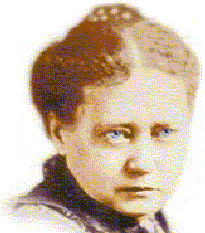
H P Blavatsky
THE LETTERS OF
H P BLAVATSKY
to
A P SINNETT
and other
miscellaneous letters transcribed, compiled,
with an
introduction
By
A. Trevor
Barker
Section 3 Page 183 – 261
The
Influence of Bowaji. . . 183
Mohini’s
Indiscretions . . . . 185
The
Dweller on the Threshold . . . 187
A
Warning from Master Illarion . . . 189
Libels
and the Law . . . . 191
A
Family Embroglio . . . . 193
The
Writing of The Secret Doctrine. . . 195
Subba
Row and The Secret Doctrine . . . 197
The
Policy of Masterly Inactivity . . . 199
Mr.
Lane-Fox . . . 201
Valuable
Evidence from Subba Row. . . 203
Lethargy
in the
More
about Solovioff . . . . 207
Evidence
of the
A
Duchess, a Fairy Tale, and Money. . .
211
The
Last Alternative . . . . 213
Myers
and Solovioff . . . . 215
The
Memoirs . . . 217
Anna
Kingsford . . . 219
The
Purpose of the Masters’ Society . . .
221
The
T.S. and Masters’ Protection . . . 223
High
Opinion of Sir Wiffiam Crookes . . . 225
Sinnett
very young in Occult Matters. . . 227
Politics
and Opinions . . . . 229
The
Ethics of Jesuitry . . . 231
The
Will of the Jesuits . . . 233
“Those
Accursed Memoirs” . . . 235
Col.
Olcott acts like a Fool. . . 237
H.
P. B. gossips . . . . . 239
The
Buddha and Brahmanism . . . 241
Buddhas
and Bodhisatwas. . . . 243
The
Seven Worlds, Races, Globes . . . 245
Evolution
and Involution . . . 247
Planets,
Rings, Rounds . . . 249
Dimensions
and Rounds . . . 251
Maya
and Reality . . . . 252
Spirituality
of Good and Evil . . . 255
The
Power of Seeing and Knowing . . . 257
Man’s
Growth and Evolution . . . 259
A
Final Correction . . . . 261
H. P. B.
LETTER
No. LXXVII
MY
DEAR MR. SINNETT,
Read
this with attention please; as I am DETERMINED to square my accounts
wherever
I have any, and put myself in a position for the few days I have to
live—that
would not be altogether that of the sick and old lion, made helpless,
that
every donkey can kick, that is hunted by all the hounds of hell and has the
doors
of every land and city shut before it or him.
My
Karma—is my deserved Karma and I do not murmur or rebel against it. But,
outside
of Karma—and I know this for I was explained the difference—there is
(a)
duty and justice to myself as to any one else of my mankind; and
(b)
some means to be provided that I could finish or rather work on, until I finish
the Secret Doctrine. Now in my present state it is thoroughly impossible.
The
Countess is a witness to what I say. She wonders daily and hourly how a
woman
in my dilapidated and debilited state of health can bear all I do, daily
and
hourly too, and not either become insane or drop down dead of heart-rupture.
I
can bear and would bear anything that is the direct result of my own mistakes
or
sowing. I mean to kick against that which is entirely the result of human
cowardice,
selfishness, and injustice. I may have brought on myself Coulombs,
Hodgsons,
even Sellins—I have done nothing to deserve to lose my best friends
and
those most devoted to the Cause, through the intrigues of those who ought to
be, if not quite ready to lay their life for Master and Cause, as I am—at any
rate
not to swell the ranks of those who keep on stoning me daily. Please put
the
question fairly and openly to Messrs. Bowaji and Mohini. Do they want me to
live to finish my work, or do they, each for their own selfish ends, mean to
finish
me? For there is a limit when even one protected as I am, must give away
in
her human nature and either lay violent hands on herself, or on those who
seek
to kill her.
This
will appear ridiculous and absurd to you. Perhaps you too fell a victim
already
to Tamil mantras and psychology as all the Gebhards have—especially
Franz—as
Miss A. has, and now
—•—
183 THE INFLUENCE OF
BOWAJI —•—
as
I see—Mohini? I would not feel surprised in the least, knowing what I do.
Now
let me speak plain and say at once that if you have not yet arrived at such
a
blessed state of a marionette in the hands of one superlatively clever at
creating
such—you are in eminent danger to fall into it, even though you never
saw
Bowaji—never spoke with him, simply by the force of circumstances that this
little creature is determined to create, that you will end by yielding to,
because—a
man of the world, you judge by the appearances created. Now I do not mean to
sit and wait till I lose you and Mrs. Sinnett as I have lost the
Gebhards,
and now Mohini entirely in the hands of one, who has nothing more to lose, and
who therefore can care little for what may be the result for himself.
I
beg you not to laugh; I pray you not to think I am writing in a hot passion,
or
in one of my fits of rage and irrepressible impulse—for I do not. I know what
I
say and therefore I mean to act thereupon.
Three
days ago I had a letter from Hubbe Schleiden giving me the startling news
that
Sellin had conquered him, that he came to an agreement with M. Gebhard that he
(H. S.) would send him back his diploma and Presidentship, would open the
Sphinx to Mr. Sellin’s vilifications against the Society, Olcott, myself (in
the
Hodgson
style and worse) and remain only in his heart, a true and devoted
theosophist
working for the Society still, since by opening his columns to the
enemy
and resigning every connection with the T.S. he would thereby prevent
Sellin
from abusing and ruining the T.S. in all the German papers. In short he
would
sacrifice himself and his journal making of the latter a paratonnere—a
lightning
conductor. Now you may ask what has that to do with Bowaji? I say a
good
deal. It. M. Gebhard is in it, and was made to see things in this light. If
asked,
M. Gebhard will deny it very sincerely, he will explain it on other
grounds.
I maintain what I say. But that’s nothing—let it go. It is only one of
the
many cases I know. Let me come to the last one.
Nothing
sincerer, more affectionate than Mohini’s letters to me to the day his
friend
B. (who hates him more bitterly now, than Coulomb ever hated me!) came to
charges—every
one of them utterly groundless and false—that he mentions in a
highly
dignified and forgiving tone. You may not see anything but very natural
misconceptions
generated through circumstances and Karma. I see things
otherwise.
Every charge in it, namely (1) that I had divulged a certain secret
of
Mohini’s to Mme. Coulomb who told it to Hodgson, (2) that I told the same to
Damodar, while I wrote to him (Mohini) now that I had never
—•—
184 THE LETTERS OF H. P.
BLAVATSKY —•—
opened
my mouth to any one upon the thing; (3) that I believed him guilty of
-----
with Miss----- as soon as I had read her letter to him at
then
told to Solovioff, who went and told to Mme. de Morsier; who thus finding
that
I believed in Mohini’s guilt believed it too, and then finding that I had
turned
front and said Mohini was not guilty, thought necessarily that I was
lying
and tried to cover him, and feeling indignant (as she well might, poor
woman,
if it were so) turned against me and Mohini and all; (4) that I had
written
to the Colonel a letter in which I had misrepresented, or told him about
Mohini
something dreadful etc. etc. etc. Enough we have to analyse now these
charges.
Every
one of them proceeds through Bowaji and his instrumentality. The charges
and
explanations with regard to Mme. de M. have been disentangled via Al.
Gebhard,
who went to
Mme.
de M. I alone know how much there is in it of Mr. B.’s influence. He told
all
this to Mohini, at all events and thus poisoned his mind against me.
You
know, for you were here at Wurzburg, at the time—whether I believed Mohini guilty;
what I had said to you I had said to Solovioff regarding him the friend he was
then—and NO MORE. I was mad to think that any woman would dare write to Mohini
such letters and saw plainly that he was guilty not of sexual
intercourse,
but of yielding to an adoration that tickled his vanity, of
corresponding
with a woman in love with him. And you know that had I even
believed
in my heart that he was guilty I would screen him, a chela, one
connected
with Masters—with my own body, not for his own sake for I would have done
everything secretly and underhand to rid the Society of such a hypocritical monster—but
I would have cut off my tongue before saying or confessing it to any one. It
would have been suicidal for the Society, myself, and thrown a new slur on the
Masters. Therefore, I have never said such a thing to Solovioff. He LIED most
positively. He gossiped, first out of pure love for mischief—as he gossiped to
me about Mohini being this and that, having had intrigue in
I
never said, what he charges me with, either to the Coulomb
—•— 185
MOHINI’S INDISCRETIONS —•—
or
Damodar. Both were told by a party wronged by Mohini of that affair, one that happened
before Mohini had even heard of the Theos. Soc. But, as Coulomb will swear to
anything against me, and that Damodar is not there to answer it—hence Mr.
Bowaji’s safe charges against me, whom HE HATES—well in a way he did not conceal
before the Countess.
I
never wrote one word about Mohini to Olcott. I avoided and delayed it. It is
only
when the affair became serious, that I told it to him in a general way,
asking
him not to believe all that would be told to him about poor Mohini, who
had
been foolish but was innocent of the crime imputed to him. You have a letter
from
the Colonel, I sent you, in which he tells me “I knew all about Mohini”—to
my
great astonishment. Now I know how he learnt it. It was through Mrs. C.
Oakley
who wrote to her husband the gossip and scandal about town from our
enemies.
Hence Col.’s letter to which Mohini alludes, and of which I know
nothing.
Please show to
you.Such
are the facts. Judge of my position and try to realise that I, taking my
theosophical
vows in dead earnest, cannot act otherwise than I mean to with
regard
even to a woman that I fully despise. I do not believe Mohini
guilty—never
did of the consummation of the last criminal act. But if he has
indeed
written letters to Miss ----- “nearly 100 in number” and “couched in the
most
extraordinary terms,” I will retract the words “Potiphar” and other
“libellous”
terms and write to her through her lawyers the enclosed, I which
please
correct and suggest anything else you think proper. I do not wish to
incriminate
Mohini, thereby, for I would be throwing slur on the Masters by
it—if
even it were the truth which I do not, cannot believe. But I wish it to be
known
plainly that it is the writing of even such letters that I do not approve
of;
and that if he gave her a certain right by flirting and flapdoodling with
her
in a way little behooving in a chela, I, had I known it at the time—would
have
never called her a “Potiphar” in writing, whatever my own personal opinion
of
her. I am perfectly aware that the threats of the lawyer are ridiculous; but
I
also know that though they cannot reach me here, they can create scandals and
throw
dirt at me in a hundred ways that no one would think of but unscrupulous
lawyers;
and I have had enough of dirt and scandals. Besides so long as I am not clean
out of this whole affair I cannot even go to London where I HAVE to go absolutely,
and whether I see you or not.
Thus
if you are a friend, you will please employ a good lawyer (I have a few
pounds
from my aunt I can spend) to go to those
I see Letter No. LXXVIIa.—ED
—•—
186 THE LETTERS OF H. P.
BLAVATSKY —•—
wretches
and have a good talk, and to tell them, that if they have indeed
letters
from Mohini to her “more than a hundred in number” and that if they can
show
the lawyer one endearing term showing love familiarity—then it is enough
for
me. As I had written letters to Mme. de M. under the impression that it was
her
who pursued him, and not he who answered or seemed to answer and
countenance,
if not encourage her love—and that Bowaji told me quite a different story, in
which Mohini was made out the victim of more than one she-woman—with details;
if now it is shown to me that it was not so, and that there is six of one and
half a dozen of the other I am ready to acknowledge my mistake publicly.
She
is not a Potiphar—and he is not the Joseph—morally (if he is physically)
that
I took him for.
Now
do not try and dissuade me from this. Show this letter to Mohini and let him ponder
over it well and show it even to his friend B. if he likes it. I am
determined,
to square all my accounts. I have suffered that which none in the
whole
Society, and perhaps the world over, would be willing to suffer if he
could
help it—and to suffer any longer now would not injure me only but the
Society,
the Cause, the MASTERS’ names. I know that, which you do not, cannot know, for
you had no such personal experience as I have. I KNOW that I have to deal no
more with the Bowaji D. N. who left me to go to Elberfeld but that I have to
fight alone, and single handed a POWER—that acts through him; and which, if I
do not conquer, will conquer (ruin) the whole Society, yourself, and ALL through
me, though personally myself IT cannot harm. What occultist would be blind
enough if he were a genuine occultist, not to perceive the impossibility, the
utter unnaturalness that a boy (or man) so utterly devoted to the CAUSE, the Masters,
and myself to a degree as I believe—should suddenly, without the least provocation,
cause, or reason, develop such a HATRED, such a fierce, savage, fiendish thirst
of revenge and desire to ruin one who, except kindness had done him nothing?
His letter of contrition to me, which I sent you, was a sham, (or a temporary
relief from the POWER in him.) No sooner written he went on the same, only more
cautiously. He set the Gebhards dead against me, and Franz and his wife against
the Countess too. He meddled in everything, led the whole affairs at Elberfeld.
He was the guiding and evil genius of the family as they will find out and he
will be that of the A.’s, and any one whom he now approaches. He wrote to me
since, two most impudent, impertinent letters which are not his (Bowaji’s) but
written in that crafty, cunning, jesuitical dugpa style I am so well acquainted
with. It is Moorad Ali resurrected! I tell you all, and Mohini the first one,
to beware. He speaks graciously of seeing me once
—•—
187 THE DWELLER ON
THE THRESHOLD —•—
more
before he returns to
could
not bear the horror—and if he does not change and the POWER does not leave him
I will not permit him to cross the threshold. How can I doubt—if all of you are
foolish enough to—when, no sooner had we left Ceylon, this last March or April—that
I saw the well known FORM (I had already seen near him in Darjeeling, but this
did not dare approach him then) ten yards off us four -- (Hartm., Flynn, Bowaji
and myself) -- on deck shaking its fist at me, and saying: “You are four now,
you will soon be three, then two—then you will remain alone, alone, ALONE!” The
prophecy has come out pretty fully. Mary Flynn, losing suddenly without any
cause or reason, her devotion—did not give a sign of life since she left,
turned round. Then Bowaji went away to Elberfeld—and there foaming at the mouth
screamed before the Countess “She will be left alone, I will prevent every one,
Mohini and every one in
Well,
remember. It is not myself but all of you and the L.L.—as also the T.S. in
general
I want to save. After what was said by Hodgson—nothing in the world can throw
an additional strain on me. But the L.L. can break up and theosophy in
I
have seen the FORM last night again, not in the house for there was Master’s
INFLULENCE
in it—but across the garden through the walls, and the Countess has seen and
felt it several times also though here she will not be hurt by it. And
as
I have seen it and received this morning the lawyer’s letter and threats, I
am
determined. If, to save the Society and rid it from that POWER—that can
approach
and theosophist and chela even, if he is not as staunch and true to the
Masters
as I am—I had to go to London with the next train and make friends with Miss L.
and common cause with her, any Hodgson and all—I would do it without hesitation.
Remember, then, my dear, faithful friend, who alone has remained such in
—•—
188 THE LETTERS OF H. P.
BLAVATSKY —•—
all
Missionaries,
accept the propositions made by the Jesuits anything. I have
arrived
to that point of indifference to moral personal suicide that I am ready
for
all. It is Mohini’s last letter that showing me the terrific danger to which
you
are all blind that determined me. My love to dear Mrs. Sinnett—St.
PATIENCE—truly!
Yours
to the consummation of the theosophical pralaya—ever
H. P. BLAVATSKY.
LETTER
No. LXXVIIA
SIR,
Having
received your letter of the 16th current I beg to inform you, that if you
can
show to my lawyer who will deliver you the present:
(1)
Any letter of mine—from those I have written privately and confidentially to
Mme.
de Morsier without the remotest idea of publicity and delivered by her to
you—in
which letter I connect your client’s name with any libellous epithet or
sentence,
or in which Miss ----‘s name is mentioned by me;
(2)
If out of the “hundred letters” from Mr. Mohini to Mdle. ---- you claim to
have
in your possession, one single endearing sentence to her address is shown
by
you to the gentleman who will call on you, a sentence clear enough to lead to
the
conjecture and conclusion that he was or desired to be on such terms as are
generally
regarded by every honest person as improper and dishonourable between a married
man and an unmarried female—in such case I shall acknowledge that I have been
entirely misinformed as to the true state of the case, and will make Miss ----
a full apology for any libellous term I have used. I believe Mr. Mohini
innocent so far. Let it be shown to me that he is not—and I will be ready to
acknowledge publicly my mistake.
H.
P. BLAVATSKY.
To
the lawyer. Now correct, remodel, and see how I can write it.
LETTER
No. LXXVIII
Saturday
13th/86.
MY
DEAR MR. SINNETT,
Here’s
a new letter with black-mail and bullying in it, this once. It proceeds
direct
via Bibiche from Coulomb with whom your lovely ex-walz-partner is in
direct
communication.
—•—
189 A
WARNING FROM MASTER
ILLARION —•—
What
the black-guardly clique means, I do not know, but what the Coulomb means I see
clear in it for it is an old, old story. But whatever it may be I am
determined
to throw it back into the Remnant’s face. I do not suppose that in
any
other mortal is? Now this address:
“Mme.
Metrovitch otherwise Mad. Blavatsky.”is a written libel and a bullying bit of
chantage, blackmail or whatever you call it. People with a mouth and a tongue
cannot be stopped from saying that every man whoever approached me, from
Meyendorff down to Olcott, was my LOVER (though it is just as much of a libel I
believe, as any of us saying that the ------ is a Potiphar, or had crim. con.
with Mohini, isn’t it?). But I do believe that when a lawyer or lawyers on the
authority of Mme. Coulomb’s infernal gossip writes such an insult implying not
only prostitution but bigamy and aliases—it is a defamation. If you please show
this to the lawyer (ours) and do make him stop it at once by saying that unless
they and Bibiche write an excuse I will prosecute them and bring them in for
libel. Now I have a right to, and if I have not and if you do not profit or
take advantage of this—then all I have to say is that you deserve being bullied
by the Bibiche. I tell you that were we in
He
was a Mazzinist, had insulted the Pope, was exiled from
came
with his wife to
a
friend of mine too—he came to
He
was a brave and daring man and could not bear it, so he went to
quand
meme and I went after him with my monkeys, doing as Illarion told me, who said
he saw death for him and that he had to die on April 19th (I think). All
this
mystery and pre-
—•—
190 THE LETTERS OF H. P.
BLAVATSKY —•—
caution
made Mme. C. open her eyes and ears and she began gossiping and
bothering
me to tell her whether it was true—what people said—that I was
secretly
married to him, she not daring I suppose to say that people believed
him
most charitably worse than a husband. I sent her to grass, and told her that
people
might say and believe whatever they liked as I didn’t care. This is the
germ
of all the later gossip. Now whether he was poisoned, poor man, as I had
always
suspected or died of typhoid fever, I cannot say. One thing I know. When I
arrived to
evening
and we buried his poor body. I was then a Russian subject and had a row for it
with the Consul at
Then
I took up Mme. Sebir, my monkeys and went back to
Mazzinists
and that people said he was my lover. I answered that since he (Ag.
Metrovitch)
had come from
relatives
and had done nothing against my country I had a right to be friends
with
him and with whomsoever I chose. As to the dirty talk about me I was
accustomed
to it and could only regret that my reputation clashed with
facts—“avoir
le reputation sans en avoir les plaisirs” -- (if any) has always
been
my fate. Well this is what Coulomb now got hold of. Last year Olcott wrote to
my aunt about this poor man and she answered him telling him, that they all had
known Metrovitch and his wife, whom he adored, and who had just died when she
asked him to go to Egypt etc. But all this is flapdoodle. What I want to know
is—has a lawyer a right to insult me in a letter, as this Remnant has
—•—
191 LIBELSS AND
THE LAW —•—
and
have I, or have I not the right to threaten him at least with proceedings?
Please
see to it, I ask you as a friend, otherwise I will have to write myself
to
some lawyer and begin an action which I can do without going to
have
no desire to begin an action myself, as you know, but I want these lawyers
to
know that I have a right to, if I choose. Perhaps they believe, indeed, the
fools
that I was secretly married to poor Metrovitch and that it is a skeleton
in
the family cupboard? I write a few words which your lawyer can show to the
Remnants
to disabuse their minds. I will not go to
Ostende.
Yours
ever,
H. P. BLAVATSKY.
Unless
you stop the “Mme. Metrovitch” business at once it will be all over
theosophical
sake
as well as mine. It’s a beautiful chance, do not lose it. The Remnants
verily
believe in that gossip, otherwise they would have never dared to write in
this
way. Well show them they are IN for once, and then we will triumph.
Just
look! I found the envelope I had not remarked till now. Opened LIBELS in
open
letters or postcards are doubly punishable in the
in
LETTER
No. LXXIX
MY
DEAR MR. SINNETT,
There’s
a letter from Gaboriau. I have answered it. He may do as he pleases. If
he
is capable of a lachete, I tell him—let him do so. I do not think he will
give
her the letter but you better write to him a kind letter and ask him to
return
it to you.
Here’s
a new impertinence from the lawyers. I have said below what I think.
Please,
engage a lawyer for me.
I
have a letter from my aunt in which she says concerning Solovioff as I had
asked
her to recall all the circumstances not trusting to my memory: “I know
nothing
of that story about Mohini, nor does it interest me; all I remember is,
that
when I tore up that letter unwittingly and you had read it and told of it
to
myself and Solovioff you began quarrelling with him and saying that you would never
believe Mohini guilty and that it was his fault if Potiphars were running after
him. If you want it I can
—•—
192 THE LETTERS OF H. P. BLAVATSKY —•—
write
a sworn deposition in French to that effect, and take my oath on the
Evangelium
(Bible) before a notary. If Solovioff says otherwise he LIES. What
can
he do, that he threatens me? Only denounce me perhaps to the gendarmes at
the
Secret Office and invent some treasonable expressions as having been
pronounced
by me. He is quite capable of it. All
Mother
has cursed him and it is said” -- (but that’s too horrible) and he was my
friend!!!
No wonder if after His first visit, and having had a good look at him
Master
would have nothing more to do with him all my prayers notwithstanding!
Yours
ever,
H. P. B.
Please
show this to Mohini. I can send you her original letter but it is in
Russian.
Let him see that I have not lied.
LETTER
No. LXXX
Mar.
3.
DEAR
MR. SINNETT,
It
never rains but it pours. I do not think it possible to answer for anything,
any
smallest event in this life and say it will have no effect. Karma is more
than
any of you think. Presently the Shah of Persia will sneeze on a Sunday and
next
Saturday all
powers
will have mistaken the sneeze for a cannon-shot. A too erotic spinster
falls
in love with a nut-meg Hindu with buck eyes, and one of the results is,
that
two families closely allied by the nearest blood-ties are separated for
ever
and a third party, innocent of the squabble from beginning to the
end—myself—is
smashed in the affray. Solovioff has turned out a dirty gossip, a meddler, and
a bully. He, whose skirts were dirtier than those of any one else,
arraigned
himself as though in virtue against Mohini, sold me like a Judas,
without
cause or warning; went to
her
family, set every one of them against me, learnt all he could learn of the
dirty
gossips of old (especially about that poor-child story) returned to
sold
us all, etc. Then wrote to me a most impudent, threatening letter, as you
know,
threatening also my aunt, who, upon learning how he had deceived us all
with
his wife (who has now turned out his unmarried sister-in-law, his other
wife’s
sister that he seduced, it now appears, when she was only thirteen) wrote
to
my sister that she, the supposed Mme. S. whom you saw, was no fit companion for
her unmarried daughters and my sister showed him, Solovioff, her aunt’s letter!!
A row—thunder and lightning. I sent to my
—•—
193 A
FAMILY EMBROGLIO —•—
aunt
his impudent letter. She sent my complaining letter to my sister and
reproached
her, it appears too violently, for allowing her daughters to sell me
like
Judases to Solovioff; to make friends and side with him against me, who had
done
them no harm, but had given up all my father’s inheritance to them, without
a
word of protest, etc. This sent my sister into hysterics and fits. The
daughters
wrote a most impudent letter to my aunt, asking her never to write to
them,
and never pronounce my name, which as Christians stank in their nostrils.
My
two aunts kicked and took my defence, and wrote thundering letters of
reproach.
New rows, new complications etc. etc. Now the result is: my sister’s
family
and my aunts have become Montecchi and Capulette, and Solovioff the Iago of
Theosophy and of myself. My sister hates me, as she declared, and her
daughters
still more. Now in
propositions—that
you know. He knows Katkoff; he is a writer; and I expect to
lose
through his kind offices my position on the Russian Vyestuik and as a
consequence
a few thousand roubles a year.
All
this—because Mohini has chosen to play at platonic (if only platonic) Don
Juan.
How is this for complication, dirt, and a diseased heart? Let it go.
Now
about other things. I do not care one rap for all the Remnants in
She
can do nothing except throwing new dirt at us and unable to sentence us
legally
they will, of course, go on simply making faces at our sisters—if we
have
any left. But let this go too. Now while you had in your head the idea of
living
together somewhere in
between
S. P. R. and the Bibiche—I had visions that I told the Countess about
three
days ago. I saw most unexpectedly your house with a large bill on the
window
“Furnished house to let”—and I saw you two and myself in
wherever
it was, but it seemed to me
a
vision by suggestion and a train of thought—then there may be something in it.
If
you only could let your house furnished—which seems easier than sub-letting
the
lease, we could live very cheap somewhere on the shores of
Doctrine.
To live in
parts
of
—•—
194 THE LETTERS OF H. P.
BLAVATSKY —•—
Now
do you think it feasible. What I spend here, some 400 marks, I will always
spend
elsewhere and no more. Bouton sent me 125 dollars most unexpectedly, says he
will be now sending more. Makes fine propositions. I enclose his letter—read it
please and send it back and say what you think of it. If Judge or Gebhard or Prof.
Coues help me taking out a copyright from
There’s
a new development and scenery, every morning. I live two lives again.
Master
finds that it is too difficult for me to be looking consciously into the
astral
light for my S.D. and so, it is now about a fortnight, I am made to see
all
I have to as though in my dream. I see large and long rolls of paper on
which
things are written and I recollect them. Thus all the Patriarchs from Adam
to
Noah were given me to see—parallel with the Rishis; and in the middle between them,
the meaning of their symbols—or personifications. Seth standing with Brighu for
first sub-race of the Root race, for inst: meaning,
anthropologically—first
speaking human sub-race of the 3rd Race; and
astronomically
-- (his years 912 y.) meaning at one and same time the length of
the
solar year in that period, the duration of his race and many other things --
(too
complicated to tell you now). Enoch finally, meaning
—•—
195 THE WRITING OF
THE SECRET DOCTRINE
—•—
the
solar year when our present duration was settled, 365 days -- (“God took him when
he was 365 years old) and so on. It is very complicated but I hope to
explain
it sufficiently clear. I have finished an enormous Introductory Chapter,
or
Preamble, Prologue, call it what you will; just to show the reader that the
text
as it goes, every Section beginning with a page of translation from the
Book
of Dzyan and the Secret Book of “Maytreya Buddha” Champai chhos Nga (in prose,
not the five books in verse known, which are a blind) are no fiction. I was
ordered to do so, to make a rapid sketch of what was known historically and in
literature, in classics and in profane and sacred histories—during the 500 years
that preceded the Christian period and the 500 y. that followed it: of magic,
the existence of a Universal Secret Doctrine known to the philosophers and
Initiates of every country and even to several of the Church fathers such as Clement
of Alexandria, Origen, and others, who had been initiated themselves.
Also
to describe the Mysteries and some rites; and I can assure you that most
extraordinary
things are given out now, the whole story of the Crucifixion, etc.
being
shown to be based on a rite as old as the world—the Crucifixion on the
Lathe
of the Candidate—trials, going down to Hell etc. all Aryan. The whole
story
hitherto unnoticed by Orientalists is found even exoterically, in the
Puranas
and Brahmanas, and then explained and supplemented with what the
Esoteric
explanations give. How the Orientalists have failed to notice it passes
comprehension.
Mr. Sinnett, dear, I have facts for 20 Vol. like
language,
the cleverness for compiling them, that I lack. Well you will soon
[see]
this Prologue, the short survey of the forthcoming Mysteries in the
text—which
covers 300 pages of foolscap. Do think of Arques and
seriously.
I must go somewhere but not in
Yours
ever,
H. P. B.
LETTER
No. LXXXI
Thursday.
MY
DEAREST MR. SINNETT,
May
THEY bless and reward you, I can only feel as deeply as it is in my nature
to
feel that you are the best friend I have left in this world and that you may
dispose
of me to the hour of my death.
Do
whatever you like. Publish the Memoirs, write what you think best and proper;
I
subscribe to it before-hand and hereby give you carte blanche and full
authority
to act and do in my name whatever you will. I am sure you will defend
the
Cause and myself
—•—
196 THE LETTERS OF H. P.
BLAVATSKY —•—
better
than I ever can. I can only say the truth on psychological, occult
grounds,
misunderstood, laughed at by all. I am powerless to defend myself. I
told
you and you would not believe it that people would believe the “spy”
invention.
The feeling against
Now
Hubbe Schleiden arrived here last night in terror saying there was real danger
for me here in
was
publicly proclaimed a “forger,” however much Hartmann may deny it
himself—that
I could be arrested. That’s jolly. Well—my conscience is clean and that’s all I
can say. He and the Countess want me to go to
I
have been looking over all my old papers, bundles untouched since
In
the latter I find two or three note papers. Some I suppose remained there
since
I
send them to you, to look at, burn or keep. I might have burned them myself.
But
I wanted to show to you how easy it would be, in case of my sudden death,
(which
may happen any day) to call me a thief, to show these two notes marked
“Surrey
House” belonging to Cyril Flower, Myer’s friend, and say I stole them
from
his house (where I dined once) for future phenomena or something of the
sort.
Now these two sheets of note paper wrapped his photograph that he sent me when
I was leaving
Yours
to the last
H. P. BLAVATSKY.
—•—
197 SUBBA ROW
AND THE SECRET
DOCTRINE —•—
LETTER
No. LXXXII
MY
DEAR MR. SINNETT,
Just
read Redway’s Catalogue and was perfectly struck and dumbfounded at seeing that
he advertises that infamous lie of Mme Coulomb (see p. 16). I do not see the
philosophy of it. Did you know it? I do not know how you will look at the thing—but
certainly I will have nothing to do whatever with Redway unless he withdraws
that advertisement. I rather publish Isis Unveiled in
devoted
theosophists as the Countess, along with such an infamous libel.
Please
see seriously to it. I am writing to draw Olcott’s attention to it. And I
swear
that I will try to put all the theosophists in
books
sold at Redway. It is an insult, a positive insult this. And the Countess
thinks
it disgusting. Can’t you speak to the man?
Please answer this seriously.
Yours
H. P. BLAVATSKY.
LETTER
No. LXXXIII
Monday
MY
DEAR MR. SINNETT,
Will
you kindly do me a favour? See if you can change me the enclosed cheque
from
Bouton in some American Bank. If a telegram to
please
cable (out of this money), I rather spend a pound or two than remain
without
money, as Olcott has stopped again sending. The first cheque from Bouton on the
Pacific could not be paid here, nor in
If
you can have it changed and send me the money in English Bank notes, I would ask
you to get for me (1) Wilson’s Vishnu Purana (his other works I do not want) and
then the best, the most complete work on Odin and the Scandinavian Mythology.
I
know nothing of the latter, and I have to refute many things in the
former,
for one that Odin “was far far anterior to the age of the Vedas!!”
I
will send to you two or three chapt. of S.D. before I send them to Subba Row
to
the
hands of S. R., lest a Hodgson would say again that the S.D. was written by
Subba
Row as
—•—
198 THE LETTERS OF H. P.
BLAVATSKY —•—
Please
see to the cheque, if you would not see the S.D. stopped once more for
lack
of pens and ink.
You
never told me whether you received Bouton’s letter I sent you, and what you think
of it? Have you received it? Love to Mrs. Sinnett.
Yours
ever
H. P. BLAVATSKY.
LETTER
No. LXXXIV
MY
DEAR MADAME ET MONSIEUR SINNETT,
Gout
and old age allowing me certain privileges, “permit me”—to address you
both.
God, through his select servant the Parson (by the by, I do not feel sure
of
a Parson—was there one, or simply Law?) having united you into one, I may
labour
under the illusion, as long as it suits my purposes, and imagine you like
Jehovah
and Eve before they were split into two by sin, and thus address you as
though
you had been never unsplit. Now you must excuse me—I have the “Secret Doctrine”
on my brain, and I am raving, I fancy.
Magnifying
glass, the Countess, and a certain dose of occult perspicacity having
happily
helped me to decipher your letter (Mrs. Eve-Sinnett), a process that
took
me about 3 ½ hours, I am able to answer you. The first sentence having
reference
to the Memoirs I read well enough. YES I am ready, i.e. for
“inspection”
never for “approval” however well written and interesting they may
be.
I have developed in me a horror for my name in print, that amounts to flesh
creeping
every time I see it. I am determined to sign the S.D. with some
fantastic
name from the world of “Non-Being.” By the bye, my Aunt sends me a
long
list of ancestors or ancestresses married with Russian Czars. Flattering—to
the
poor Devachanees I mean—to see their descendant so well appreciated by the Western
posterity. I hope they have all remained blind and deaf in Kamaloka. As I leave
—•—
199 THE POLICY OF
MASTERLY INACTIVITY —•—
I
sent him (or rather the Countess has) his box with clothes and received as
acknowledgment
and thanks a postal card thanking me for having kept his most
important
papers with me, a hint at my having “stolen” them I suppose, to use
them
against him. He is mortally afraid of me—that’s sure, and yet the fool does
not
know what I really do know.
And
now with regard to what you say about the two “chelas,” I will beg to draw
your
attention to certain things and then leave the rest to your better
judgment.
I speak on authority, and unless you or rather Mr. Sinnett helps and
seconds
me, I can do nothing.
The
French Branch which has survived Hodgson, Coulomb and even the personal efforts
of Myers—is now killed through Mohini. It is dead like a door-nail; for Mme. de
Morsier is against it. This—because I was kept in the dark all the time.
Had
I known what was going on in Paris, and the state she was in—I would have never
written her the letter I have, and would have never involved myself, nor made
her feel mad with me, with herself and so on. I knew nothing. Mohini did not
tell me one word. Babaji, if he knew it, kept all secret from me. To this
day
I do not know how and why it began, and what she believes in or does not
believe.
However—the Branch is dead and Mohini cannot deny it. She will drag
away
from us all the members she brought in. Solovioff is there to help her.
Babaji
has unsettled the Gebhards entirely. If he is permitted to return—say
good
bye to the German Branch and our mutual friends. Let this be a Prophecy—you are
warned. The German Branch is dead, thanks to him again. Had he not unsettled the
Gebhards as he has—they would have never allowed the Sphinx to go out of the Society
or let the things go down, as they did.
Now
remains the London Lodge. Who is its President? And who but the President has a
right to speak with authority? If you let those two boys do what they please
and do not counteract them, the L.L. will die of an indigestion of
Ethics.
Are you going to proceed with your policy of masterly inactivity—or
what?
Why not call a Council Meeting and have the two called and represent to
them
what they have and are doing, and say frankly and honestly that you cannot
allow
this any longer. They have either to work with you, or get out of the L.L.
and
live in
SOMEBODY
ELSE—takes up their cases in hand. Funny policy. You act as though you had no
rights. Tell them they have to decide or, that you will write a Report to Adyar,
to the Council, and let it be known there that they are ruining the last Branch
in
—•—
200 THE LETTERS OF H. P.
BLAVATSKY —•—
fault.
It is she who has spoilt both, and who is ruining the Society.
Enclosed
a letter from Franz. The “Jesuits”? I should say so. They are going now to make
me an offer on April 20th. We will see and—
Now,
lady and gentleman—I have done. What next? Better lose as little as you can of
your time while I am with you and alive. In a few days I may be with the
Jesuits
and—DEAD.
Yours till the happy event,
H. P. B.
Now
Please let me know what about the Leonard? Has my money come?
LETTER
No. LXXXV
Strictly
PRIVATE and CONFIDENTIAL
to
be neither read to Typhon-Bibiche, nor printed in The Times, not even
whispered
to Fanny A.—the theosophica-Ethical Urn with the two chela-handles.
MY
DEAR SIR PERCY,
The
die is cast, and my canoe launched on the waters of the “Wandering Jew”
again.
The Countess leaves here on the 28th of this month, having sacrificed the
Gebhards,
her relative’s visit etc. for me—may her Karma reward her. Now to stop alone I
neither fear nor care—save that in case of my quick exit I leave all my papers
to the tender mercies of the enemy, and my body to the sacrilegious
interference
of some d---d priest. But I cannot and will not stop here for
another
reason. The only acquaintance and friend (to a degree) here, Miss
Hoffman—is
mortally scared—an old spinster-like nervousness—through the kind efforts of
Sellin. This theosophob of
Now
the die is indeed cast. Even Mlle. Hoffmann will desert me, if I stop, and
then
I go. The Countess will pack up for me my goods and chattels, books and
frying
pans before she goes. I pay
—•—
201 MR. LANE-FOX
—•—
here
till the 15th of April, and between April 1 and the 15th I am on my exodus
to
only
find a comfortable warm lodging I settle and stop there till we can realise
the
“chum” dream in
something
still nearer and better. I would have preferred
female
Typhon can get hold of me and bring a law-suit for defamation, and poison my
rest once more.
because—well
because I have done my duty.
Greetings
to the household. Have you received my cheque of 262 dollars? Can you do it? I
will need the change badly. If Mrs. S. has any stamps on hand let her send them
and close the accounts, and if not let her keep them and shut up shop the same.
Yours lovingly in pitch and tar,
H. P. B.
Letter
No. LXXXVI
OSTENDE. 10 BOULEVARD
VAN
ISAGHEM,
“VILLA NOVA,”
August 12.
MY
DEAR MR. LANE FOX,
Your
kind message was delivered to me by Mohini. He says “Mr. L. F. says he is not
hostile to you: on the contrary, he defends you whenever opportunity arises. But,
of course, he does not think you perfect because you are not perfect.”
Three
propositions involved in one message. Will you permit me, while thanking
you
for the kind expressions, to make a few remarks?
(1)
Why should you be hostile to me? I have never been hostile or even untrue to
you.
People have done their best to make me believe you have been both to me.
Whether
so, or not, I think you too generous and unselfish to act upon the axiom “He
who wrongs another, will always be the first to hate him.” This is MY
opinion
of you, I knew you better from the first than you knew me. I make bold
to
say that with all your great intellect you knew me far less than anyone else
has.
Your actions have shown it to be the case.
—•—
202 THE LETTERS OF H. P.
BLAVATSKY —•—
(2)
You defend me? As well defend a corpse, on whom the Car of Jaggernath has passed!
It is my Karma, but so it is yours to be doomed to failure in whatever you
undertake, especially now that the tie between us has been broken by you. I had
offered to do whatever you would have suggested for the salvation of the T.S.;
I had placed myself entirely at your disposal. You have trusted more in people
who had neither your ability nor your sincerity, and they have forced you to
make fausse route. I never had either personal ambition or love of power, and had
ever shown myself to people in my worst light. Had I been an actress or a hypocrite,
no enemy could have crushed me. It is my actual position that can alone defend
me, if not now then after death. I am a beggar in the full sense of the
word—and I am proud of it: I am a wanderer on the Earth without roof or home—or
any prospect of returning to India, and I feel ready even for this sacrifice
provided I can do good to our Society by my physical and mental suffering.
All
this will “defend” and JUSTIFY me when I am gone. From Christ to
The
whole organisation of the “Parent” Society so-called, was a blunder and a
mistake
from beginning to end. You might have saved it. You preferred deserting it, had
you believed in my sincerity as I believed in yours—you would have waited a few
days longer at Adyar and then every reform would have been
accomplished.
You believed I had but a few days to live—you listened to other
people,
those who were then my enemies and lost your patience with the poor
Hindus:
-- It is our KARMA all round.
(3)
You do not think me perfect? A fool is he, or she, who does! Were I perfect
I
would be there where no Govt. Expedition is able to get in, not in
well
of perdition where no true Theosophist can breathe for 6 months and remain one,
if he lives.
My
dear Mr. Lane Fox . . .I
Letter
No. LXXXVII
Sunday.
MY
DEAR MR. SINNETT,
Thanks
for your letter to Light—nothing better than that and little more
required—if
anything. I said to you yesterday what I had to say: I shall follow
Master’s
suggestions. Last
I The remainder of this letter is
missing.—ED.
—•—
203 VALUABLE EVIDENCE
FROM SUBBA ROW
—•—
night—two
letters were brought to me, rather two ½ letters. One, the famous one
from
Arthur Gebhard—the second an old one from Subba Row, and the half also from him
written last year to
The
philosophy of the three being sent to you is as follows. 1st. From Arthur --
(that
has been just read two days ago for the first time by Mahatma K. H.) -- to
show
that imperfect as is my knowledge of Schiller’s tongue—by reading it, if I
had
read it I would have understood at any rate, that there was not one line in
it
that concerned Arthur’s quarrel with his father—just as I told you at
Wurzburg;
and I thanked Mahatma for it. (2) Subba Row’s letter of 1882 showing that so
far back as that time Mr. Hume was our bitterest enemy, or rather the enemy of
the Mahatmas, whom he hated gloriously as you know, not scrupling to betray
Them and all the Society behind our backs secretly and treacherously while
remaining all the time in the Society as he does still now. Whether it shall be
of any use in the future or no I cannot tell, I can only repeat D. K.’s words.
Tell Mr. Sinnett to keep it among his documents also (No. 3) the half letters
from which it is seen that Subba Row speaks of Master as “Our” Master his and
mine—I think I understand why. When at the last row between him, Hodgson, Hume
etc—Subba Row told Mr. Hume—who grinningly brought me the news—that he knew of
no Master, would tell him nothing concerning them, and that he (Hume) ought to
know better the Masters than he did, since he wrote to several members (who
preserved the letters) that he (Hume) had seen Mahat. K. H. in a vision of Yogi
clairvoyance several times, and knew all about Mahat. M.D. K. is very angry
with me for having written so inaccurately to you about him yesterday,
“dishonouring” him in your eyes. He says he never copied Olcott’s and Coul.
diagram; but it was they who copied his ---- (did I tell you otherwise?); that
I better stop my “dzin-dzin explanations,” as no one hurt me as much as myself!!!
Now there’s that hardly weened infant on my back! What next? Please don’t ask
me any more. Since I am a fool and unable to speak truth even in my favour—but
muddle it up—I shall drop every “clearing up” altogether. And please remember,
my dear Mr. Sinnett, that if those psychic asses offer after your letter in
Light to show me any “letters” or to give me a chance of rising and explaining—I
refuse to do so beforehand. I would have nothing to do with them, if it even
lead to an entire vindication. I have enough of them, of their ungentlemanly,
disgusting, Scotland yard secret proceedings, and do not wish to be any more
troubled by anything coming from Cambridge, which be—condemned.
The
“Arundale group” is not altogether composed of geniuses
—•—
204 THE LETTERS OF H. P.
BLAVATSKY —•—
as
you know. If every one was as fair as you are it would be too good to live in
this
world of dirt. I know what both Mahatmas think of you—I shall not forget
how
I saw you on that night I was dying.
I
had to part with the half of my £3-16-0 in a telegram. Olcott stopped the
appearance
of the Theosophist for a week believing in his tomfoolery that I was
ready
to come to terms with Lane Fox—he was fool enough to dispose of it without my
consent—and then what would I do? I fear all and everything from the Adyar Sages.
D.
K. passed last night into Babajee’s room and—I heard him sobbing the whole night.
I went to him and knocked but he would not open. New mystery!!
Yours ever,
H. P. B.
Compts.
and love to dear Mrs. S. and Dennie.
Letter
No.LXXXVIII
Monday.
MY
DEAR MR. SINNETT,
Yours
with enclosures received. Well, what can I say to Mr. Sergeant’s
prognostication
except—he is right. If he knows it astrologically and
intuitionally,
I know it by the aura whenever I think of India, Egypt and other
countries.
All the damned goblins of the middle spheres; all the storm-devas,
the
Hurricane, Water, Fire and Air spooks, are making themselves ready in
proportion
and apace with the preparations of the terrene inhabitants. But
what’s
the use in telling you what I see, and feel, and hear, and know? You are
a
Conservative, a deep-water Tory, and my countrymen are ninnies, flapdoodles
and
jackasses. They have neither the feeling of dignity, nor of the great wrong
done.
Fancy your Lady Isabella Stuart (or Stewart) Salisbury’s daughter,
received
like a queen at Moscow, dining with the Gen. Governor, Prince
Dolgorouki
(the old night-cap!) and flirting with Imperial guards, and Katkoff
writing
that she was received the better and the more honoured, to show the
difference
between the Russian unpolished bears and her polished “pa”—who
treated
Russia publicly to a “fraudulent swindler” and bankrupt. Well dear, it’s
a
fact, and no use concealing it to my sorrow and woe: Russia is black with
suppressed
hatred and swelling like—well, I wont say a bull-frog at a Bull—but
like
a volcano ready to burst; and I will be a Dutchman if you do not catch it
sooner
or later. And who pays for it, meanwhile? Why, H. P. B., the “O. L.” the
natural
—•—
205 LETHARGY IN
THE LONDON LODGE
—•—
consort
of the no less reviled and slandered “O. G.”—for here I am, suspected
even
of having had a hand in the “million francs” railway robbery, and unable to
go
home. Oh, how bitterly I do hate you both, England and Russia! How I wish you would
bite each other’s noses and tails, like the Kilkenny cats, and let honest people
go about quietly, and die at home! Well you won’t be flirting long with Lady Isabella’s
“Pa”—he is rolling down and you will have brought down on your back your old
renegade of
newspapers
for the last few months than I have in all my life. I believe I will
go
for politics now that I am near my sun-set; and just take a little occult
revenge
on your people who have, and are crucifying me daily. I WILL; I do not
joke.
I will take care of you though; because every bit of harm you have done to
me
was never meant, and that you have been almost without a break the best of
friends,
for me. But then I never try to think of you as an Englishman, but
as—well,
what you were two thousand years ago. You were a nice chap; only too fast after
the impure sex.
Have
you read in the last (February) Theosophist the Bhagavat Gita Lecture by
Subba
Row? Read, if you have not—page 301, from top to bottom. I have just
answered
an article that will appear simultaneously—unless Cooper Oakley, Subba Row’s
ame damnee, smuggles it out. But then Judge won’t, and I am sure you will rejoice
in your Conservative heart as you have never rejoiced at anything so theosophical.
Fawcett says it is the most crushing answer; an article which combines studied
politeness with “friendly admiration”—and that I have made him eat his own
words. He is sure to get a dyspepsia and an indigestion.
You
ask my advice in the L.L. business. Now that you have put the question to me you
may like to hear, perhaps, what Master remarked several times about the L.L.
I
cannot repeat to you his words but you may find the spirit of it in the text
of
Revelation III, 15 and 16. You may judge, and I may leave you to draw your
own
inferences. So anything to give a fresh impetus is better than inertia. If
you
remain for a while longer in your present state of lethargy your L.L. will
be
before another year is over—covered with moss and slime and you will choke in your
own products (moral I mean). What’s the use asking? You must know Master cannot
be satisfied. You CANNOT be “sat upon” nor smashed because the Don Juan is gone
and St. Theresa is now in
—•—
206 THE LETTERS OF H. P.
BLAVATSKY —•—
constant
religious ecstasies, for I would know very soon all the ins and outs of
this
horrid conspiracy through some theosophists—because they have no secrets from
me, and then I would upset all these French plans. I want the Society to go on
with its work, to progress and not to be disturbed with any political complications.
I am ready to become an infamous informer of your English Govt. WHICH I HATE,
for their sake, for the sake of my Society and of my beloved Hindus; -- yes
beloved, though two of them M. and B. are ruining and undermining daily my
honour, name, and fame with their lies. But it is not on account of these two
failures that I will cease loving my Master’s people. Ah, if Master would only
show me the way! If He would only say what I have to do to save
property,
people hung—who are innocent, and other people glorified, who are the promoters.
I know it. And to think that here I am, with the doors of India
closed
before my nose! That your Govt. here and in India, is so stupidly short
sighted
as not to see, that not only I am not, nor ever was a Russian spy—but
that
the very prosperity, progress and welfare of the T.S. depends on everything
in
India being quiet for years to come.
Now
what’s the use writing to you this letter, if you will not believe? I write
it
because I asked for permission to do so, and was given it, with a significant
shrug
of the shoulders which I interpreted as meaning—“It will do neither good,
nor
harm—he won’t believe you.” But two months ago Masters told me it was
serious.
Now Russia knows nothing of it, thanks to heaven. So my correspondents inform
me at least. But if she did—I swear, I would stick for the Hindus against
Ah,
my poor Mr. Sinnett, you are a patriot, no doubt, but you are still more a
conservative,
if you understand what I mean. It must be so, if you do not see
that
such eternal public slaps on the faces of Russia—“the swindling bankrupt”
and
the “lying beggar” as your Salisbury called Russia publicly; and such other
compliments
in your paper to the address of France, can only generate
—•—
207 MORE ABOUT
SOLOVIOFF —•—
a
terrible storm and a general European shower upon you some day. I can assure you,
my dear Mr. Sinnett, that if
Now
there are two paths before you. One is—burn this letter and think no more of it;
the other—to make use of it only in such case if you are sure this will not
get
into the papers and that my name will be unknown to all except to one having
authority
and who can warn Lord Dufferin to take care, one, in short, who may
take
measures against the thing contemplated. But I beg of you, I trust in you
as
a gentleman, a man of honour and a friend, not to compromise me uselessly.
Not
because I am afraid of being assassinated by some Frenchman—as I am warned by
one of our theosophists—for by so doing the murderer could only oblige me—but because
I would indeed be regarded as an infamous mouchard, an informing spy, and this
shame is worse than death.
Now,
what do you advise me to do? I want your answer, and will do nothing till
you
answer. Shall I advise Mr. ----- to warn Olcott or not? I am afraid poor
Olcott
will be in a dreadful funk if he learns it—anyhow—do write and answer.
Have
you seen the Report for the last anniversary in Jan. Theosophist. There
seems
a fatality that the Society cannot be chartered. But it went off
splendidly.
Love to Mrs. Sinnett.
Yours ever truly
and sincerely,
H. P. BLAVATSKY.
Letter
No. LXXXIX
May
1.
MY
DEAR MR. SINNETT,
The
Gebhards are here—poor, dear Madam Gebhard! Many misunderstandings have been settled
last night, many more will be to-day. A letter enclosed, in answer to my threat
to B. in my letter to Miss A. Judge for yourself—
Soloviof
has turned a blackguard and a black leg of the blackest dye. Fancy
after
what I told you of his proposal and offer, he said to Mr. G. that I had
made
him offer to serve the Russian Govt. as a spy!! I tell you old Nick himself
seems
at the bottom of all this conspiracy. It is infamous! He says that he (S.)
saw
Baron Meyendorf personally, who confessed to him that he had been so much in love
with me (!!) that he had even insisted that I should obtain a divorce from old
Blavats. and marry him, Baron Meyendorf. But that I had luckily refused and he
was very glad
—•—
208 THE LETTERS OF H. P.
BLAVATSKY —•—
because
he found out later what an infamous, LOOSE woman I was, and that the child WAS
HIS AND MINE!!! And the doctor’s certificate that I never bore a weazel, not
only a child? Now he lies and I am sure, cowardly and weak as I know Meyendorf to
be, he could never say such a thing to him. Then he said that he had seen in
the Secret Dept., documents in which I had offered myself as a Spy to the
Russian Govt. Do you understand the game? Of course it is the struggle between
the clay pot and the iron one. How can I go and fight in Russia
Soloviof!
I could fight him here: but none of you will let me. Now what is to be
done?
And he tried to persuade Mr. G. that the phenomenon signed by de Morsier, Soloviof,
my aunt, sister, and Judge in
drawing
room while Olcott was throwing the letter on Glinka’s head. Now here he was
caught! for my aunt had arrived with Zorn when Soloviof and Glinka had
already
left Elberfeld, and they never met. This Mad. G. remembers well and I
know
it for certain. So there’s a lie for you. He pretends to have translated
verbatim
my Russian letters to him and Mad. de Morsier has them in a large
dossier.
Now I wrote to him only three letters from Wurzburg in answer to
his—and
what Mr. G.----d says about the text, is all an invention from beginning
to
the end. Soloviof is either crazy or acts so because having compromised
himself
with his offer of espionage to me he is now afraid I should speak and
compromise
him at St. Petersburg. And so I will, I swear. I will make the story
of
the man who accuses me of immorality in my youth, known to the whole
world—and
show him living with his wife’s sister whom he seduced, and passing her off for
a legitimate wife! Nice set. And you pitch into me for trusting
Sol.!
How have I trusted him? Because I did not regard him as a blackguard? Well I
cannot do so with regard to anyone, so long as one behaves as a friend and gentleman.
You
want to publish these Memoirs and you omitted the strongest proofs you could bring,
and included such as the
forgetting
Prince Wittgenstein’s letter which is in the Theosophist when he says
how
the invisible protection of the Master, who promised him no ball would touch him
during the war—was felt by the Prince all the time in the Balkans. I believe this
is a good proof that I have not invented the Masters only in
—•—
209 EVIDENCE OF
THE BERLIN GRAPHOLOGIST
—•—
you
give that phenomenon with the fakir’s picture and you omit the testimony of
two
experts, two great artists who were not theosophists not even Spiritualists
and
whose art criticism on that picture shows its merits and proves it could not
have
been done by me. I copied the two letters from Laclear and O’Donovan out of the
“Hints on Esoteric Theosophy” No. 1. p. 82-86. You forgot as Mr. Gebhard remarked
the most important of all—the evidence of the
mistaken.”
Now Mr. Gebhard is willing to give the whole narrative, name and all,
and
I believe it is something for one expert in London to be saying one thing
and
another in Berlin—quite another. In general the Memoirs are very incomplete.
There’s
too much and too little in them. We must go over the thing carefully.
I
will go with Miss Kislingbury only to
Yours,
with love to Mrs. S. and
water
H. P. B.
LETTER
No. XC
Tuesday.
MY
DEAR MR. SINNETT,
You
are collecting materials for my biography, and it appears there is one
already
in English literature I knew nothing about. I learn of it from the
Russian
papers. In the feuilleton of Novoye Vremya, there is a review of an
English
book that appeared in 1885 by a Mrs. Frances Hays called “Women of the Day, a
Biographical Dictionary of Notable Contemporaries, by F. Hayes.” London.
In
this Dictionary in company with Mrs. Beecher Stowe, Sarah Bernhardt, Mrs.
Wood,
Madam Juliette Adam, Ouida, Anna the Celestial Dr. Kingsford, Dr.
Blackwell,
Florence Maryat (she forgot the Bibiche) I read the following, which
please
compare if you can get the book—
“Among
the women who have won for themselves fame through their scientific
researches
(?) and travels, one of the first places is given to our countrywoman
Helen
P. Blavatsky (pseud. “Radda-Bay” in Russian literature). She is the
daughter
of a Russian
—•—
210 THE LETTERS OF H. P.
BLAVATSKY —•—
Artillery
Colonel, Hahn, and was married to General Blavatsky, ex-Governor of
Tiflis,
during Crimean War. When quite a young girl yet, Mme. B. studied
languages
and learned not less than forty European and Asiatic languages and
dialects
. . . (Do you want your smelling bottle and salts?); she travelled in
all
Europe and lived in India for over forty years, (!!) where she became a
Buddhist.
Her work ‘Isis’ published in 1877 in English is considered as a most
remarkable
and learned research on Buddhism (!!!). In 1878 Mme. B. founded in
America
the Theosophical Society, and the year following she returned to India
with
the object of spreading her mystic brotherhood.”
Et
c’est ainsi qu’on ecrit l’Histoire!! Say now, if not a literal translation
from
the “Dictionary,” that no one is prophet in his own country.
Please
oblige me by seeing whether this report and translation are true; and
then,
you may advertise me as a reincarnation of Cardinal Meggofanti with
twenty-two
more languages in my head than he knew, since it was only 18, I
believe.I
wrote to the Remnant, Pulley and Grub, word for word as you wanted me. They must
be some sorry Remnants of solicitors pulling on for grub, for 6 pence ha’penny.
But what can they hope to get from a Bibiche?
I
will not write. I will wait. But indeed I do it for you only. I am sick of all
this.
Your H. P.
BLAVATSKY.
Of the “40 languages”
LETTER
No. XCI
20th
Leg
worse than first thought. Cripple in a regular way for life I’m afraid. In
bed,
and thankful that Master at Rudolph’s prayer, delivered me of fearful agony
and
pain instantaneously. Now what is required is complete rest and patience. I
can
hardly write but will try to be transported on an armchair. I have written a
good
bit for the d---d Memoirs. Why you should call this Memoirs passes my
comprehension
and that of other people who like it a good deal, as Mr. Gebhard
does.
Reminiscences would be far better and truthful. Certainly you would do far better
if you came here. This accident threw me out of my hinges altogether. No letters,
no papers, no clothes—all in
—•—
211 A
DUCHESS, A FAIRY
TALE, AND MONEY
—•—
I
would not be a fortnight there that someone would pounce upon me. Its safe at
Ostende
as Belgium believe me. I go to Blankenberg several miles from Ostende
where
it is cheaper, far cheaper. My sister and niece will be with me whenever I
wish;
and she wants to have a regular cure for three or four weeks with warm
salt
water baths. She alone can pounce upon Solovioff and make him shake in his boots,
and that she will, as her reputation is immaculate and she fears nothing.
Well
the poor Duchess has turned out a grand and really noble soul with all her
little
flapdoodles of Mary Queen of Scots and so on. She sticks to me so far and defends
me like a lioness. Whether she succeeds or not heaven and karma know alone. But
I care no more really. Well I believe M. Gebhard will invite you and then we
will settle all. Far better than to write.
Love
to Mrs. S.—and friends
Yours ever
H. P. B. “No Luck.”
I
am determined upon writing my shilling novel “The History of little ‘No Luck,’
who
develops into ‘big No Luck’ “—a fairy tale of 11,000 and odd numbers A. S. A.
See if I don’t. It would sell like hot cakes signed by “H. P. Blavatsky.”
Letter
No. XCII
MY
DEAR MR. SINNETT
Last
January the Prince sent me 537 rupees he owed me for extra things and a
letter
during the Coronation from Moscow. Since then he wrote me three times he says
and not one of his letters not even money (of which he sends me a receipt from
the Russian Agency in
I the money and letters have been intercepted
here for he traced the money to
London.
Now I ask you to do me the favour of sending the enclosed registered to him
from
shame—Talk
of Russia opening other people’s letters! Is it again the old craze?
Why
for a year I received no news from him and now I receive at last a letter in
which
he explains the fact. He thought I did not wish to write and I thought he
was
forgetting to send me the money and forgot me. Please send it registered to
Tiflis
and oblige, and take the cost out of the money Quaridge is owing us, or
ask
Mrs. Sinnett for certain things. Consummatum est. I am nearly paralysed and
obliged
to use a crutch and be wheeled about the house. Better to die. I,
“writing
affectionate and insincere letters” to Mrs. K? So do you—speak to her
politely
and smilingly
I The MS. is slightly damaged here.—ED.
—•—
212 THE LETTERS OF H. P.
BLAVATSKY —•—
-----
I sending her with her dyed hair to th-
. . . -evil, I I am sure. Only
I
am forced to do so by Boss, and you—by Mrs. Grundy. Which of the two is the noblest
Master?
Yours, legless and snappingly desperate
H. P. B.
When
did I write to Eglinton a visiting card? guess not. Either my “handwriting
or
a very good imitation of it”? Some spookish fraud, I suppose, like the letter
shown
by Billing to Massey?
Well,
go ahead and believe it. I am tired to set all of you right. May you all
become
wiser when I am dead and gone. A nice mess between you and Kingsford. The hypocritical
she-devil. Masters order us to send her letter to you and yet They will have
her President!!
It
is very important this letter to the Prince, both for money matters and help
I
ask for my poor sister whose pension is cut off. Please send it quick in your
name.
LETTER
No. XCIII
DEAR
MR. SINNETT,
I
have the most infernal letter from Olcott, new dirt and accusations, read it.
I
have never written one word about Mrs. O. to either de Morsier or Soloviof.
But
Bowajee has to you and others (though nothing of this kind) and Mary Flynn
talked
as wildly as she could at St. Cergues to both. This is why I sent her
away
frightened at her absurdities. Now see the situation. Read the Olcott
letter
carefully and see that I am also accused in it of having written the
French
words Soloviof invented about me in a letter to Mdme. de M. I write to
Miss
A. a letter you will please read and then send to her sealed. Read my
letter
to Mrs. Oakley and if on page 3 where I speak about Soloviof’s
illegitimate
wife are libellous, however true, please erase them as I have
erased
three lines before in which I say he seduced his present mistress when a
child
of 16 years old. I must ask one favour from you and Mrs. Sinnett, and this
is
to give to Mrs. O. the letter yourself (Mrs. S. would perhaps do better) and
explain
to her that I have said nothing of the kind. In my letter to Miss A. you
will
find what I say.
It
is ruin to the Theosophist as Olcott says and to the Society if Oakley leaves
Adyar.
Why should I be made to suffer for what Bowajee wrote and repeated for months.
He cannot deny it, and unless he amends I swear I deliver him into the hands of
Mrs. O.
I the MS. is slightly damaged here.—ED.
—•—
213 THE LAST ALTERNATIVE
—•—
because
I have heaps of copies of all his letters to various persons in which he
slanders
her, if slandering it is. Though he has never said anything like S. and
Mdme.
de M. now invent, you know what he wrote to you. Mary Flynn is
irresponsible.
So unless this business is disposed of and Miss O. made to see
that
she has again listened to slanders and lies, then we may expect the crash
of
the whole T. S. even at Adyar. It looks very threatening as you will see in
Olcott’s
letter. The fool believes I said all this. Oh, when will I be delivered
of
all this faint hearted, credulous lot! What shall I do. Memoirs? Of course I
threatened
S. with my true memoirs. When a man slanders me as he does why
shouldn’t
I say to him “Well if you force me, I will write the whole truth and
spare
neither myself nor you, who do worse things than I was ever accused of. I
did
tell him so—and told him that if people did not leave me quiet that I would
end
by publishing a gigantic LIE; that I had indeed invented the Masters and
written
all myself, and do it as a last resource to shield Their names from
desecration.
And so I have written to you and I ought to have done so five years
or
three years ago at least, if I had not been a fool. I need say no more. My
two
letters to Miss A. and Mrs. O. explain the whole thing. I make one more
attempt.
If I am not believed this once, well I tell you, I will resort to a
desperate
action and burn myself with the whole Society. I cannot bear it any
longer.
I wish you would write to Olcott and explain to him. I am going to
Ostende
on the 10th or 12th and then I will see. I will not go back to India
before
all is settled. Read carefully my letter to Miss A. and see what I say at
the
end. Either submission from B. or—I kick all.
Yours,
H. P. B.
Letter
No. XCIV
MY
DEAR MR. SINNETT,
I
have certainly no right to rebel against a decision of yours, however contrary
it
may go to my personal wishes. You have, no doubt your own and very good
reasons
for not coming here as hitherto proposed; but I had also mine, since
your
refusal is quite a new development—to desire and expect you
would—otherwise,
I would have never inflicted my sister and niece on the good
Gebhards
but would have timed their arrival direct to Ostende. However, unless
there
exists a parti pris on your side to avoid my sister—which would remain
incomprehensible
to me—there’s no harm done and you can see her as well at
Ostende
where she will remain with me for the cure for a month or so. Therefore,
—•—
214 THE LETTERS OF H. P.
BLAVATSKY —•—
all
I want to know is—have you anything against seeing her? Considering all our
differences
due to the infamous Soloviof are now over, and that, having read my
original
Russian letter to him and seen there was not one word in it tallying
with
the famous translation in Mad. de M.’s dossier she now sees all the depth
of
his villainy and dishonourable calumnies—she is all for me. She has read the
Memoirs,
does not find there anything to change—except a word hither and
thither—and
liking them a good deal she has added most interesting facts about
my
childhood, girlhood, family and so on. I ask you as a friend, then to let me
know
whether I can expect you at Ostende for a final determination about the
Memoirs
and a talk with her. Even the delay in their publication is a blessing
instead
of a nuisance, as you see. Had you been in my skin when the whole winter I was
bombarded with family letters warning me not to touch such or another family
matter, not to lay sacrilegious hands on that or this grave etc. you
would
then understand how nervous I felt about those Memoirs. Matters were such, that
for one sentence mentioning my prayers and supplications not to be married to
old B----- would have brought down protests and denials from my cousins who would
deem it their duty to prove that it was not my grandparents or aunt, but my
father and I who had to be blamed for the ridiculous marriage. I had to be over
cautious. Now my sister read them and no one can say that there is one word of
a fib in them or that any one of the Fadeyeffs, Witte, or Dolgoroukis compromised.
Please
do not be scared about my going to Paris, I only pass through the city
and
will remain for a few days in my room—having no legs to even go about in
carriages—but
I have to see Dramard, the Duchess, Thuzman and some old friends.
As
to my sister she is determined to go to Mme. de M. and demand of him (the
husband)
to be shown the infamous translation. My nephew the dragoon is coming purposely
for it from
compelled
to publish the infamous proceeding and to notify all the theosophists
of
the
—•—
215 MYERS
AND SOLOVIOFF —•—
fact,
since his refusal to do so shows him beyond any doubt, not the victim of a
simple
hallucination as she once thought, but an accomplice, of a dishonourable
conspiracy.
The moment the Emperor hears of the news coupled with the
conspiracy—namely
that he lives with his sister-in-law (a crime in Russia)
Soloviof
will be lost—and I swore I would give out all the facts. Then he mixed
Baron
M.’s name with his lies—and the Baron swore he would cut his nose off,
whenever
he met him, for he has never told S. anything about me as Soloviof
avers,
and I wrote to the Baron. So do not be anxious. I believe that my
soi-disant
confession will and has done 1000 times more harm to the Society than if it is
proven a lie and a conspiracy. My sister is cool and reasonable, and
will
do the things with Dramard and under his guidance—quietly. What I want is
simply
to show the depth of the whole conspiracy, the determination to ruin the
Society
on the part of our enemies. Remember, Myers is now the bosom friend of Soloviof
and his correspondent, and this will cut off his wings.
Our
dear Duchess boasts a little. She is a dear, good, honest soul, but it is
not
she who saved the Society but Dramard. However, let her think so, the dear
good
soul. She is faithful and true. My love to Mrs. Sinnett, goodbye. I intend
leaving
in a week or so.
Yours ever
truly,
H. P. BLAVATSKY.
Letter
No. XCV
A
Postcard
OSTENDE,
5 Aout, 1886.
November,
1869? Well may be for all I know or remember. We did not land. What I know is,
that it was in the year of the opening of the Canal, soon after, and when the
Empress of France was there. Whether she had been there some month before or
was then—I could not tell. But my remembrances hang on the fuss made about it
on board, and constant conversations, and that either our steamer or one going
with us was the third that crossed it. My aunt received letter
H. P. B.
—•—
216 THE LETTERS OF H. P.
BLAVATSKY —•—
Letter
No. XCVI
OSTENDE,
Aug. 18.
MY
DEAR MR. SINNETT,
Do
not be angry, do not call me adjectives but I must protest most emphatically
and
FINALLY against the book being called Memoirs. Call it “Mme. Blavatsky” as suggested
by L. C. H. and it will sell the better as people may think the work
pitches
into me. As to Memoirs this cannot be. So nothing has happened, letters
have
been received, “my inner voice” the one that never deceives me—has given
its
decree the work must not and shall not be called Memoirs—unless you
insist—in
which case I give my word of honour to protest publicly against the
title
as soon as the book is out. I write the same to Redway; let him publish
the
title at his risks and perils. Now my dear Mr. Sinnett, you know, how ready
I
am to do anything you suggest and try to do my best to please you but this is
beyond
what I can do, I told you of it before and you put me off with some
explanation
I could not understand. Unless you strike off Memoirs—people will
and
must call it a SHAM and they will be right. It is neither an autobiography
nor
a biography, but simply stray facts collected and strung together. Much will
be
wrong in it I daresay and give a false impression, whether for good or bad is
indifferent.
It is not you, who put on the title page “edited by A. P. Sinnett,”
but
me, who will be publicly and once more whipped for it by kind and merciful
readers
and critics. I will not have it, for I had as much as I could bear in
this
life and more than my share. I receive a letter in which I am reminded of
my
pledge, a sacred promise made in 1864 never to have my Memoirs published so long
as any of my family lives. I had forgotten it. I am glad I am reminded of
it
and I will keep my pledge. Therefore please write immediately to Redway to
strike
off the word and put simply “Mme. Blavatsky” otherwise I will have to
protest
and it will be worse. You do not want to harm me do you? Well you will
most
decidedly—and kill me for ever and ever if you do not do as I tell you. If
the
word is taken out no one has any reason to object. If you leave it we will
be
inundated with published questions. Why did you not put and explain the
Philadelphia
“marriage incident” if it is Memoirs you wrote? Why did you not put this and
the other every accursed gossip or distorted truth? I cannot submit to it and
if you object, I will only take it as a great unkindness and
unfriendliness
on your part. Do screen me, when it costs you so little. Do not
expose
me to further dishonouring attacks “which are sure to follow, unless Mr.
Sinnett
does what is right.”
—•—
217 THE MEMOIRS —•—
Remember
these prophetic words, and write without delay to Redway to corroborate what I
write to him.
My love and regards to Mrs.
Sinnett.
Yours always truly so far,
H. P. BLAVATSKY.
You
ARE ADVISED to call it—“Some Incidents in the Life of Mme. Blavatsky”
collected
from various sources—something like that.
LETTER
No. XCVII
OSTENDE,
Aug 23.
MY
DEAR MR. SINNETT,
I
have asked once already please to remember, in my sweetest tones “give me the bread;”
or, transliterated occultly Don’t put “Memoirs.” And to this I had a
plain
refusal.
Therefore,
to your complaint that the thing might have been left to your
“professional
judgment of a literary man,” I can only say what one would say to
a
physiologist, who would feel surprised at a man on whom he was operating and who
declined to be operated upon, to hear him shout out “Please don’t!”. “You may
be and certainly are an excellent physiologist and an operator; but as you can
not feel or understand what I feel—you better stop before you kill me.”
Now
the book coming out under the title of Memoirs would surely kill and finish
me—morally.
(1)
My aunt Mme. Witte swore before the image of some St. Flapdoodle that she would
curse me on her death-bed if I permitted any Memoirs to be published, so long
as all my relatives are yet living; and
(2)
Even this work with the Memoirs eliminated—will bring a new shower of
volcanic
mud and ashes on my doomed head. This I KNOW and you will find it so. In some
things I can neither be mistaken nor fail to see right. However I risk
it
provided it is no Memoirs and I, personally, have nothing to do with it.
Mohini
and Arthur Gebhard are here and stop with me studying “Bhagavad Gita” all the
day. Von Bergens are both here—living in a room at some distant quarters, and
boring the life out of me! Mohini declines to go to
The
“weeping” Chanoinesse, your Initiate, has lost the 1st Vol. of my
Theosophist,
and now bombards me with letters each of which is underpaid and
costs
me 50 cents—imploring me “at my feet” to forgive her—kissing my hands
which
does not help her to be forgiven and bothering me with her gush and rot.
Mohini
—•—
218 THE LETTERS OF H. P.
BLAVATSKY —•—
never
said to Bergen anything of the kind about myself or Masters. Bergen has
confessed
that he misunderstood him; and then accused Arthur of having told him about me
the same!!
Mohini
is just the same I find; only he is raised one step higher. And now he
will
never speak openly about the Masters. He is very much against Bowaji, who
is
creating mischief at a yard to every square inch.
Lane
Fox wants to come and see me and (please keep it confidential) Mrs. ANNA KINGSFORD!!
Wants to come and see me and asks me now at least to place her in communication
with the Masters!!!!!!
I
feel unable to do justice to my feelings! Love to Mrs. S.
Yours truly,
H. P. B.
LETTER
No. XCVIII
OSTENDE,
26.
MY
DEAR MR. SINNETT,
(1)
I begin by the tail of your letter. The title fits like a glove: just that
which
was wanted—No responsibility falling on me, but the whole burden on
relatives,
friends and editors—may you be happy and prosperous all. I wash my
hands.
(2)
The “curse” is the latest development. No need of pretending that which you
knew
before the incident of the “curse.” The word memoir was always hateful to
me.
I told you so, and several letters from friends (your friends also) went
dead
against it—the last Arthur and Mohini! Still I would have put up with it,
but
the aunt’s letter settled all and was the straw that broke etc. Now
requiescat
in pace.
(3)
I thought I had written a polite and correct letter to Redway. I showed it
before
I wrote it (or copied it). I had put “Dear Sir” and was told that he
would
feel surprised since he did not know me personally at such a familiarity,
so
I changed to “Sir” simply. I regard him as a gentleman and everyone from
Olcott
down to
Olcott,
and would not be more impolite with a tailor than with a Lord or a Royal
Prince.
Not in my nature. If it is not one of your “refined society” fancies and
Redway
has misunderstood the spirit of my letter, then I beg of you seriously to
make
his mind easy. Offer him my sincere excuses and plead my ignorance of your flap-doodle
English conventionalities. Tell him I am perfectly innocent of
English
—•—
219 ANNA KINGSFORD
—•—
Society
polish—and glad I am, being an unvarnished Russian savage all over.
Meanwhile
yours affect. and sincerely (as a Russian who calls a sow a sow, and
not
as an Englishman who will say beaming three yards of horizontal smiles “Oh,
how’d
you do? So delighted to see you!”—thinking all the time—“I wish the devil would
take you”)
H. B. BLAVATSKY.
P.S.
Some day you will learn to know the difference between my rude unpolished truth,
and the refined lies and HYPOCRISY of several of your pretended best friends.
But you are too young now. Mad. Gebhard cried for help, and I answered.
She
is now here with me, the dear good creature; and so changed as though she
had
been ill for a month and on her death bed. Bad doings in Platzhoffstrasse.
But
I will protect her and try to cure her, if I had to give up the ghost
myself.
Keep this to yourselves.
Yours again,
H.
P. B.
Letter
No. XCIX
MY
DEAREST MRS. SINNETT,
It
is refreshing to remark how one is understood and appreciated even by one’s
best
friends in this world of joy and bliss, for ever. My dearest friend how can
you
believe me such an infernal fool as to fall victim to Mrs. K. and Maitland’s
snares!
Do you suppose seriously that had you not even put “private and
confidential”
at the top of your letter I would have shown it or any other
letter
from yourself or Mr. S. to her or her alter ego? This is allowing
suspicion
of my being an incurable idiot going really too far. She or he my
“friends”!
Two months ago I received a long letter from her thanking me for some kind
expressions about her to the Duchess—of which I did not remember a traitor word;
and asking me permission to come in October and see me on her way to Paris,
when, perhaps, I may be allowed to put her in communication with “one of the
Masters.” To this I replied that I would be “most happy to see her”—did not notice
her reference to the Masters, not with a single comma, and hoped having so
replied that she would go to
Of
course there were kisses, and soft words from Maitland etc. Of course I
offered
them two rooms upstairs and they came, and—of course I have not opened my mouth
about the Master to her, with reference to herself and her desire; for it was
the Countess who did it for me, and in such a way that no mention of the Masters
or the slightest allusion to Them was
—•—
220 THE LETTERS OF H. P.
BLAVATSKY —•—
ever
made by her to me. She was sick the very first 24 hours and had a trance
chlorophormised,
then became all right, Maitland took me into his confidence
with
all kind of weird experiences of his own and I listened and agreed to all
he
said. To her great praise of Mohini I gave her his Manifesto to read to show
how
devoted he was to the Society and how grateful to Olcott—but she never saw my
answer. We did not speak about reforms, nor did she suggest any, except the flapdoodle
I wrote you about. The idea about the groups is MINE and the Countess thinks it
is the best, and we said casually a few words about it, but had no councils, no
earnest conversations about it. I never remained two minutes alone with her,
not even one second. The Countess was always there. I gave them all the
comforts I could but would as soon open my heart to them as kiss on both checks
Myers or Hodgson. If she corresponds with Babajee—let her do so! she must have
time to lose. But she told [me] she thought him a fool and crazy, and that every
time she saw him she could not help feeling as though she expected every moment
to see him “running up the curtain”—the most graphic thing I heard for a long time.
After remaining three days with us, they departed, and we parted seemingly
enchanted with each other’s fuller acquaintance. That’s all.
Of
course I do not mean Olcott to issue that Eulogy in prose of him by myself,
but
I do want him and Council to see Mohini’s MSS. for this will unmask him
before
them. I love Mohini and cannot help it; but I blame him and want to
paralyse
his conceit and make it harmless with those who may be too inclined to
see
in him a MAHATMA en herbes. So please send back his MSS. to me, for I want the
autograph. Now you may print both in the way you like and do the best you can
out of the two. But I want Olcott to see that while he snubs me and swears the
Society will never more dangle after my tail-skirts—that I defend him. Just as
I was writing it there come letters from India to show that they all believed I
abused the “Founder” and wanted to set up another Society, and Olcott wrote he “would
fight me to death” if I did. O Truth and Justice! Well, print and publish it
then and send me back the MSS.
Yours ever truly and sincere,
H.
P. BLAVATSKY.
LETTER
No. C
Sep.
21.
MY
DEAR MR. SINNETT,
May
be your intention and meaning was as you say. But there’s Mme. G.d. who was the
first to read it, to “feel shocked” as she said for this unnecessary slap on the
face to the Hindu
—•—
221 THE PURPOSE OF
THE MASTER’ SOCIETY
—•—
nation
whose philosophy is ours—and who understood your words as I have. And in
present.
Mme.
G. is gone; I am alone, and I have profited by my isolation to think over a
good
deal. You are mistaken if you think me so short sighted as to have failed
remarking
that Mohini is drifting away with every day more from the original
programme
and doctrine—I know it. Nevertheless, as he is a real, genuine
theosophist
in his heart and aspirations, he must be left alone, provided he
does
not, in drifting away, pull to pieces the original Society. And this he
would
surely do, were you to put in practice what you contemplate. Such is the
opinion
of the Masters, for I saw Them and talked to and with Them, the whole
evening
and night yesterday. That which you have to do, if you would be active
and
work for the original Masters’ Society, would be as follows. Explain to
Olcott
matters and claim from him and Council, that which you of the L.L.
already
virtually have: complete autonomy for the European Branches, as many, as there
are groups of the same way of thinking. Theosophy was founded as a nucleus for
Univ. Brotherhood. So was Christy. The latter was a complete failure and is a
sham, only because the R. Latin Church claims infallibility, absolute authority,
and will convert by fair or foul means the two other Churches to her way of
thinking. So do the other two but in a weaker degree. Now Christianity is the
same Theosophy, only in masquerade dresses, this cycle of ours being the carnival
period of the greater cycle, that of our sub-race. Don’t let us do as the
Christians do. Our Society was established to bring together people as searchers
after truth, independent thinkers, one having no right to force his
opinion
on the other: or meddle in his religious views. Therefore we cannot
force
Mohini and his party to follow “Olcott Blavatsky’s” programme; or as a
dissenter
from it, to drive him out of the Society, since he is a real
theosophist
in one of the aspects of divine Wisdom “theo-sophia.” Now Babaji is quite
another thing. He is a liar, a traitor, a selfish ambitious wretch, who
first
sold us—Olcott and myself, and is now selling his ex-Masters. Against him
every
true theosophist ought to rise; and those who do not are certainly
dangerous
and cannot remain in your Society, or any of those who remain true to Master
and the original programme. This is Olcott’s business
—•—
222 THE LETTERS OF H. P.
BLAVATSKY —•—
to
expel him from the Society, and you may tell him that if he does not, then
Babaji
will ruin every Branch he approaches. What you have to do if you take OUR advice
is this, leaving the management of details to your own sagacity. Call a Council
meeting, private or public (the former, at first) and explain to them,
that
Mr. Babaji is to your best knowledge a liar, and a very malicious and
disreputable
one. Tell them he was a Chela and has failed. Was sent, to you (you
have
his letter), he, in all appearance, and told you so and so, and now denies
it;
says (ask Bergen to write to you all he said, and Arthur) -- that it was not
he
but a dugpa, semblance of himself, a sorcerer’s delusion etc. etc. And yet,
he
insists he is still the chela of Mahatma K. H., who is a Mahatma and
therefore
cannot correspond with or interfere with any one—an impersonal shadow he makes
of him, in fact—that all that he said, did, and about his Master and Masters—for
four years and more was his Karma that made him labour under a delusion, illusion
and what not. Now you have but to demand an explanation from him, and before a
Council; to force him to explain things and show that it is not he who is lying
but I—when I say that he, the present Babaji, has never seen the Master 10,000
miles away or approached him or ever been to Tibet, as he insists. I bet you he
will decline an explanation and either go away from
Then,
when you have cleared the coast of that element—propose a reform. A group or
branch, however small, cannot be a theosophical Society—unless all the members
in it are magnetically bound to each other, by the same way of thinking at
least in some one direction; therefore, as you will never agree with Mohini or
he with you, propose two distinct Branches; I will be with yours and, if you succeed,
the Master will begin writing again which He will not do not even
through
me, so long as the Society is instead of a Brotherhood a political
Bulgaria.
I have sent Vol. I of the S.D. to Adyar and am now on Vol. II—the
Archaic.
This alone with the new information in it will be more than you will be
able
to digest in 25 years with the explanations promised—if you succeed in
forming
a Society of your own, faithful to the original programme and doctrine
and
the Masters, or their teaching.
These
are the only hints I am permitted to give. Action can
—•—
223 THE T. S. AND
MASTER’ PROTECTION —•—
save
the Society; inaction on your part—will kill it; as showing animosity to
Mohini
and his group would. Consult with them in a friendly way. Let them form
their
own Branch within or outside the T.S. If they do the former, all right and
good.
If they do the latter and outside the Masters and their protection they
will
only prove that it was personal ambition and love of selfish ideas that
made
them drift away. It will perhaps be better. Answer this.
Yours ever,
H.
P. B.
LETTER
No. CI
Oct.
6, 1886.
MY
DEAR MR. AND MRS. SINNETT,
I
forward Mohini’s Manifesto which you please read carefully, if you have not
before.
I trust it to your care for a few days, begging you to send it back to
me
intact as I have to send it to Olcott and Council. It cannot and will not
remain
unnoticed. He addresses it “to all theosophists interested in the
progress
of true theosophy” and it will be circulated all over America whether
printed
or not. It cannot be left unanswered. If you have changed your mind and
will
not answer it—as you wanted to—then I must send it to Adyar where it will
be
made use of, and my Reply the same. So as your idea of recasting it is good
and
you may read it in a new form to your Society or do with it whatever you
like—I
must beg you to send it me (my MSS) intact also, and as it is; for I have
neither
time nor desire to copy it and am ordered to forward both the Manifesto
and
my Reply to Adyar and thence to America.
Of
course you can do as you like. Only there are two ways left open before us,
now
that Mohini has pronounced himself; either an amicable separation into
groups,
each according to its harmonious spirit, or—a thundering separation and
collapse
of the “L.L. of T.S.” The first may be effected by you, and quietly
after
you have talked it over with Mohini and Miss A.; the other will burst upon
you
as a thunder-clap, for they are preparing for it. The minds of our best
members
are poisoned by insinuations and metaphysical and cosmistical
assumptions.
Even Bm. Keightley has sailed off on the Yogi line. Neither
Astrology
nor Mesmerism will save it. What those fanatics want is the dark
spirit
of fanaticism, engrossed in which, they have lost sight of the fact that
Mohini
has quietly withdrawn from under their noses their living Teachers and
ideals
and substituted for them himself—instead.
I
do not care for it personally. The days of heart-aching, and struggle and
fight
are over for me personally. I have done my duty, as ordered, and prefer
remaining
with Mohini on diplomatic
—•—
224 THE LETTERS OF H. P.
BLAVATSKY —•—
friendly
terms (an armed peace like the rest of Europe), than in open war. Much
of
what he says is true, but unless people are MADE to see the revers de la
medaille
of his “Saintship”—and his black ingratitude and cold heartedness to
Olcott
and all—the L.L. will be lost in a fog of Maya created by the young
gentleman.
He has psychologised them all and all see as he wants them to. You
remain
indifferent? Very well; so am I. Mrs. K. and Maitland both tell me that
the
only means of saving the L.L. is to break it into groups or—best of all for
me
to come to London and proclaim myself President of a group of Occultists!
They
take me for a Battenberg, or a Stamboulof of Bulgaria—verily. Well it
remains
for me to wash my hands of the whole matter and ask you again to send me back
both MSS—whether you recast mine or not. L’un n’empeche pas l’autre. Do so, and
send it me to read and see. My love to Mrs. S.
Yours theosophically,
H. P. B.
LETTER
No. CII
Thursday.
MY
DEAR MR. SINNETT,
Thanks
for Wilson. But I will send you £2 for the three or four other volumes,
from
Chapter VI Book IV to Book VI ending with Ch. VIII. You have sent me only 3 volumes
in which I find Book IV ending with Ch. V.
Thanks
for all compliments and Mr. Crookes’ chemical speculations. He is a dear man
who has all my respect, admiration and sympathy. I am proud of him even though
he may be less proud of me. I have received your parcel by book post just before
dinner and now it is 5, so I could not even glance at it let alone read it. But
Mrs. Countess has and says she understands nothing. Nor will I of
course;
we are ignorant fools she and I and if you have to wait till I evolve
into
my higher self to read that stupendously scientific speech to understand
it,
then you will have time to cut new teeth.
Yet,
I had brains enough to understand what you meant in your letter; and I say
right
away: Mr. Crookes, Sir, preaches and teaches a very old occult Doctrine. I
will
of course lay his work and new discovery before the Master and Mah. K. H.
and
will let you have Their opinions. Meanwhile I am impressed to send you a few pages
that I have unhooked from my Book I, Archaic Period the beginning of which you
have seen and beg you to read them carefully. Now if you do not find in it your
prelix or his—whatever its name—then I am a Battenberg. This was written at Villa
Nova when you left and the Countess has copied it all long ago. Only for
—•—
225 HIGH OPINION
OF SIR WILLIAM CROOKES
—•—
mercy’s
sake do not lose those 8 pages or you will ruin me in time lost and
other
things. If you find it answers please show to Mr. Crookes; if not—answer
me
I am a fool as usual, and then send back both those 8 pages and Mohini’s
Memoir.
I must send it to Adyar to Olcott. The Countess wants to know whether you
received her MSS on phenomena—whatever they are.
My
love to Mrs. Sinnett, unless she too regards me as a very old flapdoodle.
Yours in humility and
bereavement,
H. P. VON BLAVATSKY.
LETTER
No. CIII
Sunday.
DEAR
MR. SINNETT,
I
doubt whether the news I have to give you will be found satisfactory by
yourself
or Mr. Crookes. I have heard from Master and—Masters. It appears (as I have thought
from the first) that he is on the orthodox occult path, in his
general
method. “No one went nearer than he did to the laya region” I am told.
The
laya is the Nirvana of all organic (we have no inorganic) Substance, the
zero
point or “neutral centre” where all differentiation ceases. But when I
asked
for a few lines written in a language that I could not write, using
scientific
(chemical?) terms and symbols to show Mr. Crookes that the Masters
were
(a) in earnest and (b) that they knew what Mr. Crookes was talking about
with
his Greek letters and figures and H.’s & N.’s & N.C.’s—Master told me
very coolly that He would be very sorry to be showing his ignorance!! He knew
nothing of modern chemical terms and Mr. Crookes knew nothing of Alchemical
jargon. He looked into the aura -- (much good this will do Mr. Crookes!) and
found in the said “pamphlet aura” only two deflections, and one small point,
half of one—which showed error. I asked Him to point it out and he laughed, and
I saw no more of Them.
Well
today Dj. Khool put in an appearance and was in a hurry and would not wait and
so I had to send Louisa away—with my legs half rubbed because she looked at me
listening—as though I were crazy. Then he told me that Master sent in a word for
you, and me to tell you: “Sinnett has evidently forgotten what he had read in
the Comm. on the 7 Stanzas (Book II Archaic period). Otherwise he would have known
that out of what is plainly stated there, seven such pamphlets (as about protyle)
could be written by Mr. Crookes if he only knew it. No such scientific orthodox
terms used in the S.D. but all that can be given out in this century is there
and about chemistry and physics more than
—•—
226 THE LETTERS OF H. P.
BLAVATSKY —•—
anything
else. If Mr. Sinnett is willing to read those portions to Mr.
Crookes—or
Mr. Crookes wants to read them himself—send the MSS. to them by all means.
(Thanks) . . . Anything that will appear hazy, incomprehensible or too grotesque
I (Master) am willing to explain and even to be corrected if I fail to do so.”
On
my kicking against the idea of sending you the MSS. which I want all the time for
reference -- (then, Lord! Mr. Crookes to see and laugh at it!!!) -- Dj.
Khool
said that if I had any regard for yourself and Mr. Crookes I better do so,
or
else never ask Master to help anyone again. And then he added that one of
Master’s
Chums (he learnt the word from Olcott) a Syrian, upon hearing of your
letter
to me about protyle (that I had sent on to Them) and your proposition,
had
very seriously remarked that something ought to be done for Mr. Crookes; and Master
had agreed with him; only that He laughed (Mah. K. H.) at me, advising Master
to do that something, for otherwise I would be asking and bothering Them next
to baptise one of the London Theosophists’ children.
Thus
it is I who receives the kick. Never mind. Well, D. Kh. said before parting
company
that I better write and tell you all; that there was a chance for me
that
either you, or Mr. Crookes would refuse to read over that which you had
already
read, and Mr. C. something that he is sure to find stupid, unless he
reads
the Comm. on Stanza VI with great attention. Well I am ready to do my
duty.
But I do hope Mr. Crookes will refuse.
It
is true that ever since you left, Master has made me add some thing daily to
the
old MSS. so that much of it is new and much more that I do not understand
myself.
So that with God’s help you may find in it something to attract the
attention
of even such an eminent man as Mr. Crookes.
I
never thought he was so learned—till I heard Masters’ opinions about him and
his
aura. Master says, there is no one higher than him in chemistry in England,
nor
elsewhere except Butlerof who is dead. But then Butlerof spoiled his brains
by
Spiritualism and took it all for God’s grace, and became stupid at the end.
Well,
that’s all.
Yours—a victim always,
H. P. B.
LETTER
No. CIV
17, RUE D’OUEST, OSTEND.
January 10th, 1887.
MY
DEAR MR. S.,
You
want to know what I am doing? Atoning for my sins of having sent to you my Archaic
Doct. before it was ready. Rewriting it, adding to it, posting and
reposting,
scratching out
—•—
227 SINNETT VERY
YOUNG IN OCCULT
MATTERS —•—
and
replacing with notes from my AUTHORITIES. I was told to send you the MS.—but not
told when. The Countess who is always on the look out for practical things, wanting
to profit through Hamilton going back to London—made me send with him the MS.
Two days after I was asked for it, and when I said it had gone was answered “so
much the worse for you”—thanks. It appears that in its crude state it failed to
make Mr. Crookes faint with rapture and he must have pronounced it a full blown
flapdoodle. At least I augur it so and surmise, considering the chemical
changes produced in it, in which neither before nor now do I understand one
rap. Nor do I care.
The
year 1887 and you 47? Well this is good. There are two roads for you, I see, and
your luck and unluck depend on the one you will select. We all have quite a cargo
of bad Karma around us, so we need not complain. But you have your health, something
I will never have—and that’s a blessing for you.
You
are wrong in attributing to my neglect the review of your “United.” It is
there
two-thirds done ever since you went away but I wanted to do it well, or
leave
it alone. Two pages were dictated to me—the rest left to my own brilliant
pen.
Hence it clashes like a star with a rush-light. I am on it again however
and
this time will finish it. Ah, my poor Boss, you are young, VERY VERY young in
matters occult; and very apt to judge everything and everyone on the wrong rub,
according to your own worldly notions. That’s the trouble. Judge me as much as
you like; only do not judge others, those one thousand times greater than I ever
will be in ten Manwantaras, from the same standpoint; for the year 1887 would
then be worse than the dear departed one, 1886. Fawcett is coming to see me on
the 21st. He will be the first human creature I will talk to since the Countess
is gone; for even my doctor is sick and I never saw him but once this month.
For three weeks I am practising the Pythagorean “silence-vow” and see only
astrals from morning till night.
You
know, that young Fawcett is my great friend now. A few experiments having succeeded
he sees in me a “Magician”! Only because I saw what he thought one or two
nights, and described it to him. Well! I hope his enthusiasm will not evaporate
or that of other ex-disciples of mine. A propos. The Russian papers are again
full of me. It appears that “my hand” saved from a death peril a
gentleman
while he was occupied with abusing me and calling all my writings
LIES.
It is called “The Mysterious Hand”—Madame Blavatsky’s slender materialised form
was seen and recognised, the hand likewise, the voice ditto. My aunt is in a
funk and a religious tremor on this occasion. Writes to me to enquire whether it
is I, or the Chozain (Master) who did it. All
—•—
228 THE LETTERS OF H. P.
BLAVATSKY —•—
mystic
Petersburg in a fever; and the Holy Synode deliberating whether they
should
not send me to Ostend some holy water. A Tibetan who came back with the Prjivolsky
expedition (or after it) -- “a plant doctor” they call him as he
produces
mysterious cures with simples, told Solovioff and others it appears,
that
they were all fools and the S.P.R. asses and imbeciles, since all educated
My
dear Mr. Sinnett, I speak seriously to you, since you are not one of those
madmen
who ever mistook me for a Russian spy. You are as blind in your devotion to and
admiration of your conservative politics as a husband with a beloved wife who
makes him love. You do not see its faults, Masters do; and though they do not
care one pin for you English more than for
—•—
229 THE LETTERS OF H. P.
BLAVATSKY —•—
will
be crushed for ever and ever. Amen. I hope I may die before I am placed in
such
a despairing condition as to have to wish evil to my own country and blood, against
those who hate and have ruined me in this life for ever, only because the T.S.
is in Madras and our best Theosophists Hindu, under the rule of those who have
and are so cruelly wronging me. Ah, dear Boss of my heart. Were it not for the
Society and Masters to whom I am daily sacrificing my life-blood and honour,
were it not for a few like you among the English, whom I have learned to love
as my own flesh and bone (metaphorically for my flesh and blood I hate) -- were
it not for all this how royally I would have hated you English! Indeed, the behaviour
and policy of your present Cabinet is disgraceful, contemptible,
Judas-like,
and foolish, at the same time, gloriously!
Churchill
alone is acting like a man of sense and surprises me. I see he is no
fool,
and has a fair nose. His leaving your Salisbury in the lurch has perhaps
saved
England from a sudden pouncing of Russia upon you and with allies, my
dear—such
allies that your diplomats have never dreamt of—and not your rotten
Turkey
either. Take care, if you can help to take care in writing, do so, for
the
sake of your own country, if you cannot for the sake of the T.S. Meanwhile
here
I am: called back to India and cannot go.
I
wanted to answer all your questions but your letter is mislaid somewhere—can’t lay
my hand on it. Well this will do. We are en train to buy a “convent” for
Theosophists
to live in cheap. It is Hartmann’s idea.
Many
kind “loves” to dear Mrs. Sinnett.
H.
P. B.
LETTER
No. CV I
.
. . . . . . . . . her departed Jesus. Unless you ferret out for your own
private
amusement a new Leonard, or Crookes runs away with Mrs. Golindo and her
wig,
I do not smell any new rat in the shape of scandal ahead. Quite the
contrary.
For, above the black stormy clouds of your dirty English political
life—the
great red harlot and Beast, with the Pope and Bismarck dancing the
lanciers
and Salisbury making his grand rond around them, I perceive a bright
blue
opening, a canopy of light over your own theosophical head. This is no
inspiration,
but written in the Bookof Destiny now open before me, and in which, notwithstanding
young Fawcett upsetting books and furniture behind me, I see quite clear. Do
nottake this as a joke, for it is serious, I have just finished
reading
your “Blue Book” in the Pall Mall
I The first part of this letter is missing.
—•—
230 THE LETTERS OF H. P.
BLAVATSKY —•—
Gazette
and I am full of it—fuller than I would be had I eaten at my dinner
three
pounds of lobster and green venomous mushrooms. But you—I can’t help
loving
you. Only—what, in the name of mischief, have you been writing to Coues.
Some
great mischief from that letter in the U.S.A. Oh Lord, Lord—I wish my
enemies
would each write a book! which, according to Job, who for all he forgot to be
born in your “superior” race and was but a dirty unwashed Arab spoke wisdom
nevertheless—would be my best revenge. Now what have you been writing to Coues?
Please ask Mrs. Sinnett to be kind enough to write to me a few lines; only a
few, her real genuine honest opinion upon “She.” And when she does I will answer
and let her know my opinion.
Please
pardon my rhapsody, but I am full of politics, of the coming European
Pralaya
and that of your L.L. unless you shake off that lethargy of yours.
Meanwhile
and notwithstanding I am,
Yours ever
truly,
H. P. B.
Glad
you have managed the “Buddha and Boar.” I wish you would more. I am on the 4th
Race. I have done with the Hermaphrodite Third Race. Mr. Mohini preaches the Visishta
Advaitism and Judge writes (this confidentially) that he Mohini is trying to
loot the T.S. He tried to pervert Judge but found a hard shell, too hard for
him, for Judge—KNOWS. By the bye, have you sent him my letter from Bouton and
mine to Judge? You never said anything about that.
LETTER
No. CVI
Private
and Confidential
.
. . . . It would be well perhaps, if the Jesuits contented themselves with
making
dupes of Freemasons and opposing the Theosophists and Occultists using for it
the Protestant clergy as “cat’s paw.” But their plottings have a much
wider
scope, and embrace a minuteness of detail and care of which the world in
general
has no idea. Everything is done by them to bring the mass of mankind
again
to the state of passive ignorance which they well know is the only one
which
can help them to the consummation of their purpose of Universal Despotism.
An
old page refused for insertion in the History of England in the XIXth
century,
because of the blindness of its statesmen, will be added to it—when too
late—in
the XXth century.
The
greatest statesman in Europe, the Prince Bismarck, is the
—•—
231 THE ETHICS
OF JESUITRY —•—
only
one to know accurately all their secret plottings through his own private
adept
of the Schwarzwald. He knows it has ever been the aim of the Jesuit
Priestcraft
to stir up disaffection and rebellion in all countries to the
advancement
of its own interests. Hence, the apparent friendship with the Pope.
Watch
the “honest broker’s” manoeuvres and learn to see clear. That greatest and most
farseeing of men in addressing the German Parliament on
the
forms of insurrections and excitement of popular passions, under the
auspices
of and by the secret aid of the Jesuits. Accordingly, to turn to the
British
Empire for an example: Old England is dying and her moments are counted.
The
Times of the 11th of August 1885 stated that”nearly all the (R.C.) Prelates
had
given their adhesion to the National League.” The Times of the following 9th
Sept.
reported that “the organisation of crime and outrage in Ireland was
proceeding
with more rapid strides under the auspices of the National League and with the
benediction of the spiritual guides of the people.”
In
former times, at least, no country has better and more successfully withstood
the
encroachments and treacherous designs of Popery than England. Consequently, there
is no country the Jesuits would so much like to dismember and destroy. After
the above avowals, we may reasonably conclude that the whole Fenian conspiracy
and all its social workings have been organised and indirectly advised and
counselled by the Jesuits. That it was so, is vouchsafed by those who follow them
closely.
In
days of old, England has had Statesmen, such as Pitt and Castlereagh, who
were
true to their country and easily counterplotted and put down the Jesuit
conspiracies
in Ireland. The Jesuits finding this, have been ever since,
according
to their usual worldly craft and patience, devising how to meet the
staunchness
of English Statesmen. They have openly avowed they will put an end, at any
rate, a stop to the wheels of the English political machine by making
converts
of her chief men. All the world knows they have secured a few of the
richest,
noblemen and others. For many years there has been a report in Roman
Catholic
countries, that W. E. Gladstone was privately received into the R. C.
Church
by the Pope himself. (See “The
—•—
232 THE LETTERS OF H. P.
BLAVATSKY —•—
1868.)
No one cares to enter upon the question of the truth or not of this
statement.
We would not venture to harm any one. We know that W. E. Gladstone is the
author of “Vaticanism,” which to us, only serves to show his familiarity with
Popery. We are concerned with the latter only so far as it not only obstructs
the way to Theosophy and Occultism but threatens to throttle both. Newman and
other perverts to Popery began by assailing the Church of which they not long
after became members. What we do assert is that if W. E. G. were a real Jesuit,
he could not have played into their hands better or more effectually than he
has done. The appointment of Earl Ripon, who was not only a Roman Catholic, but
notorious as a man of mean abilities, to the Governor Generalship of India,
gave the Jesuits an excellent opportunity; and accordingly, the Jesuit Father
Ker was always at his elbow in Government House, Calcutta, and was virtually
the Viceroy of India. This Jesuit Father was the real author of “The Ilbert
Bill” which, had it passed, would have been more disastrous for
The
Jesuits have of late years candidly avowed that they hoped to succeed by
enlisting
ignorant democracies on their side. Accordingly, in 1885 W. E. G.
plays
the game of pandering to democracies, by giving the suffrage to 2,000,000
of
farm-labourers. Any one familiar with the English village labourer knows that
he
so little understands or values his vote that a pint of beer would probably
buy
it at any time; but that if you promise any impracticable thing which he
would
much covet, you may make sure of a majority of votes for any party
whatever.
Having achieved this -- (of course quite accidental) imitation of
Jesuit
policy, W. E. G. precipitates his own temporary retirement from office,
in
order to get, as he calculated, an overwhelming majority from the votes of
the
newly emancipated labourers at a General Election, and then come in again
and
carry whatever measures he pleased. He is disappointed of the overwhelming majority—slight
mistakes were made—but he still thinks he can perhaps, contrive to carry a
dashing scheme for handing
—•—
233 THE WILL OF
THE JESUITS —•—
of
the unscrupulous agitators, so that the next agitation will complete the
severance
and dismember the British Empire—which has long been the darling
scheme
of the Jesuits. If W. E. G. be not a Jesuit, we think he ought to be. His
renewed
advent to power was speedily followed by an insurrectionary meeting in
Trafalgar
Square, at which revolutionary speeches were made, and some of the
best
parts of London for 2 hours pillaged by men to whom W. E. G. would, no
doubt,
rejoice to give the suffrage. All this you know, as you must also know
that
since then another seditious meeting has been held, at which the chief
speaker
declared that by Heaven, he would himself, if he could, cut the throats
of
a million and a quarter of people who possessed, as he thought, too much of
this
world’s goods. He was vociferously applauded by his hearers.
The
Jesuits have already been shown avowing their intention to excite
revolutions
to get what they think their rights. Now here are public speakers in
England,
inciting to revolution. Ought you not then to come to the conclusion
that
these are Jesuit emissaries? These particulars are given that not only
Occultists,
but also Nations, Communities and individuals may be aware and
forewarned
against what we have no hesitation in saying are the enemies of the
human
race. It is generally known that the College of Jesuits is at Rome. It is
not
so well known that virtually, for some years, their Head Quarters are in
London
and were so even before they were expelled from Republican France. They then
flocked to
Students
of Occultism should know that while the Jesuits have by their devices,
contrived
to make the world in general, and Englishmen in particular, think
there
is no such thing as Magic and laugh at Black Magic, these astute and wily
schemers
themselves hold magnetic circles and form magnetic chains by the
concentration
of their collective WILL, when they have any special object to
effect,
or any particular and important person to influence. Again, they use
their
riches lavishly also to help them in any project. Their wealth is
enormous.
When recently expelled from
—•—
234 THE LETTERS OF H. P.
BLAVATSKY —•—
LETTER
No. CVII
MY
DEAREST MRS. SINNETT,
The
Countess is a great “imaginer” and phantasist. A few days or a fortnight
ago,
she asked me whether I would not like to go for a week to London with her.
I
said no; then she returned to the charge. I said I would think; finally she
asked
again yesterday, I told her decidedly that I had neither time, wish, nor
money
to travel for the “Roi de Prusse.” I never knew she wrote to you about
this.
Of course I will have to go to London and am decided, but in two or three
months,
when I have matter enough ready and after I find what I need in London
in
the shape of a flat not higher than 1st floor if I can’t get it ground floor.
I
will either have to hire the furniture or buy and pay it by monthly
instalments.
I need two rooms for myself and a spare bedroom and kitchen. I have Louisa’s
husband, a Dane, coming to live with her without wages and promising to do what
he can in the house, since she has to support him he being very delicate—simply
for board and lodging. Therefore, thanking you dear, for your kind
invitation—that plan is not to be thought of. I am too disagreeable a
visitor,
to impose myself on my friends for more than a couple of days. If you
can
help me to find a flat at Kensington (old house preferable) and cheap—I
would
be most thankful. You know my means; I cannot pay more for rent monthly than
between 5 and 7£. I could hardly find two furnished rooms for this price a week—therefore
I must have a flat.
Now
about Mohini. Do not please prevent me doing my duty. I was told to do so, and
do it I must under one shape or another. The question is not whether he read this
particular paper to one or 20 fellows; but that it expresses the opinion of a
group of malcontents such as Arthur, Hartmann and Mohini who excite themselves mutually
and are ever talking about the “reforms” and the untheosoph. proceedings at
Adyar, to every one who comes in their way. Please read the last number of
Path. “What is the Theos. Society” by Hartmann. It is the repetition of half
what is found in Mohini’s paper. I had asked Mohini to put all he said on paper.
But he made it in pamphlet form and evidently intended for
publication;
and as he sent it to you to be read—and Mr. Sinnett expressed
indignation,
I was ordered to answer and publish my answer. Now you have changed your ideas?
I can’t help it—for I have not changed mine. No use bringing Mohini’s or
Arthur’s or even Hartmann’s name; but the chief and all their grievances stated
in print and MSS. and spread orally among theosophists—must be answered by me,
as I have. If you cannot do this and Mr. S. will not, then please return to me
both MSS.
—•—
235 “THOSE ACCURSED MEMOIRS”
—•—
(Mohini’s
and mine) and I will see to arrange blending the two and to publish
them
myself. I repeat to you I must do my duty if others will not. I see the
results
of neglecting this and thus warning off future danger, through the eyes
of
Master—you, do not choose to see them only because that danger does not seem immediate.
Do as you like—but do not seek to prevent me to do what is my SACRED DUTY.
Please send the MSS. back.
What
about the 8 pages from S.D. sent by me to Mr. Sinnett. Surely he has read
them
and either has found therein the spirit of Mr. Crookes’ protyle or has not.
In
either case do let him forward them to me back. Tell him please I fail to
understand
his allusion to my sarcasms, I never indulged in any. Meanwhile
always
Yours devotedly and sincerely,
H. P.
BLAVATSKY.
The
Duchess has finally ruined herself by coming out with a French
Theosophist—Wants
me to write for it!! Wish she may get it.
LETTER
No. CVIII
Wednesday.
MY
DEAR MR. SINNETT,
There
seems to be a fatality attached to all you do in the best and most
friendly
intentions—for me. And I knew it from the first. There’s fruits No. I
of
the “Incidents!” Yesterday I received from my sister three columns cut out of
the
Novoye Vremya about those accursed Memoirs, a review of your book by
Moltchenoff,
the London Correspondent of that paper. Prominent among other chaff is the
sentence in my letter you framed yourself (for the Times that would not have
it) and published in the pamphlet, that “bad as the Anglo-Indian Govt. was the
Russian would be a 1000 times worse.” Against its appearance in the
pamphlet,
I did not protest. No one read it except theosophists; but its
publication
in the “Incidents” is a public slap on the face of Russia, of all
Russian
patriots—of which my sister and nieces are foremost. She is indignant
and
ready to repudiate me. She says she read the proofs and never saw that—I
suppose
not since you added it later on!
Well
any how, it is my fault, the fault of my cowardice before the cowardly art
of
Hodgson & Co. and of his accusation. If I have left or made to leave his
attack
on the phenomena unnoticed I ought to have left this beastly, vile lie
and
calumny untouched. Had I been hung by your Govt. in India on false
suspicions
I would have left at least good feeling for my memory in Russia;
—•—
236 THE LETTERS OF H. P.
BLAVATSKY —•—
as
it is now, I stand a spy, a beast in the eyes of England and a heartless,
unpatriotic
wretch in those of every Russian I honour and love, including my own sister—and
Gaboriau including the translation of that same letter in his French Occult
World! Now every Russian will read it. And it is a LIE; a horrid,
disgusting
cowardly lie of mine for which I will blush to the end of my days.
For,
however bad the Govt. in Russia, however intolerant and autocratic for its
own
subjects it is not in our Colonies like Caucasus that any Englishwoman or
Englishman
would receive such insults as I have in India, or would be taken for
a
spy, surely not. Those ninnies and goodnatured fools of Russians can never
show
enough hospitality and their authorities sufficient courtesy to foreigners,
including
the English, who hate them as the Devil does holy water. Well, I have
to
make mea culpa before Katkoff who is capable of refusing my articles after
this,
and leaving me on the tight Rs 200 from Adyar and chiefly before Russia
and
my relations. Pity you cannot read the beastly article—you would then judge
of
my feelings. He gives in it all the slander and story of the Hodgson Report
and
the S.P.R. and says of you that you are prudent enough not to come out as MY DEFENDER
in the “Incidents” but simply as a narrator of “funny” things.
Please
excuse what you are sure to call again one of the “O.L.’s fits of rage.”
I
am not in a rage, but as deeply wounded as I can be. . . . Please also, as
soon
as Mr. Crookes finishes that archaic stuff and proclaims it all rot and
fiddlesticks—send
it back, as I have to send it to Subba Row who seems to lose patience now he is
ordered to look it over.
Your ever the same,
H. P. B.
LETTER
No. CIX
M.
. . . r dictates all the time about one “Grove F. R. S.” (1855-6) who wrote
Correlations
of Physical Forces. Never heard of the man before! Was there ever
an
F. R. S. of that name? Has he written such a work? On imponderable
Forces—that
“cannot exist”? He was for a “P. G.,” yet his occult insight was
remarkable—he
says. Shall you help me to find it out?
We
are in—for Theosophist appeared with the name. I thought it would, but
believing
O. capable of anything—accepted it as possible.
I
send you a curious letter from O. to read. He counts in the money now sent the
£25
lent to Miss A. and which was already spent for D. N. in London. Thanks for all—papers
and notices etc.
—•—
237 COL. OLCOTT
ACTS LIKE A
FOOL —•—
I
do not want the work of Grove, only to know whether he was, and the character he
bears among the men of Science. He was anathematised I hear, by the Royal Society.
Yours,
H. P. BLAVATSKY.
LETTER
No. CX I
Hartmann
writes and would like to be permitted to write to you. He says he is
paralysed
and is prevented by doing me justice and helping me because he is
shown
by Olcott as a liar and black magician etc. He says he was told that I
have
prevented you to see him at Wurzburg, that I have deliberately worked at
sending
you away so as not to meet him. For mercy sake write to him the truth. I
wanted
you to meet him and I know that bad and unreliable as he is, he is often
good
and true (a medium!) but you know you did not care. Write to him that you were
hurrying off to
prevent
you from meeting him. The address is Marzstrasse 28 iii Munchen at
Count’s
Spreti. I know he can help you in many things though he is furious
against
Olcott who acted as always—like a fool.
Letter
No. CXI
MY
DEAR MR. SINNETT,
Wanted
to write with Arthur—found myself too lazy—no time rather. Now you have learnt
I suppose, that it was not “erratic” geniuses alone as you kindly call
me,
who fall occasionally into wild “flapdoodles” and make mistakes. Luckily I
was
lazy and did not write then and there to poor Judge, to give him a bit of my
mind
for refusing to print your article. Poor fellow—he who sent you a proof
sheet
out of pure Yankee courtesy and you imagining that he refused to print it
at
all! You were “dreaming a dream” surely, when you read his blue pencil
marginal
remarks; and I read only your letter and sent the whole to Arthur, who
read
both, found out your mistake and grinned at both of us for our troubles.
Well?
--
Thanks
for Transactions. Very interesting, your mesmerism. Only why can’t you
ever
write about India or Indians without allowing your pen to run away with
your
ineradicable prejudices at the expense of truth and fact? You will be
caught
one of these days—my tender friend, and repent. You want to write
esoteric
I This letter is incomplete.—ED.
—•—
238 THE LETTERS OF H. P.
BLAVATSKY —•—
facts
and you give instead English race prejudice. Believe me I speak seriously.
You
cannot remodel esoteric History to suit your little likings and dislikes.
You
say, p. 20 (last lines), “In the same way, taking races into account, the
people
of India as a race, are immensely more susceptible to mesmerism than
Europeans;
probably because, as a race, they are on a somewhat lower level of
cosmic
evolution.” Now, indeed? And you call this esoteric theosophy and
theosophic
teachings? How many times have I told you that if, as a race, they
are
lower than Europeans it is only physically and in the matter of civilisation
or
rather what you yourselves have agreed to regard as civilisation—the purely
external,
skin deep polish, or a whitened sepulchre with rottenness inside, of
the
Gospel. Hindus are spiritually intellectual and we physically spiritual.
Spiritually
they are immensely higher than we are. The physical point of
evolution
we have reached only now—they have reached it 100,000 years ago,
perhaps.
And what they are now spiritually you may not hope to reach in Europe
before
some milleniums yet. They are almost ready for the evolution of their
sixth
race units, and Europe has yet to whistle for them and must thank her
stars
for evoluting even occasionally Hindu like spiritual and beautiful
characters.
And then on p. 21 you say “The supreme perfection of sensitiveness
that
brings about capacity for clairvoyance . . . . . . I should be disposed to
regard
as an attribute of a finely developed and advanced organism”—the latter,
with
your permission, snuffs out clairvoyance and generally sensitiveness. The
weaker
the physical, the stronger spiritual perceptions. Then, by saying “that
the
quality of sensitiveness exhibited by an inferior race, or an inferior
class,
is itself inferior to that which reappears in persons spiritually
advanced
beyond the point of the maximum physical intellectuality.” If instead
of
physical you had said psycho-physical or spiritual it would be more correct.
You
must have written your Transaction—in sulks. However it may be I am sorry to have
to contradict you in the Secret D. I have written that long ago—and it is diametrically
opposite to what you say and as it was dictated to me.
Yours faithfully the same,
H. P. B.
Letter
No. CXII
Sunday,
God’s Day.
BELOVED
SISTER,
Emily
Knowles I myself answered, she is a friend. But this is what happened last
night
about 6 p.m. As Mrs. Cook was with me, Mrs. Cooper Oakley was announced!
As
I knew you had
—•—
239 H. P. B. GOSSIPS
—•—
refused
giving her my address I was disagreeably surprised—but -------. Well,
she
came in smiling—beaming, her very hat raising its blooming arms heavenward in glee
and joy. “Take care!” I heard my inner voice say, and I did. Then perceiving
Mrs. Cook whom she hates and with whom she had a big fight some months ago she
wanted to shake hands with her—though her face became gloomy as night. The
lovely atmosphere and aura spread by this brotherly theosophic feeling was a
caution! Then she begged Mrs. C. to allow her to talk with me alone a minute or
two, and when alone asked me abruptly “Why did you force me to come H. P. B.?”
I humbly retorted I never had. “I saw you in a vision three nights running she
said and Dugpas too. You said you wanted me”! I suggested that probably it was
a Dugpa who had personated me for I never wanted her, nor had I visited her.
But she insisted. She said you had no time to answer her, therefore she did not
have my address, never knew where she was going when taking her ticket on the
railway. Let herself go intuitionally. Arrived at
Well—the
moral of the fable I leave to your personal sagacity. My feelers tell
me
it will develop in some pretty shaped piece of mud that will be thrown at and
stick
on the walls of the T.S.
—•—
240 THE LETTERS OF H. P.
BLAVATSKY —•—
Your
“Lord and Master” must have lost his quiescent state of mind and the calm
placidity
of his intellectual status; he sent an Answer to Subba Row—instead of
“Gods,
Monads and Atoms” needed. If he mixes up in the same way the plaintiff and the
defendant in his divorce suit, somebody’s Karma will be the worse for it.
Bowaji, I hear, is with Hubbe Schleiden,
Yours, in a bog of brotherly love
and a swamp of Theosophy,
“O. L.” alias H.
P. B.
LETTER
No. CXIII
Letter
received by the Countess from a friend concerning the
”H.
B. of L.” I
.
. . . . . “You will be surprised to hear that my name was put to this Hermetic
circular
(a purchase in America for £20,000 of a land forOccultists) without my
consent
and that I have repudiated it and demanded that my name be taken away
out
of it, at once. I have for some time been sure that there was something
wrong
in the H. B. of L. and have taken great pains to find the clue. The real
fact
is, that the Occultism which exists at the back has been made use of by a
convicted
felon. (?!) I obtained specimens of handwriting and also a photograph
which
identified the prime mover with the felon under an alias. There was to be
a
“London Lodge” opened by him, but I sent a friend to it with a photograph in
his
pocket to identify him. He did not appear, but all present recognised him as
the
man who had represented himself as the principal mover in it. It is a gross
attempt
of [an] unmitigated scoundrel and practicer of Black Magic to engraft a
moonshine
scheme of colonisation upon Occultism” . . . . . . and to disgrace it
finally.
It is the work of the Jesuits I spoke to you of. Now the Kingsford is
mixed
up in it and many others. If you do not protect the L. L. yours—the
genuine,
from connexion with that lot as they seem determined to so connect it
by
hook or by crook, then the public will never be convinced if any new scandal
comes
out that you and we were not mixed up in it. So take care. Send Bert and
Arch
for information. Expose them by all means, and the louder the exposure the better.
Warn all the theosophists with circular.
Yours ever,
H.
P.
B.
I The Hindu Brotherhood of Luxor; vide Letter
No. CLXXXII—ED.
—•— 241
THE BUDDHA AND BRAHMANISM
—•—
LETTER
No. CXIV
MY
DEAR MR. SINNETT,
I never read Rhys David’s Paranibbana
and therefore do not know how
far
he blunders. But judging by what I have read by him, I should say he
blunders
all along the line and to set it as all a blunder is the safest.
Boar’s
flesh eaten by Buddha is of course a very transparent symbology. The
first
form assumed by Brahma when he arose from primal chaos (water in which the earth
was formed, see Ramayana), and Manu, was that of a boar who raised the earth
out of that water.
The
dish of rice and boar’s flesh refers to Brahmanism. The Secret Doctrine
explains
that the legend of the Adepts of the Left Path -- (whose descendants
are
now the Tantrikas) -- Brahmins, had by magical arts, induced Buddha to eat
of
a meal of boar’s flesh with rice. That rice was, called tsale rice—synonymous
with
the paradise for “forbidden fruit” or apple. The original Tantrikas are
said
to be the descendants -- (as also the dug-pas) of those Brahmins who, as
the
symbolical legend says, coming from the world of the Devas lived on earth,
and
by eating the tsale rice forfeited all their powers and from heavenly adepts
became
simple mortal men in their bodies. I am explaining this symbolism in the
Secret
Doctrine along with other things. The explanation of it is simply that
left
hand Brahmanism (instead of the Right Divine Knowledge) prevailed. The rice is
the “forbidden fruit” and boar and pig’s flesh is Brahmanical
exotericism—Buddha
being vowed to secrecy and having compromised between the whole truth and
symbolism as much as he dared—that truth choked him and he died of grief for
being unable to explain all. Kunda (or Tzonda as he is called by the Tibetan
and Burmese) the coppersmith or rather the son of a wealthy goldsmith, the
builder of the monastery of Pontoogon, asks permission of preparing a meal for
Buddha and his Arhats. He kills a young boar or pig
(something
strictly forbidden by Buddhist law) and dresses it with rice, the
devas
infusing into it most delicious perfume; and the choicest dishes are
prepared
with it. When Buddha comes to Tzonda or Kunda, Buddha chose the pork and rice
and would not let his disciples eat of it—as he said that no one but
himself
could digest such food. The rest of it he ordered Tzonda to bury in the
earth,
that no one should eat of it; and right away he is taken sick.
Transparent
enough I should say? No one could after him—Buddha, preach the Good Law holding
strictly to the essentials of the Secret, the true Doctrine, and yet without
giving out anything of it, donnant le change to the public—therefore
giving
the “heart” of the doctrine to the few
—•—
242 THE LETTERS OF H. P.
BLAVATSKY —•—
Elect—he
left with the world only its “eye”—which Bodhidarma and Ananda were commissioned
to preach after him. There is an extraordinary and awful mystery at the bottom
of this ridiculous allegory which none but the initiates know. If it had been
simple pork and rice—how is it that Buddha compares the “pork and rice” or puts
it on the same footing as the delicious Nogana he ate on the morning of the day
when he reached Buddha-ship? And why should he send Ananda to thank the goldsmith’s
son for the exquisite food and promise him great rewards for it hereafter in
Brahma-loka. I explain it as far as I am allowed in one of the Chap. of Secret
Doctrine which grows, grows and grows.
The
500 fine clothes and 500 layers . . . . . . . . I
LETTER
No. CXV
According
to Rhys Davids the Great Vehicle assigns (or rather speaks of) five
“groups”
of worlds which had and will each have a Buddha (see p. 204, Buddhism):
“these
five Buddhas corresponding to the last four Buddhas, including Gautama
and
the future Maitreya Buddha—the five Buddhas, that is, who belong to the
present
Kalpa, the age since the Kosmos was last destroyed.” In the Pali and
Sanskrit
texts Buddha—the title of Gautama—is shown as one of a long series of Buddhas
who appear at regular intervals in the world, and who all teach the same system
(the secret doctrine). “After the death of each Buddha his religion
flourishes
for a term and then decays, till at last completely forgotten, and
wickedness
and violence rule over the earth. Then a new Buddha appears who again preaches
the lost Dharma or Truth.”
Again
the Jains have 24 Buddhas whom they call “Tirtankaras,” 21 by groups of
three
of the seven, and 3 mystical, and some books have Gautama preceded by
four,
not three Buddhas. This is not contradiction nor inconsistency but
ignorance
of the secret doctrine. Gautama was the 4th Buddha and the 12th
Bodhisatwa
of this Yug of our earth. He was the 4th Buddha of the 4th Round.
Also
the 4th Buddha of the closing 4th Race (between the 4th and the 5th). The
fifth
or Maitreya Buddha will come after the partial destruction of the 5th and
when
the 6th Race will be established already for some hundred thousands of
years
on earth between the utter close of the remnants of the 5th and the 6th,
and
therefore he is called the fifth Buddha. The 6th will be at the beginning of
the
7th Race and the 7th at its end, perhaps half a million of years before its
close—when
the final ultimate secrets will be revealed.
I
The remainder of this letter is missing.—ED.
—•—
243 BUDDHAS AND
BODHISATWAS —•—
The
teaching that “every earthly mortal Buddha has his pure counterpart in the
mystic
world, free from the debasing influence of this material life; or rather
that
the Buddha under material conditions is only an appearance, the reflection,
or
emanation, or type of Dhyani Buddha . . .” is correct (see p. 204). The
number
of Dhyani Buddhas or Chohans is infinite, but only five are practically
acknowledged
in exoteric Buddhism and Seven in esoteric teachings.
Rhys
Davids says “that in the 10th century A.D. a new being—this time infinite,
self-existent
and omniscient—was invented and called Adhi Buddha, the Primordial Buddha.”
Error. “Addhi-Buddha” is mentioned in the oldest Sanskrit books. It means—primordial
Wisdom and is the name for the collective Intelligences of the Bodhisatwas and
Buddhas or Dhyan Chohans: -- “He is held to have evolved out of himself the
five Dhyani Buddhas by the exercise of the five meditations; while each of
these evolved out of himself by wisdom and contemplation the corresponding
Bodhisatwas, and each of them again evolved out of his immaterial essence a
Kosmos, a material world. Our present world is supposed to be the creation of
the fourth of these—of Avalokiteswara.” (p. 207). Incorrect. 7 Dhyan Chohans
are appointed at the beginning of every Round to incarnate as Bodhisatwas—beginning
by world A, then B, etc. The first corresponds to the Buddha of the 1st Race
and being its protector, incarnates at a needed moment and then becomes a
Buddha. The Second becomes a Bodhisatwa at the 2nd Race and does the same on
every planet. The third etc., reappearing each seven times.
Thus:
DHYAN BUDDHA or REINCARNATED
REAPPEAR as a MANUSHI
DHYAN CHOHAN as a BODHISATWA
( a human )
BUDDHA
1. Vairachana 1.
Samanta
Bhadra 1.
Kraku-Chandu
( end 1st Race )
2 Akshobyas 2.
Vajrapani 2.
Kanaki Muni
( end 2nd Race )
3. Ratna
3.
Ratnapani 3. Kasyapi
( end 3rd
Race )
4. Amitabha
4. Avalokitesvara 4. Gautama
( end 4th
Race
5. Amogasiddha 5.
Visvapani 5.
Maytreya
6. ....................
6. ..................... 6.
.....................
7. ....................
7. Mystery Names 7. ....................
LETTER No. CXVI
WURZBURG.
Sent to Mohini art: “Have animals Souls” to
correct. Ask him to bring it to you
and
see pp. he was told to show to you. There you shall find in the Sishtas (or
remnants)
spoken how near
—•—
244 THE LETTERS OF H. P.
BLAVATSKY —•—
the
truth came our mutual friend A. P. S. in his “Noah’s Ark Theory.” I am very
busy
on Secret D. The thing at N.Y. is repeated—only far clearer and better. I
begin
to think it shall vindicate us. Such pictures, panoramas, scenes
antediluvian
dramas with all that! Never saw or heard better. Your calculations,
“the
best and truest that can be given at this end of the 5000 y. of Kaliyug.”
Watch,
your impressions and turn your back on the S.P.R. and its rabid idiots.
H. P.
B.
LETTER
No. CXVII
The
numbers of the groups of Dhyan Chohans around the Circle “Pass Not,” is 1, 3,
5, 1, & 4, and also 3, 1, 4, 1, 5; or when left running without separation
they
read 13514, and 31415. In both cases it is twice seven, for read whatever
way,
it will be 14 (when individually additioned). Now, astronomically, I am
told
it is the numerical value of a circumference of a circle whose diameter is
one,
or the vtalue of p (pi) whatever it means! Please see what it means, when
used
in astronomical tables. Also what is the meaning of “constant co-efficient”
when
used by astronomers. I am given things of which I have no more idea than of the
mathematical value of my “children.” Funny that AL’HIM (Elohim) should also yield
that very same number, without ciphers. Thus a (a) is I ; l (l) is 3 ; t (h) is 5; ‘ (i or jodh) is I (o) ; and ~ (m)
is 4 (or 40). That yields exactly
13514,
or anagrammatically, by the Themura method it may be written 31415 -- the blessed
pi or p of which I know nothing. Do you, being a pundit? Please answer clearly—or
else I am stuck again.
Yours,
530550.
LETTER
No. CXVIII
HONOURED
SIR AND CONFEDERATE,
Yesterday
Franz Gebhard delighted me with his arrival and rejoiced my ears with
the
following quotation from a letter, that you may have heard already.
“Besides
the block of Humanity to which we belong, passing round the chain of
planets—as
correctly described in E. B.—there are six other similar blocks
simultaneously
evolving on other parts of the chain.”
To
this I listened in silent dismay, and would have remained dumb on the subject
for
ever had not Master’s far away tones struck me like a Sac . . . I box on
the
ear coming from the N.W. direction (for a wonder! He must be roaming
somewhere
in
I MS. damaged here.—ED.
—•—
245 THE SEVEN
WORLDS, RACES, GLOBES
—•—
deliberately
on to wrong tracks and not your own Madame Barbe Bleue’s vile
curiosity!
Easy to say “explain,” I wish He would Himself; for if I do and you
do
not understand me, or—which is as likely I shall not be able to “explain” so
that
you should understand, I shall be responsible for it and the only one
blamed
as usual. However, listen, and you may perhaps realise also what led even Mohini
off the right mechanical track and made him write the unutterable
flapdoodle
he has in Man—from the simply mechanical-cosmos-arrangement
standpoint
and tolerably correct one, if understood as applying to the
“simultaneous
evolution” of the six races you are talking about, in a
Socrates-like
way, with your DAIMON whispering it in your ear. For I don’t see
how
you could have got the idea in any other way.
There
are six races besides our own, which makes seven races, if you please.
Seven
upper ones and seven nether, or lower ones which make in all the 14
Brahmanical
lokas spoken about in the Vedanta. This is the exoteric text: “From
the
five quintuplated elements (the five quintuplated Buddhas of Rhys Davids and exoteric
Buddhism) -- proceed or spring, one above the other, the worlds Bhur, Bhuvar,
Swar, Mahar, Janas, Tapas and Satya; and one below the other, the nether worlds
called Atula, Vitala, Sutala, Rusatala, Talatala, Mahatala and Patala.”
Now
all the Orientalists have made a worse mess of it than you would, had I not
been
ordered to come benevolently to your rescue. Wilson makes of it in Vishnu
Purana
(pp. 209, 225 Vol ii) a regular olla podrida. Nor shall your great
mathematician
Elliot do you any good in the calculation of duration as you want
him
for he has not the ROOT number which cannot be given. So “Boss” says,
What
I give you now—please do not use it before it comes out in SECRET
Doctrine—for
it is from there as Master gave me.
These
seven worlds above and seven beneath—cannot be referred by you as “blocks” of
humanity—and here Mohini is quite right in saying, “the Monads, recognisable on
earth as human cannot properly be so called when evolving on other planets”—though
the word “planet” is also wrong, “world” would have been a better term. These
(to us) invisible worlds, in which evolute “simultaneously with our block of
Humanity” other Humanities, or rather sentient and intelligent Beings (invent a
word for how can we call them “humanity”?) are not on other planets, for each
of the 7 globes or planets of our chain has such a dual septenary circle of
RINGS—Saturn being the only half frank and sincere planet in this case—and it
is that which set Hume on his ears in the beginning with Master K. H., and that
led Mohini to contradict you in appearance—for while he was thinking of this—he
had never
—•—
246 THE LETTERS OF H. P.
BLAVATSKY —•—
learned
much of the physical or mechanical arrangement of our chain; and also
why
Mah. K. H. was ever saying of you two—“both are right and both wrong.”
Now
I beg of you not to materialise in your fifth principle way these worlds.
They
have no relation whatever with space and time as understood by your
greatest
mathematicians, but are entirely out of space and time—in the Kantian
way,
though in space and time Dhyan Chohanic conceptions and even those of
Devachan.
If you have ever understood what Zollner really meant by his “fourth
dimension
of space” you may proceed in the following wise and think of these
seven
upper worlds and the seven lower, like this: --
1.
Our globe D—has three dimensions of space of its own (the triad); for Bhur—is at
the head of matter. But it has seven in reality, though only four can be known
in this 4th Round, and the seven dimensions of space being the lot of
globe
D’s 7th Root Race in the 7th Round.
(But
it has five senses in the 5th Root Race and shall have seven physical
senses
in the 7th R.R. by the end of this Round; for the senses pertain to the
evolution
of the 1st Root Race of our 4th Round in which Speech also developed fully. I
mean the five senses as known to physiology.) Remember we are just about the
middle point of Rounds (3 ½ R.) and have passed the half of its Root Races, as
to the Spiritual senses the count
2.
Now Bhuvar pertaining to the ELEMENT (the spirit, not material) Water—it has 6
dimensions of space and 4 senses, sound, touch, form (or sight), and taste.
3.
Swar -- 5 dimensions—and 3 senses—sound, touch and form (or sight) for it
pertains
to the heat or Fire-Element.
4.
Mahar -- (Element of Air) -- 4 dimensions and two senses—sound and touch.
5.
Janas -- (Ether element) 3 dimensions, one sense—Sound including all others.
6.
Tapas -- (Super Ether, -- no element known here) 2 dimensions. The seven
senses
purely spiritual.
7.
Satya totality of Being or of Existence or one Spiritual dimension including
all;
and one sense—the UNIVERSAL sense or “Brahma’s Egg”—
Above
is SAT.
(or
Parabrahm), the SECONDLESS
REALITY.
These
worlds spring from evolution while the seven nether—proceed on the way to involution,
with Atala, Vitala, Sutala, Rosatala, Talatala, Mahatala and
Patala—the
dimensions and
—•—
247 EVOLUTION AND
INVOLUTION —•—
senses
follow in the same order—the seventh being the internal or “material egg
of
Brahma” in esoteric phraseology, in contradistinction to Brahma’s egg—the
repository
and receptacle of all those 14 worlds. The Materialistic exoteric
religions
see in them seven heavens and seven hells. The initiates know them to
be
14 planes of existences one within the other—and if possible to be
represented
by any figure then going thus, like the centripetal and centrifugal
forces—one
to the right and the other to the left. The blue pencil represents
evolution,
red involution. I
1. Central point, Brahma’s
Egg. The ALL SPIRIT.
2. Central point
Brahma’s Internal Egg—MATTER. N.B.
Here
matter
is purely
spiritual—“The Spirituality of EVIL the
other
being the Spirituality of GOOD.”
None
of these worlds are to be conceived of by the materialists of this Earth.
Each
is on a different plane of Existence, within and around our world which is
the
seventh at both ends—if end there be.
Therefore
the conch is sacred—the conch the weapon in the left hand of Vishnu
the
Preserver, and the Chakra or wheel in the right hand—standing for Eternal
Cyclic
Evolution and Involution. But these 14 worlds or “six other blocks of
Humanity”
as you call them, are neither inside nor outside, neither above or
below—they
are utterly independent of locality as said before. So do not
materialise
them, but read Kant or better yet E. Von Hartmann’s “Philosophy of
the
Unconscious” II vol. though we think that you shall get disgusted with it.
He
is very incomplete H. Schleiden says—but yet the clearest of all German
philosophers
on Principium Individuationes, and with the help of Esoteric
philosophy
would find himself on the right track.
I The dotted line represents the blue pencil
and the black line
the
red.—ED.
—•—
248 THE LETTERS OF H. P.
BLAVATSKY —•—
I
shall send you in a day or two Mohini’s “Man” corrected (passages that are
incorrect
only, of course). A second edition in view of Secret Doctrine
absolutely
needed. And the letter I sent you—as necessary. Correct and edit it
and
send it to me to copy and send to the Theosophist.
And
now goodbye—Try to etherealise your thoughts—my noble colleague and
confederate,
and may the Lord God of Israel pour upon you a little of his
Spirituality
such as he poured on Hoseah, the cultured and chaste orator.
By
the bye—speaking of the Lord God, I made a discovery: “worth a twopenny
damn”—is
not original with the cultured Myers. It is the spontaneous brain
production
of Lord Wellington, I find. “So glad”! for now I am on a real level
for
culture and poesy with English Aristocracy. Love to dear Bossess and
house-hold.
Yours in space and time, as out
of it,
H. P. B.
LETTER
No. CXIX
6, LUDWIG ST.,
Tuesday.
MY
DEAR “CONFEDERATE,”
I
believe you are angry with me for my “dismay”? Well, I could not help it.
There
was Bowajee and Hubbe Schleiden too, who had just talked about the
“materialistic”
views you took of the whole thing. Now I know, that as far as
the
physical evolution of the planets goes—you are quite right and it is not
your
fault if you were not told more. Anyhow it is not my belief that it is
“materialistic”—and
why we should be compelled to poetise truth and facts is
more
than I can tell.
I
do not say the new theory or vista “conflicts” with your impression; for to
this
day I am in the dark about that “impression.” I talk so unintelligibly, so
confusedly,
I make generally such a mess of what I say, that no wonder I thought you had
entirely misunderstood me, and thus sought to repair my guilt by making amende
honorable. But why should you have felt displeased when writing your letter?
For I felt it in my bones as soon as I began reading it?
Well
you say you got that “impression” while reading some matter among the
Secret
Doctrine (in Dharbagiri’s writing). I looked over carefully page by page
and
found nothing in D. N.’s writing, but in Damodar’s which you probably
mistook.
It is about what the Earth (and other planets) does during
“obscuration”?
Is it this? For if so, then I can tell you that Damodar wrote it
under
dictation—but you have not understood the meaning
—•—
249 PLANETS, RINGS,
ROUNDS —•—
quite
correctly. It does refer to the “worlds” I speak of and says (restoring it
in
us full sense) the following: --
“It
(the planet) cannot be resting for such a length of time. The fact is, that
after
our exit from here, the Planet gets ready to receive another group of
Humanity
coming after us. On the Planetary chain there are seven groups of
Humanity
simultaneously evolving; each Planet receiving another group, after one has
passed away to the next Planet. These seven are distinct groups and do not intermingle
with each other.” (But some of them do with its or our planet, as I shall
show). Then, he goes on talking of natural and artificial Fifth Rounders.
Is
it this? I take it to be what you found among my papers and as there is
nothing
else so I shall talk on this.
No
your theory does not conflict so far, with facts; but then they must be shown
to
you in their correct position, not in a fanciful one like Mohini’s theory of
Rings
and Rounds. The conversation you had with me referred in my mind only to the
surplus of Humanity or of the “family” left over when partial obscuration
came,
not to the nature of that family. I shall try to explain as well as I can.
By
the bye. Dharbagiri says that he never meant anything but the 14 Brahma
lokas.
These
are worlds—to their respective inhabitants as much solid and real as our
own
is to us. Each of these, nevertheless, has its own nature, laws,
senses—which
are not our nature, laws or senses. They are not in space and time for us—as we
are not in space or time—for them, as the 3-dimens. world suspects the
4-dimensional, so the latter suspects the existence of our lower world. But this
3 and 4 dimens. calculation must not lead you into the belief that
Zollner’s
theory applies to Mahar, that “world” which is next to ours, higher
than
ours, in ours (for of a different nature). In the corrections I have sent
to
Mohini I have given him correct notes on the same. Read them please and you shall
understand the thing better. It made MASTER always laugh when he heard the “knots”
made on a sealed rope or the passage of matter through matter referred to as
the result of the action of a “4 dimens. space,” when “dimension” has nothing
to do with it, and that such dimension is a faculty of our matter—as the physicists
and chemists know it, and not anything pertaining to one of the
“Worlds.”
I These are not “other families on the
other planets of our chain”
and
have no relation “with the intervening interplanetary periods.” You are
wrong
there. As I said each of the 7 planets of our chain has a dual septenary
circle
of rings;
I The 4th dimension is developing now because
we are in the 4th Round and by correspondence the 5th, 6th and 7th are to a
degree latent in our Round.
—•—
250 THE LETTERS OF H. P.
BLAVATSKY —•—
but
not an objective circle as in Saturn, for in Saturn things and Nature are
again
different and it is again a side-issue. The 14 Brahma-lokas are 7 worlds
within
ours so—and 7 within ours in this way. Now where are the words for me to
explain you this?
Of
course if there was anything in those “worlds” approaching to the constitution
of our globe it would be an utter fallacy, an absurdity to say that they are
within our world and within each other (as they are) and that yet, they “do not
intermingle together.” For it would amount to saying that a physical man can be
sitting within himself and dangling unperceived his own legs out of his nose,
and yet I have to state, once I am allowed to speak on the subject, that
although these worlds are of course in different spiritual states they are also
in different physical states, but withal as physical as our own in the
conceptions of their inhabitants.
For
what is a dimension of space? Such a dimension exists only in our conceptions.
We understand space as of three dimensions, because so far the fourth is
asserting itself only occasionally, abnormally. But it does not stand to reason
that because we speak and think of it that 3 dimensional stretch or space
should be present or existing per se in things that surround us. It simply
means that space independent of the inner or spiritual eye of the thinking
being—is
nothing.
The conception of 3, 4, 5, 6 and 7 dimensional spaces depends on the
spiritual,
not alone the physical or intellectual organisation of man. When I
say
exists I mean existence in the sense we of the earth understand the term.
These
dimensions are like Nirvana. They are, they do not “exist.” Take a being
from
our 3 dimens. and one from a 4 dimens. space world. Both are organised,
both
physical in a way (i.e. from the standpoint of the respective state of
their
“matter” or substance). Of course to these two utterly differently
organised
beings, things cannot seem alike and that their conceptions of them,
their
representations of the same and one thing shall be different. But this
difference
is not based or depend upon, or result from the fact that the said
thing,
or objects change or really modify in their nature, because one is in a
3rd
and the other in a 4th dimens. world; but it is caused by the opposite
natures
of the spiritual prisma through which those two beings are viewing the
manifestations
in their respective worlds. There is no merging possible of one
thing
into another when no such thing exists for “merging.” To be an occultist
one
has to reject in a way both the materialistic and the spiritualistic views
on
nature. The Modern Neo-Kantianism (a posteriori) is as
—•—
251 DIMENSIONS AND
ROUNDS —•—
objectionable
as the modern a priori anti-materialism to the sight of the true
occultist—if
you understand my meaning. And from this point of view (the occult) the full
rejection of Materialism would lead necessarily to the full rejection of
Spiritualism which is not the case. You and Mohini are two opposite
poles—unapproachable
to each other unless you meet on the strictly occult line,
or
rather on the lines of occultism. These words I am forced to repeat to
you—understand
this as you will. He soars in a 5 dimens. space which in our 3
dimens.
world amounts to 2 + 2 = 5, and a broken umbrella in the bargain; and
you
remain steadily on the 3 dimens. sphere seeking to force the higher
dimensions
to slip down and fit themselves in, into your 3 dimens. sphere
instead
of raising yourself to their level.
With
this double “Compt.” I proceed. But this word “dimension” is infernally
misleading.
But what to do! The seven, or rather 14 worlds, the upper seven
spiritualising
gradually from matter one within another, and the other group
spiritualising
as gradually into matter—are said to be evoluting simultaneously
because
they do; but as the Satya is the first to begin and then follows Tapas,
and
after it Janas, etc. etc. and that our world is “Mahar-Rasatala” in its
esoteric
name, the result is that you shall have to make an arithmetical
progression
for I be blessed if I can. I am strong enough on occult Metageometry and
Metaphysics but no hand at arithmetics knowing nothing of its four rules but by
name.
Suppose
Mahar Rasatala stands thus, the points of departure being marked in red and
blue:
At
the same time though Satya is the first to start with Atala = Humanity in the
1st
Round, all the others start during that
—•—
252 THE LETTERS OF H. P.
BLAVATSKY —•—
same
Round—Satya with Atala (1st sub-race) Tapas = Vitala (2nd sub-r.) and so on till
Bhur-Patala—the 7th s.r. But in subraces they are gradually developing from 1st
to 7th degree of a 49th part—and in Rounds from 1st to 7th degree, of the Seventh
of the whole.
Red I is
matter, or the nether 7 worlds. Matter evolutes from
without
within.
Blue is spirit or the “upper”
worlds. Spirit evolutes from
within
without.
This double evolution
represents our Humanity and world and the
six
simultaneous with it, the material; and our Humanity and world with the six
simultaneous
spiritual ones—or the upper worlds.
Now
suppose that in this double septenary evolution, each world of the 12 --
extra
being a figure of speech for us, and we being just such an abstraction for
each
of them individually and collectively, and that in the evolution through
seven
planets and seven Rounds, two out of the 14 must be always intermingled,
so
to say, within each other progressing towards spirit or “Brahma’s Egg”—and
retrograding
towards Matter also. Brahma’s Egg—both in their ultimate
spirituality
at the beginning and at the end (i.e.) on planet “A” -- 1st Round,
and
planet “Z” -- 7th Round.
In
this double progression our World—the only one we can judge by objectivity is no
one distinct world, but a compound of two on each planet from which radiate the
others from which our world or Earth radiated in her turn. Thus in the 1st Round
on planet A, Humanity partakes of Satya and Atala; in the IInd Round—on Planet
B it is Tapas-Vitala; IIIrd—Janas-Sutala—IVth Mahar Rasatala, etc. and on the
progression of gradations
I Red is represented by the black line and
blue by
the
dotted line.—Ed.
—•—
253 MAYA AND
REALITY —•—
in
Races and sub-races it reflects according to ascent and descent, the
qualities
and attributes physical and spiritual of all and of each of those
individually.
Now our Round is Mahar Rasatala, and our Race is Swar-Sutala,
because
the 5th. To us, in our conceptions it is only a reflection of qualities
on
the spiritual plane, and a reflection of attributes on the material or
physical—a
colouring upon us or the development in us of extra-senses,
perceptions
and so on. But in fact in the world of Reality of the (One Reality)
it
is quite different. We are a Maya in one sense all of us; but we are
realities
in our own sight, in space and time and so long as it lasts on our
plane.
The Mahatma would not speak of them for it seemed a hopeless task to
mention
these when no one could hardly take in simple rings and rounds. These
words
do not inherit our earth, but as the Satya Atala has 6 starts on the
Bhur-Patala,
which develops or starts only in the 7th Race—there seems to exist
among
adepts some calculation (of which I know nothing) that together with the
cream
of the humanity of each Round and race (since the IVth Round, for it was
no
developed Humanity to speak of on the preceding 3 rounds) together with the
Sishta—the
7 Rishis and 1 warrior, remain those who are in the tail. Otherwise
it
would not help us out of the Obscuration and 5th Rounders difficulty.
So
you see the sentient beings of those locas are not “transferable” but in each
Round
two of them—one spiritual and one material are interblended with us. Now in
this Round for inst. they take from us what they gave us previously—our five senses
and our dimensions, and begin reflecting on us their senses and
dimensions
but they have plus—their own, which throw back for them ours, and are the
causes of the phenomenal occurrences on our globe and among us, always more and
more as we progress onward. They are neither Heavens nor Hells, for the states
of these are again a different thing.
As
the Vedanta says truly Vaisvanara or the spirit of Humanity, (Viraj) is no
better
than the conceit that it is (Vaisvanara) or the whole of Humanity.
I
am not myself very steady upon those things and liable to mix up things and
produce
mistakes. But Master said to me that if “nothing happened out of the
way”
(?) He would help and the Mahatma also, as They are often here now for the Secret
Doctrine. And now good-bye.
Oh,
say please to Mrs. S. I forgot to mention it in my letter—if Master wrote
anything,
as I understand, then it shows only that He cares no more for what I
have
to suffer than for the
—•—
254 THE LETTERS OF H. P.
BLAVATSKY —•—
miseries
of a flea, and why should He? What business or pleasure has He got in
it?But
He did promise me not to do so—at any rate, not so that I would be concerned with
such writings—Well, what can I say!
Yours ever,
H.
P. BLAVATSKY.
LETTER
No. CXX
MAN
All
the private notes for Mohini and others are marked * thus.
MISTAKES IN THE 1ST
EDITION.
CORRECTIONS
FOR 2ND EDITION.
(* See please what precedes
beginning
with paragraph 2. Monads
can refer
Text, Page 12, par. 2.
only to the Humanity of the three
”During these
planetary circuits,
Rounds that preceded. I mark with blue
which have been called Rounds,
the
pencil
corrections or passages corrected.)
monads recognisable as human
can-
not I
properly be so called when
I . . . could not.
evolving on other planets. 2
It is
2 . . . (while) or “when they
only in the present fourth
Round,
were evolving on other planets”
that men, at all like those we
can
(i.e. the preceding).
conceive of 3 have
developed”.
3 “we” can conceive of—and
what are the Masters
for? *
Par. 3 (last line).
”The Ring 4 we are at
present
4 (If Round on preceding par.
describing is the fourth”.
why Ring on the following?)
Text.
Read (page 12, par. 3).
”Before reaching . . . (down
to)
5 “Before reaching the perfection
. . . is the fourth.” 5
attainable
in this Round
humanity had to pass through
four Races, each of
these having
seven Sub-races or
minor Rings
(though Mr. S.
objects to “Ring”) . . . .
The Round we are
describing is the
fourth.”
Par. 4.
Read.
”With each Round 6 a dimension
6 “With each Root race a
is added to man’s conception of
space.”
dimension, etc. . . .”
”The fourth dimension of space,
etc.”
“The fourth dimension . . . before
the fifth Root race is
completed.” †
†
Do not confuse Mohini dimensions of Space with sensuous perceptions on
the purely spiritual plane of the 6 worlds above. With every new Round the senses
(physical and spiritual) are increased by the addition of those of one of the
invisible spheres. Do not confuse Rounds with Races, or there may be again a terrible
mess. The 3 dimensions and the 4th, 5th, 6th and
—•—
255 SPIRITUALITY OF
GOOD AND EVIL
—•—
7th
belong properly to our earthly matter (the one physical sciences are
concerned
with), and the fourth dimension is asserting itself because we are in
the
fourth Round and over the middle. The Earth progresses, develops and
modifies
as we do and the rest, and in the 7th Root-Race it shall be in its 7th
development
or dimension. But the 7 upper and 7 nether worlds, or Brahmalokas, are worlds
within and in our world and ourselves. So the first Round Humanity was Satya
and Atala—the two spiritual opposites or poles of Spiritual Good and Spiritual
Evil (matter). The second Round preserving all the faculties and attributes of
these got in addition—Tapas and Vitala, the third—Janas and Sutala, and the
fourth or ours is all that and besides—Mahar and Rasatala. Do you understand
now? We are just at the middle point of Good and Evil equilibrised, so to say,
in this Round. It is a blend in Vedanta to have given
the
worlds sprung from quintuplicated elements in the order they stand. If you
know
their Sanskrit meaning, think over it and see what I mean. With every Round Humanity
went a step down, in the Spiritual Spirituality, and a step higher into Material
Spirituality. It is a double centripetal and centrifugal motion, so to
say.*
MISTAKES IN THE 1ST EDITION. CORRECTIONS
FOR 2ND
EDITION.
Page 12, line 2 from
bottom.
Corrections.
” . . . in each Ring.” 7
7 “ . . . in each
Race.”
Page 13.
(oh Jesus!) 8
8 Foot-note—what
“four Rounds
and four Rings” are
you talking
about? This is beyond
me.*
Corrections.
(From) “no human being
(down to) 9
. .
. (par. 2) before the 7 R.
. . . the mystery of
such planetary
Races (not Rings). The whole
of
existence.” 9
this par. ought to
be taken out.
It is
impossible to correct it.*
Corrections.
Page 14, par. 1. 10
10 * All this par.
refers to man
from first to the fourth
Round
and can stand if you
add a word
or two to make it
plainer.
Page 15, par. 2.
(From) “It has been implied . .
. (down to) 11
·
These three
orders evoluted
. . . imperceptible by
us.” 11
before Earth herself
was formed
They preceded Earth
not
Page 16, par. 2.
”Under the operation
of this law
12 No such thing, take it out.
of retardation, 12
the inferior kingdoms
have made little or
no progress 13
13 * A mistake; they
have;
since the tide of man’s
evolution set in.”
but long to tell.
Page 16, par. 3,
lines 8-10.
·
How about the
gigantic ferns,
” . . . next on the
line of ascent and the
antediluvian monsters—
is the vegetable
kingdom, and
where is the
correspondence and
the animal kingdom has
developed analogy?
most of the three.”
—•— 256 THE LETTERS OF H. P. BLAVATSKY —•—
MISTAKES IN
THE 1ST EDITION.
CORRECTIONS
FOR 2ND EDITION.
Page 17, par. 2.
. . . “during this Ring.”
14
14 “Round.”
Page 18, par. 1.
Read.
”The seven purely
spiritual Races
15 . . . which in the three
which in this Ring 15
preceded the
Rounds . . . (after the words
appearance of physical
man. . . .”
“physical man” add) . . .
“physical
man in the 4th—the
present Round.”
Page 18, 2nd
par.
Correction.
. . . “that with the
evolution of
16 “. . . that with the
seven
the 7 spiritual Races which
preceded Sub-Races
of the 1st Root-Race . . .”
man the earth was
fitted for his
[”which preceded man”
must go
habitation.” 16
out.]
”The first Races
were speechless, 17
17 “The first
Root-Race was
as were their
Spiritual prototypes.” 18
speechless and a
portion of the
second.”
“Speechless”—but not
dumb.
18 How can Spiritual
prototypes
be speechless or not
speechless?
Language as we know
it by sounds
is our Terrestial flapdoodle.
Page 20, par. 2.
”The inner or soul truths
which
19 “The inner or soul
truths
the men of this race but
vaguely
which the men of this 5th race . . .
conceive will by the next
sixth race.” 19 the
next, the sixth Root-race.”
Par. 3.
Read.
(From) “the first . . .
(down to)
20 The first human entities
upon
. . . ethereal
beings.” 20
globe A—first Round,
were living
germs. . . . “From
these germs
through ages of time
evoluted first
on the globe
preceding ours, during
the end of its last
period the seven
races . . .” etc.,
and these races
were they—which at
the awakening
Manvantara of our
globe were the
last Spiritual
Sishtas, who preceded
man in this Round and
on this
globe. (*These were
our ancestors,
the Seven races I
spoke about at
Elberfeld and
elsewhere, who were
the prototypes of the
seven races
of man that had to
follow—their
models so to say.
Therefore from
the 3rd
such spiritual race they had
Speech and were not
“speechless,”
if you want to be
accurate. I will
give all this in the
Secret Doctrine.*)
—•— 257 THE
POWER OF SEEING
AND KNOWING —•—
MISTAKES IN
THE 1ST EDITION.
CORRECTIONS
FOR 2ND EDITION.
Text, par. 3.
Corrections.
”. . . in this Ring 21 . . .
21 “. . . in this Round . . .
(or
. . . . seven of the Ring .
.
” World Period)
. . . through all the
Races of the
Round or minor . . .”
Page 23, par. 1. last line.
” . . . present Ring.” 22
22 “. . . present
Round.”
Page 24.
Read.
1st line. . . .
Ring 23. . .
23 . . . Round.
4th line”. . . .
ethereal races . . . ”. . . ethereal Sub-races in the in the present
Ring was seven each present Round
was seven, as in of these races developed or . . . every Root-Race.
Each of these admitted.”
Sub-Races developed
until the seventh
. . .” etc. †
Line 12. . . .” Ring. 24 . . .”
24 . . . Round.
Line 19. . . . idem. 25
idem.
25 On this page you
mix up the seven spiritual races with the seven
physical ones. The
prototypes of each globe of a Round are invariably on planet
A, each Root-race of the
Septenary being the model for one of the globes. Thus:
--
1st Root-race on
planet A stands as a model for globe A
(and its last 7th).
2nd “
“ “ “ globe B.
3rd “ “ “ “ globe C.
4th “ “ “ “ globe D.
etc., etc.
And each first Root-race on
each planet, and in each Round contains the prototypes of all the following, in
its seven Sub-races.
† Each Round being the
prototype of the Root-races (or the globe
period), and each first
Root-race—the prototype of the six races to follow—the
first Root-race of our
globe and Round, was then the synthesis within its septenary of the 6 races.
Our last shall embrace all the faculties of the first.
Remember, the “prototype”
is spiritual, physical and mental—a model, and that is
why the Masters, knowing
from their predecessors and seeing clairvoyantly what
was, can say what will be.
The last twelve lines,
on page 24, 26
* No,
it is not. The sixth
as you see are completely
wrong,
sense is
the perception of realities
must be re-written according
to what and
truth in
the invisible worlds
is said above.*
(those we can reach, of course)
and
“It is difficult for men . .
. what
of
truth and fact on earth. All
the
the other two senses are” 26
(line 8). words and
sentences of a speech
becoming coloured it
is easy to see
at once by the colour
that accom-
panies sound—when
truth is spoken
or a lie—a fact given
or a distortion
of it.
Text, page 25, 1st
line
Corrections, read.
”The succeeding races
have
27 “the succeeding races up to carried 27 . . .”
the fourth have
carried, etc.”
—•— 258
THE LETTERS OF H.
P. BLAVATSKY —•—
MISTAKES IN THE 1ST EDITION. CORRECTIONS
FOR 2ND
EDITION.
2nd par., line
3.
28 “. . . of the first objective ”. . . the first sub-race of the purely human
race, that appeared first objective race. 28 . . . “ on our Earth
in this Round.”
Page 26, line 9 from
bottom.
. . . objective race. 29 .
. .
29 objective Root-race. . . .
Page 27, line 4.
. . . only to a limited
extent. 30 30
. . . “only to a limited That our eyes . . extent.”
This may be proven by
the tradi-
tions of the First
great Deluge at
about the middle of
the fourth Root-
race when man perceived
for the
first the rainbow,
with its full
solar spectrum
colours. There is a
real meaning to this,
not the Bible
flapdoodle of the
Covenant. I shall
give it in the Secret
Doctrine.*
Page 28. 3rd line
from below.
”fifth our present race 31 .
. .” 31
* “fifth
Sub-race of the first
Root-race.”
This is why the sense
of taste is
now fully developed
in our fifth
Sub-race of the fifth
Root-race, the
prototypes of our
Root-race and its
fifth Sub-race
being—the fourth
Round and the fifth
Sub-race of the
first Root-race in this our
World
period—as you say rightly
on page 31,
(2nd par.).
Remember that we are
enveloped so to say (our
earth life)
light, colour of purely
earthly in-
tellect) and by
Rasatala—from rasa
“taste”—I believe, for I
was taught
so. The prototypes of the
Round
being colour or sight and
of the
Sub-race and
Root-race—taste. All
correspondences you see.
Text, page 29, line 5.
Corrections.
”But when the race en bloc
rises 32 . . .
“the Race
en bloc—
up to 32 . . .
”
from the first to the fourth
Root-
race rose up.” . . .
Line 6.
”and is enjoyed 33 . .
.”
33 “and was enjoyed . . .”
Par. 2, line 2.
”third sub-race of the
third
34 “third
sub-race of the First
race.” 34
Root-race. . . .”
—•— 259 MAN’S
GROWTH AND EVOLUTION
—•—
MISTAKES IN THE 1ST
EDITION.
CORRECTIONS
FOR 2ND EDITION.
Page 31, par. 2, line 2.
. . . sub-race. “At first 35
. . .”
35 “Sub-race, though it
reached
its maximum only in
the fifth sub-
race of the fifth
Root-race. At
first . . .”
2nd par., 5th
line.
”Man ate nothing.* 36 but imbibed * Flapdoodle.
. . .”
36 . . . “Man ate as
little as
the men of the third
Round,
who imbibed, etc.”
2nd par., 12th
line.
”Man did not become . . . in
our
* Of all
the senses taste is the
fourth ring until the close
of the
grossest and most material;
but
second race.” 37
taste has nothing to do
with nourish-
ment, no more than
loud or verbal
speech with talking
and understand-
ing each other. You
materialise
considerably my
Mohini also.
37 Man did not become
an eating
animal on this planet
until the close
of the third Round,
though he began
developing taste only
in the first
sub-race of the first
Root-race and
developed it entirely
in the fifth
Root-race of our
Fourth Round.
Page 34, line 8.
. . . “Son of the Fire 38 . .
.”
38 “Son of the FIRE-MIST.”
Page 35, line 16.
”During Sub-races of the 39
“. . . Sub-races of the first
second race.” 39
Root-race.
Page 35, line 18.
”But man even then was
not
40 * You
surely dream dreams,
crystallised and condensed .
. .
my
gentle child. If you had
to be recognisable by his
present descendants
Humanity of the
second Round in
as belonging to their race
(!!) . . .
your mind’s eye when writing
this
semi-ethereal . . . few
attributes as
·
passe encore—but
on this Earth and
human (!!! ???) . . . in fact
in the in
this Round !? Why see what
physical sense he was really
not a
Master
says in his letter to Mr.
man at all.” 40
Sinnett. 1st
Round man, an ethereal
being,
non-intelligent but super-
spiritual. 2nd
Round gigantic
ethereal, growing
more condensed in
body a more PHYSICAL
MAN. In the
third Round—less
gigantic, a more
rational being, “more
ape than
Deva-man -- (still a
HUMAN MAN).
The Lord love you
innocent sweety
. . . go to
confession dear, and learn
from the Padris
something of
Chapter VI, 2nd
verse, in Genesis.
You have “Forgotten
History.”
—•— 260 THE
LETTERS OF H. P. BLAVATSKY —•—
MISTAKES IN THE 1ST
EDITION.
CORRECTIONS
FOR 2ND EDITION.
Page 37, 2nd
par., 1st line.
”The third race 41
marks.”
41 “The third ‘Round’
marks.”
Page 38, 2nd par.,
line 3.
”Forbidden fruit.” 42
42 Forbidden fruit,
my son, is a question that would necessitate 95
volumes and ¾. “The Fall of
Man” occurred during the fourth Round, in the
seventh Sub-race of the
second Sub-race. Until the third Sub-race men were
pre-Adamites, or rather
Kadmonites, dual-sexed -- (see even Bible, first
Chapter, verses 26 & 27
and compare with Chapter II, verse 7; and in Chapter V,
verses 1 et seq.—begins the
Kabalistic BLIND. Yes sir, touch was developed
verily in the third
sub-race. Thus, do not pray call the seven Spiritual races
of man “OUR ancestors,” for
they are the ancestors only of the first and second
Sub-races. Our ancestors
are the shouting Post Kadmonites, the Adamites.
Remember the Deva, Pitri
and the
Text, page 47, par. 2,
line 3.
Correction.
. . . death . . .
unknown during
43 “. . . during the first
two
the first two races.
43
races it was unknown
(and the
beginning of the
third sub-race of
the first Root-race
(fourth Round)
brings it upon earth,
after the Fall
of Man!!)”
“Enoch.” * 44
44 * Enoch is a stray
descendant
of the Spiritual
races. So are many
others even in
History, but they are
rare. Enoch and
Hermes are one,
as you know. And
Hermes is
Mercury or Buddha,
etc., etc.!
Page 57, 2nd
par., 1st line.
Read.
For “second race 45 . .
.”
45 “third Round.”
Page 75, 2nd
par., 2nd line.
”. . . Ring 46 . . .
.”
46 “Round.”
Page 76, 2nd
par., 3rd line.
”race 47 . . . .”
47 “Root-race,” the
so-called
Atlanteans.
Page 77, 4th
line from below.
”. . . with the Aryans,”
and
48 “with the Aryans, then in
consequently. 48
their first
sub-race, and conse-
quently, etc.”
Page 88.
(Altan). 49
49 Atlan.
Page 89, line 10.
”Ring.” 50
50 “Round.”
Page 90, line 6.
”. . . Ring 51 . . .
.”
51 “Round.”
—•— 261 A
FINAL CORRECTION —•—
AMEN
Finis—save my error.
Bhu Janas
Bhuva Mahas
Maha Bhu
Jana
Tapas Tapas
Satya Satya 52
52 This is your
arrangement. Madame says it is a flapdoodle; and I beg to corroborate. The
order given on the left hand side is correct.
H. P.
BLAVATSKY
+ (her cross).
These pages to be taken and
read to Mr. Sinnett, please. I cannot be writing to
both and he wants to know
some things. Take this to him immediately, please.
Yours respectfully,
H. P. B.
Cardiff Blavatsky Archive
Theosophical Society, Cardiff Lodge, 206 Newport Road,
Cardiff CF24 – 1DL