Theosophical Society,
THE
KEY TO THEOSOPHY
BY
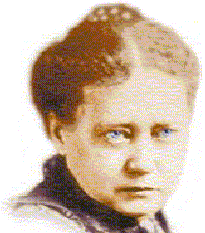
H P Blavatsky
Español:- La Clave de la Teosofía
Português:-
A Chave Para Teosofia
Dedicated
by "H.P.B." To all her Pupils, That They may Learn and Teach in their
turn.
The
Key to Theosophy
A
Clear Exposition in the Form of Question and Answer
of
the Ethics, Science, and Philosophy for the Study of Which The Theosophical
Society has been Founded.
Preface
The
purpose of this book is exactly expressed in its title, The Key to
Theosophy,
and needs but few words of explanation. It is not a complete or
exhaustive
textbook of Theosophy, but only a key to unlock the door that leads
to
the deeper study. It traces the broad outlines of the Wisdom-Religion, and
explains
its fundamental principles; meeting, at the same time, the various
objections
raised by the average Western inquirer, and endeavouring to present
unfamiliar
concepts in a form as simple and in language as clear as possible.
That
it should succeed in making Theosophy intelligible without mental effort on
the
part of the reader, would be too much to expect; but it is hoped that the
obscurity
still left is of the thought and not of the language, is due to depth
and
not to confusion. To the mentally lazy or obtuse, Theosophy must remain a
riddle;
for in the world mental as in the world spiritual each man must progress
by
his own efforts. The writer cannot do the reader's thinking for him, nor
would
the latter be any the better off if such vicarious thought were possible.
The
need for such an exposition as the present has long been felt among those
interested
in the Theosophical Society and its work, and it is hoped that it
will
supply information, as free as possible from technicalities, to many whose
attention
has been awakened, but who, as yet, are merely puzzled and not
convinced.
Some
care has been taken in disentangling some part of what is true from what is
false
in Spiritualistic teachings as to the postmortem life, and to showing the
true
nature of Spiritualistic phenomena. Previous explanations of a similar kind
have
drawn much wrath upon the writer's devoted head; the Spiritualists, like
too
many others, preferring to believe what is pleasant rather than what is
true,
and becoming very angry with anyone who destroys an agreeable delusion.
For
the past year Theosophy has been the target for every poisoned arrow of
Spiritualism,
as though the possessors of a half truth felt more antagonism to
the
possessors of the whole truth than those who had no share to boast of.
Very
hearty thanks are due from the author to many Theosophists who have sent
suggestions
and questions, or have otherwise contributed help during the writing
of
this book. The work will be the more useful for their aid, and that will be
their
best reward.
H.P.
Blavatsky
1889
Theosophy and
The Theosophical Society
The Meaning
of the Name
Q.
Theosophy and its doctrines are often referred to as a newfangled religion.
Is
it a religion?
A.
It is not. Theosophy is Divine Knowledge or Science.
Q.
What is the real meaning of the term?
A.
"Divine Wisdom," (Theosophia) or Wisdom of the gods, as (theogonia),
genealogy
of the gods. The word 'theos' means a god in Greek, one of the divine beings,
certainly not "God" in the sense attached in our day to the term.
Therefore,
it is not "Wisdom of God," as translated by some, but Divine Wisdom
such as that possessed by the gods. The term is many thousand years old.
Q.
What is the origin of the name?
A.
It comes to us from the Alexandrian philosophers, called lovers of truth,
Philaletheians,
from (phil) "loving," and (aletheia) "truth." The name
Theosophy
dates
from the third century of our era, and began with Ammonius Saccas and his
disciples, also called Analogeticists, who started the Eclectic Theosophical
system.
As
explained by Professor Wilder, they were called so because of their practice
of
interpreting all sacred legends and narratives, myths and mysteries, by a
rule
or principle of analogy and correspondence: so that events which were
related
as having occurred in the external world were regarded as expressing
operations
and experiences of the human soul. They were also denominated
Neo-Platonists.
Though Theosophy, or the Eclectic Theosophical system, is
generally
attributed to the third century, yet, if Diogenes Laërtius is to be
credited,
its origin is much earlier, as he attributed the system to an Egyptian
priest,
Pot-Amun, who lived in the early days of the Ptolemaic dynasty. The same author
tells us that the name is Coptic, and signifies one consecrated to Amun, the
God of Wisdom. Theosophy is the equivalent of Brahma-Vidya , divine knowledge.
Q.
What was the object of this system?
A.
First of all to inculcate certain great moral truths upon its disciples, and
all
those who were "lovers of the truth." Hence the motto adopted by the
Theosophical
Society: "There is no religion higher than truth."
Eclectic
Theosophy was divided under three heads:
1.
Belief in one absolute, incomprehensible and supreme Deity, or infinite
essence,
which is the root of all nature, and of all that is, visible and
invisible.
2.
Belief in man's eternal immortal nature, because, being a radiation of the
Universal
Soul, it is of an identical essence with it.
3.
Theurgy, or "divine work," or producing a work of gods; from theoi,
"gods,"
and
ergein, "to work."
The
term is very old, but, as it belongs to the vocabulary of the mysteries, was
not
in popular use. It was a mystic belief-practically proven by initiated
adepts
and priests-that, by making oneself as pure as the incorporeal
beings-i.e.,
by returning to one's pristine purity of nature-man could move the
gods
to impart to him Divine mysteries, and even cause them to become
occasionally
visible, either subjectively or objectively. It was the
transcendental
aspect of what is now called Spiritualism; but having been abused
and
misconceived by the populace, it had come to be regarded by some as
necromancy,
and was generally forbidden. A travestied practice of the theurgy of Iamblichus
lingers still in the ceremonial magic of some modern Cabalists.
Modern
Theosophy avoids and rejects both these kinds of magic and
"necromancy" as being very dangerous. Real divine theurgy requires an
almost superhuman purity and holiness of life; otherwise it degenerates into
mediumship or black magic. The immediate disciples of Ammonius Saccas, who was
called Theodidaktos, "god-taught"-such as Plotinus and his follower
Porphyry-rejected theurgy at first, but were finally reconciled to it through
Iamblichus, who wrote a work to that effect entitled De Mysteriis, under the
name of his own master, a famous Egyptian priest called Abammon. Ammonius
Saccas was the son of Christian parents, and, having been repelled by dogmatic
Spiritualistic Christianity from his childhood, became a Neo-Platonist, and
like J. Boëhme and other great seers and mystics, is said to have had divine
wisdom revealed to him in dreams and visions. Hence his name of Theodidaktos.
He resolved to reconcile every system of religion, and by demonstrating their
identical origin to establish one universal creed based on ethics. His life was
so blameless and pure, his learning so profound and vast, that several Church
Fathers were his secret disciples. Clemens Alexandrinus speaks very highly of
him. Plotinus, the "St. John" of Ammonius, was also a man universally
respected and esteemed, and of the most profound learning and integrity. When
thirty-nine years of age he
accompanied
the Roman Emperor Gordian and his army to the East, to be instructed by the
sages of Bactria and India. He had a School of Philosophy in Rome. Porphyry,
his disciple, whose real name was Malek (a Hellenized Jew), collected all the
writings of his master. Porphyry was himself a great author, and gave an
allegorical interpretation to some parts of Homer's writings.
The
system of meditation the Philaletheians resorted to was ecstasy, a system akin
to Indian Yoga practice. What is known of the Eclectic School is due to Origen,
Longinus, and Plotinus, the immediate disciples of Ammonius.
The
chief aim of the Founders of the Eclectic Theosophical School was one of the
three objects of its modern successor, the Theosophical Society, namely, to
reconcile
all religions, sects, and nations under a common system of ethics,
based
on eternal verities.
Q.
What have you to show that this is not an impossible dream; and that all the
world's
religions are based on the one and the same truth?
A.
Their comparative study and analysis. The "Wisdom-Religion" was one
in
antiquity;
and the sameness of primitive religious philosophy is proven to us by
the
identical doctrines taught to the Initiates during the mysteries, an
institution
once universally diffused.
All
the old worships indicate the existence of a single Theosophy anterior to
them.
The key that is to open one must open all; otherwise it cannot be the
right
key.
The Policy of
the Theosophical Society
Q.
In the days of Ammonius there were several ancient great religions, and
numerous
were the sects in Egypt and Palestine alone. How could he reconcile
them?
A.
By doing that which we again try to do now. The Neo-Platonists were a large
body,
and belonged to various religious philosophies; so do our Theosophists.
It
was under Philadelphus that Judaism established itself in Alexandria, and
forthwith
the Hellenic teachers became the dangerous rivals of the College of
Rabbis
of Babylon. As the author of The Eclectic Philosophy very pertinently
remarks:
The
Buddhist, Vedantic, and Magian systems were expounded along with the
philosophies
of Greece at that period. It was not wonderful that thoughtful men
supposed
that the strife of words ought to cease, and considered it possible to
extract
one harmonious system from these various teachings … Panaetius,
Athenagoras,
and Clement were thoroughly instructed in Platonic philosophy, and comprehended
its essential unity with the Oriental systems.
In
those days, the Jew Aristobulus affirmed that the ethics of Aristotle
represented
the esoteric teachings of the Law of Moses; Philo Judaeus endeavored to
reconcile the pentateuch with the Pythagorean and Platonic philosophy; and
Josephus proved that the Essenes of Carmel were simply the copyists and
followers of the Egyptian Therapeutae (the healers). So it is in our day.
We
can show the line of descent of every Christian religion, as of every, even the
smallest, sect. The latter are the minor twigs or shoots grown on the larger
branches;
but shoots and branches spring from the same trunk-the
wisdom-religion.
To prove this was the aim of Ammonius, who endeavored to induce Gentiles and
Christians, Jews and Idolaters, to lay aside their contention and strife,
remembering only that they were all in possession of the same truth
under
various vestments, and were all the children of a common mother. This is
the
aim of Theosophy likewise. Says Mosheim of Ammonius:
Conceiving
that not only the philosophers of Greece, but also all those of the
different
barbarian nations, were perfectly in unison with each other with
regard
to every essential point, he made it his business so to expound the
thousand
tenets of all these various sects as to show they had all originated
from
one and the same source, and tended all to one and the same end.
If
the writer on Ammonius in the Edinburgh Encyclopedia knows what he is talking
about, then he describes the modern Theosophists, their beliefs, and their
work, for he says, speaking of the Theodidaktos:
He
adopted the doctrines which were received in Egypt (the esoteric were those
of
India) concerning the Universe and the Deity, considered as constituting one
great
whole; concerning the eternity of the world … and established a system of
moral
discipline which allowed the people in general to live according to the
laws
of their country and the dictates of nature, but required the wise to exalt
their
mind by contemplation.
Q.
What is your authority for saying this of the ancient Theosophists of
Alexandria?
A.
An almost countless number of well-known writers. Mosheim, one of them, says
that:Ammonius taught that the religion of the multitude went hand-in-hand with
philosophy, and with her had shared the fate of being by degrees corrupted and
obscured with mere human conceits, superstitions, and lies; that it ought,
therefore,
to be brought back to its original purity by purging it of this dross
and
expounding it upon philosophical principles; and the whole Christ had in
view
was to reinstate and restore to its primitive integrity the wisdom of the
ancients;
to reduce within bounds the universally-prevailing dominion of
superstition;
and in part to correct, and in part to exterminate the various
errors
that had found their way into the different popular religions.
This,
again, is precisely what the modern Theosophists say. Only while the great
Philaletheian
was supported and helped in the policy he pursued by two Church
Fathers,
Clement and Athenagoras, by all the learned Rabbis of the Synagogue,
the
Academy and the Groves, and while he taught a common doctrine for all, we, his
followers on the same line, receive no recognition, but, on the contrary,
are
abused and persecuted. People 1,500 years ago are thus shown to have been
more
tolerant than they are in this enlightened century.
Q.
Was he encouraged and supported by the Church because, notwithstanding his
heresies, Ammonius taught Christianity and was a Christian?
A.
Not at all. He was born a Christian, but never accepted Church Christianity.
As
said of him by the same writer:
He
had but to propound his instructions according to the ancient pillars of
Hermes,
which Plato and Pythagoras knew before, and from them constituted their
philosophy. Finding the same in the prologue of the Gospel according to St.
John, he very properly supposed that the purpose of Jesus was to restore the
great
doctrine of wisdom in its primitive integrity. The narratives of the Bible
and
the stories of the gods he considered to be allegories illustrative of the
truth,
or else fables to be rejected. As says the Edinburgh Encyclopedia:
Moreover,
he acknowledged that Jesus Christ was an excellent man and the "friend of
God," but alleged that it was not his design entirely to abolish the
worship of demons (gods), and that his only intention was to purify the ancient
religion.
The
Wisdom-Religion, Esoteric in All Ages
Q.
Since Ammonius never committed anything to writing, how can one feel sure
that
such were his teachings?
A.
Neither did Buddha, Pythagoras, Confucius, Orpheus, Socrates, or even Jesus,
leave
behind them any writings. Yet most of these are historical personages, and
their
teachings have all survived. The disciples of Ammonius (among whom Origen and
Herennius) wrote treatises and explained his ethics. Certainly the latter are
as historical, if not more so, than the Apostolic writings. Moreover, his
pupils-Origen,
Plotinus, and Longinus (counselor of the famous Queen
Zenobia)-have
all left voluminous records of the Philaletheian System-so far, at
all
events, as their public profession of faith was known, for the school was
divided
into exoteric and esoteric teachings.
Q.
How have the latter tenets reached our day, since you hold that what is
properly
called the wisdom-religion was esoteric?
A.
The wisdom-religion was ever one, and being the last word of possible human
knowledge, was, therefore, carefully preserved. It preceded by long ages the
Alexandrian Theosophists, reached the modern, and will survive every other
religion
and philosophy.
Q.
Where and by whom was it so preserved?
A.
Among Initiates of every country; among profound seekers after truth-their
disciples;
and in those parts of the world where such topics have always been
most
valued and pursued: in India, Central Asia, and Persia.
Q.
Can you give me some proofs of its esotericism?
A.
The best proof you can have of the fact is that every ancient religious, or
rather
philosophical, cult consisted of an esoteric or secret teaching, and an
exoteric
(outward public) worship. Furthermore, it is a well-known fact that the
mysteries
of the ancients comprised with every nation the "greater" (secret)
and
"Lesser"
(public) mysteries-e.g., in the celebrated solemnities called the
Eleusinia,
in Greece. From the Hierophants of Samothrace, Egypt, and the
initiated
Brahmins of the India of old, down to the later Hebrew Rabbis, all
preserved,
for fear of profanation, their real bona fide beliefs secret. The
Jewish
Rabbis called their secular religious series the Merkabah(the exterior
body),
"the vehicle," or, the covering which contains the hidden soul-i.e.,
their
highest secret knowledge. Not one of the ancient nations ever imparted
through
its priests its real philosophical secrets to the masses, but allotted
to
the latter only the husks. Northern Buddhism has its "greater" and
its
"lesser"
vehicle, known as the Mahayana, the esoteric, and the Hinayana, the
exoteric,
Schools. Nor can you blame them for such secrecy; for surely you would not
think of feeding your flock of sheep on learned dissertations on botany instead
of on grass?
Pythagoras
called his Gnosis "the knowledge of things that are," or [translit.
Greek] "he gnosis ton onton" and preserved that knowledge for his
pledged disciples only: for those who could digest such mental food and feel
satisfied; and he pledged them to silence and secrecy. Occult alphabets and
secret ciphers are the development of the old Egyptian hieratic writings, the
secret of which was, in the days of old, in the possession only of the
Hierogrammatists, or initiated Egyptian priests. Ammonius Saccas, as his
biographers tell us, bound his pupils by oath not to divulge his higher doctrines
except to those who had already been instructed in preliminary knowledge, and
who were also bound by a pledge. Finally, do we not find the same even in early
Christianity, among the Gnostics, and even in the teachings of Christ?
Did
he not speak to the multitudes in parables which had a two-fold
meaning,
and explain his reasons only to his disciples? He says:
To
you it is given to know the mysteries of the kingdom of heaven; but unto them
that are without, all these things are done in parables The Essenes of Judea
and Carmel made similar distinctions, dividing their adherents into neophytes,
brethren, and the perfect, or those initiated.Examples might be brought from
every country to this effect.
Q.
Can you attain the "Secret Wisdom" simply by study? Encyclopedias
defineTheosophy
pretty much as Webster's Dictionary does, i.e.,as
…
supposed intercourse with God and superior spirits, and consequent attainment
of superhuman knowledge by physical means and chemical processes.Is this so?
A.
I think not. Nor is there any lexicographer capable of explaining, whether to
himself
or others, how superhuman knowledge can be attained by physical or
chemical
processes. Had Webster said "by metaphysical and alchemical
processes," the definition would be approximately correct: as it is, it is
absurd. Ancient Theosophists claimed, and so do the modern, that the infinite
cannot be known by the finite-i.e., sensed by the finite Self-but that the
divine essence could be communicated to the higher Spiritual Self in a state of
ecstasy. This condition can hardly be attained, like hypnotism, by
"physical and chemical means."
Q.
What is your explanation of it?
A.
Real ecstasy was defined by Plotinus as "the liberation of the mind from
its
finite
consciousness, becoming one and identified with the infinite." This is
the
highest condition, says Professor Wilder, but not one of permanent duration,
and
it is reached only by the very, very few. It is, indeed, identical with that
state
which is known in India as Samadhi. The latter is practiced by the Yogis,
who
facilitate it physically by the greatest abstinence in food and drink, and
mentally
by an incessant endeavor to purify and elevate the mind. Meditation is
silent
and unuttered prayer, or, as Plato expressed it,
…
the ardent turning of the soul toward the divine; not to ask any particular
good
(as in the common meaning of prayer), but for good itself-for the universal
Supreme
Good …-of which we are a part on earth, and out of the essence of which we have
all emerged. Therefore, adds Plato, Remain silent in the presence of the divine
ones, till they remove the clouds from thy eyes and enable thee to see by the
light which issues from themselves, not what appears as good to thee, but what
is intrinsically good.
This
is what the scholarly author of The Eclectic Philosophy, Professor
Alexander
Wilder, F.T.S., describes as "spiritual photography":
The
soul is the camera in which facts and events, future, past, and present, are
alike
fixed; and the mind becomes conscious of them. Beyond our everyday world of
limits all is one day or state-the past and future comprised in the present.
…
Death is the last ecstasis on earth. Then the soul is freed from the
constraint
of the body, and its nobler part is united to higher nature and
becomes
partaker in the wisdom and foreknowledge of the higher beings.
Real
Theosophy is, for the mystics, that state which Apollonius of Tyana was
made
to describe thus:
I
can see the present and the future as in a clear mirror. The sage need not
wait
for the vapors of the earth and the corruption of the air to foresee events
…
The theoi, or gods, see the future; common men the present, sages that which is
about to take place.
"The
Theosophy of the Sages" he speaks of is well expressed in the assertion,
"The
Kingdom of God is within us."
Q.
Theosophy, then, is not, as held by some, a newly devised scheme?
A.
Only ignorant people can thus refer to it. It is as old as the world, in its
teachings
and ethics, if not in name, as it is also the broadest and most
catholic
system among all.
Q.
How comes it, then, that Theosophy has remained so unknown to the nations of
the Western Hemisphere? Why should it have been a sealed book to races
confessedly
the most cultured and advanced?
A.
We believe there were nations as cultured in days of old and certainly more
spiritually
"advanced" than we are. But there are several reasons for this
willing
ignorance. One of them was given by St. Paul to the cultured Athenians-a
loss,
for long centuries, of real spiritual insight, and even interest, owing to
their
too great devotion to things of sense and their long slavery to the dead
letter
of dogma and ritualism. But the strongest reason for it lies in the fact
that
real Theosophy has ever been kept secret.
Q.
You have brought forward proofs that such secrecy has existed; but what was the
real cause for it?
A.
The causes for it were:
1.
The perversity of average human nature and its selfishness, always tending to
the
gratification of personal desires to the detriment of neighbors arid next of
kin.
Such people could never be entrusted with divine secrets.
2.
Their unreliability to keep the sacred and divine knowledge from desecration.
It
is the latter that led to the perversion of the most sublime truths and
symbols,
and to the gradual transformation of things spiritual into
anthropomorphic,
concrete, and gross imagery-in other words, to the dwarfing of the god-idea and
to idolatry.
Theosophy is
Not Buddhism
Q.
You are often spoken of as "Esoteric Buddhists." Are you then all
followers
of
Gautama Buddha?
A.
No more than musicians are all followers of Wagner. Some of us are Buddhists by
religion; yet there are far more Hindus and Brahmins than Buddhists among us,
and more Christian-born Europeans and Americans than converted Buddhists. The
mistake has arisen from a misunderstanding of the real meaning of the title of
Mr. Sinnett's excellent work, Esoteric Buddhism, which last word ought to have
been spelt with one, instead of two, d's, as then Budhism would have meant what
it was intended for, merely "Wisdom-ism" (Bodha, bodhi,
"intelligence," "wisdom") instead of Buddhism, Gautama's
religious philosophy. Theosophy, as already said, is the wisdom-religion.
Q.
What is the difference between Buddhism, the religion founded by the Prince
of
Kapilavastu, and Budhism, the "Wisdomism" which you say is synonymous
with Theosophy?
A.
Just the same difference as there is between the secret teachings of Christ,
which
are called "the mysteries of the Kingdom of Heaven," and the later
ritualism
and dogmatic theology of the Churches and Sects. Buddha means the
"Enlightened"
by Bodha, or understanding, Wisdom. This has passed root and
branch
into the esoteric teachings that Gautama imparted to his chosen Arhats
only.
Q.
But some Orientalists deny that Buddha ever taught any esoteric doctrine at
all?
A.
They may as well deny that Nature has any hidden secrets for the men of
science.
Further on I will prove it by Buddha's conversation with his disciple
Ananda.
His esoteric teachings were simply the Gupta-Vidya(secret knowledge) of the
ancient Brahmins, the key to which their modern successors have, with few
exceptions, completely lost. And this Vidya has passed into what is now known
as the inner teachings of the Mahayana school of Northern Buddhism. Those who
deny it are simply ignorant pretenders to Orientalism. I advise you to read the
Rev. Mr. Edkin's Chinese Buddhism-especially the chapters on the Exoteric and
Esoteric schools and teachings-and then compare the testimony of the whole
ancient world upon the subject.
Q.
But are not the ethics of Theosophy identical with those taught by Buddha?
A.
Certainly, because these ethics are the soul of the Wisdom-Religion, and were
once the common property of the initiates of all nations. But Buddha was the
first to embody these lofty ethics in his public teachings, and to make them
the foundation and the very essence of his public system. It is herein that
lies the
immense
difference between exoteric Buddhism and every other religion. For while in
other religions ritualism and dogma hold the first and most important place, in
Buddhism it is the ethics which have always been the most insisted upon. This
accounts for the resemblance, amounting almost to identity, between the ethics
of Theosophy and those of the religion of Buddha.
Q.
Are there any great points of difference?
A.
One great distinction between Theosophy and exoteric Buddhism is that the
latter,
represented by the Southern Church, entirely denies (a) the existence of
any
Deity, and (b) any conscious postmortem life, or even any self-conscious
surviving
individuality in man. Such at least is the teaching of the Siamese
sect,
now considered as the purest form of exoteric Buddhism. And it is so, if
we
refer only to Buddha's public teachings; the reason for such reticence on his
part
I will give further on. But the schools of the Northern Buddhist Church,
established
in those countries to which his initiated Arhats retired after the
Master's
death, teach all that is now called Theosophical doctrines, because
they
form part of the knowledge of the initiates-thus proving how the truth has
been
sacrificed to the dead-letter by the too-zealous orthodoxy of Southern
Buddhism.
But how much grander and more noble, more philosophical and
scientific,
even in its dead-letter, is this teaching than that of any other
Church
or religion. Yet Theosophy is not Buddhism.
Exoteric and Esoteric
Theosophy
What the
Modern Theosophical Society is Not
Q.
Your doctrines, then, are not a revival of Buddhism, nor are they entirely
copied
from the Neo-Platonic Theosophy?
A.
They are not. But to these questions I cannot give you a better answer than
by
quoting from a paper read on "Theosophy" by Dr. J.D. Buck, F.T.S., No
living Theosophist has better expressed and understood the real essence of
Theosophy than our honored friend Dr. Buck:
The
Theosophical Society was organized for the purpose of promulgating the
Theosophical
doctrines, and for the promotion of the Theosophic life. The
present
Theosophical Society is not the first of its kind. I have a volume
entitled:
Theosophical Transactions of the Philadelphian Society, published in
London
in 1697; and another with the following title: Introduction to Theosophy, or
the Science of the Mystery of Christ; that is, of Deity, Nature, and Creature,
embracing the philosophy of all the working powers of life, magical and
spiritual, ant forming a practical guide to the most sublime purity, sanctity,
and evangelical perfection; also to the attainment of divine vision, and the
holy angelic arts, potencies, and other prerogatives of the regeneration.
-published
in London in 1855. The following is the dedication of this volume:
To
the students of Universities, Colleges, and schools of Christendom: To
Professors
of Metaphysical, Mechanical, and Natural Science in all its forms: To
men
and women of Education generally, of fundamental orthodox faith: To Deists,
Arians, Unitarians, Swedenborgians, and other defective and ungrounded creeds,
rationalists, and skeptics of every kind: To just-minded and enlightened
Mohammedans,
Jews, and oriental Patriarch-religionists: but especially to the
gospel
minister and missionary, whether to the barbaric or intellectual peoples,
this
introduction to Theosophy, or the science of the ground and mystery of all
things,
is most humbly and affectionately dedicated. In the following year
(1856)
another volume was issued, royal octavo, of 600 pages, diamond type, of
Theosophical
Miscellanies. Of the last-named work 500 copies only were issued, for
gratuitous distribution to Libraries and Universities. These earlier
movements,
of which there were many, originated within the Church, with persons of great
piety and earnestness, and of unblemished character; and all of these writings
were in orthodox form, using the Christian expressions, and, like the writings
of the eminent Churchman William Law, would only be distinguished by the
ordinary reader for their great earnestness and piety. These were one and all
but attempts to derive and explain the deeper meanings and original import of
the Christian Scriptures, and to illustrate and unfold the Theosophic life.
These
works were soon forgotten, and are now generally unknown. They sought to reform
the clergy and revive genuine piety, and were never welcomed. That one word,
Heresy, was sufficient to bury them in the limbo of all such Utopias.
At
the time of the Reformation John Reuchlin made a similar attempt with the same
result, though he was the intimate and trusted friend of Luther. Orthodoxy
never desired to be informed and enlightened. These reformers were informed, as
was Paul by Festus, that too much learning had made them mad, and that it would
be dangerous to go farther. Passing by the verbiage, which was partly a matter
of habit and education with these
writers, and partly due to religious restraint through secular power, and
coming to the core of the matter, these writings were Theosophical in the
strictest sense, and pertain solely to man's knowledge of his own nature and
the higher life of the soul. The present Theosophical Movement has sometimes
been declared to be an attempt to convert Christendom to Buddhism, which means
simply that the word Heresy has lost its terrors and relinquished its power.
Individuals in every age have more or less clearly apprehended the Theosophical
doctrines and wrought them into the fabric of their lives. These doctrines
belong exclusively to no religion, and are confined to no society or time. They
are the birthright of every human soul.
Such
a thing as orthodoxy must be wrought out by each individual according to his
nature and his needs, and according to his varying experience. This may explain
why those who have imagined Theosophy to be a new religion have hunted in vain
for its creed and its ritual. Its creed is Loyalty to Truth, and its ritual
"To honor every truth by use."
How
little this principle of Universal Brotherhood is understood by the masses
of
mankind, how seldom its transcendent importance is recognized, may be seen in
the diversity of opinion and fictitious interpretations regarding the
Theosophical
Society. This Society was organized on this one principle, the
essential
Brotherhood of Man, as herein briefly outlined and imperfectly set
forth.
It has been assailed as Buddhist and anti-Christian, as though it could
be
both these together, when both Buddhism and Christianity, as set forth by
their
inspired founders, make brotherhood the one essential of doctrine and of
life.
Theosophy has been also regarded as something new under the sun, or, at
best
as old mysticism masquerading under a new name.
While
it is true that many Societies founded upon, and united to support, the
principles of altruism, or essential brotherhood, have borne various names, it
is also true that many have also been called Theosophic, and with principles
and aims as the present society bearing that name. With these societies, one and
all, the essential doctrine has been the same, and all else has been
incidental, though this does not obviate the fact that many persons are
attracted to the incidentals who overlook or ignore the essentials.
No
better or more explicit answer-by a man who is one of our most esteemed and
earnest Theosophists-could be given to your questions.
Q.
Which system do you prefer or follow, in that case, besides Buddhist ethics?
A.
None, and all. We hold to no religion, as to no philosophy in particular: we
cull
the good we find in each. But here, again, it must be stated that, like all
other
ancient systems, Theosophy is divided into Exoteric and Esoteric Sections.
Q.
What is the difference?
A.
The members of the Theosophical Society at large are free to profess whatever
religion or philosophy they like, or none if they so prefer, provided they are
in sympathy with, and ready to carry out one or more of the three objects of
the Association. The Society is a philanthropic and scientific body for the
propagation of the idea of brotherhood on practical instead of theoretical
lines.
The Fellows may be Christians or Muslims, Jews or Parsees, Buddhists or
Brahmins,
Spiritualists or Materialists, it does not matter; but every member
must
be either a philanthropist, or a scholar, a searcher into ryan and other
old
literature, or a psychic student. In short, he has to help, if he can, in
the
carrying out of at least one of the objects of the program. Otherwise he has
no
reason for becoming a "Fellow." Such are the majority of the exoteric
Society,
composed of "attached" and "unattached" members. These may,
or may not, become Theosophists de facto. Members they are, by virtue of their
having joined the Society; but the latter cannot make a Theosophist of one who
has no sense for the divine fitness of things, or of him who understands
Theosophy in his own-if the expression may be used-sectarian and egotistic way.
"Handsome is, as handsome does" could be paraphrased in this case and
be made to run: "Theosophist is, who Theosophy does."
Theosophists
and Members of the T.S.
Q.
This applies to lay members, as I understand. And what of those who pursue
the
esoteric study of Theosophy; are they the real Theosophists?
A.
Not necessarily, until they have proven themselves to be such. They have
entered
the inner group and pledged themselves to carry out, as strictly as they
can,
the rules of the occult body. This is a difficult undertaking, as the
foremost
rule of all is the entire renunciation of one's personality-i.e., a
pledged
member has to become a thorough altruist, never to think of himself, and to
forget his own vanity and pride in the thought of the good of his
fellow-creatures,
besides that of his fellow-brothers in the esoteric circle. He
has
to live, if the esoteric instructions shall profit him, a life of abstinence
in
everything, of self-denial and strict morality, doing his duty by all men.
The
few real Theosophists in the T.S. are among these members.
A.
This does not imply that outside of the T.S. and the inner circle, there are
no
Theosophists; for there are, and more than people know of; certainly far more
than are found among the lay members of the T.S.
Q.
Then what is the good of joining the so-called Theosophical Society in that
case?
Where is the incentive?
A.
None, except the advantage of getting esoteric instructions, the genuine
doctrines
of the "Wisdom-Religion," and if the real program is carried out,
deriving
much help from mutual aid and sympathy. Union is strength and harmony, and
well-regulated simultaneous efforts produce wonders. This has been the secret
of all associations and communities since mankind existed.
Q.
But why could not a man of well-balanced mind and singleness of purpose, one,
say, of indomitable energy and perseverance, become an Occultist and even an
Adept if he works alone?
A.
He may; but there are ten thousand chances against one that he will fail. For
one
reason out of many others, no books on Occultism or Theurgy exist in our day
which give out the secrets of alchemy or medieval Theosophy in plain language.
All
are symbolical or in parables; and as the key to these has been lost for
ages
in the West, how can a man learn the correct meaning of what he is reading
and
studying? Therein lies the greatest danger, one that leads to unconscious
black
magic or the most helpless mediumship. He who has not an Initiate for a
master
had better leave the dangerous study alone. Look around you and observe.
While
two-thirds of civilized society ridicule the mere notion that there is
anything
in Theosophy, Occultism, Spiritualism, or in the Cabala, the other
third
is composed of the most heterogeneous and opposite elements. Some believe in
the mystical, and even in the supernatural (!), but each believes in his own
way. Others will rush single-handed into the study of the Cabala, Psychism,
Mesmerism,
Spiritualism, or some form or another of Mysticism. Result: no two
men
think alike, no two are agreed upon any fundamental occult principles,
though
many are those who claim for themselves the ultima thule of knowledge,
and
would make outsiders believe that they are full-blown adepts. Not only is
there
no scientific and accurate knowledge of Occultism accessible in the
West-not
even of true astrology, the only branch of Occultism which, in its
exoteric
teachings, has definite laws and a definite system-but no one has any
idea
of what real Occultism means. Some limit ancient wisdom to the cabala and
the
Jewish Zohar, which each interprets in his own way according to the
dead-letter
of the Rabbinical methods. Others regard Swedenborg or Boëhme as the ultimate
expressions of the highest wisdom; while others again see in mesmerism the
great secret of ancient magic. One and all of those who put their theory into
practice are rapidly drifting, through ignorance, into black magic. Happy are
those who escape from it, as they have neither test nor criterion by which they
can distinguish between the true and the false.
Q.
Are we to understand that the inner group of the T.S. claims to learn what it
does
from real initiates or masters of esoteric wisdom?
A.
Not directly. The personal presence of such masters is not required. Suffice
it
if they give instructions to some of those who have studied under their
guidance
for years, and devoted their whole lives to their service. Then, in
turn,
these can give out the knowledge so imparted to others, who had no such
opportunity.
A portion of the true sciences is better than a mass of undigested
and
misunderstood learning. An ounce of gold is worth a ton of dust.
Q.
But how is one to know whether the ounce is real gold or only a counterfeit?
A.
A tree is known by its fruit, a system by its results. When our opponents are
able
to prove to us that any solitary student of Occultism throughout the ages
has
become a saintly adept like Ammonius Saccas, or even a Plotinus, or a
Theurgist
like Iamblichus, or achieved feats such as are claimed to have been
done
by St. Germain, without any master to guide him, and all this without being
a
medium, a self-deluded psychic, or a charlatan-then shall we confess ourselves
mistaken.
But till then, Theosophists prefer to follow the proven natural law of
the
tradition of the Sacred Science. There are mystics who have made great
discoveries
in chemistry and physical sciences, almost bordering on alchemy and Occultism;
others who, by the sole aid of their genius, have rediscovered
portions,
if not the whole, of the lost alphabets of the "Mystery language,"
and
are,
therefore, able to read correctly Hebrew scrolls; others still, who, being
seers,
have caught wonderful glimpses of the hidden secrets of Nature. But all
these
are specialists. One is a theoretical inventor, another a Hebrew, i.e.,a
Sectarian
Cabalist, a third a Swedenborg of modern times, denying all and
everything
outside of his own particular science or religion. Not one of them
can
boast of having produced a universal or even a national benefit thereby, not
even
to himself. With the exception of a few healers-of that class which the
Royal
College of Physicians or Surgeons would call quacks-none have helped with their
science Humanity, nor even a number of men of the same community.
Where
are the Chaldeans of old, those who wrought marvelous cures, "not by
charms but by simples"? Where is an Apollonius of Tyana, who healed the
sick and raised the dead under any climate and circumstances? We know some
specialists of the former class in
Q.
Is the production of such healing adepts the aim of Theosophy?
A.
Its aims are several; but the most important of all are those which are
likely
to lead to the relief of human suffering under any or every form, moral
as
well as physical. And we believe the former to be far more important than the
latter.
Theosophy has to inculcate ethics; it has to purify the soul, if it
would
relieve the physical body, whose ailments, save cases of accidents, are
all
hereditary. It is not by studying Occultism for selfish ends, for the
gratification
of one's personal ambition, pride, or vanity, that one can ever
reach
the true goal: that of helping suffering mankind. Nor is it by studying
one
single branch of the esoteric philosophy that a man becomes an Occultist,
but
by studying, if not mastering, them all.
Q.
Is help, then, to reach this most important aim, given only to those who
study
the esoteric sciences?
A.
Not at all. Every lay member is entitled to general instruction if he only
wants
it; but few are willing to become what is called "working members,"
and
most
prefer to remain the drones of Theosophy. Let it be understood that private research
is encouraged in the T.S., provided it does not infringe the limit
which
separates the exoteric from the esoteric, the blind from the conscious
magic.
The
Difference Between Theosophy and Occultism
Q.
You speak of Theosophy and Occultism; are they identical?
A.
By no means. A man may be a very good Theosophist indeed, whether in or
outsideof
the Society, without being in any way an Occultist. But no one can be
a
true Occultist without being a real Theosophist; otherwise he is simply a
black
magician, whether conscious or unconscious.
Q.
What do you mean?
A.
I have said already that a true Theosophist must put in practice the loftiest
moral
ideal, must strive to realize his unity with the whole of humanity, and
work
ceaselessly for others. Now, if an Occultist does not do all this, he must
act
selfishly for his own personal benefit; and if he has acquired more
practical
power than other ordinary men, he becomes forthwith a far more
dangerous
enemy to the world and those around him than the average mortal. This is clear.
Q.
Then is an Occultist simply a man who possesses more power than other people?
A.
Far more-if he is a practical and really learned Occultist, and not one only
in
name. Occult sciences are not, as described in Encyclopedias, …
those
imaginary sciences of the Middle Ages which related to the supposed action or
influence of Occult qualities or supernatural powers, as alchemy, magic,
necromancy, and astrology …
-for
they are real, actual, and very dangerous sciences. They teach the secret
potency
of things in Nature, developing and cultivating the hidden powers
"latent
in man," thus giving him tremendous advantages over more ignorant
mortals.
Hypnotism, now become so common and a subject of serious scientific
inquiry,
is a good instance in point. Hypnotic power has been discovered almost
by
accident, the way to it having been prepared by mesmerism; and now an able
hypnotist
can do almost anything with it, from forcing a man, unconsciously to
himself,
to play the fool, to making him commit a crime-often by proxy for the
hypnotist,
and for the benefit of the latter. Is not this a terrible power if
left
in the hands of unscrupulous persons? And please to remember that this is
only
one of the minor branches of Occultism.
Q.
But are not all these Occult sciences, magic, and sorcery, considered by the
most
cultured and learned people as relics of ancient ignorance and
superstition?
A.
Let me remind you that this remark of yours cuts both ways. The "most
cultured
and learned" among you regard also Christianity and every other
religion
as a relic of ignorance and superstition. People begin to believe now,
at
any rate, in hypnotism, and some-even of the most cultured-in Theosophy and
phenomena.
But who among them, except preachers and blind fanatics, will confess to a
belief in Biblical miracles? And this is where the point of difference
comes
in. There are very good and pure Theosophists who may believe in the
supernatural,
divine miracles included, but no Occultist will do so.
For
an Occultist practices scientificTheosophy, based on accurate knowledge of
Nature's secret workings; but a Theosophist, practicing the powers called
abnormal, minus the light of Occultism, will simply tend toward a dangerous
form of mediumship, because, although holding to Theosophy and its highest
conceivable code of ethics, he practices it in the dark, on sincere but blind
faith.
Anyone,
Theosophist or Spiritualist, who attempts to cultivate one of the branches of
Occult science-e.g.,Hypnotism, Mesmerism, or even the secrets of producing
physical phenomena, etc.-without the knowledge of the philosophic rationale of
those powers, is like a rudderless boat launched on a stormy ocean.
The
Difference Between Theosophy and Spiritualism
Q.
But do you not believe in Spiritualism?
A.
If by "Spiritualism" you mean the explanation which Spiritualists
give of
some
abnormal phenomena, then decidedly we do not. They maintain that these
manifestations
are all produced by the "spirits" of departed mortals, generally
their
relatives, who return to earth, they say, to communicate with those they
have
loved or to whom they are attached. We deny this point blank. We assert
that
the spirits of the dead cannot return to earth-save in rare and exceptional
cases,
of which I may speak later; nor do they communicate with men except by
entirely
subjective means. That which does appear objectively, is only the
phantom
of the ex-physical man. But in psychic, and so to say, "Spiritual"
Spiritualism,
we do believe, most decidedly.
Q.
Do you reject the phenomena also?
A.
Assuredly not-save cases of conscious fraud.
Q.
How do you account for them, then?
A.
In many ways. The causes of such manifestations are by no means so simple as the
Spiritualists would like to believe. Foremost of all, the deus ex machina of
the
so-called "materializations" is usually the astral body or
"double" of the
medium
or of someone present. This astral body is also the producer or operating force
in the manifestations of slate-writing, "Davenport"-like
manifestations, and so on.
Q.
You say usually-then what is it that produces the rest?
A.
That depends on the nature of the manifestations. Sometimes the astral
remains,
the Kamalokic "shells" of the vanished personalities that were; at
other
times, Elementals. Spirit is a word of manifold and wide significance. I
really
do not know what Spiritualists mean by the term; but what we understand
them
to claim is that the physical phenomena are produced by the reincarnating
Ego,
the Spiritual and immortal "individuality." And this hypothesis we
entirely
reject.
The Conscious Individuality of the disembodied cannot materialize, nor
can
it return from its own mental Devachanic sphere to the plane of terrestrial
objectivity.
Q.
But many of the communications received from the "spirits" show not
only
intelligence,
but a knowledge of facts not known to the medium, and sometimes
even
not consciously present to the mind of the investigator, or any of those
who
compose the audience.
A.
This does not necessarily prove that the intelligence and knowledge you speak
of belong to spirits, or emanate from disembodied souls. Somnambulists have
been known to compose music and poetry and to solve mathematical problems while
in their trance state, without having ever learnt music or mathematics. Others,
answered intelligently to questions put to them, and even, in several cases,
spoke languages, such as Hebrew and Latin, of which they were entirely ignorant
when awake-all this in a state of profound sleep. Will you, then, maintain that
this was caused by "spirits"?
Q.
But how would you explain it?
A.
We assert that the divine spark in man being one and identical in its essence
with
the Universal Spirit, our "spiritual Self" is practically omniscient,
but
that
it cannot manifest its knowledge owing to the impediments of matter. Now
the
more these impediments are removed, in other words, the more the physical
body
is paralyzed, as to its own independent activity and consciousness, as in
deep
sleep or deep trance, or, again, in illness, the more fully can the inner
Self
manifest on this plane. This is our explanation of those truly wonderful
phenomena
of a higher order, in which undeniable intelligence and knowledge are
exhibited.
As to the lower order of manifestations, such as physical phenomena
and
the platitudes and common talk of the general "spirit," to explain
even the
most
important of the teachings we hold upon the subject would take up more
space
and time than can be allotted to it at present. We have no desire to
interfere
with the belief of the Spiritualists any more than with any other
belief.
The responsibility must fall on the believers in "spirits." And at
the
present
moment, while still convinced that the higher sort of manifestations
occur
through the disembodied souls, their leaders and the most learned and
intelligent
among the Spiritualists are the first to confess that not all the
phenomena
are produced by spirits. Gradually they will come to recognize the
whole
truth; but meanwhile we have no right nor desire to proselytize them to
our
views. The less so, as in the cases of purely psychic and spiritual
manifestations
we believe in the intercommunication of the spirit of the living
man
with that of disembodied personalities.
We
say that in such cases it is not the spirits of the dead who descend on
earth,
but the spirits of the living that ascend to the pure spiritual Souls. In
truth
there is neither ascending nor descending, but a change of state or
condition
for the medium. The body of the latter becoming paralyzed, or
"entranced,"
the spiritual Ego is free from its trammels, and finds itself on
the
same plane of consciousness with the disembodied spirits. Hence, if there is
any
spiritual attraction between the two they can communicate, as often occurs
in
dreams. The difference between a mediumistic and a non-sensitive nature is
this:
the liberated spirit of a medium has the opportunity and facility of
influencing
the passive organs of its entranced physical body, to make them act,
speak,
and write at its will. The Ego can make it repeat, echo-like, and in the
human
language, the thoughts and ideas of the disembodied entity, as well as its
own.
But the non-receptive or non-sensitive organism of one who is very positive
cannot be so influenced. Hence, although there is hardly a human being whose
Ego does not hold free intercourse, during the sleep of his body, with those
whom it loved and lost, yet, on account of the positiveness and non-receptivity
of its physical envelope and brain, no recollection, or a very dim, dream-like
remembrance, lingers in the memory of the person once awake.
Q.
This means that you reject the philosophy of Spiritualism in toto?
A.
If by "philosophy" you mean their crude theories, we do. But they
have no
philosophy,
in truth. Their best, their most intellectual and earnest defenders
say
so. Their fundamental and only unimpeachable truth, namely, that phenomena
occur through mediums controlled by invisible forces and intelligences-no one,
except a blind materialist of the "Huxley big toe" school, will or
can deny.
With
regard to their philosophy, however, let me read to you what the able
editor
of Light, than whom the Spiritualists will find no wiser nor more devoted
champion,
says of them and their philosophy.
This
is what "M.A. Oxon," one of the very few philosophical Spiritualists,
writes,
with respect to their lack of organization and blind bigotry:
It
is worthwhile to look steadily at this point, for it is of vital moment. We
have
an experience and a knowledge beside which all other knowledge is
comparatively
insignificant. The ordinary Spiritualist waxes wroth if anyone
ventures
to impugn his assured knowledge of the future and his absolute
certainty
of the life to come. Where other men have stretched forth feeble hands
groping
into the dark future, he walks boldly as one who has a chart and knows
his
way. Where other men have stopped short at a pious aspiration or have been
content
with a hereditary faith, it is his boast that he knows what they only
believe,
and that out of his rich stores he can supplement the fading faiths
built
only upon hope. He is magnificent in his dealings with man's most
cherished
expectations. He seems to say:
You
hope for that which I can demonstrate. You have accepted a traditional
belief
in what I can experimentally prove according to the strictest scientific
method.
The old beliefs are fading; come out from them and be separate. They
contain
as much falsehood as truth. Only by building on a sure foundation of
demonstrated
fact can your superstructure be stable. All round you old faiths
are
toppling. Avoid the crash and get you out.
When
one comes to deal with this magnificent person in a practical way, what is
the
result? Very curious and very disappointing. He is so sure of his ground
that
he takes no trouble to ascertain the interpretation which others put upon
his
facts. The wisdom of the ages has concerned itself with the explanation of
what
he rightly regards as proven; but he does not turn a passing glance on its
researches.
He does not even agree altogether with his brother Spiritualist. It
is
the story over again of the old Scotch body who, together with her husband,
formed
a "kirk." They had exclusive keys to Heaven, or, rather, she had, for
she
was
"na certain aboot Jamie." So the infinitely divided and subdivided
and
re-subdivided
sects of Spiritualists shake their heads, and are "na certain
aboot"
one another. Again, the collective experience of mankind is solid and
unvarying
on this point that union is strength, and disunion a source of
weakness
and failure. Shoulder to shoulder, drilled and disciplined, a rabble
becomes
an army, each man a match for a hundred of the untrained men that may be
brought against it. Organization in every department of man's work means
success, saving of time and labor, profit and development. Want of method, want
of plan, haphazard work, fitful energy, undisciplined effort-these mean
bungling failure. The voice of humanity attests the truth. Does the
Spiritualist accept the verdict and act on the conclusion? Verily, no. He
refuses to organize. He is a law unto himself, and a thorn in the side of his
neighbors.
Q.
I was told that the Theosophical Society was originally founded to crush
Spiritualism
and belief in the survival of the individuality in man?
A.
You are misinformed. Our beliefs are all founded on that immortal
individuality.
But then, like so many others, you confuse personality with
individuality.
Your Western psychologists do not seem to have established any
clear
distinction between the two. Yet it is precisely that difference which
gives
the keynote to the understanding of Eastern philosophy, and which lies at
the
root of the divergence between the Theosophical and Spiritualistic
teachings.
And though it may draw upon us still more the hostility of some
Spiritualists,
yet I must state here that it is Theosophy which is the true and
unalloyed
Spiritualism, while the modern scheme of that name is, as now
practiced
by the masses, simply transcendental materialism.
Q.
Please explain your idea more clearly.
A.
What I mean is that though our teachings insist upon the identity of spirit
and
matter, and though we say that spirit is potential matter, and matter simply
crystallized
spirit (e.g., as ice is solidified steam), yet since the original
and
eternal condition of allis not spirit but meta-spirit, so to speak, we
maintain
that the term spirit can only be applied to the true individuality.
Q.
But what is the distinction between this "true individuality" and the
"I" or
"Ego"
of which we are all conscious?
A.
Before I can answer you, we must argue upon what you mean by "I" or
"Ego." We distinguish between the simple fact of self-consciousness,
the simple feeling that "I am I," and the complex thought that
"I am Mr. Smith" or "Mrs. Brown." Believing as we do in a
series of births for the same Ego, or reincarnation, this distinction is the
fundamental pivot of the whole idea. You see "Mr. Smith" really means
a long series of daily experiences strung together by the thread of memory, and
forming what Mr. Smith calls "himself." But none of these
"experiences" are really the "I" or the Ego, nor do they
give "Mr. Smith" the feeling that he is himself, for he forgets the
greater part of his daily
experiences,
and they produce the feeling of Egoity in him only while they last.
We
Theosophists, therefore, distinguish between this bundle of
"experiences,"
which
we call the false (because so finite and evanescent)personality, and that
element
in man to which the feeling of "I am I" is due. It is this "I am
I"
which
we call the true individuality; and we say that this "Ego" or
individuality
plays, like an actor, many parts on the stage of life. Let us call
every
new life on earth of the same Egoa night on the stage of a theater. One
night
the actor, or "Ego," appears as "Macbeth," the next as
"Shylock," the
third
as "Romeo," the fourth as "Hamlet" or "King
Lear," and so on, until he has
run
through the whole cycle of incarnations. The Ego begins his life-pilgrimage
as
a sprite, an "Ariel," or a "Puck"; he plays the part of a
super, is a
soldier,
a servant, one of the chorus; rises then to "speaking parts," plays
leading
roles, interspersed with insignificant parts, till he finally retires
from
the stage as "Prospero," the magician.
Q.
I understand. You say, then, that this true Ego cannot return to earth after
death.
But surely the actor is at liberty, if he has preserved the sense of his
individuality,
to return if he likes to the scene of his former actions?
A.
We say not, simply because such a return to earth would be incompatible with
any state of unalloyed bliss after death, as I am prepared to prove. We say
that man suffers so much unmerited misery during his life, through the fault of
others
with whom he is associated, or because of his environment, that he is
surely
entitled to perfect rest and quiet, if not bliss, before taking up again
the
burden of life. However, we can discuss this in detail later.
Why is
Theosophy Accepted?
Q.
I understand to a certain extent; but I see that your teachings are far more
complicated
and metaphysical than either Spiritualism or current religious
thought.
Can you tell me, then, what has caused this system of Theosophy which you
support to arouse so much interest and so much animosity at the same time?
A.
There are several reasons for it, I believe; among other causes that may be
mentioned
is:
1.
The great reaction from the crassly materialistic theories now prevalent
among
scientific teachers.
2.
General dissatisfaction with the artificial theology of the various Christian
Churches,
and the number of daily increasing and conflicting sects.
3.
An ever-growing perception of the fact that the creeds which are so obviously
self-and
mutually-contradictory cannot be true, and that claims which are
unverified
cannot be real. This natural distrust of conventional religions is
only
strengthened by their complete failure to preserve morals and to purify
society
and the masses.
4.
A conviction on the part of many, and knowledge by a few, that there must be
somewhere
a philosophical and religious system which shall be scientific and not
merely
speculative.
5.
A belief, perhaps, that such a system must be sought for in teachings far
antedating
any modern faith.
Q.
But how did this system come to be put forward just now?
A.
Just because the time was found to be ripe, which fact is shown by the
determined
effort of so many earnest students to reach the truth, at whatever
cost
and wherever it may be concealed. Seeing this, its custodians permitted
that
some portions at least of that truth should be proclaimed. Had the
formation
of the Theosophical Society been postponed a few years longer, one
half
of the civilized nations would have become by this time rank materialists,
and
the other half anthropomorphists and phenomenalists.
Q.
Are we to regard Theosophy in any way as a revelation?
A.
In no way whatever-not even in the sense of a new and direct disclosure from
some
higher, supernatural, or, at least, superhuman beings; but only in the
sense
of an "unveiling" of old, very old, truths to minds hitherto ignorant
of
them,
ignorant even of the existence and preservation of any such archaic
knowledge.
It
has become "fashionable," especially of late, to deride the notion
that there
ever
was, in the mysteries of great and civilized peoples, such as the
Egyptians,
Greeks, or Romans, anything but priestly imposture. Even the
Rosicrucians
were no better than half lunatics, half knaves. Numerous books have been written
on them; and tyros, who had hardly heard the name a few years before, sallied
out as profound critics and Gnostics on the subject of alchemy, the
fire-philosophers, and mysticism in general. Yet a long series of the
Hierophants
of Egypt, India, Chaldea, and Arabia are known, along with the
greatest
philosophers and sages of Greece and the West, to have included under
the
designation of wisdom and divine science all knowledge, for they considered
the
base and origin of every art and science as essentially divine. Plato
regarded
the mysteries as most sacred, and Clemens Alexandrinus, who had been himself
initiated into the Eleusinian mysteries, has declared "that the
doctrines
taught therein contained in them the end of all human knowledge." Were
Plato and Clemens two knaves or two fools, we wonder, or-both?
Q.
You spoke of "Persecution." If truth is as represented by Theosophy,
why has it met with such opposition, and with no general acceptance?
A.
For many and various reasons again, one of which is the hatred felt by men
for
"innovations," as they call them. Selfishness is essentially
conservative,
and
hates being disturbed. It prefers an easy-going, unexacting lie to the
greatest
truth, if the latter requires the sacrifice of one's smallest comfort.
The
power of mental inertia is great in anything that does not promise immediate
benefit
and reward. Our age is preeminently unspiritual and matter of fact.
Moreover,
there is the unfamiliar character of Theosophic teachings; the highly
abstruse
nature of the doctrines, some of which contradict flatly many of the
human
vagaries cherished by sectarians, which have eaten into the very core of
popular
beliefs. If we add to this the personal efforts and great purity of life
exacted
of those who would become the disciples of the inner circle, and the
very
limited class to which an entirely unselfish code appeals, it will be easy
to
perceive the reason why Theosophy is doomed to such slow, uphill work. It is
essentially the philosophy of those who suffer, and have lost all hope of being
helped
out of the mire of life by any other means. Moreover, the history of any
system
of belief or morals, newly introduced into a foreign soil, shows that its
beginnings
were impeded by every obstacle that obscurantism and selfishness
could
suggest. "The crown of the innovator is a crown of thorns" indeed! No
pulling
down of old, worm-eaten buildings can be accomplished without some
danger.
Q.
All this refers rather to the ethics and philosophy of the T.S. Can you give
me
a general idea of the Society itself, its objects and statutes?
A.
This was never made secret. Ask, and you shall receive accurate answers.
Q.
But I heard that you were bound by pledges?
A.
Only in the Arcane or "Esoteric" Section.
Q.
And also, that some members after leaving did not regard themselves bound by
them. Are they right?
A.
This shows that their idea of honor is an imperfect one. How can they be
right?
As well said in The Path, our theosophical organ at New York, treating of
such
a case:
Suppose
that a soldier is tried for infringement of oath and discipline, and is
dismissed
from the service. In his rage at the justice he has called down, and
of
whose penalties he was distinctly forewarned, the soldier turns to the enemy
with
false information-a spy and traitor-as a revenge upon his former Chief, and
claims
that his punishment has released him from his oath of loyalty to a cause.
Is
he justified, think you? Don't you think he deserves being called a
dishonorable
man, a coward?
Q.
I believe so; but some think otherwise.
A.
So much the worse for them. But we will talk on this subject later, if you
please.
The
Working System of the T.S. *1)
The Objects
of the Society
Q.
What are the objects of the "Theosophical Society"?
A.
They are three, and have been so from the beginning.
1.
To form the nucleus of a Universal Brotherhood of Humanity without
distinction
of race, color, or creed.
2.
To promote the study of Aryan *2) and other Scriptures, of the World's
religions
and sciences, and to vindicate the importance of old Asiatic
literature,
namely, of the Brahmanical, Buddhist, and Zoroastrian philosophies.
3.
To investigate the hidden mysteries of Nature under every aspect possible,
and
the psychic and spiritual powers latent in man especially.
These
are, broadly stated, the three chief objects of the Theosophical Society.
*1)
See also appendix at the end of this file
*2)
H.P.B. means the original Indo-Germanic race from Northern India (see
H.P.B.,
The Theosophical Glossary, London, 1892
and
also the glossary at the end of this file)
Q.
Can you give me some more detailed information upon these?
A.
We may divide each of the three objects into as many explanatory clauses as
may
be found necessary.
Q.
Then let us begin with the first. What means would you resort to, in order to
promote
such a feeling of brotherhood among races that are known to be of the
most
diversified religions, customs, beliefs, and modes of thought?
A.
Allow me to add that which you seem unwilling to express. Of course we know
that with the exception of two remnants of races-the Parsees and the Jews-every
nation is divided, not merely against all other nations, but even against
itself.
This is found most prominently among the so-called civilized Christian
nations.
Hence your wonder, and the reason why our first object appears to you a Utopia.
Is it not so?
Q.
Well, yes; but what have you to say against it?
A.
Nothing against the fact; but much about the necessity of removing the causes
which make Universal Brotherhood a Utopia at present.
Q.
What are, in your view, these causes?
A.
First and foremost, the natural selfishness of human nature. This
selfishness,
instead of being eradicated, is daily strengthened and stimulated
into
a ferocious and irresistible feeling by the present religious education,
which
tends not only to encourage, but positively to justify it. People's ideas
about
right and wrong have been entirely perverted by the literal acceptance of
the
Jewish Bible. All the unselfishness of the altruistic teachings of Jesus has
become
merely a theoretical subject for pulpit oratory; while the precepts of
practical
selfishness taught in the Mosaic Bible, against which Christ so vainly
preached,
have become ingrained into the innermost life of the Western nations.
"An
eye for an eye and a tooth for a tooth" has come to be the first maxim of
your
law. Now, I state openly and fearlessly, that the perversity of this
doctrine
and of so many others Theosophy alone can eradicate.
The Common
Origin of Man
Q.
How?
A.
Simply by demonstrating on logical, philosophical, metaphysical, and even
scientific
grounds that: (a) All men have spiritually and physically the same
origin,
which is the fundamental teaching of Theosophy. (b) As mankind is
essentially
of one and the same essence, and that essence is one-infinite,
uncreate,
and eternal, whether we call it God or Nature-nothing, therefore, can
affect
one nation or one man without affecting all other nations and all other
men.
This is as certain and as obvious as that a stone thrown into a pond will,
sooner
or later, set in motion every single drop of water therein.
Q.
But this is not the teaching of Christ, but rather a pantheistic notion.
A.
That is where your mistake lies. It is purely Christian, although not Judaic,
and
therefore, perhaps, your Biblical nations prefer to ignore it.
Q.
This is a wholesale and unjust accusation. Where are your proofs for such a
statement?
A.
They are ready at hand. Christ is alleged to have said: "Love each
other" and
"Love
your enemies;" for
…
if ye love them (only) which love you, what reward (or merit) have ye? Do not
even
the publicans the same? And if you salute your brethren only, what do ye
more
than others? Do not even publicans so?
These
are Christ's words. But Genesis says "Cursed be Canaan, a servant of
servants
shall he be unto his brethren." And, therefore, Christian but Biblical
people
prefer the law of Moses to Christ's law of love. They base upon the Old
Testament,
which panders to all their passions, their laws of conquest,
annexation,
and tyranny over races which they call inferior. What crimes have
been
committed on the strength of this infernal (if taken in its dead letter)
passage
in Genesis, history alone gives us an idea, however inadequate.
At
the close of the Middle Ages slavery, under the power of moral forces, had
mainly
disappeared from
For
four hundred years men and women and children were torn from all whom they knew
and loved, and were sold on the coast of Africa to foreign traders; they were
chained below decks-the dead often with the living-during the horrible
"middle passage," and, according to Bancroft, an impartial historian,
two hundred and fifty thousand out of three and a quarter millions were thrown
into the sea on that fatal passage, while the remainder were consigned to
nameless misery in the mines, or under the lash in the cane and rice fields.
The guilt of this great crime rests on the Christian Church. "In the name
of the most Holy Trinity" the Spanish Government (Roman Catholic)
concluded more than ten treaties authorizing the sale of five hundred thousand
human beings; in 1562 Sir John Hawkins sailed on his diabolical errand of buying
slaves in Africa and
selling
them in the West Indies in a ship which bore the sacred name of Jesus;
while
Elizabeth, the Protestant Queen, rewarded him for his success in this
first
adventure of Englishmen in that inhuman traffic by allowing him to wear as
his
crest "a demi-Moor in his proper color, bound with a cord, or, in other
words,
a manacled Negro slave."
Q.
I have heard you say that the identity of our physical origin is proved by
science,
that of our spiritual origin by the Wisdom-Religion. Yet we do not find
Darwinists
exhibiting great fraternal affection.
A.
Just so. This is what shows the deficiency of the materialistic systems, and
proves
that we Theosophists are in the right. The identity of our physical
origin
makes no appeal to our higher and deeper feelings. Matter, deprived of
its
soul and spirit, or its divine essence, cannot speak to the human heart. But
the
identity of the soul and spirit, of real, immortal man, as Theosophy teaches
us,
once proven and deep-rooted in our hearts, would lead us far on the road of
real
charity and brotherly goodwill.
Q.
But how does Theosophy explain the common origin of man?
A-1.By
teaching that the root of all nature, objective and subjective, and
everything
else in the universe, visible and invisible, is, was, and ever will
be
one absolute essence, from which all starts, and into which everything
returns.
This is Aryan ( See remark on the use of the word Aryan a while back)
philosophy,
fully represented only by the Vedantins, and the Buddhist system.
With
this object in view, it is the duty of all Theosophists to promote in every
practical
way, and in all countries, the spread of non-sectarian education.
Q.
What do the written statutes of your Society advise its members to do besides
this? On the physical plane, I mean?
A.
In order to awaken brotherly feeling among nations we have to assist in the
international
exchange of useful arts and products, by advice, information, and
cooperation
with all worthy individuals and associations (provided, however, add the
statutes, "that no benefit or percentage shall be taken by the Society or
the
'Fellows' for its or their corporate services"). For instance, to take a
practical
illustration. The organization of Society, depicted by Edward Bellamy,
in
his magnificent work Looking Backwards, admirably represents the Theosophical
idea of what should be the first great step towards the full realization of
universal brotherhood. The state of things he depicts falls short of
perfection, because selfishness still exists and operates in the hearts of men.
But in the main, selfishness and individualism have been overcome by the
feeling of
solidarity
and mutual brotherhood; and the scheme of life there described
reduces
the causes tending to create and foster selfishness to a minimum.
Q.
Then as a Theosophist you will take part in an effort to realize such an
ideal?
A.
Certainly; and we have proved it by action. Have not you heard of the
Nationalist
clubs and party which have sprung up in America since the
publication
of Bellamy's book? They are now coming prominently to the front, and will do so
more and more as time goes on. Well, these clubs and this party were started in
the first instance by Theosophists. One of the first, the Nationalist Club of
Boston, Massachusetts, has Theosophists for President and Secretary, and the
majority of its executive belong to the T.S. In the constitution of all their
clubs, and of the party they are forming, the influence of Theosophy and of the
Society is plain, for they all take as their basis, their first and
fundamental
principle, the Brotherhood of Humanity as taught by Theosophy. In
their
declaration of Principles they state:
The
principle of the Brotherhood of Humanity is one of the eternal truths that
govern
the world's progress on lines which distinguish human nature from brute
nature.
What
can be more Theosophical than this? But it is not enough. What is also
needed
is to impress men with the idea that, if the root of mankind is one, then
there
must also be one truth which finds expression in all the various
religions-except
in the Jewish, as you do not find it expressed even in the
Cabala.
Q.
This refers to the common origin of religions, and you may be right there.
But
how does it apply to practical brotherhood on the physical plane?
A.
First, because that which is true on the metaphysical plane must be also true
on
the physical. Secondly, because there is no more fertile source of hatred and
strife
than religious differences. When one party or another thinks himself the
sole
possessor of absolute truth, it becomes only natural that he should think
his
neighbor absolutely in the clutches of Error or the Devil. But once get a
man
to see that none of them has the whole truth, but that they are mutually
complementary,
that the complete truth can be found only in the combined views of all, after
that which is false in each of them has been sifted out-then true
brotherhood
in religion will be established. The same applies in the physical
world.
Q.
Please explain further.
A.
Take an instance. A plant consists of a root, a stem, and many shoots and
leaves.
As humanity, as a whole, is the stem which grows from the spiritual
root,
so is the stem the unity of the plant. Hurt the stem and it is obvious
that
every shoot and leaf will suffer. So it is with mankind.
Q.
Yes, but if you injure a leaf or a shoot, you do not injure the whole plant.
A.
And therefore you think that by injuring one man you do not injure humanity?
But
how do you know? Are you aware that even materialistic science teaches that any
injury, however, slight, to a plant will affect the whole course of its
future
growth and development? Therefore, you are mistaken, and the analogy is
perfect.
If, however, you overlook the fact that a cut in the finger may often
make
the whole body suffer, and react on the whole nervous system, I must all
the
more remind you that there may well be other spiritual laws, operating on
plants
and animals as well as on mankind, although, as you do not recognize
their
action on plants and animals, you may deny their existence.
Q.
What laws do you mean?
A.
We call them Karmic laws; but you will not understand the full meaning of the
term
unless you study Occultism. However, my argument did not rest on the
assumption
of these laws, but really on the analogy of the plant. Expand the
idea,
carry it out to a universal application, and you will soon find that in
true
philosophy every physical action has its moral and everlasting effect. Hurt
a
man by doing him bodily harm; you may think that his pain and suffering cannot
spread by any means to his neighbors, least of all to men of other nations.
We
affirm that it will, in good time. Therefore, we say, that unless every man is
brought
to understand and accept as an axiomatic truth that by having wronged
one
man we wrong not only ourselves but the whole of humanity in the long run,
no
brotherly feelings such as preached by all the great Reformers, preeminently
by
Buddha and Jesus, are possible on earth.
Our Other
Objects
Q.
Will you now explain the methods by which you propose to carry out the second
object?
A.
To collect for the library at our headquarters of Adyar, Madras-and by the
Fellows
of their Branches for their local libraries-all the good works upon the
world's
religions that we can. To put into written form correct information upon
the
various ancient philosophies, traditions, and legends, and disseminate the
same
in such practicable ways as the translation and publication of original
works
of value, and extracts from and commentaries upon the same, or the oral
instructions
of persons learned in their respective departments.
Q.
And what about the third object, to develop in man his latent spiritual or
psychic
powers?
A.
This has to be achieved also by means of publications, in those places where
no
lectures and personal teachings are possible. Our duty is to keep alive in
man
his spiritual intuitions. To oppose and counteract-after due investigation
and
proof of its irrational nature-bigotry in every form, religious, scientific,
or
social, and cant above all, whether as religious sectarianism or as belief in
miracles
or anything supernatural. What we have to do is to seek to obtain
knowledge
of all the laws of nature, and to diffuse it. To encourage the study
of
those laws least understood by modern people, the so-called Occult Sciences,
based on the true knowledge of nature, instead of, as at present, on
superstitious
beliefs based on blind faith and authority. Popular folklore and
traditions,
however fanciful at times, when sifted may lead to the discovery of
long-lost,
but important, secrets of nature. The Society, therefore, aims at
pursuing
this line of inquiry, in the hope of widening the field of scientific
and
philosophical observation.
On the
Sacredness of the Pledge
Q.
Have you any ethical system that you carry out in the Society?
A.
The ethics are there, ready and clear enough for whomsoever would follow
them.
They are the essence and cream of the world's ethics, gathered from the
teachings
of all the world's great reformers. Therefore, you will find
represented
therein Confucius and Zoroaster, Lao-tzu and the Bhagavad-Gita , the precepts
of Gautama Buddha and Jesus of Nazareth, of Hillel and his school, as of
Pythagoras, Socrates, Plato, and their schools.
Q.
Do the members of your Society carry out these precepts? I have heard of
great
dissensions and quarrels among them.
A.
Very naturally, since although the reform (in its present shape) may be
called
new, the men and women to be reformed are the same human, sinning natures as of
old. As already said, the earnest working members are few; but many are the
sincere and well-disposed persons, who try their best to live up to the
Society's and their own ideals. Our duty is to encourage and assist individual
fellows
in self-improvement, intellectual, moral, and spiritual; not to blame or
condemn
those who fail. We have, strictly speaking, no right to refuse admission
to
anyone-especially in the Esoteric Section of the Society, wherein "he who
enters
is as one newly born." But if any member, his sacred pledges on his word
of
honor and immortal Self notwithstanding, chooses to continue, after that
"new birth," with the new man, the vices or defects of his old life,
and to indulge
in
them still in the Society, then, of course, he is more than likely to be
asked
to resign and withdraw; or, in case of his refusal, to be expelled. We
have
the strictest rules for such emergencies.
Q.
Can some of them be mentioned?
A.
They can. To begin with, no Fellow in the Society, whether exoteric or
esoteric,
has a right to force his personal opinions upon another Fellow.
It
is not lawful for any officer of the Parent Society to express in public, by
word
or act, any hostility to, or preference for, any one section, religious or
philosophical,
more than another. All have an equal right to have the essential
features
of their religious belief laid before the tribunal of an impartial
world.
And no officer of the Society, in his capacity as an officer, has the
right
to preach his own sectarian views and beliefs to members assembled, except when
the meeting consists of his co-religionists. After due warning, violation of
this rule shall be punished by suspension or expulsion.
This
is one of the offenses in the Society at large. As regards the inner
section,
now called the Esoteric, the following rules have been laid down and
adopted,
so far back as 1880.
No
Fellow shall put to his selfish use any knowledge communicated to him by any
member of the first section (now a higher "degree"); violation of the
rule being punished by expulsion.
Now,
however, before any such knowledge can be imparted, the applicant has to bind
himself by a solemn oath not to use it for selfish purposes, nor to reveal
anything
said except by permission.
Q.
But is a man expelled, or resigning, from the section free to reveal anything
he
may have learned, or to break any clause of the pledge he has taken?
A.
Certainly not. His expulsion or resignation only relieves him from the
obligation
of obedience to the teacher, and from that of taking an active part
in
the work of the Society, but surely not from the sacred pledge of secrecy.
Q.
But is this reasonable and just?
A.
Most assuredly. To any man or woman with the slightest honorable feeling a
pledge
of secrecy taken even on one's word of honor, much more to one's Higher
Self-the God within-is binding till death. And though he may leave the Section
and the Society, no man or woman of honor will think of attacking or injuring a
body to which he or she has been so pledged.
Q.
But is not this going rather far?
A.
Perhaps so, according to the low standard of the present time and morality.
But
if it does not bind as far as this, what use is a pledge at all? How can
anyone
expect to be taught secret knowledge, if he is to be at liberty to free
himself
from all the obligations he had taken, whenever he pleases? What
security,
confidence, or trust would ever exist among men, if pledges such as
this
were to have no really binding force at all? Believe me, the law of
retribution
(Karma) would very soon overtake one who so broke his pledge, and
perhaps
as soon as the contempt of every honorable man would, even on this
physical
plane. As well expressed in the New York Path just cited on this
subject,A
pledge once taken, is forever binding in both the moral and the occult worlds.
If
we break it once and are punished, that does not justify us in breaking it
again,
and so long as we do, so long will the mighty lever of the Law (of Karma)
react
upon us.
The Relations
of the T.S. to Theosophy
On
Self-Improvement
Q.
Is moral elevation, then, the principal thing insisted upon in your Society?
A.
Undoubtedly! He who would be a true Theosophist must bring himself to live as
one.
Q.
If so, then, as I remarked before, the behavior of some members strangely
belies
this fundamental rule.
A.
Indeed it does. But this cannot be helped among us, any more than amongst
those
who call themselves Christians and act like fiends. This is no fault of
our
statutes and rules, but that of human nature. Even in some exoteric public
branches,
the members pledge themselves on their "Higher Self" to live the life
prescribed
by Theosophy. They have to bring their Divine Self to guide their
every
thought and action, every day and at every moment of their lives. A true
Theosophist
ought "to deal justly and walk humbly."
Q.
What do you mean by this?
A.
Simply this: the one self has to forget itself for the many selves. Let me
answer
you in the words of a true Philaletheian, an F.T.S., who has beautifully
expressed
it in The Theosophist:
What
every man needs first is to find himself, and then take an honest inventory
of
his subjective possessions, and, bad or bankrupt as it may be, it is not
beyond
redemption if we set about it in earnest.
But
how many do? All are willing to work for their own development and progress;
very few for those of others. To quote the same writer again:
Men
have been deceived and deluded long enough; they must break their idols, put
away their shams, and go to work for themselves-nay, there is one little word
too
much or too many, for he who works for himself had better not work at all;
rather
let him work himself for others, for all. For every flower of love and
charity
he plants in his neighbor's garden, a loathsome weed will disappear from
his
own, and so this garden of the gods-Humanity-shall blossom as a rose. In all
Bibles,
all religions, this is plainly set forth-but designing men have at first
misinterpreted
and finally emasculated, materialized, besotted them. It does not
require
a new revelation. Let every man be a revelation unto himself. Let once
man's
immortal spirit take possession of the temple of his body, drive out the
money-changers
and every unclean thing, and his own divine humanity will redeem him, for when
he is thus at one with himself he will know the "builder of the
Q.
This is pure Altruism, I confess.
A.
It is. And if only one Fellow of the T.S. out of ten would practice it ours
would
be a body of elect indeed. But there are those among the outsiders who
will
always refuse to see the essential difference between Theosophy and the
Theosophical
Society, the idea and its imperfect embodiment. Such would visit
every
sin and shortcoming of the vehicle, the human body, on the pure spirit
which
sheds thereon its divine light. Is this just to either? They throw stones
at
an association that tries to work up to, and for the propagation of, its
ideal
with most tremendous odds against it. Some vilify the Theosophical Society only
because it presumes to attempt to do that in which other systems-Church and
State Christianity preeminently-have failed most egregiously; others because
they would fain preserve the existing state of things: Pharisees and Sadducees
in the seat of Moses, and publicans and sinners revelling in high places, as
under the Roman Empire during its decadence. Fair-minded people, at any rate,
ought to remember that the man who does all he can, does as much as he who has
achieved the most, in this world of relative possibilities. This is a simple
truism, an axiom supported for believers in the Gospels by the parable of the
talents given by their Master: the servant who doubled his two talents was
rewarded
as much as that other fellow-servant who had received five. To every
man
it is given "according to his several ability."
Q.
Yet it is rather difficult to draw the line of demarcation between the
abstract
and the concrete in this case, as we have only the latter to form our
judgment
by.
A.
Then why make an exception for the T.S.? Justice, like charity, ought to
begin
at home. Will you revile and scoff at the "Sermon on the Mount"
because
your
social, political and even religious laws have, so far, not only failed to
carry
out its precepts in their spirit, but even in their dead letter? Abolish
the
oath in Courts, Parliament, Army and everywhere, and do as the Quakers do,
if
you will call yourselves Christians. Abolish the Courts themselves, for if
you
would follow the Commandments of Christ, you have to give away your coat to him
who deprives you of your cloak, and turn your left cheek to the bully who
smites you on the right. "Resist not evil, love your enemies, bless them
that curse you, do good to them that hate you," for "whosoever shall
break one of the least of these Commandments and shall teach men so, he shall
be called the least in the Kingdom of Heaven," and "whosoever shall
say 'Thou fool' shall be in danger of hell fire." And why should you
judge, if you would not be judged in your turn? Insist that between Theosophy
and the Theosophical Society there is no difference, and forthwith you lay the
system of Christianity and its very essence open to the same charges, only in a
more serious form.
Q.
Why more serious?
A.
Because, while the leaders of the Theosophical Movement, recognizing fully
their
shortcomings, try all they can do to amend their ways and uproot the evil
existing
in the Society; and while their rules and bylaws are framed in the
spirit
of Theosophy, the Legislators and the Churches of nations and countries
which
call themselves Christian do the reverse. Our members, even the worst
among
them, are no worse than the average Christian. Moreover, if the Western
Theosophists
experience so much difficulty in leading the true Theosophical
life,
it is because they are all the children of their generation. Every one of
them
was a Christian, bred and brought up in the sophistry of his Church, his
social
customs, and even his paradoxical laws. He was this before he became a
Theosophist,
or rather, a member of the Society of that name, as it cannot be
too
often repeated that between the abstract ideal and its vehicle there is a
most
important difference.
The Abstract
and the Concrete
Q.
Please elucidate this difference a little more.
A.
The Society is a great body of men and women, composed of the most
heterogeneous
elements. Theosophy, in its abstract meaning, is Divine Wisdom, or the aggregate
of the knowledge and wisdom that underlie the Universe-the
homogeneity
of eternal good; and in its concrete sense it is the sum total of
the
same as allotted to man by nature, on this earth, and no more. Some members
earnestly endeavor to realize and, so to speak, to objectivize Theosophy in
their lives; while others desire only to know of, not to practice it; and
others still may have joined the Society merely out of curiosity, or a passing
interest,
or perhaps, again, because some of their friends belong to it. How,
then,
can the system be judged by the standard of those who would assume the
name
without any right to it? Is poetry or its muse to be measured only by those
would-be
poets who afflict our ears? The Society can be regarded as the
embodiment
of Theosophy only in its abstract motives; it can never presume to
call
itself its concrete vehicle so long as human imperfections and weaknesses
are
all represented in its body; otherwise the Society would be only repeating
the
great error and the outflowing sacrilege of the so-called Churches of
Christ.
If Eastern comparisons may be permitted, Theosophy is the shoreless
ocean
of universal truth, love, and wisdom, reflecting its radiance on the
earth,
while the Theosophical Society is only a visible bubble on that
reflection.
Theosophy is divine nature, visible and invisible, and its Society
human
nature trying to ascend to its divine parent. Theosophy, finally, is the
fixed
eternal sun, and its Society the evanescent comet trying to settle in an
orbit
to become a planet, ever revolving within the attraction of the sun of
truth.
It was formed to assist in showing to men that such a thing as Theosophy
exists,
and to help them to ascend towards it by studying and assimilating its
eternal
verities.
Q.
I thought you said you had no tenets or doctrines of your own?
A.
No more we have. The Society has no wisdom of its own to support or teach. It
is simply the storehouse of all the truths uttered by the great seers,
initiates,
and prophets of historic and even prehistoric ages; at least, as many
as
it can get. Therefore, it is merely the channel through which more or less of
truth,
found in the accumulated utterances of humanity's great teachers, is
poured
out into the world.
Q.
But is such truth unreachable outside of the society? Does not every Church
claim
the same?
A.
Not at all. The undeniable existence of great initiates-true "Sons of
God"-shows
that such wisdom was often reached by isolated individuals, never,
however,
without the guidance of a master at first. But most of the followers of
such,
when they became masters in their turn, have dwarfed the Catholicism of
these
teachings into the narrow groove of their own sectarian dogmas. The
commandments
of a chosen master alone were then adopted and followed, to the exclusion of
all others-if followed at all, note well, as in the case of the
Sermon
on the Mount. Each religion is thus a bit of the divine truth, made to
focus
a vast panorama of human fancy which claimed to represent and replace that
truth.
Q.
But Theosophy, you say, is not a religion?
A.
Most assuredly it is not, since it is the essence of all religion and of
absolute
truth, a drop of which only underlies every creed. To resort once more
to
metaphor. Theosophy, on earth, is like the white ray of the spectrum, and
every
religion only one of the seven prismatic colors. Ignoring all the others,
and
cursing them as false, every special colored ray claims not only priority,
but
to be that white ray itself, and anathematizes even its own tints from light
to
dark, as heresies. Yet, as the sun of truth rises higher and higher on the
horizon
of man's perception, and each colored ray gradually fades out until it
is
finally reabsorbed in its turn, humanity will at last be cursed no longer
with
artificial polarizations, but will find itself bathing in the pure
colorless
sunlight of eternal truth. And this will be Theosophia.
Q.
Your claim is, then, that all the great religions are derived from Theosophy,
and
that it is by assimilating it that the world will be finally saved from the
curse
of its great illusions and errors?
A.
Precisely so. And we add that our Theosophical Society is the humble seed
which,
if watered and left to live, will finally produce the Tree of Knowledge
of
Good and Evil which is grafted on the Tree of Life Eternal. For it is only by
studying
the various great religions and philosophies of humanity, by comparing
them
dispassionately and with an unbiased mind, that men can hope to arrive at
the
truth. It is especially by finding out and noting their various points of
agreement
that we may achieve this result. For no sooner do we arrive-either by
study,
or by being taught by someone who knows-at their inner meaning, than we find,
almost in every case, that it expresses some great truth in Nature.
Q.
We have heard of a Golden Age that was, and what you describe would be a
Golden
Age to be realized at some future day. When shall it be?
A.
Not before humanity, as a whole, feels the need of it. A maxim in the Persian
Javidan
Khirad says:
Truth
is of two kinds-one manifest and self-evident; the other demanding
incessantly
new demonstrations and proofs.
It
is only when this latter kind of truth becomes as universally obvious as it
is
now dim, and therefore liable to be distorted by sophistry and casuistry; it
is
only when the two kinds will have become once more one, that all people will
be
brought to see alike.
Q.
But surely those few who have felt the need of such truths must have made up
their minds to believe in something definite? You tell me that, the Society
having
no doctrines of its own, every member may believe as he chooses and
accept
what he pleases. This looks as if the Theosophical Society was bent upon
reviving the confusion of languages and beliefs of the
A.
What is meant by the Society having no tenets or doctrines of its own is,
that
no special doctrines or beliefs are obligatory on its members; but, of
course,
this applies only to the body as a whole. The Society, as you were told,
is
divided into an outer and an inner body. Those who belong to the latter have,
of
course, a philosophy, or-if you so prefer it-a religious system of their own.
Q.
May we be told what it is?
A.
We make no secret of it. It was outlined a few years ago in The Theosophist
and
Esoteric Buddhism, and may be found still more elaborated in The Secret
Doctrine.
It is based on the oldest philosophy of the world, called the
Wisdom-Religion
or the Archaic Doctrine. If you like, you may ask questions and have them
explained.
The
Fundamental Teachings of Theosophy
On God and
Prayer
Q.
Do you believe in God?
A.
That depends what you mean by the term.
Q.
I mean the God of the Christians, the Father of Jesus, and the Creator: the
Biblical
God of Moses, in short.
A.
In such a God we do not believe. We reject the idea of a personal, or an
extra-cosmic
and anthropomorphic God, who is but the gigantic shadow of man, and not of man
at his best, either. The God of theology, we say-and prove it-is a bundle of
contradictions and a logical impossibility. Therefore, we will have nothing to
do with him.
Q.
State your reasons, if you please.
A.
They are many, and cannot all receive attention. But here are a few. This God
is
called by his devotees infinite and absolute, is he not?
Q.
I believe he is.
A.
Then, if infinite-i.e.,limitless-and especially if absolute, how can he have
a
form, and be a creator of anything? Form implies limitation, and a beginning
as
well as an end; and, in order to create, a Being must think and plan. How can
the
absolute be supposed to think-i.e.,to have any relation whatever to that
which
is limited, finite, and conditioned? This is a philosophical, and a
logical
absurdity. Even the Hebrew Cabala rejects such an idea, and therefore,
makes
of the one and the Absolute Deific Principle an infinite Unity called
Ain-Soph
*)
*)Ain-Soph
(Greek: toh pan, epeiros), the boundless or limitless, in and of
nature,
the non-existing that IS, but that is not a Being.
In
order to create, the Creator has to become active; and as this is impossible
for
absoluteness, the infinite principle had to be shown becoming the cause of
evolution
(not creation) in an indirect way-i.e., through the emanation from
itself
(another absurdity, due this time to the translators of the Cabala) of
the
Sephiroth.
How
can the non-active eternal principle emanate or emit? The Parabrahman of the
Vedantins does nothing of the kind; nor does the Ain-Soph of the Chaldean
Cabala.
It is an eternal and periodical law which causes an active and creative
force
(the logos) to emanate from the ever-concealed and incomprehensible one
principle
at the beginning of every Mah -Manvantara, or new cycle of life.
Q.
How about those Cabalists, who, while being such, still believe in Jehovah,
or
the Tetragrammaton?
A.
They are at liberty to believe in what they please, as their belief or
disbelief
can hardly affect a self-evident fact. The Jesuits tell us that two
and
two are not always four to a certainty, since it depends on the will of God
to
make 2 × 2 = 5. Shall we accept their sophistry for all that?
Q.
Then you are Atheists?
A.
Not that we know of, and not unless the epithet of "Atheist" is to be
applied
to
those who disbelieve in an anthropomorphic God. We believe in a Universal
Divine
Principle, the root of all, from which all proceeds, and within which all
shall
be absorbed at the end of the great cycle of Being.
Q.
This is the old, old claim of Pantheism. If you are Pantheists, you cannot be
Deists;
and if you are not Deists, then you have to answer to the name of
Atheists.
A.
Not necessarily so. The term Pantheism is again one of the many abused terms,
whose real and primitive meaning has been distorted by blind prejudice and a
one-sided view of it. If you accept the Christian etymology of this compound
word, and form it of pan , "all," and theos , "god," and then
imagine and teach that this means that every stone and every tree in Nature is
a God or the one God, then, of course, you will be right, and make of
Pantheists
fetish-worshippers,
in addition to their legitimate name. But you will hardly be
as
successful if you etymologize the word Pantheism esoterically, and as we do.
Q.
What is, then, your definition of it?
A.
Let me ask you a question in my turn. What do you understand by Pan, or
Nature?
Q.
Nature is, I suppose, the sum total of things existing around us; the
aggregate
of causes and effects in the world of matter, the creation or
universe.
A.
Hence the personified sum and order of known causes and effects; the total of
all finite agencies and forces, as utterly disconnected from an intelligent
Creator
or Creators, and perhaps "conceived of as a single and separate
force"-as
in your encyclopedias?
Q.
Yes, I believe so.
A.
Well, we neither take into consideration this objective and material nature,
which
we call an evanescent illusion, nor do we mean by Nature, in the sense of
its
accepted derivation from the Latin Natura(becoming, from nasci, to be born).
When
we speak of the Deity and make it identical, hence coeval, with Nature, the
eternal
and uncreate nature is meant, and not your aggregate of flitting shadows
and
finite unrealities. We leave it to the hymn-makers to call the visible sky
or
heaven, God's Throne, and our earth of mud His footstool. Our deity is
neither
in a paradise, nor in a particular tree, building, or mountain: it is
everywhere,
in every atom of the visible as of the invisible Cosmos, in, over,
and
around every invisible atom and divisible molecule; for it is the mysterious
power
of evolution and involution, the omnipresent, omnipotent, and even
omniscient
creative potentiality.
Q.
Stop! Omniscience is the prerogative of something that thinks, and you deny
to
your Absoluteness the power of thought.
A.
We deny it to the absolute, since thought is something limited and
conditioned.
But you evidently forget that in philosophy absolute
unconsciousness
is also absolute consciousness, as otherwise it would not be
absolute.
Q.
Then your Absolute thinks?
A.
No, it does not; for the simple reason that it is Absolute Thought itself.
Nor
does it exist, for the same reason, as it is absolute existence, and
Be-ness,
not a Being. Read the superb Cabalistic poem by Solomon Ben Jehudah Gabirol, in
the Kether-Malchut, and you will understand:
Thou
art one, the root of all numbers, but not as an element of numeration; for
unity
admits not of multiplication, change, or form.
Thou
art one, and in the secret of Thy unity the wisest of men are lost, because
they
know it not.
Thou
art one, and Thy unity is never diminished, never extended, and cannot be
changed.
Thou
art one, and no thought of mine can fix for Thee a limit, or define Thee.
Thou
art, but not as one existent, for the understanding and vision of mortals
cannot
attain to Thy existence, nor determine for Thee the where, the how and
the
why …
In
short, our Deity is the eternal, incessantly evolving, not creating, builder
of
the universe; that universe itself unfolding out of its own essence, not
being
made. It is a sphere, without circumference, in its symbolism, which has
but
one ever-acting attribute embracing all other existing or thinkable
attributes-itself.
It is the one law, giving the impulse to manifested, eternal,
and
immutable laws, within that never-manifesting, because absolute law, which
in
its manifesting periods is The ever-Becoming.
Q.
I once heard one of your members remarking that Universal Deity, being
everywhere,
was in vessels of dishonor, as in those of honor, and, therefore,
was
present in every atom of my cigar ash! Is this not rank blasphemy?
A.
I do not think so, as simple logic can hardly be regarded as blasphemy. Were
we
to exclude the Omnipresent Principle from one single mathematical point of
the
universe, or from a particle of matter occupying any conceivable space,
could
we still regard it as infinite?
Is it
Necessary to Pray?
Q.
Do you believe in prayer, and do you ever pray?
A.
We do not. We act, instead of talking.
Q.
You do not offer prayers even to the Absolute Principle?
A.
Why should we? Being well-occupied people, we can hardly afford to lose time in
addressing verbal prayers to a pure abstraction. The Unknowable is capable of
relations only in its parts to each other, but is non-existent as regards any
finite relations. The visible universe depends for its existence and phenomena
on its mutually acting forms and their laws, not on prayer or prayers.
Q.
Do you not believe at all in the efficacy of prayer?
A.
Not in prayer taught in so many words and repeated externally, if by prayer
you
mean the outward petition to an unknown God as the addressee, which was
inaugurated
by the Jews and popularized by the Pharisees.
Q.
Is there any other kind of prayer?
A.
Most decidedly; we call it will-prayer, and it is rather an internal command
than
a petition.
Q.
To whom, then, do you pray when you do so?
A.
To "our Father in heaven"-in its esoteric meaning.
Q.
Is that different from the one given to it in theology?
A.
Entirely so. An Occultist or a Theosophist addresses his prayer to his Father
which
is in secret, not to an extra-cosmic and therefore finite God; and that
"Father"
is in man himself.
Q.
Then you make of man a God?
A.
Please say "God" and not a God. In our sense, the inner man is the
only God
we
can have cognizance of. And how can this be otherwise? Grant us our postulate
that God is a universally diffused, infinite principle, and how can man alone
escape from being soaked through by, and in, the Deity? We call our
"Father in heaven" that deific essence of which we are cognizant
within us, in our heart and spiritual consciousness, and which has nothing to
do with the
anthropomorphic
conception we may form of it in our physical brain or its fancy:
"Know
ye not that ye are the temple of God, and that the spirit of (the
absolute)
God dwelleth in you?"
One
often finds in Theosophical writings conflicting statements about the
Christos
principle in man. Some call it the sixth principle (Buddhi), others the
seventh
(Atma).
If
Christian Theosophists wish to make use of such expressions,
let
them be made philosophically correct by following the analogy of the old
Wisdom-Religion
symbols. We say that Christos is not only one of the three
higher
principles, but all the three regarded as a Trinity. This Trinity
represents
the Holy Ghost, the Father, and the Son, as it answers to abstract
spirit,
differentiated spirit, and embodied spirit. Krishna and Christ are
philosophically
the same principle under its triple aspect of manifestation. In
the
Bhagavad-Gita we find Krishna calling himself indifferently Atma, the
abstract
Spirit, Kshetrajña, the Higher or reincarnating Ego, and the Universal
Self,
all names which, when transferred from the Universe to man, answer to
Atma,
Buddhi, and Manas. The Anugita is full of the same doctrine.
Yet,
let no man anthropomorphize that essence in us. Let no Theosophist, if he
would
hold to divine, not human truth, say that this "God in secret"
listens to,
or
is distinct from, either finite man or the infinite essence-for all are one.
Nor,
as just remarked, that a prayer is a petition. It is a mystery rather; an
occult
process by which finite and conditioned thoughts and desires, unable to
be
assimilated by the absolute spirit which is unconditioned, are translated
into
spiritual wills and the will; such process being called "spiritual
transmutation."
The intensity of our ardent aspirations changes prayer into the
"philosopher's
stone," or that which transmutes lead into pure gold. The only
homogeneous
essence, our "will-prayer" becomes the active or creative force,
producing
effects according to our desire.
Q.
Do you mean to say that prayer is an occult process bringing about physical
results?
A.
I do. Will-Power becomes a living power. But woe unto those Occultists and
Theosophists,
who, instead of crushing out the desires of the lower personal ego or physical
man, and saying, addressing their Higher Spiritual Ego immersed in Atma-Buddhic
light, "Thy will be done, not mine," etc., send up waves of
will-power
for selfish or unholy purposes! For this is black magic, abomination,
and
spiritual sorcery. Unfortunately, all this is the favorite occupation of our
Christian
statesmen and generals, especially when the latter are sending two
armies
to murder each other. Both indulge before action in a bit of such
sorcery,
by offering respectively prayers to the same God of Hosts, each
entreating
his help to cut its enemies' throats.
Q.
David prayed to the Lord of Hosts to help him smite the Philistines and slay
the
Syrians and the Moabites, and "the Lord preserved David whithersoever he
went."
In that we only follow what we find in the Bible.
A.
Of course you do. But since you delight in calling yourselves Christians, not
Israelites
or Jews, as far as we know, why do you not rather follow that which
Christ
says? And he distinctly commands you not to follow "them of old
times,"
or
the Mosaic law, but bids you do as he tells you, and warns those who would
kill
by the sword, that they, too, will perish by the sword. Christ has given
you
one prayer of which you have made a lip prayer and a boast, and which none but
the true Occultist understands. In it you say, in your dead-sense meaning:
"Forgive us our debts, as we forgive our debtors," which you never
do. Again, he told you to love your enemies and do good to them that hate you.
It
is surely not the "meek prophet of
Q.
But how do you explain the universal fact that all nations and peoples have
prayed
to, and worshiped a God or Gods? Some have adored and propitiated devils and
harmful spirits, but this only proves the universality of the belief in the
efficacy
of prayer.
A.
It is explained by that other fact that prayer has several other meanings
besides
that given it by the Christians. It means not only a pleading or
petition,
but meant, in days of old, far more an invocation and incantation. The
mantra,
or the rhythmically chanted prayer of the Hindus, has precisely such a
meaning,
as the Brahmins hold themselves higher than the common devas or
"Gods."
A
prayer may be an appeal or an incantation for malediction, and a curse (as in
the
case of two armies praying simultaneously for mutual destruction) as much as
for blessing. And as the great majority of people are intensely selfish, and
pray
only for themselves, asking to be given their "daily bread" instead
of
working
for it, and begging God not to lead them "into temptation" but to
deliver
them (the memorialists only) from evil, the result is, that prayer, as
now
understood, is doubly pernicious: (a) It kills in man self-reliance; (b) It
develops
in him a still more ferocious selfishness and egotism than he is
already
endowed with by nature. I repeat, that we believe in "communion" and
simultaneous
action in unison with our "Father in secret"; and in rare moments
of
ecstatic bliss, in the mingling of our higher soul with the universal
essence,
attracted as it is towards its origin and center, a state, called
during
life Samadhi, and after death, Nirvana. We refuse to pray to created
finite
beings-i.e., gods, saints, angels, etc., because we regard it as
idolatry.
We cannot pray to the absolute for reasons explained before;
therefore,
we try to replace fruitless and useless prayer by meritorious and
good-producing
actions.
Q.
Christians would call it pride and blasphemy. Are they wrong?
A.
Entirely so. It is they, on the contrary, who show Satanic pride in their
belief
that the Absolute or the Infinite, even if there was such a thing as the
possibility
of any relation between the unconditioned and the conditioned-will
stoop
to listen to every foolish or egotistical prayer. And it is they again,
who
virtually blaspheme, in teaching that an Omniscient and Omnipotent God needs
uttered prayers to know what he has to do! This-understood esoterically-is
corroborated by both Buddha and Jesus. The one says:
Seek
nought from the helpless Gods-pray not! but rather act; for darkness will
not
brighten. Ask nought from silence, for it can neither speak nor hear.
And
the other-Jesus-recommends:
"Whatsoever
ye shall ask in my name (that of
Christos)
that will I do."
Of
course, this quotation, if taken in its literal sense, goes against our
argument. But if we accept it esoterically, with the full knowledge of the meaning
of the term Christos which to us represents Atma-Buddhi-Manas, the
"self," it comes to this: the only God we must recognize and pray to,
or rather act in unison with, is that spirit of God of which our body is the
temple, and in which it dwelleth.
Prayer Kills
Self-Reliance
Q.
But did not Christ himself pray and recommend prayer?
A.
It is so recorded, but those "prayers" are precisely of that kind of
communion
just mentioned with one's "Father in secret." Otherwise, and if we
identify
Jesus with the universal deity, there would be something too absurdly
illogical
in the inevitable conclusion that he, the "very God himself" prayed
to
himself,
and separated the will of that God from his own!
Q.
One argument more; an argument, moreover, much used by some Christians. They
say,
I
feel that I am not able to conquer any passions and weaknesses in my own
strength.
But when I pray to Jesus Christ I feel that he gives me strength and
that
in His power I am able to conquer.
A.
No wonder. If "Christ Jesus" is God, and one independent and separate
from
him
who prays, of course everything is, and must be possible to "a mighty
God." But, then, where's the merit, or justice either, of such a conquest?
Why should the pseudo-conqueror be rewarded for something done which has cost
him only prayers? Would you, even a simple mortal man, pay your laborer a full
day's wage if you did most of his work for him, he sitting under an apple tree,
and praying to you to do so, all the while? This idea of passing one's whole
life in moral idleness, and having one's hardest work and duty done by
another-whether God or man-is most revolting to us, as it is most degrading to
human dignity.
Q.
Perhaps so, yet it is the idea of trusting in a personal Savior to help and
strengthen
in the battle of life, which is the fundamental idea of modern
Christianity.
And there is no doubt that, subjectively, such belief is
efficacious;
i.e., that those who believe do feel themselves helped and
strengthened.
A.
Nor is there any more doubt, that some patients of "Christian" and
"Mental
Scientists"-the
great "Deniers"-are also sometimes cured; nor that hypnotism,
and
suggestion, psychology, and even mediumship, will produce such results, as
often,
if not oftener. You take into consideration, and string on the thread of
your
argument, successes alone. And how about ten times the number of failures?
Surely
you will not presume to say that failure is unknown even with a
sufficiency
of blind faith, among fanatical Christians?
Q.
But how can you explain those cases which are followed by full success? Where
does a Theosophist look to for power to subdue his passions and selfishness?
A.
To his Higher Self, the divine spirit, or the God in him, and to his Karma.
How
long shall we have to repeat over and over again that the tree is known by
its
fruit, the nature of the cause by its effects? You speak of subduing
passions,
and becoming good through and with the help of God or Christ. We ask, where do
you find more virtuous, guiltless people, abstaining from sin and
crime,
in Christendom or Buddhism-in Christian countries or in heathen lands?
Statistics
are there to give the answer and corroborate our claims. According to
the
last census in
committed
by Christians, Muslims, Hindus, Eurasians, Buddhists, etc., etc., on
two
millions of population taken at random from each, and covering the
misdemeanors
of several years, the proportion of crimes committed by the
Christian
stands as 15 to 4 as against those committed by the Buddhist
population.
No Orientalist, no historian of any note, or traveler in Buddhist
lands,
from Bishop Bigandet and Abbé Huc, to Sir William Hunter and every
fair-minded
official, will fail to give the palm of virtue to Buddhists before
Christians.
Yet the former (not the true Buddhist Siamese sect, at all events)
do
not believe in either God or a future reward, outside of this earth. They do
not
pray, neither priests nor laymen. "Pray!" they would exclaim in
wonder, "to
whom,
or what?"
Q.
Then they are truly Atheists.
A.
Most undeniably, but they are also the most virtue-loving and virtue-keeping
men
in the whole world. Buddhism says: Respect the religions of other men and
remain
true to your own; but Church Christianity, denouncing all the gods of
other
nations as devils, would doom every non-Christian to eternal perdition.
Q.
Does not the Buddhist priesthood do the same?
A.
Never. They hold too much to the wise precept found in the Dhammapada to do so,
for they know that,
If
any man, whether he be learned or not, consider himself so great as to
despise
other men, he is like a blind man holding a candle-blind himself, he
illumines
others.
On the Source
of the Human Soul
Q.
How, then, do you account for man being endowed with a Spirit and Soul?
Whence
these?
A.
From the Universal Soul. Certainly not bestowed by a personal God. Whence the
moist element in the jelly-fish? From the Ocean which surrounds it, in which it
lives and breathes and has its being, and whither it returns when dissolved.
Q.
So you reject the teaching that Soul is given, or breathed into man, by God?
A.
We are obliged to. The "Soul" spoken of in Genesis is, as therein
stated, the
"living
Soul" or Nephesh (the vital,animal soul) with which God (we say
"nature"
and
immutable law) endows man like every animal. Is not at all the thinking soul
or
mind; least of all is it the immortal Spirit.
Q.
Well, let us put it otherwise: is it God who endows man with a human rational
Soul
and immortal Spirit?
A.
Again, in the way you put the question, we must object to it. Since we
believe
in nopersonal God, how can we believe that he endows man with anything?
But
granting, for the sake of argument, a God who takes upon himself the risk of
creating
a new Soul for every new-born baby, all that can be said is that such a
God
can hardly be regarded as himself endowed with any wisdom or prevision.
Certain
other difficulties and the impossibility of reconciling this with the
claims
made for the mercy, justice, equity and omniscience of that God, are so
many
deadly reefs on which this theological dogma is daily and hourly broken.
Q.
What do you mean? What difficulties?
A.
I am thinking of an unanswerable argument offered once in my presence by a
Singhalese
Buddhist priest, a famous preacher, to a Christian missionary-one in
no
way ignorant or unprepared for the public discussion during which it was
advanced.
It was near
Megattivati
to give his reasons why the Christian God should not be accepted by
the
"heathen." Well, the Missionary came out of that forever memorable
discussion
second best, as usual.
Q.
I should be glad to learn in what way.
A.
Simply this: the Buddhist priest premised by asking the padre whether his God
had given commandments to Moses only for men to keep, but to be broken by God
himself. The missionary denied the supposition indignantly. Well, said his
opponent,
…
you tell us that God makes no exceptions to this rule, and that no Soul can be
born without his will. Now God forbids adultery, among other things, and yet
you say in the same breath that it is he who creates every baby born, and he
who
endows
it with a Soul. Are we then to understand that the millions of children
born
in crime and adultery are your God's work? That your God forbids and
punishes
the breaking of his laws; and that, nevertheless, he creates daily and
hourly
souls for just such children? According to the simplest logic, your God
is
an accomplice in the crime; since, but for his help and interference, no such
children
of lust could be born. Where is the justice of punishing not only the
guilty
parents but even the innocent babe for that which is done by that very
God,
whom yet you exonerate from any guilt himself?
The
missionary looked at his watch and suddenly found it was getting too late
for
further discussion.
Q.
You forget that all such inexplicable cases are mysteries, and that we are
forbidden
by our religion to pry into the mysteries of God.
A.
No, we do not forget, but simply reject such impossibilities. Nor do we want
you
to believe as we do. We only answer the questions you ask. We have, however,
another name for your "mysteries."
The Buddhist
Teachings on the Above
Q.
What does Buddhism teach with regard to the Soul?
A.
It depends whether you mean exoteric, popular Buddhism, or its esoteric
teachings.
The former explains itself in The Buddhist Catechism in this wise:
Soul
it considers a word used by the ignorant to express a false idea. If
everything
is subject to change, then man is included, and every material part
of
him must change. That which is subject to change is not permanent, so there
can
be no immortal survival of a changeful thing.
This
seems plain and definite. But when we come to the question that the new
personality
in each succeeding rebirth is the aggregate of "Skandhas," or the
attributes,
of the old personality, and ask whether this new aggregation of
Skandhas
is a new being likewise, in which nothing has remained of the last, we
read
that:
In
one sense it is a new being, in another it is not. During this life the
Skandhas
are continually changing, while the man A.B. of forty is identical as
regards
personality with the youth A.B. of eighteen, yet by the continual waste
and
reparation of his body and change of mind and character, he is a different
being.
Nevertheless, the man in his old age justly reaps the reward or suffering
consequent
upon his thoughts and actions at every previous stage of his life. So
the
new being of the rebirth, being the same individuality as before (but not
the
same personality), with but a changed form, or new aggregation of
Skandhas,justly
reaps the consequences of his actions and thoughts in the
previous
existence.
This
is abstruse metaphysics, and plainly does not express disbelief in Soul by
any
means.
Q.
Is not something like this spoken of in Esoteric Buddhism?
A.
It is, for this teaching belongs both to Esoteric Budhism or Secret Wisdom,
and
to the exoteric Buddhism, or the religious philosophy of Gautama Buddha.
Q.
But we are distinctly told that most of the Buddhists do not believe in the
Soul's
immortality?
A.No
more do we, if you mean by Soul the personal Ego, or life-Soul-Nephesh.But
every learned Buddhist believes in the individual or divine Ego.
Those
who do not, err in their judgment. They are as mistaken on this point, as those
Christians who mistake the theological interpolations of the later editors of
the
Gospels about damnation and hellfire, for verbatim utterances of Jesus.
Neither
Buddha nor "Christ" ever wrote anything themselves, but both spoke in
allegories
and used "dark sayings," as all true Initiates did, and will do for a
long
time yet to come. Both Scriptures treat of all such metaphysical questions
very
cautiously, and both, Buddhist and Christian records, sin by that excess of
exotericism;
the dead letter meaning far overshooting the mark in both cases.
Q.
Do you mean to suggest that neither the teachings of Buddha nor those of
Christ
have been heretofore rightly understood?
A.
What I mean is just as you say. Both Gospels, the Buddhist and the Christian,
were preached with the same object in view. Both reformers were ardent
philanthropists and practical altruists-preaching most unmistakably Socialism
of the noblest and highest type, self-sacrifice to the bitter end. "Let
the sins of the whole world fall upon me that I may relieve man's misery and
suffering!" cries Buddha. "I would not let one cry whom I could
save!" exclaims the Prince-beggar, clad in the refuse rags of the
burial-grounds. "Come unto me all ye that labor and are heavy laden and I
will give you rest," is the appeal to
the
poor and the disinherited made by the "Man of Sorrows," who hath not
where to lay his head. The teachings of both are boundless love for humanity,
charity, forgiveness of injury, forgetfulness of self, and pity for the deluded
masses; both show the same contempt for riches, and make no difference between
meum and tuum.
Their
desire was, without revealing to all the sacred mysteries of
initiation,
to give the ignorant and the misled, whose burden in life was too
heavy
for them, hope enough and an inkling into the truth sufficient to support
them
in their heaviest hours. But the object of both Reformers was frustrated,
owing
to excess of zeal of their later followers. The words of the Masters
having
been misunderstood and misinterpreted, behold the consequences!
Q.
But surely Buddha must have repudiated the soul's immortality, if all the
Orientalists
and his own Priests say so!
A.
The Arhats began by following the policy of their Master and the majority of
the
subsequent priests were not initiated, just as in Christianity; and so,
little
by little, the great esoteric truths became almost lost. A proof in point
is,
that, out of the two existing sects in
be
the absolute annihilation of individuality and personality, and the other
explains
Nirvana, as we Theosophists do.
Q.
But why, in that case, do Buddhism and Christianity represent the two
opposite
poles of such belief?
A.
Because the conditions under which they were preached were not the same. In
every
caste save their own, had driven millions of men into idolatry and almost
fetishism.
Buddha had to give the death-blow to an exuberance of unhealthy fancy and
fanatical superstition resulting from ignorance, such as has rarely been
known
before or after. Better a philosophical atheism than such ignorant worship
for
those: Who cry upon their gods and are not heard,
Or
are not heeded …
-and
who live and die in mental despair. He had to arrest first of all this
muddy
torrent of superstition, to uprooterrors before he gave out the truth. And
as
he could not give out all, for the same good reason as Jesus, who remindshis
disciples
that the Mysteries of Heaven are not for the unintelligent masses, but
for
the elect alone, and therefore "spake he to them in parables"-so his
caution
led
Buddhato conceal too much. He even refused to say to the monk Vacchagotta
whether there was, or was not an Ego in man. When pressed to answer, "the
Exalted one maintained silence."
Buddha
gives to Ananda, his initiated disciple, who inquires for the reason of
this
silence, a plain and unequivocal answer in the dialogue translated by
If
I, Ananda, when the wandering monk Vacchagotta asked me: "Is there the
Ego?" had answered "The Ego is," then that, Ananda, would have
confirmed the doctrine of the Samanas and Brahmans, who believed in permanence.
If I, Ananda, when the wandering monk Vacchagotta asked me, "Is there not
the Ego?" had answered, "The Ego is not," then that, Ananda,
would have confirmed the doctrine of those who believed in annihilation. If I,
Ananda, when the wandering monk Vacchagotta asked me, "Is there the
Ego?" had answered, "The Ego is," would that have served my end,
Ananda, by producing in him the knowledge: all existences (dhamma) are non-ego?
But if I, Ananda, had answered, "The Ego is not," then that, Ananda,
would only have caused the wandering monk Vacchagotta to be thrown from one
bewilderment to another: "My Ego, did it not exist before? But now it
exists no longer!"
This
shows, better than anything, that Gautama Buddha withheld such difficult
metaphysical
doctrines from the masses in order not to perplex them more. What he meant was
the difference between the personal temporary Ego and the Higher Self, which
sheds its light on the imperishable Ego, the spiritual "I" of man.
Q.
This refers to Gautama, but in what way does it touch the Gospels?
A.
Read history and think over it. At the time the events narrated in the
Gospels
are alleged to have happened, there was a similar intellectual
fermentation
taking place in the whole civilized world, only with opposite
results
in the East and the West. The old gods were dying out. While the
civilized
classes drifted in the train of the unbelieving Sadducees into
materialistic
negations and mere dead-letter Mosaic form in
moral
dissolution in
strange
gods, or became hypocrites and Pharisees. Once more the time for a
spiritual
reform had arrived. The cruel, anthropomorphic and jealous God of the
Jews,
with his sanguinary laws of "an eye for eye and tooth for tooth," of
the
shedding
of blood and animal sacrifice, had to be relegated to a secondary place
and
replaced by the merciful "Father in Secret." The latter had to be
shown, not
as
an extra-Cosmic God, but as a divine Savior of the man of flesh, enshrined in
his
own heart and soul, in the poor as in the rich. No more here than in India,
could
the secrets of initiation be divulged, lest by giving that which is holy
to
the dogs, and casting pearls before swine, both the Revealer and the things
revealed
should be trodden under foot. Thus, the reticence of both Buddha and
Jesus-whether
the latter lived out the historic period allotted to him or not,
and
who equally abstained from revealing plainly the Mysteries of Life and
Death-led
in the one case to the blank negations of Southern Buddhism, and in
the
other, to the three clashing forms of the Christian Church and the 300 sects
in
Protestant England alone.
Theosophical Teachings
as to Nature and Man
The Unity of
All in All
Q.
Having told me what God, the Soul and Man are not, in your views, can you
inform
me what they are, according to your teachings?
A.
In their origin and in eternity the three, like the universe and all therein,
are
one with the absolute Unity, the unknowable deific essence I spoke about
some
time back. We believe in no creation, but in the periodical and consecutive
appearances
of the universe from the subjective onto the objective plane of
being,
at regular intervals of time, covering periods of immense duration.
Q.
Can you elaborate the subject?
A.
Take as a first comparison and a help towards a more correct conception, the
solar year, and as a second, the two halves of that year, producing each a day
and a night of six months' duration at the North Pole. Now imagine, if you can,
instead of a Solar year of 365 days, eternity. Let the sun represent the
universe,
and the polar days and nights of six months each-days and nights
lasting
each 182 trillions and quadrillions of years, instead of 182 days each.
As
the sun arises every morning on our objective horizon out of its (to us)
subjective
and antipodal space, so does the Universe emerge periodically on the
plane
of objectivity, issuing from that of subjectivity-the antipodes of the
former.
This is the "Cycle of Life." And as the sun disappears from our
horizon,
so
does the Universe disappear at regular periods, when the "Universal
night"
sets
in. The Hindus call such alternations the "Days and Nights of Brahm
," or
the
time of Manvantara and that of Pralaya (dissolution). The Westerns may call
them
Universal Days and Nights if they prefer. During the latter (the nights)
All
is in All; every atom is resolved into one Homogeneity.
Evolution and
Illusion
Q.
But who is it that creates each time the Universe?
A.
No one creates it. Science would call the process evolution; the
pre-Christian
philosophers and the Orientalists called it emanation: we,
Occultists
and Theosophists, see in it the only universal and eternal reality
casting
a periodical reflection of itself on the infinite Spatial depths. This
reflection,
which you regard as the objective materialuniverse, we consider as a
temporary
illusion and nothing else. That alone which is eternal is real.
Q.
At that rate, you and I are also illusions.
A.
As flitting personalities, today one person, tomorrow another-we are. Would
you
call the sudden flashes of the aurora borealis, the Northern lights, a
"reality,"
though it is as real as can be while you look at it? Certainly not;
it
is the cause that produces it, if permanent and eternal, which is the only
reality,
while the other is but a passing illusion.
Q.
All this does not explain to me how this illusion called the universe
originates;
how the conscious to be, proceeds to manifest itself from the
unconsciousness
that is.
A.
It is unconsciousnessonly to our finite consciousness. Verily may we
paraphrase
…
and (Absolute) light (which is darkness) shineth in darkness (which is
illusionary
material light); and the darkness comprehendeth it not.
This
absolute light is also absolute and immutable law. Whether by radiation or
emanation-we
need not quarrel over terms-the universe passes out of its
homogeneous
subjectivity onto the first plane of manifestation, of which planes
there
are seven, we are taught. With each plane it becomes more dense and
material
until it reaches this, our plane, on which the only world approximately
known
and understood in its physical composition by Science, is the planetary or
Solar system-one sui generis,we are told.
Q.
What do you mean bysui generis?
A.
I mean that, though the fundamental law and the universal working of laws of
Nature
are uniform, still our Solar system (like every other such system in the
millions
of others in Cosmos) and even our Earth, has its own program of
manifestations
differing from the respective programs of all others. We speak of
the
inhabitants of other planets and imagine that if they are men, i.e.,
thinking
entities, they must be as we are. The fancy of poets and painters and
sculptors
never fails to represent even the angels as a beautiful copy of
man-plus
wings. We say that all this is an error and a delusion; because, if on
this
little earth alone one finds such a diversity in its flora, fauna, and
mankind-from
the seaweed to the cedar of Lebanon, from the jellyfish to the
elephant,
from the Bushman and negro to the Apollo Belvedere-alter the
conditions
cosmic and planetary, and there must be as a result quite a different
flora,
fauna, and mankind. The same laws will fashion quite a different set of
things
and beings even on this our plane, including in it all our planets. How
much
more different then must be externalnature in other Solar systems, and how
foolish is it to judge of other stars and worlds and human beings by our own,
as physical science does!
Q.
But what are your data for this assertion?
A.
What science in general will never accept as proof-the cumulative testimony
of
an endless series of Seers who have testified to this fact. Their spiritual
visions,
real explorations by, and through, physical and spiritual senses
untrammeled
by blind flesh, were systematically checked and compared one with the other, and
their nature sifted. All that was not corroborated by unanimous and collective
experience was rejected, while that only was recorded as established truth
which, in various ages, under different climes, and throughout an untold series
of incessant observations, was found to agree and receive constantly further
corroboration. The methods used by our scholars and students of the
psycho-spiritual sciences do not differ from those of students of the natural
and physical sciences, as you may see. Only our fields of research are on two
different planes, and our instruments are made by no human hands, for which
reason perchance they are only the more reliable. The retorts,
accumulators,
and microscopes of the chemist and naturalist may get out of
order;
the telescope and the astronomer's horological instruments may get
spoiled;
our recording instruments are beyond the influence of weather or the
elements.
Q.
And therefore you have implicit faith in them?
A.
Faith is a word not to be found in theosophical dictionaries: we say
knowledge
based, on observation and experience. There is this difference,
however,
that while the observation and experience of physical science lead the
Scientists
to about as many "working" hypotheses as there are minds to evolve
them,
our knowledgeconsents to add to its lore only those facts which have
become
undeniable, and which are fully and absolutely demonstrated. We have no two
beliefs or hypotheses on the same subject.
Q.
Is it on such data that you came to accept the strange theories we find in
Esoteric
Buddhism?
A.
Just so. These theories may be slightly incorrect in their minor details, and
even
faulty in their exposition by lay students; they are facts in nature,
nevertheless,
and come nearer the truth than any scientific hypothesis.
On The
Septenary Constitution of Our Planet
Q.
I understand that you describe our earth as forming part of a chain of
earths?
A.
We do. But the other six "earths" or globes, are not on the same
plane of
objectivity
as our earth is; therefore we cannot see them.
Q.
Is that on account of the great distance?
A.
Not at all, for we see with our naked eye planets and even stars at
immeasurably
greater distances; but it is owing to those six globes being
outside
our physical means of perception, or plane of being. It is not only that
their
material density, weight, or fabric are entirely different from those of
our
earth and the other known planets; but they are (to us) on an entirely
different
layer of space, so to speak; a layer not to be perceived or felt by
our
physical senses. And when I say "layer," please do not allow your
fancy to
suggest
to you layers like strata or beds laid one over the other, for this
would
only lead to another absurd misconception. What I mean by "layer" is
that plane of infinite space which by its nature cannot fall under our ordinary
waking
perceptions, whether mental or physical; but which exists in nature
outside
of our normal mentality or consciousness, outside of our
three-dimensional
space, and outside of our division of time. Each of the seven
fundamental
planes (or layers) in space-of course as a whole, as the pure space
of
Locke's definition, not as our finite space-has its own objectivity and
subjectivity,
its own space and time, its own consciousness and set of senses.
But
all this will be hardly comprehensible to one trained in the modern ways of
thought.
Q.
What do you mean by a different set of senses? Is there anything on our human
plane that you could bring as an illustration of what you say, just to give a
clearer
idea of what you may mean by this variety of senses, spaces, and
respective
perceptions?
A.
None; except, perhaps, that which for Science would be rather a handy peg on
which to hang a counter argument. We have a different set of senses in
dreamlife,
have we not? We feel, talk, hear, see, taste and function in general
on
a different plane; the change of state of our consciousness being evidenced
by
the fact that a series of acts and events embracing years, as we think, pass
ideally
through our mind in one instant. Well, that extreme rapidity of our
mental
operations in dreams, and the perfect naturalness, for the time being, of
all
the other functions, show us that we are on quite another plane. Our
philosophy
teaches us that, as there are seven fundamental forces in nature, and
seven
planes of being, so there are seven states of consciousness in which man
can
live, think, remember and have his being. To enumerate these here is
impossible,
and for this one has to turn to the study of Eastern metaphysics.
But
in these two states-the waking and the dreaming-every ordinary mortal, from
a
learned philosopher down to a poor untutored savage, has a good proof that
such
states differ.
Q.
You do not accept, then, the well-known explanations of biology and
physiology
to account for the dream state?
A.
We do not. We reject even the hypotheses of your psychologists, preferring
the
teachings of Eastern Wisdom. Believing in seven planes of Kosmic being and
states of Consciousness, with regard to the Universe or the Macrocosm, we stop
at the fourth plane, finding it impossible to go with any degree of certainty
beyond.
But with respect to the Microcosm, or man, we speculate freely on his
seven
states and principles.
Q.
How do you explain these?
A.
We find, first of all, two distinct beings in man; the spiritual and the
physical,
the man who thinks, and the man who records as much of these thoughts as he is
able to assimilate. Therefore we divide him into two distinct natures; the
upper or the spiritual being, composed of three principles or aspects; and the
lower or the physical quaternary, composed of four-in all seven.
The Septenary
Nature of Man
Q.
Is it what we call Spirit and Soul, and the man of flesh?
A.
It is not. That is the old platonic division. Plato was an Initiate, and
therefore
could not go into forbidden details; but he who is acquainted with the
archaic
doctrine finds the seven in Plato's various combinations of Soul and
Spirit.
He regarded man as constituted of two parts-one eternal, formed of the
same
essence as the Absoluteness, the other mortal and corruptible, deriving its
constituent
parts from the minor "created" Gods. Man is composed, he shows, of
(1)
A mortal body,
(2)
An immortal principle,
(3)
A "separate mortal kind of Soul." It is that which we respectively
call the physical man, the Spiritual Soul or Spirit, and the animal Soul (the
Nous and psuche).
This
is the division adopted by Paul, another Initiate, who maintains that there is
a psychical body which is sown in the corruptible (astral soul or body), and a
spiritual body that is raised in incorruptible substance. Even James
corroborates the same by saying that the "wisdom" (of our lower soul)
descendeth not from the above, but is terrestrial ("psychical,"
"demoniacal," see the Greek text) while the other is heavenly wisdom.
Now so plain is it that Plato and even Pythagoras, while speaking but of three
principles, give them seven separate functions, in their various combinations,
that if we contrast our teachings this will become quite plain. Let us take a
cursory view of these seven aspects by drawing two tables.
Theosophical
Division of the Lower Quaternary
Sanskrit
Term Exoteric Meaning Explanation
1.Rupa,
or Sthula-sarira Physical body Is the vehicle of all the
other
principles during life.
1.Prana
Life, or Vital principle Necessary only to a, c,
d,
and the functions of the lower Manas, which
embrace
all those limited to the (physical) brain.
(c)
Linga- sarira Astral Body The Double,the phantom body.
(d)
Kamarupa The seat of animal desires and passions This is the center of the
animal
man, where lies the line of demarcation which separates the mortal man
from
the immortal entity.
Theosophical
Division of the Upper Imperishable Triad
Sanskrit
Term Exoteric Meaning Explanation
(e)
Manas-a dual principle in its functions. Mind, Intelligence: which is the
higher
human mind, whose light, or radiation links the Monad, for the lifetime,
to
the mortal man. The future state and the Karmic destiny of man depend on
whether
Manas gravitates more downward to Kamarupa, the seat of the animal
passions,
or upwards to Buddhi, the SpiritualEgo. In the later case, the higher
consciousness
of the individual Spiritual aspirations of mind (Manas),
assimilating
Buddhi, are absorbed by it and form the Ego, which goes into
Devachanic
bliss.
(f)
Buddhi The Spiritual Soul The vehicle of pure universal spirit.
(g)
Atma Spirit One with the Absolute, as its radiation.
In
Mr. Sinnett's Esoteric Buddhism d, e, and f, are respectively called the
Animal,
the Human, and the Spiritual Souls, which answers as well. Though the
principles
in Esoteric Buddhism are numbered, this is, strictly speaking,
useless.
The dual Monad alone ( Atma-Buddhi) is susceptible of being thought of as the
two highest numbers (the sixth and seventh). As to all others, since that
principle
only which is predominant in man has to be considered as the first and
foremost,
no numeration is possible as a general rule. In some men it is the
higher
Intelligence (Manas or the fifth) which dominates the rest; in others the
Animal
Soul (Kamarupa) that reigns supreme, exhibiting the most bestial
instincts,
etc.
Now
what does Plato teach? He speaks of the interior man as constituted of two
parts-one
immutable and always the same, formed of the same substance as Deity, and the
other mortal and corruptible. These "two parts" are found in our
upper Triad, and the lower Quaternary (see table above, ). He explains that
when the Soul, psuche, "allies herself to the Nous (divine spirit or
substance *)), she
does
everything aright and felicitously;" but the case is otherwise when she
attaches
herself to Anoia, (folly, or the irrational animal Soul). Here, then,
we
have Manas(or the Soul in general) in its two aspects: when attaching itself
to
Anoia (our Kamarupa, or the "Animal Soul" in Esoteric Buddhism) it
runs
towards
entire annihilation, as far as the personal Ego is concerned; when
allying
itself to the Nous ( Atma-Buddhi) it merges into the immortal,
imperishable
Ego, and then its spiritual consciousness of the personal that was,
becomes
immortal.
*)
St. Paul calls Plato's nous 'spirit';but since this spirit is 'substance',
Buddhi
is meant then and notAtma; philosophically speaking this (Atma) cannot be
called 'substance'. We count Atma as a human 'principle' in order to not create
yet more confusion. In reality it is not a 'human' but the universal absolute
principle
of which buddhi, the soul-spirit, is the vehicle. [reversely
translated
note from Dutch translation - editor]
The
Distinction Between Soul and Spirit
Q.
Do you really teach, as you are accused of doing by some Spiritualists and
French
Spiritists, the annihilation of every personality?
A.
We do not. But as this question of the duality-the individuality of the
Divine
Ego, and the personality of the human animal-involves that of the
possibility
of the real immortal Ego appearing in Seance rooms as a
"materialized
spirit," which we deny as already explained, our opponents have
started
the nonsensical charge.
Q.
You have just spoken of psuche running towards its entire annihilation if it
attaches
itself to Anoia. What did Plato, and do you mean by this?
A.
The entire annihilation of the personal consciousness, as an exceptional and
rare
case, I think. The general and almost invariable rule is the merging of the
personal
into the individual or immortal consciousness of the Ego, a
transformation
or a divine transfiguration, and the entire annihilation only of
the
lower quaternary. Would you expect the man of flesh, or the temporary
personality,his
shadow, the "astral," his animal instincts and even physical
life,
to survive with the "spiritual Ego" and become everlasting, eternal?
Naturally
all this ceases to exist, either at, or soon after corporeal death. It
becomes
in time entirely disintegrated and disappears from view, being
annihilated
as a whole.
Q.
Then you also reject resurrection in the flesh?
A.
Most decidedly we do! Why should we, who believe in the archaic esoteric
philosophy
of the Ancients, accept the unphilosophical speculations of the later
Christian
theology, borrowed from the Egyptian and Greek exoteric Systems of the
Gnostics?
Q.
The Egyptians revered Nature-Spirits, and deified even onions: your Hindus
are
idolaters,to this day; the Zoroastrians worshiped, and do still worship, the
Sun;
and the best Greek philosophers were either dreamers or
materialists-witness
Plato and Democritus. How can you compare!
A.
It may be so in your modern Christian and even Scientific catechism; it is
not
so for unbiased minds. The Egyptians revered the "One-Only-One," as
Nout; and it is from this word that Anaxagoras got his denomination Nous, or as
he calls it, nous autokrates , "the Mind or Spirit Self-potent", the
archetes
kinedeos
, the leading motor, or primum-mobile of all. With him the Nous was
God,
and the logos was man, his emanation. The Nous is the spirit (whether in
Kosmos
or in man), and the logos, whether Universe or astral body, the emanation of
the former, the physical body being merely the animal. Our external powers
perceive phenomena; our Nous alone is able to recognize their noumena.
It
is the logos alone, or the noumenon, that survives, because it is immortal in
its very nature and essence, and the logos in man is the Eternal Ego, that
which
reincarnates
and lasts forever. But how can the evanescent or external shadow,
the
temporary clothing of that divine Emanation which returns to the source
whence
it proceeded, be that which is raised in incorruptibility?
Q.
Still you can hardly escape the charge of having invented a new division of
man's
spiritual and psychic constituents; for no philosopher speaks of them,
though
you believe that Plato does.
A.
And I support the view. Besides Plato, there is Pythagoras, who also followed
the same idea.Says Plutarch:
Plato
and Pythagoras distribute the soul into two parts, the rational (noetic)
and
irrational (agnoia); that part of the soul of man which is rational is
eternal;
for though it be not God, yet it is the product of an eternal deity,
but
that part of the soul which is divested of reason (agnoia) dies.
The
modern term Agnostic comes from Agnosis,a cognate word. We wonder why Mr.
Huxley, the author of the word, should have connected his great intellect with
"the soul divested of reason" which dies? Is it the exaggerated
humility of the modern materialist?
Pythagoras
described the Soul as a self-moving Unit (monad) composed of three elements,
the Nous(Spirit), the phren (mind), and the thumos (life, breath or the Nephesh
of the Cabalists) which three correspond to our " Atma-buddhi,"
(higher
Spirit-Soul), to Manas(the Ego), and to Kamarupa in conjunction with the lower
reflection of Manas. That which the Ancient Greek philosophers termed Soul, in
general, we call Spirit, or Spiritual Soul, Buddhi, as the vehicle of Atma (the
Agathon,or Plato's Supreme Deity). The fact that Pythagoras and others state
that phren and thumos are shared by us with the brutes, proves that in this
case the lower Manasic reflection (instinct) and Kamarupa (animal living
passions)
are meant. And as Socrates and Plato accepted the clue and followed
it,
if to these five, namely, Agathon (Deity or Atma),Psuche (Soul in its
collective
sense), Nous (Spirit or Mind), Phren (physical mind), and Thumos
(Kamarupa
or passions) we add the eidolon of the Mysteries, the shadowyform or the human
double, and the physical body,it will be easy to demonstrate that the ideas of
both Pythagoras and Plato were identical with ours. Even the Egyptians held to
the Septenary division. In its exit, they taught, the Soul (Ego) had to pass
through its seven chambers, or principles, those it left behind, and those it
took along with itself. The only difference is that, ever bearing in mind the
penalty of revealing Mystery-doctrines, which was death, they gave out the
teaching
in a broad outline, while we elaborate it and explain it in its
details.
But though we do give out to the world as much as is lawful, even in
our
doctrine more than one important detail is withheld, which those who study
the
esoteric philosophy and are pledged to silence, are alone entitled to know.
The Greek
Teachings
Q.
We have magnificent Greek and Latin, Sanskrit and Hebrew scholars. How is it
that we find nothing in their translations that would afford us a clue to what
you
say?
A.
Because your translators, their great learning notwithstanding, have made of
the
philosophers, the Greeks especially, misty instead of mystic writers. Take
as
an instance Plutarch, and read what he says of "the principles" of
man. That
which
he describes was accepted literally and attributed to metaphysical
superstition
and ignorance. Let me give you an illustration in point. Says
Plutarch:
Man
is compound; and they are mistaken who think him to be compounded of two parts
only. For they imagine that the understanding (brain intellect) is a part
of
the soul (the upper Triad), but they err in this no less than those who make
the
soul to be a part of the body, i.e., those who make of the Triad part of the
corruptible
mortal quaternary.For the understanding (nous) as far exceeds the
soul,
as the soul is better and diviner than the body. Now this composition of
the
soul ( psuche) with the understanding (nous) makes reason; and with the body
(or thumos, the animal soul) passion; of which the one is the beginning or
principle
of pleasure and pain, and the other of virtue and vice. Of these three
parts
conjoined and compacted together, the earth has given the body, the moon
the
soul, and the sun the understanding to the generation of man.
This
last sentence is purely allegorical, and will be comprehended only by those
who
are versed in the esoteric science of correspondences and know which planet is
related to every principle. Plutarch divides the latter into three groups,
and
makes of the body a compound of physical frame, astral shadow, and breath, or
the triple lower part, which "from earth was taken and to earth
returns"; of the middle principle and the instinctual soul, the second
part, derived from and through and ever influenced by the moon; and only of the
higher part or the Spiritual Soul, with the tmic and Manasic elements in it
does he make a direct emanation of the Sun, who stands here for Agathon the
Supreme Deity.
This
is proven by what he says further as follows:
Now
of the deaths we die, the one makes man two of three and the other one of
(out
of) two. The former is in the region and jurisdiction of Demeter, whence
the
name given to the Mysteries, telein , resembled that given to death,
teleutan.
The Athenians also heretofore called the deceased sacred to Demeter.
As
for the other death, it is in the moon or region of Persephone.
Here
you have our doctrine, which shows man a septenary during life; a quintile
just
after death, in Kamaloka; and a threefold Ego, Spirit-Soul, and
consciousness
inDevachan. This separation, first in "the Meadows of Hades," as
Plutarch calls the Kamaloka, then in Devachan, was part and parcel of the
performances
during the sacred Mysteries, when the candidates for initiation
enacted
the whole drama of death, and the resurrection as a glorified spirit, by
which
name we mean Consciousness. This is what Plutarch means when he says:
And
as with the one, the terrestrial, so with the other celestial Hermes doth
dwell.
This suddenly and with violence plucks the soul from the body; but
Prospina
mildly and in a long time disjoins the understanding from the soul.
(Proserpina,
or Persephone, stands here for postmortem Karma, which is said to
regulate
the separation of the lower from the higher principles: the Soul, as
Nephesh,
the breath of animal life, which remains for a time in Kamaloka, from
the
higher compound Ego, which goes into the state of Devachan, or bliss.)
For
this reason she is called Monogenes, only begotten, or rather begetting one
alone;
for the better part of man becomes alone when it is separated by her.Now
both
the one and the other happens thus according to nature. It is ordained by
Fate
(Fatum or Karma) that every soul, whether with or without understanding
(mind),
when gone out of the body, should wander for a time, though not all for
the
same, in the region lying between the earth and moon (Kamaloka). For those
that
have been unjust and dissolute suffer then the punishment due to their
offenses;
but the good and virtuous are there detained till they are purified,
and
have, by expiation, purged out of them all the infections they might have
contracted
from the contagion of the body, as if from foul health, living in the
mildest
part of the air, called the Meadows of Hades, where they must remain for a
certain prefixed and appointed time. And then, as if they were returning from a
wandering pilgrimage or long exile into their country, they have a taste of
joy,
such as they principally receive who are initiated into Sacred Mysteries,
mixed
with trouble, admiration, and each one's proper and peculiar hope.
This
is Nirvanic bliss, and no Theosophist could describe in plainer though
esoteric
language the mental joys of Devachan, where every man has his paradise
around
him, erected by his consciousness. But you must beware of the general
error
into which too many even of our Theosophists fall. Do not imagine that
because
man is called septenary, then quintuple and a triad, he is a compound of
seven,
five, or three entities;or, as well expressed by a Theosophical writer,
of
skins to be peeled off like the skins of an onion. The principles, as already
said,
save the body, the life, and the astral eidolon,all of which disperse at
death,
are simply aspects andstates of consciousness. There is but one real man,
enduring
through the cycle of life and immortal in essence, if not in form, and
this
is Manas, the Mind-man or embodied Consciousness. The objection made by the
materialists, who deny the possibility of mind and consciousness acting without
matter is worthless in our case. We do not deny the soundness of their
argument; but we simply ask our opponents,
Are
you acquainted with all the states of matter,you who knew hitherto but of
three?
And how do you know whether that which we refer to as absolute
consciousness
or Deity forever invisible and unknowable, be not that which,
though
it eludes forever our human finite conception, is still universal
Spirit-matter
or matter-Spirit in its absolute infinitude?
It
is then one of the lowest, and in its manvantaric manifestations
fractioned-aspects
of this Spirit-matter, which is the conscious Ego that
creates
its own paradise, a fool's paradise, it may be, still a state of bliss.
Q.
But what is Devachan?
A.
The "land of gods" literally; a condition, a state of mental bliss.
Philosophically
a mental condition analogous to, but far more vivid and real
than,
the most vivid dream. It is the state after death of most mortals.
On the
Various Postmortem States
The Physical
and the Spiritual Man
Q.
I am glad to hear you believe in the immortality of the Soul.
A.
Not of "the Soul," but of the divine Spirit; or rather in the
immortality of
the
reincarnating Ego.
Q.
What is the difference?
A.
A very great one in our philosophy, but this is too abstruse and difficult a
question
to touch lightly upon. We shall have to analyze them separately, and
then
in conjunction. We may begin with Spirit.
We
say that the Spirit (the "Father in secret" of Jesus), or Atma, is no
individual
property of any man, but is the Divine essence which has no body, no
form,
which is imponderable, invisible and indivisible, that which does not
existand
yet is, as the Buddhists say of Nirvana. It only overshadows the
mortal;
that which enters into him and pervades the whole body being only its
omnipresent
rays, or light, radiated throughBuddhi, its vehicle and direct
emanation.
This is the secret meaning of the assertions of almost all the
ancient
philosophers, when they said that "the rational part of man's soul"
never
entered wholly into the man, but only overshadowed him more or less
through
the irrational spiritual Soul or Buddhi.
Buddhi
is irrational in the sense that as a pure emanation of the Universal mind
it
can have no individual reason of its own on this plane of matter, but like
the
Moon, who borrows her light from the Sun and her life from the Earth, so
Buddhi,
receiving its light of Wisdom from Atma,gets its rational qualities from
Manas.
Per se,as something homogeneous, it is devoid of attributes.
Q.
I labored under the impression that the "Animal Soul" alone was
irrational,
not
the Divine.
A.
You have to learn the difference between that which is negatively, or
passively"irrational,"
because undifferentiated, and that which is irrational
because
too active and positive. Man is a correlation of spiritual powers, as
well
as a correlation of chemical and physical forces, brought into function by
what
we call principles.
Q.I
have read a good deal upon the subject, and it seems to me that the notions of
the older philosophers differed a great deal from those of the medieval
Cabalists,
though they do agree in some particulars.
A.
The most substantial difference between them and us is this. While we believe
with
the Neo-Platonists and the Eastern teachings that the spirit ( Atma) never
descends
hypostatically into the living man, but only showers more or less its
radiance
on the inner man (the psychic and spiritual compound of the astral
principles),
the Cabalists maintain that the human Spirit, detaching itself from
the
ocean of light and Universal Spirit, enters man's Soul, where it remains
throughout
life imprisoned in the astral capsule. All Christian Cabalists still
maintain
the same, as they are unable to break quite loose from their
anthropomorphic
and Biblical doctrines.
Q.
And what do you say?
A.
We say that we only allow the presence of the radiation of Spirit (or Atma)
in
the astral capsule, and so far only as that spiritual radiancy is concerned.
We
say that man and Soul have to conquer their immortality by ascending towards
the unity with which, if successful, they will be finally linked and into which
they are finally, so to speak, absorbed. The individualization of man after
death
depends on the spirit, not on his soul and body. Although the word
personality,in
the sense in which it is usually understood, is an absurdity if
applied
literally to our immortal essence, still the latter is, as our
individual
Ego, a distinct entity, immortal and eternal,per se. It is only in
the
case of black magicians or of criminals beyond redemption, criminals who
have
been such during a long series of lives-that the shining thread, which
links
the spirit to the personal soul from the moment of the birth of the child,
is
violently snapped, and the disembodied entity becomes divorced from the
personal
soul, the latter being annihilated without leaving the smallest
impression
of itself on the former. If that union between the lower, or personal
Manas,
and the individual reincarnating Ego, has not been effected during life,
then
the former is left to share the fate of the lower animals, to gradually
dissolve
into ether, and have its personality annihilated. But even then the Ego
remains
a distinct being. It (the spiritual Ego) only loses one Devachanic
state-after
that special, and in that case indeed useless, life-as that
idealized
Personality,and is reincarnated, after enjoying for a short time its
freedom
as a planetary spirit almost immediately.
Q.
It is stated in Isis Unveiled that such planetary Spirits or Angels, "the
gods
of the Pagans or the Archangels of the Christians," will never be men on
our
planet.
A.
Quite right. Not "such," but some classes of higher Planetary
Spirits. They
will
never be men on this planet, because they are liberated Spirits from a
previous,
earlier world, and as such they cannot rebecome men on this one. Yet
all
these will live again in the next and far higher Maha-Manvantara, after this
"great
Age," and "Brahma pralaya," (a little period of 16 figures or
so) is
over.
For you must have heard, of course, that Eastern philosophy teaches us
that
mankind consists of such "Spirits" imprisoned in human bodies? The
difference
between animals and men is this: the former are ensouled by the
principles
potentially,the latter actually. Do you understand now the
difference?
Q.
Yes; but this specialization has been in all ages the stumbling-block of
metaphysicians.
A.
It was. The whole esotericism of the Buddhist philosophy is based on this
mysterious
teaching, understood by so few persons, and so totally misrepresented by many
of the most learned modern scholars.
Even
metaphysicians are too inclined to confound the effect with the cause. An Ego
who has won his immortal life as spirit will remain the same inner self
throughout all his rebirths on earth; but this does not imply necessarily that
he must either remain the Mr. Smith or Mr. Brown he was on earth, or lose his
individuality. Therefore, the astral soul and the terrestrial body of man may,
in the dark hereafter, be absorbed into the cosmical ocean of sublimated
elements, and cease to feel his last personal Ego (if it did not deserve to
soar higher), and the divine Ego still remain the same unchanged entity, though
this terrestrial experience of his emanation may be totally obliterated at the
instant of separation from the unworthy vehicle.
Q.
If the "Spirit," or the divine portion of the soul, is preexistent as
a
distinct
being from all eternity, as Origen, Synesius, and other semi-Christians
and
semi-Platonic philosophers taught, and if it is the same, and nothing more
than
the metaphysically-objective soul, how can it be otherwise than eternal?
And
what matters it in such a case, whether man leads a pure life or an animal,
if,
do what he may, he can never lose his individuality?
A.
This doctrine, as you have stated it, is just as pernicious in its
consequences
as that of vicarious atonement. Had the latter dogma, in company
with
the false idea that we are all immortal, been demonstrated to the world in
its
true light, humanity would have been bettered by its propagation.
Let
me repeat to you again. Pythagoras, Plato, Timaeus of Locris, and the old
Alexandrian
School, derived the Soulof man (or his higher principles and
attributes)
from the Universal World Soul, the latter being, according to their
teachings,
Aether(Pater-Zeus). Therefore, neither of these principles can be
unalloyedessence
of the Pythagorean Monas, or our Atma-Buddhi,because the Anima Mundi is but the
effect, the subjective emanation or rather radiation of the
former.
Both the humanSpirit (or the individuality), the reincarnating Spiritual
Ego,
and Buddhi, the Spiritual soul, are preexistent. But, while the former
exists
as a distinct entity, an individualization, the soul exists as
preexisting
breath, an unscient [lacking in knowledge] portion of an intelligent
whole.
Both were originally formed from the Eternal Ocean of light; but as the
Fire-Philosophers,
the medieval Theosophists, expressed it, there is a visible
as
well as invisible spirit in fire. They made a difference between theanima
bruta
and the anima divina. Empedocles firmly believed all men and animals to
possess
two souls; and in Aristotle we find that he calls one the reasoning
soul,nous
, and the other, the animal soul, psuche . According to these
philosophers,
the reasoning soul comes from within the universal soul, and the
other
from without.
Q.
Would you call the Soul, i.e., the human thinking Soul, or what you call the
Ego-matter?
A.
Not matter, but substanceassuredly; nor would the word matter, if prefixed
with
the adjective, primordial, be a word to avoid. That matter, we say, is
coeternal
with Spirit, and is not our visible, tangible, and divisible matter,
but
its extreme sublimation. Pure Spirit is but one remove from the no-Spirit,
or
the absolute all.Unless you admit that man was evolved out of this primordial
Spirit-matter,
and represents a regular progressive scale of principles
frommeta-Spirit
down to the grossest matter, how can we ever come to regard the inner man as
immortal, and at the same time as a spiritual Entity and a mortal
man?
Q.
Then why should you not believe in God as such an Entity?
A.
Because that which is infinite and unconditioned can have no form, and cannot
be a being, not in any Eastern philosophy worthy of the name, at any rate. An
"entity" is immortal, but is so only in its ultimate essence, not in
its
individual
form. When at the last point of its cycle, it is absorbed into its
primordial
nature; and it becomes spirit, when it loses its name of Entity.
Its
immortality as a form is limited only to its life cycle or the Maha
-Manvantara;
after which it is one and identical with the Universal Spirit, and
no
longer a separate Entity. As to the personal Soul-by which we mean the spark
of
consciousness that preserves in the Spiritual Ego the idea of the personal
"I"
of the last incarnation-this lasts, as a separate distinct recollection,
only
throughout the Devachanic period; after which time it is added to the
series
of other innumerable incarnations of the Ego, like the remembrance in our
memory
of one of a series of days, at the end of a year. Will you bind the
infinitude
you claim for your God to finite conditions? That alone which is
indissolubly
cemented by Atma (i.e., Buddhi-Manas) is immortal. The Soul of man
(i.e.,
of the personality)per se is neither immortal, eternal nor divine. Says
The
Zohar:
The
soul, when sent to this earth, puts on an earthly garment, to preserve
herself
here, so she receives above a shining garment, in order to be able to
look
without injury into the mirror, whose light proceeds from the Lord of
Light.
Moreover,
The Zohar teaches that the soul cannot reach the abode of bliss,
unless
she has received the "holy kiss," or the reunion of the soul with the
substance
from which she emanated-spirit. All souls are dual, and, while the
latter
is a feminine principle, the spirit is masculine. While imprisoned in
body,
man is a trinity, unless his pollution is such as to have caused his
divorce
from the spirit. "Woe to the soul which prefers to her divine husband
(spirit)
the earthly wedlock with her terrestrial body," records a text of The
Book
of the Keys, a Hermetic work. Woe indeed, for nothing will remain of that
personality
to be recorded on the imperishable tablets of the Ego's memory.
Q.
How can that which, if not breathed by God into man, yet is on your own
confession
of an identical substance with the divine, fail to be immortal?
A.
Every atom and speck of matter, not of substance only, is imperishable in its
essence,
but not in its individual consciousness. Immortality is but one's
unbroken
consciousness; and the personal consciousness can hardly last longer
than
the personality itself, can it? And such consciousness, as I already told
you,
survives only throughout Devachan, after which it is reabsorbed, first, in
the
individual,and then in the universal consciousness. Better enquire of your
theologians
how it is that they have so sorely jumbled up the Jewish Scriptures.
Read
the Bible, if you would have a good proof that the writers of the
Pentateuch,
and Genesisespecially, never regarded nephesh, that which God
breathes
into Adam, as the immortal soul. Here are some instances: "And God
created
… every nephesh (life) that moveth," meaning animals; and it is said:
"And
man became a nephesh" (living soul), which shows that the wordnephesh was
indifferently applied to immortal man and to mortal beast. "And surely
your
blood
of yournepheshim (lives) will I require; at the hand of every beast will I
require
it, and at the hand of man," "Escape for nephesh" (escape for
thy life,
it
is translated). "Let us not kill him," reads the English version.
"Let us not
kill
his nephesh," is the Hebrew text. "Nepheshfor nephesh," says
Leviticus. "He
that
killeth any man shall surely be put to death," literally "He that
smiteth
the
nephesh of a man;" and from verse 18 and following it reads: "And he
that
killeth
a beast (nephesh) shall make it good … Beast for beast," whereas the
original
text has it "nephesh for nephesh." How could man killthat which is
immortal?
And this explains also why the Sadducees denied the immortality of the soul, as
it also affords another proof that very probably the Mosaic Jews-the
uninitiated
at any rate-never believed in the soul's survival at all.
On Eternal
Reward and Punishment, and on Nirvana
Q.
It is hardly necessary, I suppose, to ask you whether you believe in the
Christian
dogmas of Paradise and Hell, or in future rewards and punishments as
taught
by the Orthodox churches?
A.
As described in your catechisms, we reject them absolutely; least of all
would
we accept their eternity. But we believe firmly in what we call the Law of
Retribution,
and in the absolute justice and wisdom guiding this Law, or Karma.
Hence
we positively refuse to accept the cruel and unphilosophical belief in
eternal
reward or eternal punishment.
We
say with Horace:
Let
rules be fixed that may our rage contain,
And
punish faults with a proportioned pain;
But
do not flay him who deserves alone
A
whipping for the fault that he has done.
This
is a rule for all men, and a just one. Have we to believe that God, of whom
you
make the embodiment of wisdom, love and mercy, is less entitled to these
attributes
than mortal man?
Q.
Have you any other reasons for rejecting this dogma?
A.
Our chief reason for it lies in the fact of reincarnation. As already stated,
we
reject the idea of a new soul created for every newly-born babe. We believe
that
every human being is the bearer, or Vehicle, of anEgo coeval with every
other
Ego; because all Egos are of the same essence and belong to the primeval
emanation
from one universal infinite Ego. Plato calls the latter thelogos (or
the
second manifested God); and we, the manifested divine principle, which is
one
with the universal mind or soul, not the anthropomorphic, extra-cosmic and
personal
God in which so many Theists believe. Pray do not confuse.
Q.
But where is the difficulty, once you accept a manifested principle, in
believing
that the soul of every new mortal is created by that Principle, as all
the
Souls before it have been so created?
A.
Because that which is impersonal can hardly create, plan and think, at its
own
sweet will and pleasure. Being a universal Law, immutable in its periodical
manifestations,
those of radiating and manifesting its own essence at the
beginning
of every new cycle of life, it is not supposed to create men, only to
repent
a few years later of having created them. If we have to believe in a
divine
principle at all, it must be in one which is as absolute harmony, logic,
and
justice, as it is absolute love, wisdom, and impartiality; and a God who
would
create every soul for the space ofone brief span of life, regardless of
the
fact whether it has to animate the body of a wealthy, happy man, or that of
a
poor suffering wretch, hapless from birth to death though he has done nothing
to
deserve his cruel fate-would be rather a senselessfiend than a God. Why, even
the
Jewish philosophers, believers in the Mosaic Bible (esoterically, of
course),
have never entertained such an idea; and, moreover, they believed in
reincarnation,
as we do.
Q.
Can you give me some instances as a proof of this?
A.
Most decidedly I can. Philo Judaeus says:
The
air is full of them (of souls); those which are nearest the earth,
descending
to be tied to mortal bodies, palindromousi authis , return to other
bodies,
being desirous to live in them.
In
The Zohar, the soul is made to plead her freedom before God:
Lord
of the Universe! I am happy in this world, and do not wish to go into
another
world, where I shall be a handmaid, and be exposed to all kinds of
pollution.
The
doctrine of fatal necessity, the everlasting immutable law, is asserted in
the
answer of the Deity: "Against thy will thou becomest an embryo, and
against
thy
will thou art born." Light would be incomprehensible without darkness to
make
it manifest by contrast; good would be no longer good without evil to show the
priceless nature of the boon; and so personal virtue could claim no merit,
unless it had passed through the furnace of temptation. Nothing is eternal and
unchangeable, save the concealed Deity. Nothing that is finite-whether because
it had a beginning, or must have an end-can remain stationary. It must either
progress or recede; and a soul which thirsts after a reunion with its spirit,
which
alone confers upon it immortality, must purify itself through cyclic
transmigrations
onward toward the only land of bliss and eternal rest, called in
The
Zohar,"The Palace of Love," ; in the Hindu religion,
"Moksha"; among the
Gnostics,
"The Pleroma of Eternal Light"; and by the Buddhists,
"Nirvana." And all these states are temporary, not eternal.
Q.
Yet there is no reincarnation spoken of in all this.
A.
A soul which pleads to be allowed to remain where she is, must be
pre
existent,and not have been created for the occasion. In The Zohar,however,
there
is a still better proof. Speaking of the reincarnatingEgos (the rational
souls),
those whose last personality has to fade out entirely, it is said:
All
souls which have alienated themselves in heaven from the Holy One-blessed be
His Name-have thrown themselves into an abyss at their very existence, and have
anticipated the time when they are to descend once more on earth.
"The
Holy One" means here, esoterically, the Atma, or Atma-Buddhi.
Q.
Moreover, it is very strange to find Nirvana spoken of as something
synonymous
with the Kingdom of Heaven, or the Paradise, since according to every Orientalist
of note Nirvana is a synonym of annihilation!
A.
Taken literally, with regard to the personality and differentiated matter,
not
otherwise. These ideas on reincarnation and the trinity of man were held by
many
of the early Christian Fathers. It is the jumble made by the translators of
the
New Testament and ancient philosophical treatises between soul and spirit,
that
has occasioned the many misunderstandings. It is also one of the many
reasons
why Buddha, Plotinus, and so many other Initiates are now accused of
having
longed for the total extinction of their souls-"absorption unto the
Deity,"
or "reunion with the universal soul," meaning, according to modern
ideas,
annihilation. The personal soul must, of course, be disintegrated into
its
particles, before it is able to link its purer essence forever with the
immortal
spirit. But the translators of both the Acts and the Epistles,who laid
the
foundation of the Kingdom of Heaven, and the modern commentators on the
Buddhist
Sutra of the Foundation of the Kingdom of Righteousness, have muddled the sense
of the great apostle of Christianity as of the great reformer of
India.
The former have smothered the word psuchikos , so that no reader imagines it to
have any relation with soul; and with this confusion of soul and spirit
together, Biblereaders get only a perverted sense of anything on the subject.
On
the other hand, the interpreters of Buddha have failed to understand the
meaning and object of the Buddhist four degrees of Dhyana. Ask the
Pythagoreans, "Can that spirit, which gives life and motion and partakes
of the nature of light, be reduced to nonentity?" "Can even that
sensitive spirit in brutes which exercises memory, one of the rational
faculties, die and become nothing?" observe the Occultists. In Buddhist
philosophyannihilation means only a dispersion of matter, in whatever form or
semblance of form it may be, for everything that has form is temporary, and is,
therefore, really an illusion. For in eternity the longest periods of time are
as a wink of the eye. So with form. Before we have time to realize that we have
seen it, it is gone like an instantaneous flash of lightning, and passed
forever. When the Spiritual entity breaks loose forever from every particle of
matter, substance, or form, and rebecomes a Spiritual breath: then only does it
enter upon the eternal and unchangeable Nirvana, lasting as long as the cycle
of life has lasted-an eternity, truly. And then that Breath, existing in
Spirit, is nothing because it is all;as a form, a semblance, a shape, it is
completely annihilated; as absolute Spirit it still
is,
for it has become Be-nessitself. The very word used, "absorbed in the
universal
essence," when spoken of the "Soul" as Spirit, means "union
with." It
can
never mean annihilation, as that would mean eternal separation.
Q.
Do you not lay yourself open to the accusation of preaching annihilation by
the
language you yourself use? You have just spoken of the Soul of man returning to
its primordial elements.
A.
But you forget that I have given you the differences between the various
meanings
of the word Soul, and shown the loose way in which the term Spirit has been
hitherto translated. We speak of ananimal, a human, and a spiritual, Soul, and
distinguish between them. Plato, for instance, calls "rational Soul"
that
which
we call Buddhi, adding to it the adjective of "spiritual," however;
but
that
which we call the reincarnating Ego, Manas, he calls Spirit, Nous,etc.,
whereas
we apply the term Spirit, when standing alone and without any
qualification,
to Atma alone. Pythagoras repeats our archaic doctrine when
stating
that the Ego (Nous) is eternal with Deity; that the soul only passed
through
various stages to arrive at divine excellence; while thumos returned to
the
earth, and even the phren, the lower Manas,was eliminated. Again, Plato
defines
Soul (Buddhi) as "the motion that is able to move itself."
"Soul," he
adds
(Laws X.), "is the most ancient of all things, and the commencement of
motion,"
thus calling Atma-Buddhi "Soul," and Manas "Spirit," which
we do not.
Soul
was generated prior to body, and body is posterior and secondary, as being
according to nature, ruled over by the ruling soul. The soul which administers
all things that are moved in every way, administers likewise the heavens.Soul
then leads everything in heaven, and on earth, and in the sea, by its
movements-the
names of which are, to will, to consider to take care of, to
consult.
to form opinions true and false, to be in a state of joy, sorrow,
confidence,
fear, hate, love, together with all such primary movements as are
allied
to these … Being a goddess herself, she ever takes as an ally Nous, a
god,
and disciplines all things correctly and happily; but when with Annoia-not
nous-it
works out everything the contrary.
In
this language, as in the Buddhist texts, the negative is treated as essential
existence.
Annihilation comes under a similar exegesis. The positive state is
essential
being, but no manifestation as such. When the spirit, in Buddhist
parlance,
enters Nirvana, it loses objective existence, but retains subjective
being.
To objective minds this is becoming absolute "nothing"; to
subjective,
No-thing,
nothing to be displayed to sense. Thus, their Nirvana means the
certitude
of individual immortality in Spirit, not in Soul, which, though "the
most
ancient of all things," is still-along with all the other Gods-a finite
emanation,
in forms and individuality, if not in substance.
Q.
I do not quite seize the idea yet, and would be thankful to have you explain
this
to me by some illustrations.
A.
No doubt it is very difficult to understand, especially to one brought up in
the
regular orthodox ideas of the Christian Church. Moreover, I must tell you
one.
thing; and this is that unless you have studied thoroughly well the
separate
functions assigned to all the human principles and the state of all
these
after death, you will hardly realize our Eastern philosophy.
On the
Various Principles in Man
Q.
I have heard a good deal about this constitution of the "inner man"
as you
call
it, but could never make "head or tail on't" as Gabalis expresses it.
A.
Of course, it is most difficult, and, as you say, "puzzling" to
understand
correctly
and distinguish between the various aspects,called by us the
principles
of the real Ego. It is the more so as there exists a notable
difference
in the numbering of those principles by various Eastern schools,
though
at the bottom there is the same identical substratum of teaching.
Q.
Do you mean the Vedantins, as an instance? Don't they divide your seven
principles
into five only?
A.They
do; but though I would not presume to dispute the point with a learned
Vedantin,
I may yet state as my private opinion that they have an obvious reason
for
it. With them it is only that compound spiritual aggregate which consists of
various
mental aspects that is called Man at all, the physical body being in
their
view something beneath contempt, and merely an illusion. Nor is the
Vedanta
the only philosophy to reckon in this manner. Lao-tzu, in his Tao Te
Ching,
mentions only five principles, because he, like the Vedantins, omits to
include
two principles, namely, the spirit ( Atma) and the physical body, the
latter
of which, moreover, he calls "the cadaver." Then there is the Taraka
Raja-Yoga
School. Its teaching recognizes only three principles in fact; but
then,
in reality, their Sthulopadhi, or the physical body, in its waking
conscious
state, their Sukshmopadhi, the same body in Svapna,or the dreaming
state,
and their Karanopadhi or "causal body," or that which passes from one
incarnation
to another, are all dual in their aspects, and thus make six. Add to
this
Atma, the impersonal divine principle or the immortal element in Man,
undistinguished
from the Universal Spirit, and you have the same seven again.
They
are welcome to hold to their division; we hold to ours.
[See
'Secret Doctrine', part 1, p. 182 for a clearer exposition]
Q.
Then it seems almost the same as the division made by the mystic Christians:
body,
soul, and spirit?
A.
Just the same. We could easily make of the body the vehicle of the "vital
Double";
of the latter the vehicle of Life or Prana; of Kamarupa,or (animal)
soul,
the vehicle of the higher and the lowermind, and make of this six
principles,
crowning the whole with the one immortal spirit. In Occultism every
qualitative
change in the state of our consciousness gives to man a new aspect,
and
if it prevails and becomes part of the living and acting Ego, it must be
(and
is) given a special name, to distinguish the man in that particular state
from
the man he is when he places himself in another state.
Q.
It is just that which it is so difficult to understand.
A.
It seems to me very easy, on the contrary, once that you have seized the main
idea,i.e.,
that man acts on this or another plane of consciousness, in strict
accordance
with his mental and spiritual condition. But such is the materialism
of
the age that the more we explain the less people seem capable of
understanding
what we say. Divide the terrestrial being called man into three
chief
aspects, if you like, and unless you make of him a pure animal you cannot
do
less. Take his objective body; the thinking principle in him-which is only a
little
higher than the instinctualelement in the animal-or the vital conscious
soul;
and that which places him so immeasurably beyond and higher than the
animal-i.e.,his
reasoning soul or "spirit." Well, if we take these three groups
or
representative entities, and subdivide them, according to the occult
teaching,
what do we get?
First
of all, Spirit (in the sense of the Absolute, and therefore, indivisible
All),
or Atma. As this can neither be located nor limited in philosophy, being
simply
that which is in Eternity, and which cannot be absent from even the
tiniest
geometrical or mathematical point of the universe of matter or
substance,
it ought not to be called, in truth, a "human" principle at all.
Rather,
and at best, it is in Metaphysics, that point in space which the human
Monad
and its vehicle man occupy for the period of every life. Now that point is
as
imaginary as man himself, and in reality is an illusion, a Maya ; but then
for
ourselves, as for other personal Egos, we are a reality during that fit of
illusion
called life, and we have to take ourselves into account, in our own
fancy
at any rate, if no one else does. To make it more conceivable to the human
intellect,
when first attempting the study of Occultism, and to solve the a-b-c
of
the mystery of man, Occultism calls this seventh principle the synthesis of
the
sixth, and gives it for vehicle the SpiritualSoul, Buddhi. Now the latter
conceals
a mystery, which is never given to any one, with the exception of
irrevocably
pledgedChelas, or those, at any rate, who can be safely trusted. Of
course,
there would be less confusion, could it only be told; but, as this is
directly
concerned with the power of projecting one's double consciously and at
will,
and as this gift, like the "ring of Gyges," would prove very fatal to
man
at
large and to the possessor of that faculty in particular, it is carefully
guarded.
But let us proceed with the principles. This divine soul, or Buddhi,
then,
is the vehicle of the Spirit. In conjunction, these two are one,
impersonal
and without any attributes (on this plane, of course), and make two
spiritual
principles. If we pass onto the Human Soul, Manas or mens, everyone
will
agree that the intelligence of man is dual to say the least: e.g., the
high-minded
man can hardly become low-minded; the very intellectual and
spiritual-minded
man is separated by an abyss from the obtuse, dull, and
material,
if not animal-minded man.
Q.
But why should not man be represented by two principles or two aspects,
rather?
A.
Every man has these two principles in him, one more active than the other,
and
in rare cases, one of these is entirely stunted in its growth, so to say, or
paralysed
by the strength and predominance of the otheraspect, in whatever
direction.
These, then, are what we call the two principles or aspects of Manas,
the
higher and the lower; the former, the higher Manas, or the thinking,
conscious
Ego gravitating toward the spiritual Soul (Buddhi); and the latter, or
its
instinctual principle, attracted to Kama,the seat of animal desires and
passions
in man. Thus, we havefour principles justified; the last three being
(1)
the "Double," which we have agreed to call Protean, or Plastic Soul;
the
vehicle
of (2) the life principle; and (3) the physical body. Of course no
physiologist
or biologist will accept these principles, nor can he make head or
tail
of them. And this is why, perhaps, none of them understand to this day
either
the functions of the spleen, the physical vehicle of the Protean Double,
or
those of a certain organ on the right side of man, the seat of the
above-mentioned
desires, nor yet does he know anything of the pineal gland,
which
he describes as a horny gland with a little sand in it, which gland is in
truth
the very seat of the highest and divinest consciousness in man, his
omniscient,
spiritual and all-embracing mind. And this shows to you still more
plainly
that we have neither invented these seven principles, nor are they new
in
the world of philosophy, as we can easily prove.
Q.
But what is it that reincarnates, in your belief?
A.
The Spiritual thinking Ego, the permanent principle in man, or that which is
the
seat of Manas. It is not Atma, or even Atma-Buddhi, regarded as the dual
Monad,
which is the individual, or divineman, but Manas; for Atma is the
Universal
All, and becomes the Higher-Self of man only in conjunction with
Buddhi,
its vehicle, which links it to the individuality (or divine man). For it
is
the Buddhi-Manas which is called the Causal body,(the United fifth and sixth
Principles)
and which is Consciousness,that connects it with every personality
it
inhabits on earth. Therefore, Soul being a generic term, there are in men
three
aspectsof Soul-the terrestrial, or animal; the Human Soul; and the
Spiritual
Soul; these, strictly speaking, are one Soul in its three aspects. Now
of
the first aspect, nothing remains after death; of the second (nous or Manas)
only
its divine essence if left unsoiledsurvives, while the third in addition to
being
immortal becomesconsciously divine, by the assimilation of the higher
Manas.
But to make it clear, we have to say a few words first of all about
Reincarnation.
Q.
You will do well, as it is against this doctrine that your enemies fight the
most
ferociously.
A.
You mean the Spiritualists? I know; and many are the absurd objections
laboriously
spun by them over the pages of Light. So obtuse and malicious are
some
of them, that they will stop at nothing. One of them found recently a
contradiction,
which he gravely discusses in a letter to that journal, in two
statements
picked out of Mr. Sinnett's lectures. He discovers that grave
contradiction
in these two sentences: "Premature returns to earth-life in the
cases
when they occur may be due to Karmic complication … "; and "there is
no accident in the supreme act of divine justice guiding evolution." So
profound a thinker would surely see a contradiction of the law of gravitation
if a man
stretched
out his hand to stop a falling stone from crushing the head of a
child!
On
Reincarnation or Rebirth
What is
Memory According to Theosophical Teaching?
Q.
The most difficult thing for you to do, will be to explain and give
reasonable
grounds for such a belief. No Theosophist has ever yet succeeded in
bringing
forward a single valid proof to shake my skepticism. First of all, you
have
against this theory of reincarnation, the fact that no single man has yet
been
found to remember that he has lived, least of all who he was, during his
previous
life.
A.
Your argument, I see, tends to the same old objection; the loss of memory in
each
of us of our previous incarnation. You think it invalidates our doctrine?
My
answer is that it does not, and that at any rate such an objection cannot be
final.
Q.
I would like to hear your arguments.
A.
They are short and few. Yet when you take into consideration (a) the utter
inability
of the best modern psychologists to explain to the world the nature of
mind;
and (b) their complete ignorance of its potentialities, and higher states,
you
have to admit that this objection is based on an a priori conclusion drawn
from
prima facieand circumstantial evidence more than anything else. Now what is
"memory" in your conception, pray?
Q.
That which is generally accepted: the faculty in our mind of remembering and
of
retaining the knowledge of previous thoughts, deeds, and events.
A.
Please add to it that there is a great difference between the three accepted
forms
of memory. Besides memory in general you have Remembrance,
Recollection,and
Reminiscence, have you not? Have you ever thought over the
difference?
Memory, remember, is a generic name.
Q.
Yet, all these are only synonyms.
A.
Indeed, they are not-not in philosophy, at all events. Memory is simply an
innate
power in thinking beings, and even in animals, of reproducing past
impressions
by an association of ideas principally suggested by objective things
or
by some action on our external sensory organs. Memory is a faculty depending
entirely on the more or less healthy and normal functioning of our physical
brain; and remembranceand recollection are the attributes and handmaidens of
that memory. But reminiscence is an entirely different thing.
Reminiscence
is defined by the modern psychologist as something intermediate between
remembrance and recollection,or "a conscious process of recalling past
occurrences, but without that full and varied reference to particular things
which
characterizes
recollection." Locke, speaking of recollection and remembrance,
says:
When
an idea again recurs without the operation of the like object on the
external
sensory, it is remembrance;if it be sought after by the mind, and with
pain
and endeavor found and brought again into view, it is recollection.
But
even Locke leaves reminiscence without any clear definition, because it is
no
faculty or attribute of our physical memory, but an intuitional perception
apart
from and outside our physical brain; a perception which, covering as it
does
(being called into action by the ever-present knowledge of our spiritual
Ego)
all those visions in man which are regarded as abnormal-from the pictures
suggested
by genius to theravings of fever and even madness-are classed by
science
as having no existence outside of our fancy. Occultism and Theosophy,
however,
regard reminiscence in an entirely different light. For us, while
memory
is physical and evanescent and depends on the physiological conditions of the
brain-a fundamental proposition with all teachers of mnemonics, who have the researches
of modern scientific psychologists to back them-we call
reminiscencethe
memory of the soul. And it is this memory which gives the
assurance
to almost every human being, whether he understands it or not, of his
having
lived before and having to live again. Indeed, as Wordsworth has it:
Our
birth is but a sleep and a forgetting,
The
soul that rises with us, our life's star,
Hath
elsewhere had its setting,
And
cometh from afar.
Q.
If it is on this kind of memory-poetry and abnormal fancies, on your own
confession-that
you base your doctrine, then you will convince very few, I am
afraid.
A.
I did not "confess" it was a fancy. I simply said that physiologists
and
scientists
in general regard such reminiscences as hallucinations and fancy, to
which
learned conclusion they are welcome. We do not deny that such visions of the
past and glimpses far back into the corridors of time, are not abnormal, as
contrasted
with our normal daily life experience and physical memory. But we do maintain
with Professor W. Knight, that: The absence of memory of any action done in a
previous state cannot be a conclusive argument against our having lived through
it.
And
every fair-minded opponent must agree with what is said in Butler's Lectures on
Platonic Philosophy:
That
the feeling of extravagance with which it (preexistence) affects us has its
secret
source in materialistic or semi-materialistic prejudices.
Besides
which we maintain that memory, as Olympiodorus called it, is simply
fantasy,
and the most unreliable thing in us.
Says
Olympiodorus, in Platonis Phaed.:
The
fantasy is an impediment to our intellectual conceptions; and hence, when we
are agitated by the inspiring influence of the Divinity, if the fantasy
intervenes,
the enthusiastic energy ceases: for enthusiasm and the ecstasy are
contrary
to each other. Should it be asked whether the soul is able to energize
without
the fantasy, we reply, that its perception of universals proves that it
is
able. It has perceptions, therefore, independent of the fantasy; at the same
time,
however, the fantasy attends in its energies, just as a storm pursues him
who
sails on the sea.
Ammonius
Saccas asserted that the only faculty in man directly opposed to
prognostication,
or looking into futurity, is memory. Furthermore, remember that
memory
is one thing and mind or thought is another; one is a recording machine,
a
register which very easily gets out of order; the other (thoughts) are eternal
and
imperishable. Would you refuse to believe in the existence of certain things
or
men only because your physical eyes have not seen them? Would not the
collective
testimony of past generations who have seen him be a sufficient
guarantee
that Julius Caesar once lived? Why should not the same testimony of
the
psychic senses of the masses be taken into consideration ?
Q.
But don't you think that these are too fine distinctions to be accepted by
the
majority of mortals?
A.
Say rather by the majority of materialists. And to them we say, behold: even
in
the short span of ordinary existence, memory is too weak to register all the
events
of a lifetime. How frequently do even most important events lie dormant
in
our memory until awakened by some association of ideas, or aroused to
function
and activity by some other link. This is especially the case with
people
of advanced age, who are always found suffering from feebleness of
recollection.
When, therefore, we remember that which we know about the physical and the
spiritual principles in man, it is not the fact that our memory has
failed
to record our precedent life and lives that ought to surprise us, but the
contrary,
were it to happen.
Why Do We Not
Remember Our Past Lives?
Q.
You have given me a bird's eye view of the seven principles; now how do they
account for our complete loss of any recollection of having lived before?
A.
Very easily. Since those principles which we call physical, and none of which
is
denied by science, though it calls them by other names-namely, the body,
life,
passional and animal instincts, and the astral eidolon of every man
(whether
perceived in thought or our mind's eye, or objectively and separate
from
the physical body), which principles we call Sthula-sharira, Prana,
Kamarupa,
andLinga-sharira (see above).
[Those
principles] are disintegrated after death with their constituent
elements,
memory along with its brain, this vanished memory of a vanished
personality,
can neither remember nor record anything in the subsequent
reincarnation
of the Ego. Reincarnation means that this Ego will be furnished
with
a new body, a new brain, and a new memory. Therefore it would be as absurd to
expect this memory to remember that which it has never recorded as it would be
idle to examine under a microscope a shirt never worn by a murderer, and seek
on it for the stains of blood which are to be found only on the clothes he
wore.
It
is not the clean shirt that we have to question, but the clothes worn during
the
perpetration of the crime; and if these are burnt and destroyed, how can you
get
at them?
Q.
Aye! How can you get at the certainty that the crime was ever committed at
all,
or that the "man in the clean shirt" ever lived before?
A.
Not by physical processes, most assuredly; nor by relying on the testimony of
that which exists no longer. But there is such a thing as circumstantial
evidence,
since our wise laws accept it, more, perhaps, even than they should.
To
get convinced of the fact of reincarnation and past lives, one must put
oneself
in rapport with one's real permanent Ego, not one's evanescent memory.
Q.
But how can people believe in that which they do not know, nor have ever
seen,
far less put themselves in rapport with it?
A.
If people, and the most learned, will believe in the Gravity, Ether, Force,
and
what not of Science, abstractions "and working hypotheses," which
they have neither seen, touched, smelt, heard, nor tasted-why should not other
people
believe,
on the same principle, in one's permanent Ego, a far more logical and
important
"working hypothesis" than any other?
Q.
What is, finally, this mysterious eternal principle? Can you explain its
nature
so as to make it comprehensible to all?
A.
The Ego which reincarnates, the individual and immortal-not
personal-"I"; the
vehicle,
in short, of the Atma-Buddhic Monad, that which is rewarded in Devachan and
punished on earth, and that, finally, to which the reflection only of the
Skandhas, or attributes, of every incarnation attaches itself.
There
are five Skandhas or attributes in the Buddhist teachings: Rupa (form or
body),
material qualities;Vedana , sensation; Sanna , abstract ideas;
Samkhara,tendencies
of mind; Vinnana, mental powers. Of these we are formed, by them we are
conscious of existence; and through them communicate with the world about us.
Q.
What do you mean by Skandhas?
A.
Just what I said: "attributes," among which is memory, all of which
perish
like
a flower, leaving behind them only a feeble perfume. Here is another
paragraph
from H.S. Olcott's Buddhist Catechism which bears directly upon the
subject.
It deals with the question as follows:
The
aged man remembers the incidents of his youth, despite his being physically
and
mentally changed. Why, then, is not the recollection of past lives brought
over
by us from our last birth into the present birth? Because memory is
included
within the Skandhas, and the Skandhas having changed with the new
existence,
a memory, the record of that particular existence, develops. Yet the
record
or reflection of all the past lives must survive, for when Prince Siddh
rtha
became Buddha, the full sequence of His previous births were seen by Him …
and
any one who attains to the state of Jñana can thus retrospectively trace the
line
of his lives.
This
proves to you that while the undying qualities of the personality-such as
love,
goodness, charity, etc.-attach themselves to the immortal Ego,
photographing
on it, so to speak, a permanent image of the divine aspect of the
man
who was, his material Skandhas (those which generate the most marked Karmic
effects) are as evanescent as a flash of lightning, and cannot impress the new
brain of the new personality; yet their failing to do so impairs in no way the
identity
of the reincarnating Ego.
Q.
Do you mean to infer that which survives is only the Soul-memory, as you call
it, that Soul or Ego being one and the same, while nothing of the personality
remains?
A.
Not quite; something of each personality, unless the latter was an
absolutematerialist
with not even a chink in his nature for a spiritual ray to
pass
through, must survive, as it leaves its eternal impress on the incarnating
permanent
Self or Spiritual Ego. (Or the Spiritual,in contradistinction to the
personal
Self. The student must not confuse this Spiritual Ego with the "higher
self"
which is Atma, the God within us, and inseparable from the Universal
Spirit.)
The
personality with its Skandhas is ever changing with every new birth. It is,
as
said before, only the part played by the actor (the true Ego) for one night.
This
is why we preserve no memory on the physical plane of our past lives,
though
thereal "Ego" has lived them over and knows them all.
Q.
Then how does it happen that the real or Spiritual man does not impress his
new
personal "I" with this knowledge?
A.
How is it that the servant-girls in a poor farmhouse could speak Hebrew and
play
the violin in their trance or somnambular state, and knew neither when in
their
normal condition? Because, as every genuine psychologist of the old, not
your
modern, school, will tell you, the Spiritual Ego can act only when the
personal
Ego is paralyzed. The Spiritual "I" in man is omniscient and has
every
knowledge
innate in it; while the personal self is the creature of its
environment
and the slave of the physical memory. Could the former manifest
itself
uninterruptedly, and without impediment, there would be no longer men on
earth,
but we should all be gods.
Q.
Still there ought to be exceptions, and some ought to remember.
A.
And so there are. But who believes in their report? Such sensitives are
generally
regarded as hallucinated hysteriacs, as crack-brained enthusiasts, or
humbugs,
by modern materialism. Let them read, however, works on this subject,
preeminently Reincarnation, a Study of Forgotten Truthby E.D. Walker, F.T.S.,
and see in it the mass of proofs which the able author brings to bear on this
vexed question. One speaks to people of soul, and some ask "What is
Soul?" "Have you ever proved its existence?" Of course it is
useless to argue with those who are materialists. But even to them I would put
the question:
Can
you remember what you were or did when a baby? Have you preserved the
smallest
recollection of your life, thoughts, or deeds, or that you lived at all
during
the first eighteen months or two years of your existence? Then why not
deny
that you have ever lived as a babe, on the same principle?
When
to all this we add that the reincarnating Ego, or individuality, retains
during
the Devachanic period merely the essence of the experience of its past
earth-life
or personality, the whole physical experience involving into a state
of
in potentia, or being, so to speak, translated into spiritual formulae; when
we
remember further that the term between two rebirths is said to extend from
ten
to fifteen centuries, during which time the physical consciousness is
totally
and absolutely inactive, having no organs to act through, and therefore
no
existence, the reason for the absence of all remembrance in the purely
physical
memory is apparent.
Q.
You just said that the Spiritual Ego was omniscient. Where, then, is that
vaunted
omniscience during his Devachanic life, as you call it?
A.
During that time it is latent and potential, because, first of all, the
Spiritual
Ego (the compound of Buddhi-Manas) is not the Higher Self, which being one with
the Universal Soul or Mind is alone omniscient; and, secondly, because Devachan
is the idealized continuation of the terrestrial life just left behind, a
period of retributive adjustment, and a reward for unmerited wrongs and sufferings
undergone in that special life. It is omniscient only potentiallyin
Devachan,
and de facto exclusively in Nirvana, when the Ego is merged in the
Universal
Mind-Soul. Yet it rebecomesquasi omniscient during those hours on
earth
when certain abnormal conditions and physiological changes in the body
make
the Ego free from the trammels of matter. Thus the examples cited above of
somnambulists, a poor servant speaking Hebrew, and another playing the violin,
give you an illustration of the case in point. This does not mean that the
explanations
of these two facts offered us by medical science have no truth in
them,
for one girl had, years before, heard her master, a clergyman, read Hebrew
works
aloud, and the other had heard an artist playing a violin at their farm.
But
neither could have done so as perfectly as they did had they not been
ensouled
by that which, owing to the sameness of its nature with the Universal
Mind,
is omniscient. Here the higher principle acted on the Skandhas and moved
them;
in the other, the personality being paralyzed, the individuality
manifested
itself. Pray do not confuse the two.
On
Individuality and Personality
Q.
But what is the difference between the two?
A.
Even Col. Olcott, forced to it by the logic of Esoteric philosophy, found
himself
obliged to correct the mistakes of previous Orientalists who made no
such
distinction, and gives the reader his reasons for it. Thus he says:
The
successive appearances upon the earth, or "descents into generation,"
of the tanhaically coherent parts (Skandhas) of a certain being, are a
succession of
personalities.
In each birth the personality differs from that of a previous or
next
succeeding birth. Karma, the deus ex machina, masks (or shall we say
reflects?)
itself now in the personality of a sage, again as an artisan, and so
on
throughout the string of births. But though personalities ever shift, the one
line
of life along which they are strung, like beads, runs unbroken; it is ever
that
particular line, never any other. It is therefore individual, an individual
vital
undulation, which began in Nirvana, or the subjective side of nature, as
the
light or heat undulation through aether, began at its dynamic source; is
careering
through the objective side of nature under the impulse of Karma and
the
creative direction of Tanha (the unsatisfied desire for existence); and
leads
through many cyclic changes back to Nirvana. Mr. Rhys-Davids calls that
which
passes from personality to personality along the individual chain
character,
or doing.Since character is not a mere metaphysical abstraction, but
the
sum of one's mental qualities and moral propensities, would it not help to
dispel
what Mr. Rhys-Davids calls "the desperate expedient of a mystery" if
we
regarded
the life-undulation as individuality, and each of its series of natal
manifestations
as a separate personality? The perfect individual, Buddhist
speaking,
is a Buddha, I should say; for Buddha is but the rare flower of
humanity,
without the least supernatural admixture. And as countless generations
("four
asankheyyas and a hundred thousand cycles,") are required to develop a
man
into a Buddha, and the iron will to become one runs throughout all the
successive
births, what shall we call that which thus wills and perseveres?
Character?
One's individuality: an individuality but partly manifested in any
one
birth, but built up of fragments from all the births?
Q.
I confess that I am still in the dark. Indeed it is just that difference,
then,
that you cannot impress too much on our minds.
A.
I try to; but alas, it is harder with some than to make them feel a reverence
for
childish impossibilities, only because they are orthodox,and because
orthodoxy
is respectable. To understand the idea well, you have to first study
the
dual sets of principles: the spiritual,or those which belong to the
imperishable
Ego; and the material,or those principles which make up the
ever-changing
bodies or the series of personalities of that Ego. Let us fix
permanent
names to these, and say that:
1.
Atma, the "Higher Self," is neither your Spirit nor mine, but like
sunlight
shines
on all. It is the universally diffused "divine principle," and is
inseparable
from its one and absolute Meta-Spirit, as the sunbeam is inseparable
from
sunlight.
2.
Buddhi (the spiritual soul) is only its vehicle. Neither each separately, nor
the
two collectively, are of any more use to the body of man, than sunlight and
its
beams are for a mass of granite buried in the earth, unless the divine Duad
is
assimilated by, and reflected in, some consciousness.Neither Atma nor Buddhi
are ever reached by Karma, because the former is the highest aspect of Karma,
its working agentof itself in one aspect, and the other is unconscious on this
plane. This consciousness or mind is,
3.
Manas, the derivation or product in a reflected form of Ahankara, "the
conception
of I," or Ego-ship. It is, therefore, when inseparably united to the
first
two, called the Spiritual Ego, and Taijasi (the radiant). This is the real
Individuality,
or the divine man. It is this Ego which-having originally
incarnated
in the senseless human form animated by, but unconscious (since it
had
no consciousness) of, the presence in itself of the dual monad-made of that
human-like
form a real man.Mahat or the "Universal Mind" is the source of Manas.
The latter is Mahat, i.e., mind, in man. Manas is also called Kshetrajña,
"embodied Spirit," because it is, according to our philosophy, the
Manasaputras,or "Sons of the Universal Mind," who created,or rather
produced, the thinking man, "manu," by incarnating in the third Race
mankind in our Round. It is Manas, therefore, which is the real incarnating and
permanent Spiritual Ego, the individuality, and our various and numberless
personalities only its external masks.
It
is that Ego, that "Causal Body," which overshadows every personality
Karma
forces
it to incarnate into; and this Ego which is held responsible for all the
sins
committed through, and in, every new body or personality-the evanescent
masks
which hide the true Individual through the long series of rebirths.
Q.
But is this just? Why should this Ego receive punishment as the result of
deeds
which it has forgotten?
A.
It has not forgotten them; it knows and remembers its misdeeds as well as you
remember what you have done yesterday. Is it because the memory of that bundle
of physical compounds called "body" does not recollect what its
predecessor (the personality that was) did, that you imagine that the real Ego
has forgotten them? As well say it is unjust that the new boots on the feet of
a boy, who is flogged for stealing apples, should be punished for that which
they know nothing of.
Q.
But are there no modes of communication between the Spiritual and human
consciousness
or memory?
A.
Of course there are; but they have never been recognized by your scientific
modern
psychologists. To what do you attribute intuition, the "voice of the
conscience,"
premonitions, vague undefined reminiscences, etc., etc., if not to
such
communications? Would that the majority of educated men, at least, had the fine
spiritual perceptions of Coleridge, who shows how intuitional he is in some of
his comments. Hear what he says with respect to the probability that "all
thoughts are in themselves imperishable."
If
the intelligent faculty (sudden 'revivals' of memory) should be rendered more
comprehensive,
it would require only a different and appropriate organization,
the
body celestial instead of the body terrestrial, to bring before every human
soul
the collective experience of its whole past existence(existences, rather).
And
this body celestial is our Manasic Ego.
On the Reward
and Punishment of the Ego
Q.
I have heard you say that the Ego, whatever the life of the person he
incarnated
in may have been on Earth, is never visited with
postmortempunishment.
A.
Never, save in very exceptional and rare cases of which we will not speak
here,
as the nature of the "punishment" in no way approaches any of your
theological
conceptions of damnation.
Q.
But if it is punished in this life for the misdeeds committed in a previous
one,
then it is this Ego that ought to be rewarded also, whether here, or when
disincarnated.
A.
And so it is. If we do not admit of any punishment outside of this earth, it
is
because the only state the Spiritual Self knows of, hereafter, is that of
unalloyed
bliss.
Q.
What do you mean?
A.
Simply this: crimes and sins committed on a plane of objectivity and in a
world
of matter, cannot receive punishment in a world of pure subjectivity.We
believe
in no hell or paradise as localities; in no objective hellfires and
worms
that never die, nor in any Jerusalem with streets paved with sapphires and
diamonds.
What we believe in is a postmortem state or mental condition, such as we are in
during a vivid dream. We believe in an immutable law of absolute Love, Justice,
and Mercy. And believing in it, we say: Whatever the sin and dire
results
of the original Karmic transgression of the now incarnated Egos no man
(or
the outer material and periodical form of the Spiritual Entity) can be held,
with
any degree of justice, responsible for the consequences of his birth. He
does
not ask to be born, nor can he choose the parents that will give him life.
In
every respect he is a victim to his environment, the child of circumstances
over
which he has no control; and if each of his transgressions were impartially
investigated,
there would be found nine out of every ten cases when he was the
one
sinned against, rather than the sinner.
It
is on this transgression that the cruel and illogical dogma of the Fallen
Angels
has been built. It is explained in Vol. II of The Secret Doctrine. All
our
"Egos" are thinking and rational entities (Manasaputas) who had
lived,
whether
under human or other forms, in the precedent life cycle (Manvantara),
and
whose Karma it was to incarnate in the man of this one. It was taught in the
Mysteries
that, having delayed to comply with this law (or having "refused to
create"
as Hinduism says of the Kumaras and Christian legend of the Archangel
Michael),
i.e., having failed to incarnate in due time, the bodies predestined
for
them got defiled, hence the original sin of the senseless forms and the
punishment
of the Egos. That which is meant by the rebellious angels being
hurled
down into Hell is simply explained by these pure Spirits or Egos being
imprisoned
in bodies of unclean matter, flesh.
Life
is at best a heartless play, a stormy sea to cross, and a heavy burden
often
too difficult to bear. The greatest philosophers have tried in vain to
fathom
and find out its raison d'être, and have all failed except those who had
the
key to it, namely, the Eastern sages. Life is, as Shakespeare describes it:
…
but a walking shadow-a poor player,
That
struts and frets his hour upon the stage,
And
then is heard no more. It is a tale
Told
by an idiot, full of sound and fury,
Signifying
nothing.
Nothing
in its separate parts, yet of the greatest importance in its
collectivity
or series of lives. At any rate, almost every individual life is,
in
its full development, a sorrow. And are we to believe that poor, helpless
man,
after being tossed about like a piece of rotten timber on the angry billows
of
life, is, if he proves too weak to resist them, to be punished by
never-ending
damnation, or even a temporary punishment? Never! Whether a great or an average
sinner, good or bad, guilty or innocent, once delivered of the
burden
of physical life, the tired and worn-out Manu("thinking Ego") has won
the right to a period of absolute rest and bliss. The same unerringly wise and
just
rather
than merciful Law, which inflicts upon the incarnated Ego the Karmic
punishment
for every sin committed during the preceding life on Earth, provided
for
the now disembodied Entity a long lease of mental rest, i.e., the entire
oblivion
of every sad event, aye, to the smallest painful thought, that took
place
in its last life as a personality, leaving in the soul-memory but the
reminiscence
of that which was bliss, or led to happiness. Plotinus, who said
that
our body was the true river of Lethe, for "souls plunged into it forget
all,"
meant more than he said. For, as our terrestrial body is like Lethe, so is
our
celestial bodyin Devachan, and much more.
Q.
Then am I to understand that the murderer, the transgressor of law divine and
human
in every shape, is allowed to go unpunished?
A.
Who ever said that? Our philosophy has a doctrine of punishment as stern as
that
of the most rigid Calvinist, only far more philosophical and consistent
with
absolute justice. No deed, not even a sinful thought, will go unpunished;
the
latter more severely even than the former, as a thought is far more
potential
in creating evil results than even a deed.
Verily
I say unto you, that whosoever looketh at a woman to lust after her, hath
committed
adultery with her already in his heart.
We
believe in an unerring law of Retribution, called Karma, which asserts itself
in
a natural concatenation of causes and their unavoidable results.
Q.
And how, or where, does it act?
A.
Every laborer is worthy of his hire, saith Wisdom in the Gospel; every
action,
good or bad, is a prolific parent, saith the Wisdom of the Ages. Put the
two
together, and you will find the "why." After allowing the Soul,
escaped from
the
pangs of personal life, a sufficient, aye, a hundredfold compensation,
Karma,
with its army of Skandhas, waits at the threshold of Devachan, whence the Ego
reemerges to assume a new incarnation. It is at this moment that the future
destiny of the now-rested Ego trembles in the scales of just Retribution, as it
now falls once again under the sway of active Karmic law. It is in this rebirth
which is ready for it, a rebirth selected and prepared by this mysterious,
inexorable,
but in the equity and wisdom of its decrees infallible law, that the
sins
of the previous life of the Ego are punished. Only it is into no imaginary
Hell,
with theatrical flames and ridiculous tailed and horned devils, that the
Ego
is cast, but verily onto this earth, the plane and region of his sins, where
he
will have to atone for every bad thought and deed. As he has sown, so will he
reap.
Reincarnation will gather around him all those other Egos who have
suffered,
whether directly or indirectly, at the hands, or even through the
unconscious
instrumentality, of the past personality. They will be thrown by
Nemesis
in the way of the new man, concealing the old, the eternal Ego, and …
Q.
But where is the equity you speak of, since these new "personalities"
are not
aware
of having sinned or been sinned against?
A.
Has the coat torn to shreds from the back of the man who stole it, by another
man
who was robbed of it and recognizes his property, to be regarded as fairly
dealt
with? The new "personality" is no better than a fresh suit of clothes
with
its
specific characteristics, color, form, and qualities; but the real man who
wears
it is the same culprit as of old. It is the individualitywho suffers
through
his "personality." And it is this, and this alone, that can account
for
the
terrible, still onlyapparent, injustice in the distribution of lots in life
to
man. When your modern philosophers will have succeeded in showing to us a
good
reason, why so many apparently innocent and good men are born only to
suffer
during a whole lifetime; why so many are born poor unto starvation in the
slums
of great cities, abandoned by fate and men; why, while these are born in
the
gutter, others open their eyes to light in palaces; while a noble birth and
fortune
seem often given to the worst of men and only rarely to the worthy;
while
there are beggars whose inner selves are peers to the highest and noblest
of
men; when this, and much more, is satisfactorily explained by either your
philosophers
or theologians, then only, but not till then, you will have the
right
to reject the theory of reincarnation. The highest and grandest of poets
have
dimly perceived this truth of truths. Shelley believed in it, Shakespeare
must
have thought of it when writing on the worthlessness of Birth. Remember his
words:
Why
should my birth keep down my mounting spirit?
Are
not all creatures subject unto time?
There's
legions now of beggars on the earth,
That
their original did spring from Kings,
And
many monarchs now, whose fathers were
The
riff-raff of their age …
Alter
the word fathers into Egos-and you will have the truth.
On the
Kamaloka and Devachan
On
the Fate of the Lower Principles
Q.
You spoke of Kamaloka,what is it?
A.
When the man dies, his lower three principles leave him forever; i.e., body,
life,
and the vehicle of the latter, the astral body or the double of the living
man.
And then, his four principles-the central or middle principle, the animal
soul
or Kamarupa, with what it has assimilated from the lower Manas, and the
higher
triad find themselves in Kamaloka. The latter is an astral locality, the
limbus
of scholastic theology, the Hades of the ancients, and, strictly
speaking,
a locality only in a relative sense. It has neither a definite area
nor
boundary, but exists within subjective space; i.e., is beyond our sensuous
perceptions.
Still it exists, and it is there that the astral eidolons of all
the
beings that have lived, animals included, await their second death. For the
animals
it comes with the disintegration and the entire fading out of their
astral
particles to the last. For the human eidolonit begins when the
Atma-Buddhi-Manasic
triad is said to "separate" itself from its lower
principles,
or the reflection of the ex-personality,by falling into the
Devachanic
state.
Q.
And what happens after this?
A.
Then the Kamarupic phantom, remaining bereft of its informing thinking
principle,
the higher Manas, and the lower aspect of the latter, the animal
intelligence,
no longer receiving light from the higher mind, and no longer
having
a physical brain to work through, collapses.
Q.
In what way?
A.
Well, it falls into the state of the frog when certain portions of its brain
are
taken out by the vivisector. It can think no more, even on the lowest animal
plane.
Henceforth it is no longer even the lower Manas, since this "lower"
is
nothing
without the "higher."
Q.
And is it thisnonentity which we find materializing in Seance rooms with
Mediums?
A.
It is this nonentity. A true nonentity, however, only as to reasoning or
cogitating
powers, still an Entity, however astral and fluidic, as shown in
certain
cases when, having been magnetically and unconsciously drawn toward a
medium,
it is revived for a time and lives in him by proxy, so to speak. This
"spook,"
or the Kamarupa, may be compared with the jelly-fish, which has an
ethereal
gelatinous appearance so long as it is in its own element, or water
(the
medium's specific aura), but which, no sooner is it thrown out of it, than
it
dissolves in the hand or on the sand, especially in sunlight. In the medium's
Aura,
it lives a kind of vicarious life and reasons and speaks either through
the
medium's brain or those of other persons present. But this would lead us too
far,
and upon other people's grounds, whereon I have no desire to trespass. Let
us
keep to the subject of reincarnation.
Q.
What of the latter? How long does the incarnating Ego remain in the
Devachanic
state?
A.
This, we are taught, depends on the degree of spirituality and the merit or
demerit
of the last incarnation. The average time is from ten to fifteen
centuries,
as I already told you.
Q.
But why could not this Ego manifest and communicate with mortals as
Spiritualists
will have it? What is there to prevent a mother from communicating
with
the children she left on earth, a husband with his wife, and so on? It is a
most
consoling belief, I must confess; nor do I wonder that those who believe in
it
are so averse to give it up.
A.
Nor are they forced to, unless they happen to prefer truth to fiction,
however
"consoling." Uncongenial our doctrines may be to Spiritualists; yet,
nothing
of what we believe in and teach is half as selfish and cruel as what
they
preach.
Q.
I do not understand you. What is selfish?
A.
Their doctrine of the return of Spirits, the real "personalities" as
they
say;
and I will tell you why. If Devachan-call it "paradise" if you like,
a
"place
of bliss and of supreme felicity," if it is anything-is such a place (or
say
state), logic tells us that no sorrow or even a shade of pain can be
experienced
therein. "God shall wipe away all the tears from the eyes" of those
in
paradise, we read in the book of many promises. And if the "Spirits of the
dead"
are enabled to return and see all that is happening on earth, and
especially
in their homes, what kind of bliss can be in store for them?
Why
Theosophists Do Not Believe in the Return of Pure "Spirits"
Q.
What do you mean? Why should this interfere with their bliss?
A.
Simply this; and here is an instance. A mother dies, leaving behind her
little
helpless children-orphans whom she adores-perhaps a beloved husband also.
We
say that her "Spirit" or Ego-that individuality which is now all
impregnated,
for
the entire Devachanic period, with the noblest feelings held by its late
personality,i.e.,
love for her children, pity for those who suffer, and so on-we
say
that it is now entirely separated from the "vale of tears," that its
future
bliss
consists in that blessed ignorance of all the woes it left behind.
Spiritualists
say, on the contrary, that it is as vividly aware of them, and
more
so than before, for "Spirits see more than mortals in the flesh do."
We say
that
the bliss of the Devachaneeconsists in its complete conviction that it has
never
left the earth, and that there is no such thing as death at all; that
thepostmortem
spiritual consciousness of the mother will represent to her that
she
lives surrounded by her children and all those whom she loved; that no gap,
no
link, will be missing to make her disembodied state the most perfect and
absolute
happiness. The Spiritualists deny this point blank. According to their
doctrine,
unfortunate man is not liberated even by death from the sorrows of
this
life. Not a drop from the life-cup of pain and suffering will miss his
lips;
and whether willing or unwilling, since he sees everything now, shall he
drink
it to the bitter dregs. Thus, the loving wife, who during her lifetime was
ready
to save her husband sorrow at the price of her heart's blood, is now
doomed
to see, in utter helplessness, his despair, and to register every hot
tear
he sheds for her loss. Worse than that, she may see the tears dry too soon,
and
another beloved face shine on him, the father of her children; find another
woman
replacing her in his affections; doomed to hear her orphans giving the
holy
name of "mother" to one indifferent to them, and to see those little
children
neglected, if not ill-treated. According to this doctrine the "gentle
wafting
to immortal life" becomes without any transition the way into a new path
of
mental suffering! And yet, the columns of the Banner of Light, the veteran
journal
of the American Spiritualists, are filled with messages from the dead,
the
"dear departed ones," who all write to say how very happy they are!
Is such
a
state of knowledge consistent with bliss? Then bliss stands in such a case for
the
greatest curse, and orthodox damnation must be a relief in comparison to it!
Q.
But how does your theory avoid this? How can you reconcile the theory of
Soul's
omniscience with its blindness to that which is taking place on earth?
A.
Because such is the law of love and mercy. During every Devachanic period the
Ego, omniscient as it is per se, clothes itself, so to say, with the reflection
of
the "personality" that was. I have just told you that the ideal
efflorescence
of
all the abstract, therefore undying and eternal qualities or attributes, such
as
love and mercy, the love of the good, the true and the beautiful, that ever
spoke
in the heart of the living "personality," clung after death to the
Ego,
and
therefore followed it to Devachan. For the time being, then, the Ego becomes
the ideal reflection of the human being it was when last on earth, and that is
not omniscient. Were it that, it would never be in the state we call Devachan
at all.
Q.
What are your reasons for it?
A.
If you want an answer on the strict lines of our philosophy, then I will say
that
it is because everything is illusion (Maya ) outside of eternal truth,
which
has neither form, color, nor limitation. He who has placed himself beyond
the
veil of Maya -and such are the highest Adepts and Initiates-can have no
Devachan.
As to the ordinary mortal, his bliss in it is complete. It is an
absoluteoblivion
of all that gave it pain or sorrow in the past incarnation, and
even
oblivion of the fact that such things as pain or sorrow exist at all. The
Devachanee
lives its intermediate cycle between two incarnations surrounded by
everything
it had aspired to in vain, and in the companionship of everyone it
loved
on earth. It has reached the fulfillment of all its soul-yearnings. And
thus
it lives throughout long centuries an existence of unalloyedhappiness,
which
is the reward for its sufferings in earth-life. In short, it bathes in a
sea
of uninterrupted felicity spanned only by events of still greater felicity
in
degree.
Q.
But this is more than simple delusion, it is an existence of insane
hallucinations!
A.
From your standpoint it may be, not so from that of philosophy. Besides
which,
is not our whole terrestrial life filled with such delusions? Have you
never
met men and women living for years in a fool's paradise? And because you should
happen to learn that the husband of a wife, whom she adores and believes
herself as beloved by him, is untrue to her, would you go and break her heart
and beautiful dream by rudely awakening her to the reality? I think not. I say
it again, such oblivion and hallucination-if you call it so-are only a merciful
law
of nature and strict justice. At any rate, it is a far more fascinating
prospect
than the orthodox golden harp with a pair of wings. The assurance that
The
soul that lives ascends frequently and runs familiarly through the streets
of
the heavenly Jerusalem, visiting the patriarchs and prophets, saluting the
apostles,
and admiring the army of martyrs.
-may
seem of a more pious character to some. Nevertheless, it is a hallucination
of
a far more delusive character, since mothers love their children with an
immortal
love, we all know, while the personages mentioned in the "heavenly
Jerusalem"
are still of a rather doubtful nature. But I would, still, rather
accept
the "new Jerusalem," with its streets paved like the show windows of
a
jeweler's
shop, than find consolation in the heartless doctrine of the
Spiritualists.
The idea alone that the intellectual conscious souls of one's
father,
mother, daughter, or brother find their bliss in a "Summerland"-only
a
little
more natural, but just as ridiculous as the "New Jerusalem" in its
description-would
be enough to make one lose every respect for one's "departed ones."
To believe that a pure spirit can feel happy while doomed to witness the sins,
mistakes, treachery, and, above all, the sufferings of those from whom it is
severed by death and whom it loves best, without being able to help them, would
be a maddening thought.
Q.
There is something in your argument. I confess to having never seen it in
this
light.
A.
Just so, and one must be selfish to the core and utterly devoid of the sense
of
retributive justice, to have ever imagined such a thing. We are with those
whom
we have lost in material form, and far, far nearer to them now, than when
they
were alive. And it is not only in the fancy of the Devachanee, as some may
imagine,
but in reality. For pure divine love is not merely the blossom of a
human
heart, but has its roots in eternity. Spiritual holy love is immortal, and
Karma
brings sooner or later all those who loved each other with such a
spiritual
affection to incarnate once more in the same family group. Again we
say
that love beyond the grave, illusion though you may call it, has a magic and
divine
potency which reacts on the living. A mother's Ego filled with love for
the
imaginary children it sees near itself, living a life of happiness, as real
to
it as when on earth-that love will always be felt by the children in flesh.
It
will manifest in their dreams, and often in various events-in providential
protection
and escape, for love is a strong shield, and is not limited by space
or
time. As with this Devachanic "mother," so with the rest of human
relationships
and attachments, save the purely selfish or material. Analogy will
suggest
to you the rest.
Q.
In no case, then, do you admit the possibility of the communication of the
living
with the disembodied spirit?
A.
Yes, there is a case, and even two exceptions to the rule.
The
first exception is during the few days that follow immediately the death of
a
person and before the Ego passes into the Devachanic state. Whether any living
mortal, save a few exceptional cases has derived much benefit from the return
of the spirit into the objective plane is another question. The spirit is dazed
after death and falls very soon into what we call "predevachanic
unconsciousness."
When the intensity of the desire in the dying person to return
for
some purpose forced the higher consciousness to remain awake,and therefore it
was really the individuality, the "Spirit" that communicated.
The
second exception is found in the Nirmanakayas.
Q.
What about them? And what does the name mean for you?
A.
It is the name given to those who, though they have won the right to Nirvana
and
cyclic rest have out of pity for mankind and those they left on earth
renounced
the Nirv ic state. This is not "Devachan," as the latter is an
illusion
of our consciousness, a happy dream, and as those who are fit for
Nirvana
must have lost entirely every desire or possibility of the world's
illusions.
Such
an adept, or Saint, or whatever you may call him, believing it a selfish
act
to rest in bliss while mankind groans under the burden of misery produced by
ignorance, renounces Nirvana, and determines to remain invisible in spirit on
this
earth. They have no material body, as they have left it behind; but
otherwise
they remain with all their principles even in astral life in our
sphere.
And such can and do communicate with a few elect ones, only surely not with
ordinary mediums.
Q.
I have put you the question about Nirmanakayas because I read in some German
and other works that it was the name given to the terrestrial appearances or
bodies assumed by Buddhas in the Northern Buddhist teachings.
A.
So they are, only the Orientalists have confused this terrestrial body by
understanding
it to be objective and physical instead of purely astral and
subjective.
Q.
And what good can they do on earth?
A.
Not much, as regards individuals, as they have no right to interfere with
Karma,
and can only advise and inspire mortals for the general good. Yet they do more
beneficent actions than you imagine.
Q.
To this Science would never subscribe, not even modern psychology. For them, no
portion of intelligence can survive the physical brain. What would you answer
them?
A.
I would not even go to the trouble of answering, but would simply say, in the
words
given to "M.A. Oxon,"
Intelligence
is perpetuated after the body is dead. Though it is not a question
of
the brain only … It is reasonable to propound the indestructibility of the
human
spirit from what we know.
Q.
But "M.A. Oxon" is a Spiritualist?
A.
Quite so, and the only true Spiritualist I know of, though we may still
disagree
with him on many a minor question. Apart from this, no Spiritualist
comes
nearer to the occult truths than he does. Like any one of us he speaks
incessantly
…
of the surface dangers that beset the ill-equipped, feather-headed muddler
with
the occult, who crosses the threshold without counting the cost. Some
things
that I do know of Spiritualism and some that I do not.
Our
only disagreement rests in the question of "Spirit Identity."
Otherwise, I,
for
one, coincide almost entirely with him, and accept the three propositions he
embodied
in his address of July, 1884. It is this eminent Spiritualist, rather,
who
disagrees with us, not we with him.
Q.
What are these propositions?
A.
They are:
1.
That there is a life coincident with, and independent of the physical life of
the
body.
2.
That, as a necessary corollary, this life extends beyond the life of the
body.
We say it extends throughout Devachan.
3.
That there is communication between the denizens of that state of existence
and
those of the world in which we now live.
All
depend, you see, on the minor and secondary aspects of these fundamental
propositions.
Everything depends on the views we take of Spirit and Soul, or
Individuality
and Personality.Spiritualists confuse the two "into one." We
separate
them, and say that, with the exceptions above enumerated, no Spiritwill
revisit
the earth, though the animal Soul may. But let us return once more to
our
direct subject, the Skandhas.
Q.
I begin to understand better now. It is the Spirit, so to say, of those
Skandhas
which are the most ennobling, which, attaching themselves to the
incarnating
Ego, survive, and are added to the stock of its angelic experiences.
And
it is the attributes connected with the material Skandhas, with selfish and
personal
motives. which, disappearing from the field of action between two
incarnations,
reappear at the subsequent incarnation as Karmic results to be
atoned
for; and therefore the Spirit will not leave Devachan. Is it so?
A.
Very nearly so. If you add to this that the law of retribution, or Karma,
rewarding
the highest and most spiritual in Devachan, never fails to reward them
again
on earth by giving them a further development, and furnishing the Ego with
a
body fitted for it, then you will be quite correct.
A Few Words
About the Skandhas
Q.
What becomes of the other, the lower Skandhas of the personality, after the
death
of the body? Are they quite destroyed?
A.
They are and yet they are not-a fresh metaphysical and occult mystery for you.
They are destroyed as the working stock in hand of the personality; they remain
as Karmic effects, as germs, hanging in the atmosphere of the terrestrial
plane, ready to come to life, as so many avenging fiends, to attach themselves
to the new personality of the Ego when it reincarnates.
Q.
This really passes my comprehension, and is very difficult to understand.
A.
Not once that you have assimilated all the details. For then you will see
that
for logic, consistency, profound philosophy, divine mercy and equity, this
doctrine
of Reincarnation has not its equal on earth. It is a belief in a
perpetual
progress for each incarnating Ego, or divine soul, in an evolution
from
the outward into the inward, from the material to the Spiritual, arriving
at
the end of each stage at absolute unity with the divine Principle. From
strength
to strength, from the beauty and perfection of one plane to the greater
beauty
and perfection of another, with accessions of new glory, of fresh
knowledge
and power in each cycle, such is the destiny of every Ego, which thus becomes
its own Savior in each world and incarnation.
Q.
But Christianity teaches the same. It also preaches progression.
A.
Yes, only with the addition of something else. It tells us of the
impossibilityof
attaining Salvation without the aid of a miraculous Savior, and
therefore
dooms to perdition all those who will not accept the dogma. This is
just
the difference between Christian theology and Theosophy. The former
enforces
belief in the Descent of the Spiritual Ego into the Lower Self; the
latter
inculcates the necessity of endeavoring to elevate oneself to the
Christos,
or Buddhi state.
Q.
By teaching the annihilation of consciousness in case of failure, however,
don't
you think that it amounts to the annihilation of Self, a in the opinion of
the
non-metaphysical?
A.
From the standpoint of those who believe in the resurrection of the body
literally,and
insist that every bone, every artery and atom of flesh will be
raised
bodily on the Judgment Day-of course it does. If you still insist that it
is
the perishable form and finite qualities that make up immortal man, then we
shall hardly understand each other. And if you do not understand that, by
limiting
the existence of every Ego to one life on earth, you make of Deity an
ever-drunken
Indra of the Pur ic dead letter, a cruel Moloch, a god who makes an
inextricable mess on Earth, and yet claims thanks for it, then the sooner we
drop the conversation the better.
Q.
But let us return, now that the subject of the Skandhas is disposed of, to
the
question of the consciousness which survives death. This is the point which
interests
most people. Do we possess more knowledge in Devachan than we do in earthlife?
A.
In one sense, we can acquire more knowledge; that is, we can develop further
any
faculty which we loved and strove after during life, provided it is
concerned
with abstract and ideal things, such as music, painting, poetry, etc.,
since
Devachan is merely an idealized and subjective continuation of earth-life.
Q.
But if in Devachan the Spirit is free from matter, why should it not possess
all
knowledge?
A.
Because, as I told you, the Ego is, so to say, wedded to the memory of its
last
incarnation. Thus, if you think over what I have said, and string all the
facts
together, you will realize that the Devachanic state is not one of
omniscience,
but a transcendental continuation of the personal life just
terminated.
It is the rest of the soul from the toils of life.
Q.
But the scientific materialists assert that after the death of man nothing
remains;
that the human body simply disintegrates into its component elements;
and
that what we call soul is merely a temporary self-consciousness produced as
a
byproduct of organic action, which will evaporate like steam. Is not theirs a
strange
state of mind?
A.
Not strange at all, that I see. If they say that self-consciousness ceases
with
the body, then in their case they simply utter an unconscious prophecy, for
once
they are firmly convinced of what they assert, no conscious after-life is
possible
for them. For there are exceptions to every rule.
On Postmortem
and Postnatal Consciousness
Q.
But if human self-consciousness survives death as a rule, why should there be
exceptions?
A.
In the fundamental principles of the spiritual world no exception is
possible.
But there are rules for those who see, and rules for those who prefer
to
remain blind.
Q.
Quite so, I understand. This is but an aberration of the blind man, who
denies
the existence of the sun because he does not see it. But after death his
spiritual
eyes will certainly compel him to see. Is this what you mean?
A.
He will not be compelled, nor will he see anything. Having persistently
denied
during life the continuance of existence after death, he will be unable
to
see it, because his spiritual capacity having been stunted in life, it cannot
develop
after death, and he will remain blind. By insisting that he must see it,
you
evidently mean one thing and I another. You speak of the spirit from the
spirit,
or the flame from the flame-of Atma, in short-and you confuse it with
the
human soul-Manas … You do not understand me; let me try to make it clear.
The
whole gist of your question is to know whether, in the case of a downright
materialist,
the complete loss of self-consciousness and self-perception after
death
is possible? Isn't it so? I answer, it is possible. Because, believing
firmly
in our Esoteric Doctrine, which refers to the postmortemperiod, or the
interval
between two lives or births, as merely a transitory state, I say,
whether
that interval between two acts of the illusionary drama of life lasts
one
year or a million, that postmortem state may, without any breach of the
fundamental
law, prove to be just the same state as that of a man who is in a
dead
faint.
Q.
But since you have just said that the fundamental laws of the after-death
state
admit of no exceptions, how can this be?
A.
Nor do I say that it does admit of an exception. But the spiritual law of
continuity
applies only to things which are truly real. To one who has read and
understood
Mundakya Upanishad and Vedantasara all this becomes very clear. I
will
say more: it is sufficient to understand what we mean by Buddhi and the
duality
of Manas to gain a clear perception why the materialist may fail to have
a
self-conscious survival after death. Since Manas, in its lower aspect, is the
seat
of the terrestrial mind, it can, therefore, give only that perception of
the
Universe which is based on the evidence of that mind; it cannot give
spiritual
vision. It is said in the Eastern school, that between Buddhi and
Manas
(the Ego), or Isvara and Prajña *1) there is in reality no more difference
thanbetween
a forest and its trees, a lake and its waters,as the Mundakya
teaches.
One or hundreds of trees dead from loss of vitality, or uprooted, are
yet
incapable of preventing the forest from being still a forest.
1]
But, as I understand it, Buddhi represents in this simile the forest, and
Manas-Taijasi
*2] the trees. And if Buddhi is immortal, how can that which is
similar
to it, i.e.,Manas-Taijasi , entirely lose its consciousness till the day
of
its new incarnation? I cannot understand it.
*1]
Isvara is the collective consciousness of the manifested godhead, Brahma,
i.e.
the collective consciousness of the host of Dhyan Chohans (see Secret
Doctrine);
Prajña is their individual wisdom.
*2]
Taijasi means the 'radiant', as a consequence of its union with Buddhi, i.e.
Manas,
the human soul, enlightened by the rays of the divine soul. Hence
Manas-Taijasi
can be described as radiant intellect, the human reason
enlightened
by the light of the spirit; and Buddhi-Manas is the revelation of
the
divine plus the human intellect and self-consciousness.
(These
two footnotes reversely translated from Dutch.[ editor])
Q.
But, as I understand it, Buddhi represents in this simile the forest and
Manas-taijasi the trees. And if Buddha
is immortal how can that which is similar to it i.e. Mana-taijasi entirely lose
it consciousness till the day of its new incarnation ? I cannot understand it.
A.
You cannot, because you will mix up an abstract representation of the whole
with
its casual changes of form. Remember that if it can be said of Buddhi-Manas
that it is unconditionally immortal, the same cannot be said of the lower
Manas, still less of Taijasi , which is merely an attribute. Neither of these,
neither
Manas
nor Taijasi , can exist apart from Buddhi, the divine soul, because the
first
(Manas) is, in its lower aspect, a quality of the terrestrial personality,
and
the second (Taijasi ) is identical with the first, because it is the same
Manas
only with the light of Buddhi reflected on it. In its turn, Buddhi would
remain
only an impersonal spirit without this element which it borrows from the
human
soul, which conditions and makes of it, in this illusive Universe, as it
were
something separate from the universal soul for the whole period of the
cycle
of incarnation. Say rather that Buddhi-Manascan neither die nor lose its
compound
self-consciousness in Eternity, nor the recollection of its previous
incarnations
in which the two-i.e., the spiritual and the human soul-had been
closely
linked together. But it is not so in the case of a materialist, whose
human
soul not only receives nothing from the divine soul, but even refuses to
recognize
its existence. You can hardly apply this axiom to the attributes and
qualities
of the human soul, for it would be like saying that because your
divine
soul is immortal, therefore the bloom on your cheek must also be
immortal;
whereas this bloom, like Taijasi , is simply a transitory phenomenon.
Q.
Do I understand you to say that we must not mix in our minds the noumenon
with
the phenomenon, the cause with its effect?
A.
I do say so, and repeat that, limited to Manas or the human soul alone, the
radiance
of Taijas itself becomes a mere question of time; because both
immortality
and consciousness after death become, for the terrestrial
personality
of man, simply conditioned attributes, as they depend entirely on
conditions
and beliefs created by the human soul itself during the life of its
body.
Karma acts incessantly: we reap in our after-life only the fruit of that
which
we have ourselves sown in this.
Q.
But if my Ego can, after the destruction of my body, become plunged in a
state
of entire unconsciousness, then where can be the punishment for the sins
of
my past life?
A.
Our philosophy teaches that Karmic punishment reaches the Ego only in its
next
incarnation. After death it receives only the reward for the unmerited
sufferings
endured during its past incarnation.
(Some
Theosophists have taken exception to this phrase, but the words are those of
Master, and the meaning attached to the word unmerited is that given above. In
the T.P.S. pamphlet No. 6, a phrase, criticized subsequently in Lucifer, was
used which was intended to convey the same idea. In form, however, it was
awkward and open to the criticism directed against it; but the essential idea was
that men often suffer from the effects of the actions done by others, effects
which thus do not strictly belong to their own Karma-and for these sufferings
they of course deserve compensation.)
The
whole punishment after death, even for the materialist, consists, therefore,
in
the absence of any reward, and the utter loss of the consciousness of one's
bliss
and rest. Karma is the child of the terrestrial Ego, the fruit of the
actions
of the tree which is the objective personality visible to all, as much
as
the fruit of all the thoughts and even motives of the spiritual "I";
but
Karma
is also the tender mother, who heals the wounds inflicted by her during
the
preceding life, before she will begin to torture this Ego by inflicting upon
him
new ones. If it may be said that there is not a mental or physical suffering
in
the life of a mortal which is not the direct fruit and consequence of some
sin
in a preceding existence; on the other hand, since he does not preserve the
slightest
recollection of it in his actual life, and feels himself not deserving
of
such punishment, and therefore thinks he suffers for no guilt of his own,
this
alone is sufficient to entitle the human soul to the fullest consolation,
rest,
and bliss in his postmortemexistence. Death comes to our spiritual selves
ever
as a deliverer and friend. For the materialist who, notwithstanding his
materialism,
was not a bad man, the interval between the two lives will be like
the
unbroken and placid sleep of a child, either entirely dreamless, or filled
with
pictures of which he will have no definite perception; while for the
average
mortal it will be a dream as vivid as life, and full of realistic bliss
and
visions.
Q.
Then the personal man must always go on suffering blindly the Karmic
penalties
which the Ego has incurred?
A.
Not quite so. At the solemn moment of death every man, even when death is
sudden,
sees the whole of his past life marshaled before him, in its minutest
details.
For one short instant the personal becomes one with the individual and
all-knowing
Ego. But this instant is enough to show to him the whole chain of
causes
which have been at work during his life. He sees and now understands
himself
as he is, unadorned by flattery or self-deception. He reads his life,
remaining
as a spectator looking down into the arena he is quitting; he feels
and
knows the justice of all the suffering that has overtaken him.
Q.
Does this happen to everyone?
A.
Without any exception. Very good and holy men see, we are taught, not only
the
life they are leaving, but even several preceding lives in which were
produced
the causes that made them what they were in the life just closing. They
recognize
the law of Karma in all its majesty and justice.
Q.
Is there anything corresponding to this before rebirth?
A.
There is. As the man at the moment of death has a retrospective insight into
the
life he has led, so, at the moment he is reborn onto earth, the Ego,awaking
from
the state of Devachan, has a prospective vision of the life which awaits
him,
and realizes all the causes that have led to it. He realizes them and sees
futurity,
because it is between Devachan and rebirth that the Ego regains his
full
manasicconsciousness, and rebecomes for a short time the god he was,
before,
in compliance with Karmic law, he first descended into matter and
incarnated
in the first man of flesh. The "golden thread" sees all its
"pearls"
and
misses not one of them.
What is
Really Meant by Annihilation
Q.
I have heard some Theosophists speak of a golden thread on which their lives
were strung. What do they mean by this?
A.
In the Hindu Sacred books it is said that the part of us which undergoes
periodical
incarnation is the Sutratman, which means literally the "Thread
Soul."
It is a synonym of the reincarnating Ego-Manas conjoined with
Buddhi-which
absorbs the Manasic recollections of all our preceding lives. It is
so
called, because, like the pearls on a thread, so is the long series of human
lives
strung together on that one thread. In some Upanishad these recurrent
rebirths
are likened to the life of a mortal which oscillates periodically
between
sleep and waking.
Q.
This, I must say, does not seem very clear, and I will tell you why. For the
man
who awakes, another day commences, but that man is the same in soul and body as
he was the day before; whereas at every incarnation a full change takes place
not only of the external envelope, sex, and personality, but even of the mental
and psychic capacities. The simile does not seem to me quite correct. The man
who arises from sleep remembers quite clearly what he has done yesterday, the
day before, and even months and years ago. But none of us has the slightest
recollection of a preceding life or of any fact or event concerning it … I may
forget in the morning what I have dreamt during the night, still I know that I
have slept and have the certainty that I lived during sleep; but what
recollection
can I have of my past incarnation until the moment of death? How do you
reconcile this?
A.
Some people do recollect their past incarnations during life; but these are
Buddhas
and Initiates. This is what the Yogis call Samm -Sambuddha, or the
knowledge
of the whole series of one's past incarnations.
Q.
But we ordinary mortals who have not reached Samm -Sambuddha, how are we to
understand this simile?
A.
By studying it and trying to understand more correctly the characteristics
and
the three kinds of sleep. Sleep is a general and immutable law for man as
for
beast, but there are different kinds of sleep and still more different
dreams
and visions.
Q.
But this takes us to another subject. Let us return to the materialist who,
while
not denying dreams, which he could hardly do, yet denies immortality in
general
and the survival of his own individuality.
A.
And the materialist, without knowing it, is right. One who has no inner
perception
of, and faith in, the immortality of his soul, in that man the soul
can
never become Buddhi-Taijasi , but will remain simply Manas, and for Manas
alone
there is no immortality possible. In order to live in the world to come a
conscious
life, one has to believe first of all in that life during the
terrestrial
existence. On these two aphorisms of the Secret Science all the
philosophy
about the postmortem consciousness and the immortality of the soul is built.
The Ego receives always according to its deserts. After the dissolution
of
the body, there commences for it a period of full awakened consciousness, or a
state of chaotic dreams, or an utterly dreamless sleep undistinguishable from
annihilation, and these are the three kinds of sleep. If our physiologists find
the
cause of dreams and visions in an unconscious preparation for them during
the
waking hours, why cannot the same be admitted for the postmortem dreams?
I
repeat it: death is sleep.After death, before the spiritual eyes of the soul,
begins
a performance according to a program learnt and very often unconsciously
composed by ourselves: the practical carrying out of correct beliefs or of
illusions which have been created by ourselves. The Methodist will be
Methodist, the Muslim a Muslim, at least for some time-in a perfect fool's
paradise of each man's creation and making. These are the postmortem fruits of
the tree of life.
Naturally,
our belief or unbelief in the fact of conscious immortality is unable
to
influence the unconditioned reality of the fact itself, once that it exists;
but
the belief or unbelief in that immortality as the property of independent or
separate
entities, cannot fail to give color to that fact in its application to
each
of these entities. Now do you begin to understand it?
Q.
I think I do. The materialist, disbelieving in everything that cannot be
proven
to him by his five senses, or by scientific reasoning, based exclusively
on
the data furnished by these senses in spite of their inadequacy, and
rejecting
every spiritual manifestation, accepts life as the only conscious
existence.
Therefore according to their beliefs so will it be unto them. They
will
lose their personal Ego, and will plunge into a dreamless sleep until a new
awakening.
Is it so?
A.
Almost so. Remember the practically universal teaching of the two kinds of
conscious
existence: the terrestrial and the spiritual. The latter must be
considered
real from the very fact that it is inhabited by the eternal,
changeless,
and immortal Monad; whereas the incarnating Ego dresses itself up in new
garments entirely different from those of its previous incarnations, and in
which
all except its spiritual prototype is doomed to a change so radical as to
leave
no trace behind.
Q.
How so? Can my conscious terrestrial "I" perish not only for a time,
like the
consciousness
of the materialist, but so entirely as to leave no trace behind?
A.
According to the teaching, it must so perish and in its fullness; all except
the
principle which, having united itself with the Monad, has thereby become a
purely
spiritual and indestructible essence, one with it in the Eternity. But in
the
case of an out-and-out materialist, in whose personal "I" no Buddhi
has ever
reflected
itself, how can the latter carry away into the Eternity one particle
of
that terrestrial personality? Your spiritual "I" is immortal; but
from your
present
self it can carry away into Eternity that only which has become worthy
of
immortality, namely, the aroma alone of the flower that has been mown by
death.
Q.
Well, and the flower, the terrestrial "I"?
A.
The flower, as all past and future flowers which have blossomed and will have
to blossom on the mother bough, the Sutratman, all children of one root or
Buddhi-will
return to dust. Your present "I," as you yourself know, is not the
body
now sitting before me, nor yet is it what I would call Manas-Sutratman, but
Sutratman-Buddhi.
Q.
But this does not explain to me, at all, why you call life after death
immortal,
infinite, and real, and the terrestrial life a simple phantom or
illusion;
since even that postmortem life has limits, however much wider they
may
be than those of terrestrial life.
A.
No doubt. The spiritual Ego of man moves in eternity like a pendulum between
the hours of birth and death. But if these hours, marking the periods of life
terrestrial and life spiritual, are limited in their duration, and if the very
number
of such stages in Eternity between sleep and awakening, illusion and
reality,
has its beginning and its end, on the other hand, the spiritual pilgrim
is
eternal. Therefore are the hours of his postmortem life, when, disembodied,
he
stands face to face with truth and not the mirages of his transitory earthly
existences,
during the period of that pilgrimage which we call "the cycle of
rebirths"-the
only reality in our conception. Such intervals, their limitation
notwithstanding,
do not prevent the Ego, while ever perfecting itself, from
following
undeviatingly, though gradually and slowly, the path to its last
transformation,
when that Ego, having reached its goal, becomes a divine being.
These
intervals and stages help towards this final result instead of hindering
it;
and without such limited intervals the divine Ego could never reach its
ultimate
goal. I have given you once already a familiar illustration by
comparing
the Ego,or the individuality, to an actor, and its numerous and
various
incarnations to the parts it plays. Will you call these parts or their
costumes
the individuality of the actor himself? Like that actor, the Ego is
forced
to play during the cycle of necessity, up to the very threshold of
ParaNirvana,
many parts such as may be unpleasant to it. But as the bee collects
its
honey from every flower, leaving the rest as food for the earthly worms, so
does
our spiritual individuality, whether we call it Sutratman or Ego.
Collecting
from every terrestrial personality, into which Karma forces it to
incarnate,
the nectar alone of the spiritual qualities and self-consciousness,
it
unites all these into one whole and emerges from its chrysalis as the
glorified
Dhyani-Chohan. So much the worse for those terrestrial personalities
from
which it could collect nothing. Such personalities cannot assuredly outlive
consciously
their terrestrial existence.
Q.
Thus, then, it seems that, for the terrestrial personality, immortality is
still
conditional. Is, then, immortality itself not unconditional?
A.
Not at all. But immortality cannot touch the non-existent: for all that which
exists
as Sat, or emanates from Sat, immortality and Eternity are absolute.
Matter
is the opposite pole of spirit, and yet the two are one. The essence of
all
this, i.e., Spirit, Force, and Matter, or the three in one, is as endless as
it
is beginningless; but the form acquired by this triple unity during its
incarnations,
its externality, is certainly only the illusion of our personal
conceptions.
Therefore do we call Nirvana and the Universal life alone a
reality,
while relegating the terrestrial life, its terrestrial personality
included,
and even its Devachanic existence, to the phantom realm of illusion.
Q.
But why in such a case call sleep the reality, and waking the illusion?
A.
It is simply a comparison made to facilitate the grasping of the subject, and
from
the standpoint of terrestrial conceptions it is a very correct one.
Q.
And still I cannot understand, if the life to come is based on justice and
the
merited retribution for all our terrestrial suffering, how in the case of
materialists,
many of whom are really honest and charitable men, there should
remain
of their personality nothing but the refuse of a faded flower.
A.
No one ever said such a thing. No materialist, however unbelieving, can die
forever
in the fullness of his spiritual individuality. What was said is that
consciousness
can disappear either fully or partially in the case of a
materialist,
so that no conscious remains of his personality survive.
Q.
But surely this is annihilation?
A.
Certainly not. One can sleep a dead sleep and miss several stations during a
long
railway journey, without the slightest recollection or consciousness, and
awake
at another station and continue the journey past innumerable other
halting-places
till the end of the journey or the goal is reached. Three kinds
of
sleep were mentioned to you: the dreamless, the chaotic, and the one which is
so
real, that to the sleeping man his dreams become full realities. If you
believe
in the latter why can't you believe in the former; according to the
after-life
a man has believed in and expected, such is the life he will have. He
who
expected no life to come will have an absolute blank, amounting to
annihilation,
in the interval between the two rebirths. This is just the
carrying
out of the program we spoke of, a program created by the materialists
themselves.
But there are various kinds of materialists, as you say. A selfish,
wicked
Egoist, one who never shed a tear for anyone but himself, thus adding
entire
indifference to the whole world to his unbelief, must, at the threshold
of
death, drop his personality forever. This personality having no tendrils of
sympathy
for the world around and hence nothing to hook onto Sutratman, it
follows
that with the last breath every connection between the two is broken.
There
being no Devachan for such a materialist, the Sutratman will reincarnate
almost
immediately. But those materialists who erred in nothing but their
disbelief
will oversleep but one station. And the time will come when that
ex-materialist
will perceive himself in the Eternity and perhaps repent that he
lost
even one day, one station, from the life eternal.
Q.
Still, would it not be more correct to say that death is birth into a new
life,
or a return once more into eternity?
A.
You may if you like. Only remember that births differ, and that there are
births
of "still-born" beings, which are failures of nature. Moreover, with
your
Western
fixed ideas about material life, the words living and being are quite
inapplicable
to the pure subjective state of postmortem existence. It is just
because,
save in a few philosophers who are not read by the many, and who
themselves
are too confused to present a distinct picture of it, it is just
because
your Western ideas of life and death have finally become so narrow, that on the
one hand they have led to crass materialism, and on the other, to the
still
more material conception of the other life, which the Spiritualists have
formulated
in their Summerland. There the souls of men eat, drink, marry, and
live
in a paradise quite as sensual as that of Mohammed, but even less
philosophical.
Nor are the average conceptions of the uneducated Christians any
better,
being if possible still more material. What between truncated angels,
brass
trumpets, golden harps, and material hellfires, the Christian heaven seems
like
a fairy scene at a Christmas pantomime.
It
is because of these narrow conceptions that you find such difficulty in
understanding.
It is just because the life of the disembodied soul, while
possessing
all the vividness of reality, as in certain dreams, is devoid of
every
grossly objective form of terrestrial life, that the Eastern philosophers
have
compared it with visions during sleep.
Definite
Words for Definite Things
Q.
Don't you think it is because there are no definite and fixed terms to
indicate
each principle in man, that such a confusion of ideas arises in our
minds
with respect to the respective functions of these principles?
A.
I have thought of it myself. The whole trouble has arisen from this: we have
started
our expositions of, and discussion about, the principles, using their
Sanskrit
names instead of coining immediately, for the use of Theosophists,
their
equivalents in English. We must try and remedy this now.
Q.
You will do well, as it may avoid further confusion; no two theosophical
writers,
it seems to me, have hitherto agreed to call the same principle by the
same
name.
A.
The confusion is more apparent than real, however. I have heard some of our
Theosophists
express surprise at, and criticize several essays speaking of these
principles;
but, when examined, there was no worse mistake in them than that of
using
the word Soul to cover the three principles without specifying the
distinctions.
The first, as positively the clearest of our Theosophical writers,
Mr.
A.P. Sinnett, has some comprehensive and admirably-written passages on the
"Higher Self." His real idea has also been misconceived by some,
owing to his using the word Soul in a general sense. Yet here are a few
passages which will show to you how clear and comprehensive is all that he
writes on the subject:
The
human soul, once launched on the streams of evolution as a human
individuality,
passes through alternate periods of physical and relatively
spiritual
existence. It passes from the one plane, or stratum, or condition of
nature
to the other under the guidance of its Karmic affinities; living in
incarnations
the life which its Karma has preordained; modifying its progress
within
the limitations of circumstances, and-developing fresh Karma by its use
or
abuse of opportunities-it returns to spiritual existence (Devachan) after
each
physical life-through the intervening region of Kamaloka-for rest and
refreshment
and for the gradual absorption into its essence, as so much cosmic
progress,
of the life's experience gained "on earth" or during physical
existence.
This view of the matter will, moreover, have suggested many
collateral
inferences to anyone thinking over the subject; for instance, that
the
transfer of consciousness from the Kamaloka to the Devachanic stage of this
progression
would necessarily be gradual; that in truth, no hard-and-fast line
separates
the varieties of spiritual conditions, that even the spiritual and
physical
planes, as psychic faculties in living people show, are not so
hopelessly
walled off from one another as materialistic theories would suggest;
that
all states of nature are all around us simultaneously, and appeal to
different
perceptive faculties; and so on … It is clear that during physical
existence
people who possess psychic faculties remain in connection with the
planes
of super-physical consciousness; and although most people may not be
endowed
with such faculties, we all, as the phenomena of sleep, even, and
especially
… those of somnambulism or mesmerism, show, are capable of entering into
conditions of consciousness that the five physical senses have nothing to do
with. We-the souls within us-are not as it were altogether adrift in the ocean
of matter. We clearly retain some surviving interest or rights in the
shore
from which, for a time, we have floated off. The process of incarnation,
therefore,
is not fully described when we speak of an alternate existence on the
physical
and spiritual planes, and thus picture the soul as a complete entity
slipping
entirely from the one state of existence to the other. The more correct
definitions
of the process would probably represent incarnation as taking place
on
this physical plane of nature by reason of an efflux emanating from the soul.
The
Spiritual realm would all the while be the proper habitat of the Soul, which
would
never entirely quit it; and that non-materializable portion of the Soul
which
abides permanently on the spiritual plane may fitly, perhaps, be spoken of
as
the Higher Self.
This
"Higher Self" is Atma, and of course it is
"non-materializable," as Mr.
Sinnett
says. Even more, it can never be "objective" under any circumstances,
even
to the highest spiritual perception. For Atma or the "Higher Self" is
really
Brahma, the Absolute, and indistinguishable from it. In hours of Samadhi,
the
higher spiritual consciousness of the Initiate is entirely absorbed in the
one
essence, which is Atma, and therefore, being one with the whole, there can
be
nothing objective for it. Now some of our Theosophists have got into the
habit
of using the words Self and Ego as synonymous, of associating the term
Self
with only man's higher individual or even personal "Self" or
Ego,whereas
this
term ought never to be applied except to the One universal Self. Hence the
confusion.
Speaking of Manas, the "causal body," we may call it-when connecting
it with the Buddhic radiance-the "Higher Ego," never the "Higher
Self." For even Buddhi, the "Spiritual Soul," is not the Self,
but the vehicle only of Self. All the other "Selves"-such as the
"Individual" self and "personal" self-ought never to be spoken
or written of without their qualifying and characteristic
adjectives.
Thus
in this most excellent essay on the "Higher Self," this term is
applied to
the
sixth principleor Buddhi; and has in consequence given rise to just such
misunderstandings.
The statement thatA child does not acquire its sixth principle-or become a
morally responsible being capable of generating Karma-until seven years
old.-proves what is meant therein by the Higher Self. Therefore, the able
author is quite justified in explaining that after the "Higher Self"
has passed into the human being and saturated the personality-in some of the
finer organizations only-with its consciousness People with psychic faculties
may indeed perceive this Higher Self through their finer senses from time to
time.
But
so are those, who limit the term Higher Selfto the Universal Divine
Principle,
"justified" in misunderstanding him. For, when we read, without being
prepared
for this shifting of metaphysical terms, that while
Fully
manifesting on the physical plane … the Higher Self still remains a
conscious
spiritual Ego on the corresponding plane of Nature.
We
are apt to see in the "Higher Self" of this sentence, Atma, and in
the
spiritual
Ego, Manas,or rather Buddhi-Manas, and forthwith to criticize the
whole
thing as incorrect.
To
avoid henceforth such misapprehensions, I propose to translate literally from
the
Occult Eastern terms their equivalents in English, and offer these for
future
use.
[The Self and
the Egos ]
The
Higher Self is Atma, the inseparable ray of the Universal and One Self. It
is
the God above, more than within, us. Happy the man who succeeds in saturating
his inner Ego with it!
The
Spiritual divine Ego is the Spiritual soul or Buddhi, in close union with
Manas,
the mind-principle, without which it is no Ego at all, but only the Atmic
Vehicle.
The
Inner, or Higher "Ego" is Manas,the "Fifth" Principle,
so-called,
independently
of Buddhi. The Mind-Principle is only the Spiritual Ego when
merged
into one with Buddhi-no materialist being supposed to have in himsuch an Ego,
however great his intellectual capacities. It is the permanent
Individuality
or the "Reincarnating Ego."
The
Lower, or Personal "Ego" is the physical man in conjunction with his
lower
Self,
i.e., animal instincts, passions, desires, etc. It is called the "false
personality,"
and consists of the lower Manas combined with Kamarupa, and
operating
through the Physical body and its phantom or "double."
The
remaining principle Prana, or Life, is, strictly speaking, the radiating
force
or Energy of Atma-as the Universal Life and the One Self-Its lower or
rather
(in its effects) more physical, because manifesting, aspect. Prana or
Life
permeates the whole being of the objective Universe; and is called a
principle
only because it is an indispensable factor and the deus ex machina of
the
living man.
Q.
This division being so much simplified in its combinations will answer
better,
I believe. The other is much too metaphysical.
A.
If outsiders as well as Theosophists would agree to it, it would certainly
make
matters much more comprehensible.
On the Nature
of Our Thinking Principle
The Mystery
of the Ego
Q.
I perceive in the quotation you brought forward a little while ago from The
Buddhist
Catechisma discrepancy that I would like to hear explained. It is there
stated
that the Skandhas-memory included-change with every new incarnation. And yet,
it is asserted that the reflection of the past lives, which, we are told,
are
entirely made up of Skandhas, "must survive." At the present moment I
am not quite clear in my mind as to what it is precisely that survives, and I
would
like
to have it explained. What is it? Is it only that "reflection," or
those
Skandhas,
or always that same Ego, the Manas?
A.
I have just explained that the reincarnating Principle, or that which we call
the
divineman, is indestructible throughout the life cycle: indestructible as a
thinking
Entity, and even as an ethereal form. The "reflection" is only the
spiritualized
remembrance,during the Devachanic period, of the ex-personality,
Mr.
A. or Mrs. B.-with which the Ego identifies itself during that period. Since
the
latter is but the continuation of the earth-life, so to say, the very acme
and
pitch, in an unbroken series, of the few happy moments in that now past
existence,
the Egohas to identify itself with the personal consciousness of that
life,
if anything shall remain of it.
Q.
This means that theEgo, notwithstanding its divine nature, passes every such
period
between two incarnations in a state of mental obscuration, or temporary
insanity.
A.
You may regard it as you like. Believing that, outside the One Reality,
nothing
is better than a passing illusion-the whole Universe included-we do not view it
as insanity, but as a very natural sequence or development of the terrestrial
life.
What
is life? A bundle of the most varied experiences, of daily changing ideas,
emotions,
and opinions. In our youth we are often enthusiastically devoted to an
ideal,
to some hero or heroine whom we try to follow and revive; a few years
later,
when the freshness of our youthful feelings has faded out and sobered
down,
we are the first to laugh at our fancies. And yet there was a day when we
had
so thoroughly identified our own personality with that of the ideal in our
mind-especially
if it was that of a living being-that the former was entirely
merged
and lost in the latter. Can it be said of a man of fifty that he is the
same
being that he was at twenty? The innerman is the same; the outward living
personality
is completely transformed and changed. Would you also call these
changes
in the human mental states insanity?
Q.
How would youname them, and especially how would you explain the permanence of
one and the evanescence of the other?
A.
We have our own doctrine ready, and to us it offers no difficulty. The clue
lies
in the double consciousness of our mind, and also, in the dual nature of
the
mental principle. There is a spiritual consciousness, the Manasic mind
illumined
by the light of Buddhi, that which subjectively perceives
abstractions;
and the sentient consciousness (the lowerManasic light),
inseparable
from our physical brain and senses. This latter consciousness is
held
in subjection by the brain and physical senses, and, being in its turn
equally
dependent on them, must of course fade out and finally die with the
disappearance
of the brain and physical senses. It is only the former kind of
consciousness,
whose root lies in eternity, which survives and lives forever,
and
may, therefore, be regarded as immortal. Everything else belongs to passing
illusions.
Q.
What do you really understand by illusion in this case?
A.
It is very well described in the just-mentioned essay on "The Higher
Self."
Says
its author:
The
theory we are considering (the interchange of ideas between the Higher Ego
and
the lower self) harmonizes very well with the treatment of this world in
which
we live as a phenomenal world of illusion, the spiritual plane of nature
being
on the other hand the noumenal world or plane of reality. That region of
nature
in which, so to speak, the permanent soul is rooted is more real than
that
in which its transitory blossoms appear for a brief space to wither and
fall
to pieces, while the plant recovers energy for sending forth a fresh
flower.
Supposing flowers only were perceptible to ordinary senses, and their
roots
existed in a state of Nature intangible and invisible to us, philosophers
in
such a world who divined that there were such things as roots in another
plane
of existence would be apt to say of the flowers: "These are not the real
plants;
they are of no relative importance, merely illusive phenomena of the
moment."
This
is what I mean. The world in which blossom the transitory and evanescent
flowers
of personal lives is not the real permanent world; but that one in which
we
find the root of consciousness, that root which is beyond illusion and dwells
in
the eternity.
Q.
What do you mean by the root dwelling in eternity?
A.
I mean by this root the thinking entity, the Ego which incarnates, whether we
regard
it as an "Angel," "Spirit," or a Force. Of that which falls
under our
sensuous
perceptions only what grows directly from, or is attached to this
invisible
root above, can partake of its immortal life. Hence every noble
thought,
idea, and aspiration of the personality it informs, proceeding from and
fed
by this root, must become permanent. As to the physical consciousness, as it is
a quality of the sentient but lower principle, (Kamarupa or animal instinct,
illuminated
by the lower manasicreflection), or the human Soul-it must
disappear.
That which displays activity, while the body is asleep or paralyzed,
is
the higher consciousness, our memory registering but feebly and
inaccurately-because
automatically-such experiences, and often failing to be
even
slightly impressed by them.
Q.
But how is it that Manas, although you call it Nous, a "God," is so
weak
during
its incarnations, as to be actually conquered and fettered by its body?
A.
I might retort with the same question and ask:
How
is it that he, whom you regard as "the God of Gods" and the One
living God, is so weak as to allow evil (or the Devil) to have the best of him
as much as of all his creatures, whether while he remains in Heaven, or during
the time he was incarnated on this earth?
You
are sure to reply again: "This is a Mystery; and we are forbidden to pry
into
the mysteries of God." Not being forbidden to do so by our religious
philosophy,
I answer your question that, unless a God descends as an Avatara,no divine
principle can be otherwise than cramped and paralyzed by turbulent, animal
matter. Heterogeneity will always have the upper hand over homogeneity, on this
plane of illusions, and the nearer an essence is to its root-principle,
Primordial Homogeneity, the more difficult it is for the latter to assert
itself on earth. Spiritual and divine powers lie dormant in every human Being;
and the wider the sweep of his spiritual vision the mightier will be the God
within him. But as few men can feel that God, and since, as an average rule,
deity is always bound and limited in our thought by earlier conceptions, those
ideas that are inculcated in us from childhood, therefore, it is so difficult
for you to
understand
our philosophy.
Q.
And is it this Ego of ours which is our God?
A.
Not at all; "A God" is not the universal deity, but only a spark from
the one
ocean
of Divine Fire. Our God within us, or "our Father in Secret" is what
we
call
the Higher Self, Atma.Our incarnating Ego was a God in its origin, as were
all
the primeval emanations of the One Unknown Principle. But since its "fall
into
Matter," having to incarnate throughout the cycle, in succession, from
first
to last, it is no longer a free and happy god, but a poor pilgrim on his
way
to regain that which he has lost. I can answer you more fully by repeating
what
is said of the Inner Man:
From
the remotest antiquity mankind as a wholehave always been convinced of the
existence of a personal spiritual entity within the personal physical man. This
inner
entity was more or less divine, according to its proximity to the
crown.The
closer the union the more serene man's destiny, the less dangerous the external
conditions. This belief is neither bigotry nor superstition, only an
ever-present,
instinctive feeling of the proximity of another spiritual and
invisible
world, which, though it be subjective to the senses of the outward
man,
is perfectly objective to the inner ego. Furthermore, they believed that
there
are external and internal conditions which affect the determination of our
will
upon our actions. They rejected fatalism, for fatalism implies a blind
course
of some still blinder power. But they believed in destiny or Karma, which
from
birth to death every man is weaving thread by thread around himself, as a
spider
does his cobweb; and this destiny is guided by that presence termed by
some
the guardian angel, or our more intimate astral inner man, who is but too
often
the evil genius of the man of flesh or the personality. Both these lead on
Man,
but one of them must prevail; and from the very beginning of the invisible
affray
the stern and implacable law of compensation and retributionsteps in and
takes
its course, following faithfully the fluctuating of the conflict. When the
last
strand is woven, and man is seemingly enwrapped in the net-work of his own
doing, then he finds himself completely under the empire of this self-made
destiny.
It then either fixes him like the inert shell against the immovable
rock,
or like a feather carries him away in a whirlwind raised by his own
actions.
Such
is the destiny of the Man-the true Ego, not the Automaton, the shell that
goes
by that name. It is for him to become the conqueror over matter.
The Complex
Nature of Manas
Q.
But you wanted to tell me something of the essential nature of Manas, and of
the
relation in which the Skandhas of physical man stand to it?
A.
It is this nature, mysterious, Protean, beyond any grasp, and almost shadowy
in
its correlations with the other principles, that is most difficult to
realize,
and still more so to explain. Manas is a principle, and yet it is an
"Entity"
and individuality or Ego. He is a "God," and yet he is doomed to an
endless
cycle of incarnations, for each of which he is made responsible, and for
each
of which he has to suffer. All this seems as contradictory as it is
puzzling;
nevertheless, there are hundreds of people, even in Europe, who
realize
all this perfectly, for they comprehend the Ego not only in its
integrity
but in its many aspects. Finally, if I would make myself
comprehensible,
I must begin by the beginning and give you the genealogy of this
Ego
in a few lines.
Q.
Say on.
A.
Try to imagine a "Spirit," a celestial Being, whether we call it by
one name
or
another, divine in its essential nature, yet not pure enough to be one with
the
All, and having, in order to achieve this, to do purify its nature as to
finally
gain that goal. It can do so only by passing individually and
personally,
i.e.,spiritually and physically, through every experience and
feeling
that exists in the manifold or differentiated Universe. It has,
therefore,
after having gained such experience in the lower kingdoms, and having
ascended
higher and still higher with every rung on the ladder of being, to pass
through
every experience on the human planes. In its very essence it is thought,
and
is, therefore, called in its plurality Manasaputra, "the Sons of the
(Universal)
mind." This individualized "Thought" is what we Theosophists
call
the
real human Ego, the thinking Entity imprisoned in a case of flesh and bones.
This
is surely a Spiritual Entity, not Matter, and such Entities are the
incarnating
Egos that inform the bundle of animal matter called mankind, and
whose
names are Manasa or "Minds." But once imprisoned, or incarnate, their
essence
becomes dual: that is to say, the rays of the eternal divine Mind,
considered
as individual entities, assume a two-fold attribute which is (a)
their
essential inherent characteristic, heaven-aspiring mind (higher Manas),
and
(b) the human quality of thinking, or animal cogitation, rationalized owing
to
the superiority of the human brain, the Kama-tending or lower Manas. One
gravitates
toward Buddhi, the other, tending downward, to the seat of passions
and
animal desires. The latter have no room in Devachan, nor can they associate
with
the divine triad which ascends as one into mental bliss. Yet it is the Ego,
the
Manasic Entity, which is held responsible for all the sins of the lower
attributes,
just as a parent is answerable for the transgressions of his child,
so
long as the latter remains irresponsible.
Q.
Is this "child" the "personality"?
A.
It is. When, therefore, it is stated that the "personality" dies with
the
body
it does not state all. The body, which was only the objective symbol of Mr.
A.
or Mrs. B., fades away with all its material Skandhas, which are the visible
expressions
thereof. But all that which constituted during life the spiritual
bundle
of experiences, the noblest aspirations, undying affections, and
unselfishnature
of Mr. A. or Mrs. B. clings for the time of the Devachanic
period
to the Ego, which is identified with the spiritual portion of that
terrestrial
Entity, now passed away out of sight. The Actor is so imbued with
the
role just played by him that he dreams of it during the whole Devachanic
night,
which visioncontinues till the hour strikes for him to return to the
stage
of life to enact another part.
Q.
But how is it that this doctrine, which you say is as old as thinking men,
has
found no room, say, in Christian theology?
A.
You are mistaken, it has; only theology has disfigured it out of all
recognition,
as it has many other doctrines. Theology calls the Ego the Angel
that
God gives us at the moment of our birth, to take care of our Soul. Instead
of
holding that "Angel" responsible for the transgressions of the poor
helpless
"Soul,"
it is the latter which, according to theological logic, is punished for
all
the sins of both flesh and mind! It is the Soul, the immaterialbreath of God
and
his alleged creation, which, by some most amazing intellectual jugglery, is
doomed
to burn in a material hell without ever being consumed, while the
"Angel" escapes scot-free, after folding his white pinions and
wetting them with a few tears. Aye, these are our "ministering
Spirits," the "messengers of mercy" who are sent, Bishop Mant
tells us:
…
to fulfill Good for Salvation's heirs, for us they still Grieve when we sin,
rejoice when we repent …
Yet
it becomes evident that if all the Bishops the world over were asked to
define
once for all what they mean bySoul and its functions, they would be as
unable
to do so as to show us any shadow of logic in the orthodox belief!
The Doctrine
is Taught in St. John's Gospel
Q.
To this the adherents to this belief might answer, that if even the orthodox
dogma
does promise the impenitent sinner and materialist a bad time of it in a
rather
too realistic Inferno, it gives them, on the other hand, a chance for
repentance
to the last minute. Nor do they teach annihilation, or loss of
personality,
which is all the same.
A.
If the Church teaches nothing of the kind, on the other hand, Jesus does; and
that
is something to those, at least, who place Christ higher than Christianity.
Q.
Does Christ teach anything of the sort?
A.
He does; and every well-informed Occultist and even Cabalist will tell you
so.
Christ, or the fourth Gospel at any rate, teaches reincarnation as also the
annihilation
of the personality, if you but forget the dead letter and hold to
the
esoteric Spirit. Remember the parable spoken of by St. John. What does the
parable
speak about if not of theupper triad in man? Atma is the Husbandman-the
Spiritual Ego or Buddhi (Christos) the Vine, while the animal and vital Soul,
the
personality, is the "branch."
I
am the true vine, and my Father is the Husbandman. Every branch in me that
beareth
not fruit he taketh away … As the branch cannot bear fruit of itself
except
it abide in the vine; no more can ye, except ye abide in me. I am the
Vine-ye
are the branches. If a man abide not in me he is cast forth as a branch,
and
is withered and cast into the fire and burned.
Now
we explain it in this way. Disbelieving in the hellfire which theology
discovers
as underlying the threat to the branches, we say that the
"Husbandman" means Atma, the Symbol for the infinite, impersonal
Principle, while the Vine stands for the Spiritual Soul, Christos, and each
"branch" represents a new incarnation.
Q.
But what proofs have you to support such an arbitrary interpretation?
A.Universal
symbology is a warrant for its correctness and that it is not
arbitrary.
Hermas says of "God" that he "planted the Vineyard," i.e.,
he created
mankind.
In the Cabala, it is shown that the Aged of the Aged, or the "Long
Face,"
plants a vineyard, the latter typifying mankind; and a vine, meaning
Life.
The Spirit of "KingMessiah" is, therefore, shown as washing his
garments
inthe
wine from above, from the creation of the world. [Zohar XL, 10] And King
Messiah
is the Ego purified by washing his garments (i.e., his personalities in
rebirth),
in the wine from above, or Buddhi. Adam, or A-Dam, is "blood." The
Life
of the flesh is in the blood (nephesh-soul). And Adam-Kadmon is the
Only-Begotten.
Noah also plants a vineyard-the allegorical hotbed of future
humanity.
As a consequence of the adoption of the same allegory, we find it
reproduced
in the Nazarene Codex.Seven vines are procreated-which seven vines are our
Seven Races with their seven Saviors or Buddhas-which spring from Iukabar Zivo,
and Ferho (or Parcha) Raba waters them.[Codex Nazareus, iii, pp. 60,61] When
the blessed will ascend among the creatures of Light, they shall see Iavar-Xivo,
Lord of Life, and the First Vine.[Cod. Naz., ii, p.281] These Cabalistic
metaphors are thus naturally repeated in the Gospel according to St. John.
Let
us not forget that in the human system-even according to those philosophies
which
ignore our septenary division-the Ego or thinking man is called the Logos,
or
the Son of Soul and Spirit. "Manas is the adopted Son of King *** and
Queen
***"
(esoteric equivalents for Atma and Buddhi), says an occult work. He is the
"man-god"
of Plato, who crucifies himself in Space (or the duration of the life
cycle)
for the redemption of Matter. This he does by incarnating over and over
again,
thus leading mankind onward to perfection, and making thereby room for
lower
forms to develop into higher. Not for one life does he cease progressing
himself
and helping all physical nature to progress; even the occasional, very
rare
event of his losing one of his personalities, in the case of the latter
being
entirely devoid of even a spark of spirituality, helps toward his
individual
progress.
Q.
But surely, if theEgo is held responsible for the transgressions of its
personalities,
it has to answer also for the loss, or rather the complete
annihilation,
of one of such.
A.
Not at all, unless it has done nothing to avert this dire fate. But if, all
its
efforts notwithstanding, its voice, that of our conscience, was unable to
penetrate
through the wall of matter, then the obtuseness of the latter
proceeding
from the imperfect nature of the material is classed with other
failures
of nature. The Ego is sufficiently punished by the loss of Devachan,
and
especially by having to incarnate almost immediately.
Q.
This doctrine of the possibility of losing one's soul-or personality, do you
call
it?-militates against the ideal theories of both Christians and
Spiritualists,
though Swedenborg adopts it to a certain extent, in what he
callsSpiritual
death. They will never accept it.
A.
This can in no way alter a fact in nature, if it be a fact, or prevent such a
thing
occasionally taking place. The universe and everything in it, moral,
mental,
physical, psychic, or Spiritual, is built on a perfect law of
equilibrium
and harmony. As said before (see Isis Unveiled), the centripetal
force
could not manifest itself without the centrifugal in the harmonious
revolutions
of the spheres, and all forms and their progress are the products of
this
dual force in nature. Now the Spirit (or Buddhi) is the centrifugal and the
soul
(Manas) the centripetal spiritual energy; and to produce one result they
have
to be in perfect union and harmony. Break or damage the centripetal motion of
the earthly soul tending toward the center which attracts it; arrest its
progress
by clogging it with a heavier weight of matter than it can bear, or
than
is fit for the Devachanic state, and the harmony of the whole will be
destroyed.
Personal life, or perhaps rather its ideal reflection, can only be
continued
if sustained by the two-fold force, that is by the close union of
Buddhi
and Manasin every rebirth or personal life. The least deviation from
harmony
damages it; and when it is destroyed beyond redemption the two forces separate
at the moment of death.
During
a brief interval the personal form (called indifferently Kamarupa and
Mayavirupa), the spiritual efflorescence of which, attaching itself to the Ego,
follows it into Devachan and gives to the permanent individuality its personal
coloring (pro tem, so to speak), is carried off to remain in Kamaloka and to be
gradually annihilated.
For
it is after the death of the utterly depraved, the unspiritual and the wicked
beyond redemption, that arrives the critical and supreme moment. If during life
the ultimate and desperate effort of the Inner Self (Manas), to unite something
of the personality with itself and the high glimmering ray of the divine
Buddhi, is
thwarted;
if this ray is allowed to be more and more shut out from the
ever-thickening
crust of physical brain, the Spiritual Ego or Manas, once freed
from
the body, remains severed entirely from the ethereal relic of the
personality;
and the latter, or Kamarupa, following its earthly attractions, is
drawn
into and remains in Hades,which we call the Kamaloka. These are "the
withered
branches" mentioned by Jesus as being cut off from the
Vine.Annihilation,
however, is never instantaneous, and may require centuries
sometimes
for its accomplishment. But there the personality remains along with
the
remnants of other more fortunate personal Egos, and becomes with them a
shell
and an Elementary.As said in Isis Unveiled, it is these two classes of
"Spirits,"
the shells and the Elementaries, which are the leading "Stars" on the
great
spiritual stage of "materializations." And you may be sure of it, it
is
not
they who incarnate; and, therefore, so few of these "dear departed
ones"
know
anything of reincarnation, misleading thereby the Spiritualists.
Q.
But does not the author of Isis Unveiled stand accused of having preached
against
reincarnation?
A.
By those who have misunderstood what was said, yes. At the time that work was
written, reincarnation was not believed in by any Spiritualists, either English
or
American, and what is said there of reincarnation was directed against the
French
Spiritists, whose theory is as unphilosophical and absurd as the Eastern
teaching
is logical and self-evident in its truth. The Reincarnationists of the
Allan
Kardec School believe in an arbitrary and immediate reincarnation. With
them,
the dead father can incarnate in his own unborn daughter, and so on. They
have
neither Devachan, Karma, nor any philosophy that would warrant or prove the
necessity of consecutive rebirths. But how can the author of Isis Unveiled
argue against Karmic reincarnation, at long intervals varying between 1,000 and
1,500 years, when it is the fundamental belief of both Buddhists and Hindus?
Q.
Then you reject the theories of both the Spiritists and the Spiritualists, in
their
entirety?
A.
Not in their entirety, but only with regard to their respective fundamental
beliefs.
Both rely on what their "Spirits" tell them; and both disagree as
much
with
each other as we Theosophists disagree with both. Truth is one; and when we
hear the French spooks preaching reincarnation, and the English spooks denying
and denouncing the doctrine, we say that either the French or the English
"Spirits" do not know what they are talking about. We believe with
the
Spiritualists
and the Spiritists in the existence of "Spirits," or invisible
Beings
endowed with more or less intelligence. But, while in our teachings their
kinds
and genera are legion, our opponents admit of no other than human
disembodied
"Spirits," which, to our knowledge, are mostly Kamalokic Shells.
Q.
You seem very bitter against Spirits. As you have given me your views and
your
reasons for disbelieving in the materialization of, and direct
communication
in seances, with the disembodied spirits-or the "spirits of the
dead"-would
you mind enlightening me as to one more fact? Why are some
Theosophists
never tired of saying how dangerous is intercourse with spirits,
and
mediumship? Have they any particular reason for this?
A.
We must suppose so. I know I have. Owing to my familiarity for over half a
century
with these invisible, yet but too tangible and undeniable
"influences,"
from
the conscious Elementals, semi-consciousshells, down to the utterly
senseless
and nondescript spooks of all kinds, I claim a certain right to my
views.
Q.
Can you give an instance or instances to show why these practices should be
regarded
as dangerous?
A.
This would require more time than I can give you. Every cause must be judged by
the effects it produces. Go over the history of Spiritualism for the last
fifty
years, ever since its reappearance in this century in America-and judge
for
yourself whether it has done its votaries more good or harm. Pray understand
me. I do not speak against real Spiritualism, but against the modern movement
which goes under that name, and the so-called philosophy invented to explain
its phenomena.
Q.
Don't you believe in their phenomena at all?
A.
It is because I believe in them with too good reason, and (save some cases of
deliberate
fraud) know them to be as true as that you and I live, that all my
being
revolts against them. Once more I speak only of physical, not mental or
even
psychic phenomena. Like attracts like. There are several high-minded, pure,
good
men and women, known to me personally, who have passed years of their lives
under the direct guidance and even protection of high "Spirits,"
whether
disembodied
or planetary. But these Intelligences are not of the type of the
John
Kings and the Ernests who figure in seancerooms. These Intelligences guide and
control mortals only in rare and exceptional cases to which they are
attracted
and magnetically drawn by the Karmic past of the individual. It is not
enough
to sit "for development" in order to attract them. That only opens
the
door
to a swarm of "spooks," good, bad, and indifferent, to which the
medium
becomes
a slave for life. It is against such promiscuous mediumship and
intercourse
with goblins that I raise my voice, not against spiritual mysticism.
The
latter is ennobling and holy; the former is of just the same nature as the
phenomena
of two centuries ago, for which so many witches and wizards have been made to
suffer. Read Glanvil and other authors on the subject of witchcraft, and you
will find recorded there the parallels of most, if not all, of the physical
phenomena of nineteenth century "Spiritualism."
Q.
Do you mean to suggest that it is all witchcraft and nothing more?
A.
What I mean is that, whether conscious or unconscious, all this dealing with
the
dead is necromancy, and a most dangerous practice. For ages before Moses
such
raising of the dead was regarded by all the intelligent nations as sinful
and
cruel, inasmuch as it disturbs the rest of the souls and interferes with
their
evolutionary development into higher states. The collective wisdom of all
past
centuries has ever been loud in denouncing such practices. Finally, I say,
what
I have never ceased repeating orally and in print for fifteen years: While
some
of the so-called "spirits" do not know what they are talking about,
repeating
merely-like poll-parrots-what they find in the mediums' and other
people's
brains, others are most dangerous, and can only lead one to evil. These
are
two self-evident facts. Go into Spiritualistic circles of the Allan Kardec
school,
and you find "spirits" asserting reincarnation and speaking like
Roman
Catholics
born.
Turn
to the "dear departed ones" in England and America, and you
will
hear them denying reincarnation through thick and thin, denouncing those
who
teach it, and holding to Protestant views. Your best, your most powerful
mediums,
have all suffered in health of body and mind. Think of the sad end of
Charles
Foster, who died in an asylum, a raving lunatic; of Slade, an epileptic;
of
Eglinton-the best medium now in England-subject to the same.
Look
back over the life of D.D. Home, a man whose mind was steeped in gall and
bitterness, who never had a good word to say of anyone whom he suspected of
possessing psychic powers, and who slandered every other medium to the bitter
end. This Calvin of Spiritualism suffered for years from a terrible spinal
disease, brought on by his intercourse with the "spirits," and died a
perfect wreck. Think again of the sad fate of poor Washington Irving Bishop. I
knew him in New York, when he was fourteen, and he was undeniably a medium. It
is true that the poor man stole a march on his "spirits," and
baptized them "unconscious muscular action," to the great gaudiumof
all the corporations of highly learned and scientific fools, and to the
replenishment of his own pocket. But de mortuis nil nisi bonum; his end was a
sad one. He had strenuously concealed his epileptic fits-the first and
strongest symptom of genuine mediumship-and who knows whether he was dead or in
a
trance when the postmortem examination was performed? His relatives insist
that
he was alive, if we are to believe Reuter's telegrams. Finally, behold the
veteran
mediums, the founders and prime movers of modern spiritualism-the Fox sisters.
After more than forty years of intercourse with the "Angels," the
latter
have led them to become incurable sots, who are now denouncing, in public
lectures, their own life-long work and philosophy as a fraud. What kind of
spirits must they be who prompted them, I ask you?
Q.
But is your inference a correct one?
A.
What would you infer if the best pupils of a particular school of singing
broke
down from overstrained sore throats? That the method followed was a bad one. So
I think the inference is equally fair with regard to Spiritualism when
we
see their best mediums fall a prey to such a fate. We can only say: Let those
who
are interested in the question judge the tree of Spiritualism by its fruits,
and
ponder over the lesson. We Theosophists have always regarded the
Spiritualists
as brothers having the same mystic tendency as ourselves, but they
have
always regarded us as enemies. We, being in possession of an older
philosophy,
have tried to help and warn them; but they have repaid us by
reviling
and traducing us and our motives in every possible way. Nevertheless,
the
best English Spiritualists say just as we do, wherever they treat of their
belief
seriously. Hear "M.A. Oxon" confessing this truth:
Spiritualists
are too much inclined to dwell exclusively on the intervention of
external
spirits in this world of ours,and to ignore the powers of the incarnate
Spirit.Why
vilify and abuse us, then, for saying precisely the same? Henceforward, we will
have nothing more to do with Spiritualism. And now let us return to
Reincarnation.
On the
Mysteries of Reincarnation
Periodical
Rebirths
Q.
You mean, then, that we have all lived on earth before, in many past
incarnations,
and shall go on so living?
A.
I do. The life cycle, or rather the cycle of conscious life, begins with the
separation
of the mortal animal-man into sexes, and will end with the close of
the
last generation of men, in the seventh round and seventh race of mankind.
Considering
we are only in the fourth round and fifth race, its duration is more
easily
imagined than expressed.
Q.
And we keep on incarnating in new personalities all the time?
A.
Most assuredly so; because this life cycle or period of incarnation may be
best
compared to human life. As each such life is composed of days of activity
separated
by nights of sleep or of inaction, so, in the incarnation cycle, an
active
life is followed by a Devachanic rest.
Q.
And it is this succession of births that is generally defined as
reincarnation?
A.
Just so. It is only through these births that the perpetual progress of the
countless
millions of Egos toward final perfection and final rest (as long as
was
the period of activity) can be achieved.
Q.
And what is it that regulates the duration, or special qualities of these
incarnations?
A.
Karma, the universal law of retributive justice.
Q.
Is it an intelligent law?
A.
For the Materialist, who calls the law of periodicity which regulates the
marshaling
of the several bodies, and all the other laws in nature, blind forces
and
mechanical laws, no doubt Karma would be a law of chance and no more. For us,
no adjective or qualification could describe that which is impersonal and no
entity, but a universal operative law. If you question me about the causative
intelligence
in it, I must answer you I do not know. But if you ask me to define
its
effects and tell you what these are in our belief, I may say that the
experience
of thousands of ages has shown us that they are absolute and unerring equity,
wisdom, and intelligence.For Karma in its effects is an unfailing
redresser
of human injustice, and of all the failures of nature; a stern
adjuster
of wrongs; a retributive law which rewards and punishes with equal
impartiality.
It is, in the strictest sense, "no respecter of persons," though,
on
the other hand, it can neither be propitiated, nor turned aside by prayer.
This
is a belief common to Hindus and Buddhists, who both believe in Karma.
Q.
In this Christian dogmas contradict both, and I doubt whether any Christian
will
accept the teaching.
A.
No; and Inman gave the reason for it many years ago. As he puts it, while
…
the Christians will accept any nonsense, if promulgated by the Church as a
matter
of faith … the Buddhists hold that nothing which is contradicted by sound
reason can be a true doctrine of Buddha.
They
do not believe in any pardon for their sins, except after an adequate and
just
punishment for each evil deed or thought in a future incarnation, and a
proportionate
compensation to the parties injured.
Q.
Where is it so stated?
A.
In most of their sacred works. Consider the following Theosophical tenet:
Buddhists
believe that every act, word, or thought has its consequence, which
will
appear sooner or later in the present or in the future state. Evil acts
will
produce evil consequences, good acts will produce good consequences:
prosperity
in this world, or birth in heaven (Devachan) … in the future state.
Q.
Christians believe the same thing, don't they?
A.
Oh, no; they believe in the pardon and the remission of all sins. They are
promised
that if they only believe in the blood of Christ (an innocentvictim!),
in
the blood offered by Him for the expiation of the sins of the whole of
mankind,
it will atone for every mortal sin. And we believe neither in vicarious
atonement,
nor in the possibility of the remission of the smallest sin by any
god,
not even by a "personal Absolute" or "Infinite," if such a
thing could have
any
existence. What we believe in, is strict and impartial justice. Our idea of
the
unknown Universal Deity, represented by Karma, is that it is a Power which
cannot
fail, and can, therefore, have neither wrath nor mercy, only absolute
Equity,
which leaves every cause, great or small, to work out its inevitable
effects.
The saying of Jesus: "With what measure you mete it shall be measured
to
you again," neither by expression nor implication points to any hope of
future
mercy or salvation by proxy. This is why, recognizing as we do in our
philosophy
the justice of this statement, we cannot recommend too strongly
mercy,
charity, and forgiveness of mutual offenses. Resist not evil, and render
good
for evil, are Buddhist precepts, and were first preached in view of the
implacability
of Karmic law. For man to take the law into his own hands is
anyhow
a sacrilegious presumption. Human Law may use restrictive not punitive
measures;
but a man who, believing in Karma, still revenges himself and refuses
to
forgive every injury, thereby rendering good for evil, is a criminal and only
hurts
himself. As Karma is sure to punish the man who wronged him, by seeking to
inflict an additional punishment on his enemy, he, who instead of leaving that
punishment
to the great Law adds to it his own mite, only begets thereby a cause
for
the future reward of his own enemy and a future punishment for himself. The
unfailing
Regulator affects in each incarnation the quality of its successor;
and
the sum of the merit or demerit in preceding ones determines it.
Q.
Are we then to infer a man's past from his present?
A.
Only so far as to believe that his present life is what it justly should be,
to
atone for the sins of the past life. Of course-seers and great adepts
excepted-we
cannot as average mortals know what those sins were. From our
paucity
of data, it is impossible for us even to determine what an old man's
youth
must have been; neither can we, for like reasons, draw final conclusions
merely
from what we see in the life of some man, as to what his past life may
have
been.
What is
Karma?
Q.
But what is Karma?
A.
As I have said, we consider it as the Ultimate Law of the Universe, the
source,
origin, and fount of all other laws which exist throughout Nature. Karma
is
the unerring law which adjusts effect to cause, on the physical, mental, and
spiritual
planes of being. As no cause remains without its due effect from
greatest
to least, from a cosmic disturbance down to the movement of your hand, and as
like produces like,Karma is that unseen and unknown law which adjusts wisely,
intelligently, and equitably each effect to its cause, tracing the
latter
back to its producer. Though itself unknowable,its action is perceivable.
Q.
Then it is the "Absolute," the "Unknowable" again, and is
not of much value
as
an explanation of the problems of life?
A.
On the contrary. For, though we do not know what Karma is per se, and in its
essence, we do know how it works, and we can define and describe its mode of
action with accuracy. We only do notknow its ultimate Cause, just as modern
philosophy
universally admits that the ultimate Cause of anything is
"unknowable."
Q.
And what has Theosophy to say in regard to the solution of the more practical
needs of humanity? What is the explanation which it offers in reference to the
awful suffering and dire necessity prevalent among the so-called "lower
classes."
A.
To be pointed, according to our teaching all these great social evils, the
distinction
of classes in Society, and of the sexes in the affairs of life, the
unequal
distribution of capital and of labor-all are due to what we tersely but
truly
denominate Karma.
Q.
But, surely, all these evils which seem to fall upon the masses somewhat
indiscriminately
are not actual merited and individual Karma?
A.
No, they cannot be so strictly defined in their effects as to show that each
individual
environment, and the particular conditions of life in which each
person
finds himself, are nothing more than the retributive Karma which the
individual
generated in a previous life. We must not lose sight of the fact that
every
atom is subject to the general law governing the whole body to which it
belongs,
and here we come upon the wider track of the Karmic law. Do you not
perceive
that the aggregate of individual Karma becomes that of the nation to
which
those individuals belong, and further, that the sum total of National Karma
is
that of the World? The evils that you speak of are not peculiar to the
individual
or even to the Nation, they are more or less universal; and it is
upon
this broad line of Human interdependence that the law of Karma finds its
legitimate
and equable issue.
Q.
Do I, then, understand that the law of Karma is not necessarily an individual
law?
A.
That is just what I mean. It is impossible that Karma could readjust the
balance
of power in the world's life and progress, unless it had a broad and
general
line of action. It is held as a truth among Theosophists that the
interdependence
of Humanity is the cause of what is called Distributive Karma,
and
it is this law which affords the solution to the great question of
collective
suffering and its relief. It is an occult law, moreover, that no man
can
rise superior to his individual failings, without lifting, be it ever so
little,
the whole body of which he is an integral part. In the same way, no one
can
sin, nor suffer the effects of sin, alone. In reality, there is no such
thing
as "Separateness"; and the nearest approach to that selfish state,
which
the
laws of life permit, is in the intent or motive.
Q.
And are there no means by which the distributive or national Karma might be
concentrated
or collected, so to speak, and brought to its natural and
legitimate
fulfillment without all this protracted suffering?
A.
As a general rule, and within certain limits which define the age to which we
belong,
the law of Karma cannot be hastened or retarded in its fulfillment. But
of
this I am certain, the point of possibility in either of these directions has
never
yet been touched. Listen to the following recital of one phase of national
suffering,
and then ask yourself whether, admitting the working power of
individual,
relative, and distributive Karma, these evils are not capable of
extensive
modification and general relief. What I am about to read to you is
from
the pen of a National Savior, one who, having overcome Self, and being free to
choose, has elected to serve Humanity, in bearing at least as much as a
woman's
shoulders can possibly bear of National Karma. This is what she says:
Yes,
Nature always does speak, don't you think? only sometimes we make so much noise
that we drown her voice. That is why it is so restful to go out of the
town
and nestle awhile in the Mother's arms. I am thinking of the evening on
Hampstead
Heath when we watched the sun go down; but oh! upon what suffering and misery
that sun had set! A lady brought me yesterday a big hamper of wild flowers. I
thought some of my East-end family had a better right to it than I, and so I
took it down to a very poor school in Whitechapel this morning.
You
should have seen the pallid little faces brighten! Thence I went to pay for some
dinners at a little cookshop for some children. It was in a back street,
narrow, full of jostling people; stench indescribable, from fish, meat, and
other food, all reeking in a sun that, in Whitechapel, festers instead of
purifying. The
cookshop
was the quintessence of all the smells. Indescribable meat-pies at 1d.,
loathsome
lumps of 'food' and swarms of flies, a very altar of Beelzebub! All
about,
babies on the prowl for scraps, one, with the face of an angel, gathering
up
cherrystones as a light and nutritious form of diet. I came westward with
every
nerve shuddering and jarred, wondering whether anything can be done with some
parts of London save swallowing them up in an earthquake and starting their
inhabitants afresh, after a plunge into some purifying Lethe, out of which not
a memory might emerge! And then I thought of Hampstead Heath, and-pondered.
If
by any sacrifice one could win the power to save these people, the cost would
not be worth counting; but, you see,they must be changed-and how can that be
wrought?
In the condition they now are, they would not profit by any environment in
which they might be placed; and yet, in their present surroundings they must
continue to putrefy.
It
breaks my heart, this endless, hopeless misery, and the brutish degradation
that is at once its outgrowth and its root. It is like the banyan tree; every
branch roots itself and sends out new shoots. What a difference between these
feelings and the peaceful scene at Hampstead! and yet we, who are the brothers
and sisters of these poor creatures, have only a right to use Hampstead Heaths
to gain strength to save Whitechapels.
Q.
That is a sad but beautiful letter, and I think it presents with painful
conspicuity
the terrible workings of what you have called "Relative and
Distributive
Karma." But alas! there seems no immediate hope of any relief short
of
an earthquake, or some such general engulfment!
A.
What right have we to think so while one-half of humanity is in a position to
effect
an immediate relief of the privations which are suffered by their
fellows?
When every individual has contributed to the general good what he can
of
money, of labor, and of ennobling thought, then, and only then, will the
balance
of National Karma be struck, and until then we have no right nor any
reasons
for saying that there is more life on the earth than Nature can support.
It
is reserved for the heroic souls, the Saviors of our Race and Nation, to find
out
the cause of this unequal pressure of retributive Karma, and by a supreme
effort
to readjust the balance of power, and save the people from a moral
engulfment
a thousand times more disastrous and more permanently evil than the
like
physical catastrophe, in which you seem to see the only possible outlet for
this
accumulated misery.
Q.
Well, then, tell me generally how you describe this law of Karma?
A.
We describe Karma as that Law of readjustment which ever tends to restore
disturbed
equilibrium in the physical, and broken harmony in the moral world. We say that
Karma does not act in this or that particular way always; but that it
always
does act so as to restore Harmony and preserve the balance of
equilibrium,
in virtue of which the Universe exists.
Q.
Give me an illustration.
A.
Later on I will give you a full illustration. Think now of a pond. A stone
falls
into the water and creates disturbing waves. These waves oscillate
backwards
and forwards till at last, owing to the operation of what physicists
call
the law of the dissipation of energy, they are brought to rest, and the
water
returns to its condition of calm tranquility. Similarly all action, on
every
plane, produces disturbance in the balanced harmony of the Universe, and
the
vibrations so produced will continue to roll backwards and forwards, if its
area
is limited, till equilibrium is restored. But since each such disturbance
starts
from some particular point, it is clear that equilibrium and harmony can
only
be restored by the reconverging to that same point of all the forces which
were
set in motion from it. And here you have proof that the consequences of a
man's
deeds, thoughts, etc. must all react upon himself with the same force with
which
they were set in motion.
Q.
But I see nothing of a moral character about this law. It looks to me like
the
simple physical law that action and reaction are equal and opposite.
A.
I am not surprised to hear you say that. Europeans have got so much into the
ingrained
habit of considering right and wrong, good and evil, as matters of an
arbitrary
code of law laid down either by men, or imposed upon them by a
Personal
God. We Theosophists, however, say that "Good" and
"Harmony," and "Evil" and "Dis-harmony," are
synonymous. Further we maintain that all pain and suffering are results of want
of Harmony, and that the one terrible and only cause of the disturbance of
Harmony is selfishness in some form or another.
Hence
Karma gives back to every man the actual consequences of his own actions,
without any regard to their moral character; but since he receives his due for
all, it is obvious that he will be made to atone for all sufferings which he
has
caused,
just as he will reap in joy and gladness the fruits of all the happiness
and
harmony he had helped to produce. I can do no better than quote for your
benefit
certain passages from books and articles written by our Theosophists-those who
have a correct idea of Karma.
Q.
I wish you would, as your literature seers to be very sparing on this
subject?
A.
Because it is themost difficult of all our tenets. Some short time ago there
appeared
the following objection from a Christian pen:
Granting
that the teaching in regard to Theosophy is correct, and that "man must
be
his own savior, must overcome self and conquer the evil that is in his dual
nature,
to obtain the emancipation of his soul," what is man to do after he has
been
awakened and converted to a certain extent from evil or wickedness? How is he
to get emancipation, or pardon, or the blotting out of the evil or wickedness
he has already done?
To
this Mr. J.H. Conelly replies very pertinently that no one can hope to
"make
the
theosophical engine run on the theological track." As he has it:
The
possibility of shirking individual responsibility is not among the concepts
of
Theosophy. In this faith there is no such thing as pardoning, or "blotting
out
of evil or wickedness already done," otherwise than by the adequate
punishment
therefore of the wrong-doer and the restoration of the harmony in the universe
that had been disturbed by his wrongful act. The evil has been his own, and
while others must suffer its consequences, atonement can be made by nobody but
himself.
The
condition contemplated … in which a man shall have been "awakened and
converted
to a certain extent from evil or wickedness," is that in which a man
shall
have realized that his deeds are evil and deserving of punishment. In that
realization
a sense of personal responsibility is inevitable, and just in
proportion
to the extent of his awakening or "converting" must be the sense of
that
awful responsibility. While it is strong upon him is the time when he is
urged
to accept the doctrine of vicarious atonement.
He
is told that he must also repent, but nothing is easier than that. It is an
amiable
weakness of human nature that we are quite prone to regret the evil we
have
done when our attention is called, and we have either suffered from it
ourselves
or enjoyed its fruits. Possibly, close analysis of the feeling would
show
us that thing which we regret is rather the necessity that seemed to
require
the evil as a means of attainment of our selfish ends than the evil
itself.
Attractive
as this prospect of casting our burden of sins "at the foot of the
cross"
may be to the ordinary mind, it does not commend itself to the Theosophic
student. He does not apprehend why the sinner by attaining knowledge of his
evil can thereby merit any pardon for or the blotting out of his past
wickedness; or why repentance and future right living entitle him to a
suspension in his favor of the universal law of relation between cause and
effect.
The
results of his evil deeds continue to exist; the suffering caused to others by
his wickedness is not blotted out. The Theosophical student takes the result of
wickedness upon the innocent into his problem. He considers not only the guilty
person, but his victims.
Evil
is an infraction of the laws of harmony governing the universe, and the
penalty
thereof must fall upon the violator of that law himself. Christ uttered
the
warning, "Sin no more, lest a worse thing come upon thee," and St.
Paul
said,
"Work out your own salvation. Whatsoever a man soweth, that shall he also
reap." That, by the way, is a fine metaphoric rendering of the sentence of
the Pur as far antedating him-that "every man reaps the consequences of
his own
acts."
This
is the principle of the law of Karma which is taught by Theosophy. Sinnett,
in
his Esoteric Buddhism,rendered Karma as "the law of ethical
causation." "The
law
of retribution," as Mme. Blavatsky translates its meaning, is better. It
is
the
power which
Just
though mysterious, leads us on unerring
Through
ways unmarked from guilt to punishment.
But
it is more. It rewards merit as unerringly and amply as it punishes demerit.
It
is the outcome of every act, of thought, word, and deed, and by it men mold
themselves,
their lives and happenings. Eastern philosophy rejects the idea of a
newly
created soul for every baby born. It believes in a limited number of
monads,
evolving and growing more and more perfect through their assimilation of many
successive personalities. Those personalities are the product of Karma and it
is by Karma and reincarnation that the human monad in time returns to its
source-absolute
deity.
E.D.
Walker, in his Reincarnation, offers the following explanation:
Briefly,
the doctrine of Karma is that we have made ourselves what we are by
former
actions, and are building our future eternity by present actions. There
is
no destiny but what we ourselves determine. There is no salvation or
condemnation
except what we ourselves bring about … Because it offers no shelter for
culpable actions and necessitates a sterling manliness, it is less welcome to
weak natures than the easy religious tenets of vicarious atonement,
intercession, forgiveness, and deathbed conversions … In the domain of eternal
justice
the offense and the punishment are inseparably connected as the same
event,
because there is no real distinction between the action and its outcome …
It
is Karma, or our old acts, that draws us back into earthly life. The spirit's
abode
changes according to its Karma, and this Karma forbids any long
continuance
in one condition, because it is always changing. So long as action
is
governed by material and selfish motives, just so long must the effect of
that
action be manifested in physical rebirths. Only the perfectly selfless man
can
elude the gravitation of material life. Few have attained this, but it is
the
goal of mankind.
And
then the writer quotes from The Secret Doctrine:
Those
who believe in Karma have to believe in destiny, which, from birth to
death,
every man is weaving, thread by thread, around himself, as a spider does
his
cobweb, and this destiny is guided either by the heavenly voice of the
invisible
prototype outside of us, or by our more intimate astral or inner man,
who
is but too often the evil genius of the embodied entity called man. Both
these
lead on the outward man, but one of them must prevail; and from the very
beginning
of the invisible affray the stern and implacable law of compensation
steps
in and takes its course, faithfully following the fluctuations. When the
last
strand is woven, and man is seemingly enwrapped in the network of his own
doing,
then he finds himself completely under the empire of this self-made
destiny
… An Occultist or a philosopher will not speak of the goodness or
cruelty
of Providence; but, identifying it with Karma-Nemesis, he will teach
that,
nevertheless, it guards the good and watches over them in this as in
future
lives; and that it punishes the evil-doer-aye, even to his seventh
rebirth-so
long, in short, as the effect of his having thrown into perturbation
even
the smallest atom in the infinite world of harmony has not been finally
readjusted.
For the only decree of Karma-an eternal and immutable decree-is
absolute
harmony in the world of matter as it is in the world of spirit. It is
not,
therefore, Karma that rewards or punishes, but it is we who reward or
punish
ourselves according to whether we work with, through and along with
nature,
abiding by the laws on which that harmony depends, or-break them. Nor
would
the ways of Karma be inscrutable were men to work in union and harmony, instead
of disunion and strife. For our ignorance of those ways-which one portion of
mankind calls the ways of Providence, dark and intricate; while
another
sees in them the action of blind fatalism; and a third simple chance,
with
neither gods nor devils to guide them-would surely disappear if we would
but
attribute all these to their correct cause … We stand bewildered before the
mystery
of our own making and the riddles of life that we will not solve, and
then
accuse the great Sphinx of devouring us. But verily there is not an
accident
of our lives, not a misshapen day, or a misfortune, that could not be
traced
back to our own doings in this or in another life … The law of Karma is
inextricably
interwoven with that of reincarnation … It is only this doctrine
that
can explain to us the mysterious problem of good and evil, and reconcile
man
to the terrible and apparent injustice of life. Nothing but such certainty
can
quiet our revolted sense of justice. For, when one unacquainted with the
noble
doctrine looks around him and observes the inequalities of birth and
fortune,
of intellect and capacities; when one sees honor paid to fools and
wastrels,
on whom fortune has heaped her favors by mere privilege of birth, and
their
nearest neighbor, with all his intellect and noble virtues-far more
deserving
in every way-perishing for want and for lack of sympathy-when one sees all this
and has to turn away, helpless to relieve the undeserved suffering,
one's
ears ringing and heart aching with the cries of pain around him-that
blessed
knowledge of Karma alone prevents him from cursing life and men as well as
their supposed Creator … This law, whether conscious or unconscious,
predestines
nothing and no one. It exists from and in eternity truly, for it is
eternity
itself; and as such, since no act can be coequal with eternity, it
cannot
be said to act, for it is action itself. It is not the wave which drowns
the
man, but the personal action of the wretch who goes deliberately and places
himself
under the impersonal action of the laws that govern the ocean's motion.
Karma
creates nothing, nor does it design. It is man who plants and creates
causes,
and Karmic law adjusts the effects, which adjustment is not an act but
universal
harmony, tending ever to resume its original position, like a bough,
which,
bent down too forcibly, rebounds with corresponding vigor. If it happen
to
dislocate the arm that tried to bend it out of its natural position, shall we
say
it is the bough which broke our arm or that our own folly has brought us to
grief?
Karma has never sought to destroy intellectual and individual liberty,
like
the god invented by the Monotheists. It has not involved its decrees in
darkness
purposely to perplex man, nor shall it punish him who dares to
scrutinize
its mysteries. On the contrary, he who unveils through study and
meditation
its intricate paths, and throws light on those dark ways, in the
windings
of which so many men perish owing to their ignorance of the labyrinth
of
life, is working for the good of his fellowmen. Karma is an absolute and
eternal
law in the world of manifestation; and as there can only be one
Absolute,
as one Eternal, ever-present Cause, believers in Karma cannot be
regarded
as atheists or materialists, still less as fatalists, for Karma is one
with
the Unknowable, of which it is an aspect, in its effects in the phenomenal
world.
Another
able Theosophic writer says:
Every
individual is making Karma either good or bad in each action and thought
of
his daily round, and is at the same time working out in this life the Karma
brought
about by the acts and desires of the last. When we see people afflicted
by
congenital ailments it may be safely assumed that these ailments are the
inevitable
results of causes started by themselves in a previous birth. It may
be
argued that, as these afflictions are hereditary, they can have nothing to do
with
a past incarnation; but it must be remembered that the Ego, the real man,
the
individuality, has no spiritual origin in the parentage by which it is
reembodied,
but it is drawn by the affinities which its previous mode of life
attracted
round it into the current that carries it, when the time comes for
rebirth,
to the home best fitted for the development of those tendencies … This
doctrine
of Karma, when properly understood, is well calculated to guide and
assist
those who realize its truth to a higher and better mode of life, for it
must
not be forgotten that not only our actions but our thoughts also are most
assuredly
followed by a crowd of circumstances that will influence for good or
for
evil our own future, and, what is still more important, the future of many
of
our fellow-creatures. If sins of omission and commission could in any case be
only self-regarding, the fact on the sinner's Karma would be a matter of minor
consequence.
The effect that every thought and act through life carries with it
for
good or evil a corresponding influence on other members of the human family
renders a strict sense of justice, morality, and unselfishness so necessary to
future happiness or progress. A crime once committed, an evil thought sent out
from the mind, are past recall-no amount of repentance can wipe out their
results
in the future. Repentance, if sincere, will deter a man from repeating
errors;
it cannot save him or others from the effects of those already produced,
which
will most unerringly overtake him either in this life or in the next
rebirth.
Mr.
J.H. Conelly proceeds-
The
believers in a religion based upon such doctrine are willing it should be
compared
with one in which man's destiny for eternity is determined by the
accidents
of a single, brief earthly existence, during which he is cheered by
the
promise that "as the tree falls so shall it lie"; in which his
brightest
hope,
when he wakes up to a knowledge of his wickedness, is the doctrine of
vicarious
atonement, and in which even that is handicapped, according to the
Presbyterian
Confession of Faith.
By
the decree of God, for the manifestation of his glory, some men and angels
are
predestinated unto everlasting life and others foreordained to everlasting
death.
These
angels and men thus predestinated and foreordained are particularly and
unchangeably
designed; and their number is so certain and definite that it
cannot
be either increased or diminished … As God hath appointed the elect unto glory
… Neither are any other redeemed by Christ effectually called, justified,
adopted, sanctified, and saved, but the elect only.
The
rest of mankind God was pleased, according to the unsearchable counsel of
his
own will, whereby he extendeth or withholdeth mercy as he pleaseth, for the
glory
of his sovereign power over his creatures, to pass by and to ordain them
to
dishonor and wrath for their sin to the praise of his glorious justice.
This
is what the able defender says. Nor can we do any better than wind up the
subject
as he does, by a quotation from a magnificent poem. As he says:
The
exquisite beauty of Edwin Arnold's exposition of Karma in The Light of Asia
tempts to its reproduction here, but it is too long for quotation in full. Here
is
a portion of it:
Karma-all
that total of a soul
Which
is the things it did, the thoughts it had,
The
"self" it wove with woof of viewless time
Crossed
on the warp invisible of acts.
Before
beginning and without an end,
As
space eternal and as surety sure,
Is
fixed a Power divine which moves to good,
Only
its laws endure.
It
will not be despised of anyone;
Who
thwarts it loses, and who serves it gains;
The
hidden good it pays with peace and bliss,
The
hidden ill with pains.
It
seeth everywhere and marketh all;
Do
right-it recompenseth! Do one wrong-
The
equal retribution must be made,
Though
Dharma tarry long.
It
knows not wrath nor pardon; utter-true,
Its
measures mete, its faultless balance weighs;
Times
are as naught, tomorrow it will judge
Or
after many days.
Such
is the law which moves to righteousness,
Which
none at last can turn aside or stay;
The
heart of it is love, the end of it
Is
peace and consummation sweet. Obey.
And
now I advise you to compare our Theosophic views upon Karma, the law of
Retribution, and say whether they are not both more philosophical and just than
this cruel and idiotic dogma which makes of "God" a senseless fiend;
the tenet, namely, that the "elect only" will be saved, and the rest
doomed to eternal
perdition!
Q.
Yes, I see what you mean generally; but I wish you could give some concrete
example
of the action of Karma?
A.
That I cannot do. We can only feel sure, as I said before, that our present
lives
and circumstances are the direct results of our own deeds and thoughts in
lives
that are past. But we, who are not Seers or Initiates, cannot know
anything
about the details of the working of the law of Karma.
Q.
Can anyone, even an Adept or Seer, follow out this Karmic process of
readjustment
in detail?
A.
Certainly: "Those who know" can do so by the exercise of powers which
are
latent
even in all men.
Who Are Those
Who Know?
Q.
Does this hold equally of ourselves as of others?
A.
Equally. Aa just said, the same limited vision exists for all, save those who
have
reached in the present incarnation the acme of spiritual vision and
clairvoyance.
We can only perceive that, if things with us ought to have been
different,
they would have been different; that we are what we have made
ourselves,
and have only what we have earned for ourselves.
Q.
I am afraid such a conception would only embitter us.
A.
I believe it is precisely the reverse. It is disbelief in the just law of
retribution
that is more likely to awaken every combative feeling in man. A
child,
as much as a man, resents a punishment, or even a reproof he believes to
be
unmerited, far more than he does a more severe punishment, if he feels that
it
is merited. Belief in Karma is the highest reason for reconcilement to one's
lot
in this life, and the very strongest incentive towards effort to better the
succeeding
rebirth. Both of these, indeed, would be destroyed if we supposed
that
our lot was the result of anything but strict Law, or that destiny was in
any
other hands than our own.
Q.
You have just asserted that this system of Reincarnation under Karmic law
commended
itself to reason, justice, and the moral sense. But, if so, is it not
at
some sacrifice of the gentler qualities of sympathy and pity, and thus a
hardening
of the finer instincts of human nature?
A.
Only apparently, not really. No man can receive more or less than his deserts
without
a corresponding injustice or partiality to others; and a law which could
be
averted through compassion would bring about more misery than it saved, more
irritation and curses than thanks. Remember also, that we do not administer the
law, if we do create causes for its effects; it administers itself; and again,
that the most copious provision for the manifestation of just compassion and
mercy is shown in the state of Devachan.
Q.
You speak of Adepts as being an exception to the rule of our general
ignorance.
Do they really know more than we do of Reincarnation and after
states?
A.
They do, indeed. By the training of faculties we all possess, but which they
alone
have developed to perfection, they have entered in spirit these various
planes
and states we have been discussing. For long ages, one generation of
Adepts
after another has studied the mysteries of being, of life, death, and
rebirth,
and all have taught in their turn some of the facts so learned.
Q.
And is the production of Adepts the aim of Theosophy?
A.
Theosophy considers humanity as an emanation from divinity on its return path
thereto. At an advanced point upon the path, Adeptship is reached by those who
have devoted several incarnations to its achievement. For, remember well, no
man has ever reached Adeptship in the Secret Sciences in one life; but many
incarnations
are necessary for it after the formation of a conscious purpose and
the
beginning of the needful training. Many may be the men and women in the very
midst of our Society who have begun this uphill work toward illumination
several incarnations ago, and who yet, owing to the personal illusions of the
present life, are either ignorant of the fact, or on the road to losing every
chance in this existence of progressing any farther. They feel an irresistible
attraction
toward
occultism and the Higher Life, and yet are too personal and
self-opinionated,
too much in love with the deceptive allurements of mundane
life
and the world's ephemeral pleasures, to give them up; and so lose their
chance
in their present birth. But, for ordinary men, for the practical duties
of
daily life, such a far-off result is inappropriate as an aim and quite
ineffective
as a motive.
Q.
What, then, may be their object or distinct purpose in joining the
Theosophical
Society?
A.
Many are interested in our doctrines and feel instinctively that they are
truer
than those of any dogmatic religion. Others have formed a fixed resolve to
attain
the highest ideal of man's duty.
The
Difference Between Faith and Knowledge, Or Blind and Reasoned Faith
Q.
You say that they accept and believe in the doctrines of Theosophy. But, as
they
do not belong to those Adepts you have just mentioned, then they must
accept
your teachings on blind faith. In what does this differ from that of
conventional
religions?
A.
As it differs on almost all the other points, so it differs on this one. What
you
call "faith," and that which is blind faith, in reality, and with
regard to
the
dogmas of the Christian religions, becomes with us "knowledge," the
logical
sequence
of things we know, about facts in nature. Your Doctrines are based upon
interpretation, therefore, upon the secondhandtestimony of Seers; ours upon the
invariable and unvarying testimony of Seers. The ordinary Christian theology,
for instance, holds that man is a creature of God, of three component
parts-body,
soul, and spirit-all essential to his integrity, and all, either in
the
gross form of physical earthly existence or in the etherealized form of
post-resurrection
experience, needed to so constitute him forever, each man
having
thus a permanent existence separate from other men, and from the Divine.
Theosophy,
on the other hand, holds that man, being an emanation from the
Unknown,
yet ever present and infinite Divine Essence, his body and everything
else
is impermanent, hence an illusion; Spirit alone in him being the one
enduring
substance, and even that losing its separated individuality at the
moment
of its complete reunion with the Universal Spirit.
Q.
If we lose even our individuality, then it becomes simply annihilation.
A.
I say it does not,since I speak of separate, not of universal individuality.
The
latter becomes as a part transformed into the whole; the dewdropis not
evaporated,
but becomes the sea. Is physical man annihilated,when from a fetus
he
becomes an old man? What kind of Satanic pride must be ours if we place our
infinitesimally small consciousness and individuality higher than the universal
and
infinite consciousness!
Q.
It follows, then, that there is, de facto, no man, but all is Spirit?
A.
You are mistaken. It thus follows that the union of Spirit with matter is but
temporary;
or, to put it more clearly, since Spirit and matter are one, being
the
two opposite poles of the universal manifested substance-that Spirit loses
its
right to the name so long as the smallest particle and atom of its
manifesting
substance still clings to any form, the result of differentiation.
To
believe otherwise is blind faith.
Q.
Thus it is on knowledge,not on faith, that you assert that the permanent
principle,
the Spirit, simply makes a transit through matter?
A.
I would put it otherwise and say-we assert that the appearance of the
permanent
and oneprinciple, Spirit, as matter is transient, and, therefore, no
better
than an illusion.
Q.
Very well; and this, given out on knowledge not faith?
A.
Just so. But as I see very well what you are driving at, I may just as well
tell
you that we hold faith, such as you advocate, to be a mental disease, and
real
faith, i.e., the pistis of the Greeks, as "belief based on
knowledge,"
whether
supplied by the evidence of physical or spiritual senses.
Q.
What do you mean?
A.
I mean, if it is the difference between the two that you want to know, then I
can
tell you that between faith on authority and faith on one's spiritual
intuition,
there is a very great difference.
Q.
What is it?
A.
One is human credulity and superstition, the other human belief and
intuition.As
Professor Alexander Wilder says in his "Introduction to the
Eleusinian
Mysteries,"
It
is ignorance which leads to profanation. Men ridicule what they do not
properly
understand … The undercurrent of this world is set towards one goal;
and
inside of human credulity … is a power almost infinite, a holy faith capable
of
apprehending the most supreme truths of all existence.
Those
who limit that "credulity" to human authoritative dogmas alone, will
never
fathom
that power nor even perceive it in their natures. It is stuck fast to the
external
plane and is unable to bring forth into play the essence that rules it;
for
to do this they have to claim their right of private judgment, and this they
never
dare to do.
Q.
And is it that "intuition" which forces you to reject God as a
personal
Father,
Ruler, and Governor of the Universe?
A.
Precisely. We believe in an ever unknowable Principle, because blind
aberration
alone can make one maintain that the Universe, thinking man, and all
the
marvels contained even in the world of matter, could have grown without some
intelligent powers to bring about the extraordinarily wise arrangement of all
its
parts. Nature may err, and often does, in its details and the external
manifestations
of its materials, never in its inner causes and results. Ancient
pagans
held on this question far more philosophical views than modern
philosophers,
whether Agnostics, Materialists, or Christians; and no pagan
writer
has ever yet advanced the proposition that cruelty and mercy are not
finite
feelings, and can therefore be made the attributes of an infinite god.
Their
gods, therefore, were all finite. The Siamese author of the Wheel of the
Law,expresses
the same idea about your personal god as we do; he says:
A
Buddhist might believe in the existence of a god, sublime above all human
qualities
and attributes-a perfect god, above love, and hatred, and jealousy,
calmly
resting in a quietude that nothing could disturb, and of such a god he
would
speak no disparagement not from a desire to please him or fear to offend
him,
but from natural veneration; but he cannot understand a god with the
attributes
and qualities of men, a god who loves and hates, and shows anger; a
Deity
who, whether described as by Christian Missionaries or by Mohammedans or
Brahmins, or Jews, falls below his standard of even an ordinary good man.
Q.
Faith for faith, is not the faith of the Christian who believes, in his human
helplessness
and humility, that there is a merciful Father in Heaven who will
protect
him from temptation, help him in life, and forgive him his
transgressions,
better than the cold and proud, almost fatalistic faith of the
Buddhists,
Vedantins, and Theosophists?
A.
Persist in calling our belief "faith" if you will. But once we are
again on
this
ever-recurring question, I ask in my turn: faith for faith, is not the one
based
on strict logic and reason better than the one which is based simply on
human
authority or-hero-worship?Our "faith" has all the logical force of
the
arithmetical
truism that two and two will produce four. Your faith is like the
logic
of some emotional women, of whom Tourgenyeff said that for them two and two
were generally five, and a tallow candle into the bargain. Yours is a faith,
moreover, which clashes not only with every conceivable view of justice and
logic, but which, if analyzed, leads man to his moral perdition, checks the
progress
of mankind, and positively making of might, right-transforms every
second
man into a Cain to his brother Abel.
Q.
What do you allude to?
Has God the
Right to Forgive?
A.
To the Doctrine of Atonement; I allude to that dangerous dogma in which you
believe, and which teaches us that no matter how enormous our crimes against
the laws of God and of man, we have but to believe in the self-sacrifice of
Jesus for the salvation of mankind, and his blood will wash out every stain. It
is twenty years that I preach against it, and I may now draw your attention to
a
paragraph
from Isis Unveiled, written in 1875. This is what Christianity
teaches,
and what we combat:
God's
mercy is boundless and unfathomable. It is impossible to conceive of a
human
sin so damnable that the price paid in advance for the redemption of the
sinner
would not wipe it out if a thousandfold worse. And furthermore, it is
never
too late to repent. Though the offender wait until the last minute of the
last
hour of the last day of his mortal life, before his blanched lips utter the
confession
of faith, he may go to Paradise; the dying thief did it, and so may
all
others as vile. These are the assumptions of the Church, and of the Clergy;
assumptions
banged at the heads of your countrymen by England's favorite
preachers,
right in the "light of the nineteenth century," …
-this
most paradoxical age of all. Now to what does it lead?
Q.
Does it not make the Christian happier than the Buddhist or Brahmin?
A.
No; not the educated man, at any rate, since the majority of these have long
since
virtually lost all belief in this cruel dogma. But it leads those who
still
believe in it more easily to the threshold of every conceivable crime,
than
any other I know of. Let me quote to you once more:
If
we step outside the little circle of creed and consider the universe as a
whole
balanced by the exquisite adjustment of parts, how all sound logic, how
the
faintest glimmering sense of Justice, revolts against this Vicarious
Atonement!
If the criminal sinned only against himself, and wronged no one but
himself;
if by sincere repentance he could cause the obliteration of past
events,
not only from the memory of man, but also from that imperishable record, which
no deity-not even the most Supreme of the Supreme-can cause to disappear, then
this dogma might not be incomprehensible. But to maintain that one may wrong
his fellowman, kill, disturb the equilibrium of society and the natural order
of things, and then-through cowardice, hope, or compulsion, it matters not-be
forgiven by believing that the spilling of one blood washes out the other blood
spilt-this is preposterous!
Can
the resultsof a crime be obliterated even though the crime itself should be
pardoned? The effects of a cause are never limited to the boundaries of the
cause, nor can the results of crime be confined to the offender and his victim.
Every
good as well as evil action has its effects, as palpably as the stone flung
into calm water. The simile is trite, but it is the best ever conceived, so let
us use it. The eddying circles are greater and swifter as the disturbing object
is greater or smaller, but the smallest pebble, nay, the tiniest speck, makes
its ripples. And this disturbance is not alone visible and on the surface.
Below, unseen, in every direction-outward and downward-drop pushes drop until
the sides and bottom are touched by the force. More, the air above the water is
agitated, and this
disturbance
passes, as the physicists tell us, from stratum to stratum out into
space
forever and ever; an impulse has been given to matter, and that is never
lost,
can never be recalled! …
So
with crime, and so with its opposite. The action may be instantaneous, the
effects
are eternal. When, after the stone is once flung into the pond, we can
recall
it to the hand, roll back the ripples, obliterate the force expended,
restore
the etheric waves to their previous state of non-being, and wipe out
every
trace of the act of throwing the missile, so that Time's record shall not
show
that it ever happened, then, thenwe may patiently hear Christians argue for
the
efficacy of this Atonement,-and cease to believe in Karmic Law. As it now
stands, we call upon the whole world to decide, which of our two doctrines is
the most appreciative of deific justice, and which is more reasonable, even on
simple human evidence and logic.
Q.
Yet millions believe in the Christian dogma and are happy.
A.
Pure sentimentalism overpowering their thinking faculties, which no true
philanthropist
or Altruist will ever accept. It is not even a dream of
selfishness,
but a nightmare of the human intellect. Look where it leads to, and
tell
me the name of that pagan country where crimes are more easily committed or
more numerous than in Christian lands. Look at the long and ghastly annual
records
of crimes committed in European countries; and behold Protestant and
Biblical
America. There, conversions effected in prisons are more numerous than those
made by public revivals and preaching. See how the ledger-balance of
Christian
justice (!) stands: Red-handed murderers, urged on by the demons of
lust,
revenge, cupidity, fanaticism, or mere brutal thirst for blood, who kill
their
victims, in most cases, without giving them time to repent or call on
Jesus.
These, perhaps, died sinful, and, of course-consistently with theological
logic-met
the reward of their greater or lesser of fences. But the murderer,
overtaken
by human justice, is imprisoned, wept over by sentimentalists, prayed
with
and at, pronounces the charmed words of conversion, and goes to the
scaffold
a redeemed child of Jesus! Except for the murder, he would not have
been
prayed with, redeemed, pardoned. Clearly this man did well to murder, for
thus
he gained eternal happiness! And how about the victim, and his, or her
family,
relatives, dependents, social relations; has justice no recompense for
them?
Must they suffer in this world and the next, while he who wronged them
sits
beside the "holy thief" of Calvary, and is forever blessed? On this
question
the clergy keep a prudent silence. (Isis Unveiled) And now you know why
Theosophists-whose fundamental belief and hope is justice for all, in Heaven as
on earth, and in Karma-reject this dogma.
Q.
The ultimate destiny of man, then, is not a Heaven presided over by God, but
the
gradual transformation of matter into its primordial element, Spirit?
A.
It is to that final goal to which all tends in nature.
Q.
Do not some of you regard this association or "fall of spirit into
matter" as
evil,
and rebirth as a sorrow?
A.
Some do, and therefore strive to shorten their period of probation on earth.
It
is not an unmixed evil, however, since it ensures the experience upon which
we
mount to knowledge and wisdom. I mean that experience which teaches that the
needs of our spiritual nature can never be met by other than spiritual
happiness.
As long as we are in the body, we are subjected to pain, suffering
and
all the disappointing incidents occurring during life. Therefore, and to
palliate
this, we finally acquire knowledge which alone can afford us relief and
hope
of a better future.
What is
Practical Theosophy?
Duty
Q.
Why, then, the need for rebirths, since all alike fail to secure a permanent
peace?
A.
Because the final goal cannot be reached in any way but through life
experiences,
and because the bulk of these consist in pain and suffering. It is
only
through the latter that we can learn. Joys and pleasures teach us nothing;
they
are evanescent, and can only bring in the long run satiety. Moreover, our
constant
failure to find any permanent satisfaction in life which would meet the
wants
of our higher nature, shows us plainly that those wants can be met only on
their
own plane, to wit-the spiritual.
Q.
Is the natural result of this a desire to quit life by one means or another?
A.
If you mean by such desire "suicide," then I say, most decidedly not.
Such a
result
can never be a "natural" one, but is ever due to a morbid brain
disease,
or
to most decided and strong materialistic views. It is the worst of crimes and
dire
in its results. But if by desire, you mean simply aspiration to reach
spiritual
existence, not a wish to quit the earth, then I would call it a very
natural
desire indeed. Otherwise voluntary death would be an abandonment of our present
post and of the duties incumbent on us, as well as an attempt to shirk Karmic
responsibilities, and thus involve the creation of new Karma.
Q.
But if actions on the material plane are unsatisfying, why should duties,
which
are such actions, be imperative?
A.
First of all, because our philosophy teaches us that the object of doing our
duties
to all men and to ourselves the last, is not the attainment of personal
happiness,
but of the happiness of others; the fulfillment of right for the sake
of
right, not for what it may bring us. Happiness, or rather contentment, may
indeed
follow the performance of duty, but is not and must not be the motive for
it.
Q.
What do you understand precisely by "duty" in Theosophy? It cannot be
the
Christian
duties preached by Jesus and his Apostles, since you recognize
neither?
A.
You are once more mistaken. What you call "Christian duties" were
inculcated by every great moral and religious Reformer ages before the
Christian era. All that was great, generous, heroic, was, in days of old, not
only talked about and preached from pulpits as in our own time, but acted upon
sometimes by whole nations. The history of the Buddhist reform is full of the
most noble and most heroically unselfish acts.
Be
ye all of one mind, having compassion one of another; love as brethren, be
pitiful,
be courteous; not rendering evil for evil, or railing for railing; but
contrariwise,
blessing …
-was
practically carried out by the followers of Buddha, several centuries
before
Peter. The Ethics of Christianity are grand, no doubt; but as undeniably
they
are not new, and have originated as "Pagan" duties.
Q.
And how would you define these duties, or "duty," in general, as you
understand
the term?
A.
Duty is that whichis due to Humanity, to our fellowmen, neighbors, family,
and
especially that which we owe to all those who are poorer and more helpless
than
we are ourselves. This is a debt which, if left unpaid during life, leaves
us
spiritually insolvent and morally bankrupt in our next incarnation. Theosophy
is
the quintessence of duty.
Q.
So is Christianity when rightly understood and carried out.
A.
No doubt it is; but then, were it not a lip-religion in practice, Theosophy
would
have little to do amidst Christians. Unfortunately it is but such
lip-ethics.
Those who practice their duty towards all, and for duty's own sake,
are
few; and fewer still are those who perform that duty, remaining content with
the
satisfaction of their own secret consciousness. It is- … the public voice
Of
praise that honors virtue and rewards it, -which is ever uppermost in the
minds
of the "world renowned" philanthropists. Modern ethics are beautiful
to
read
about and hear discussed; but what are words unless converted into actions?
Finally:
if you ask me how we understand Theosophical duty practically and in
view
of Karma, I may answer you that our duty is to drink without a murmur to
the
last drop, whatever contents the cup of life may have in store for us, to
pluck
the roses of life only for the fragrance they may shed on others, and to
be
ourselves content but with the thorns, if that fragrance cannot be enjoyed
without
depriving someone else of it.
Q.
All this is very vague. What do you do more than Christians do?
A.
It is not what we members of the Theosophical Society do-though some of us try
our best-but how much farther Theosophy leads to good than modern
Christianity
does. I say-action, enforced action, instead of mere intention and
talk.
A man may be what he likes, the most worldly, selfish and hard-hearted of
men,
even a deep-dyed rascal, and it will not prevent him from calling himself a
Christian,
or others from so regarding him. But no Theosophist has the right to
this
name, unless he is thoroughly imbued with the correctness of Carlyle's
truism:
"The end of man is an action and not a thought,though it were the
noblest"-and
unless he sets and models his daily life upon this truth. The
profession
of a truth is not yet the enactment of it; and the more beautiful and
grand
it sounds, the more loudly virtue or duty is talked about instead of being
acted
upon, the more forcibly it will always remind one of the Dead Sea fruit.
Cant
is the most loathsome of all vices; and cant is the most prominent feature
of
the greatest Protestant country of this century-England.
Q.
What do you consider as due to humanity at large?
A.
Full recognition of equal rights and privileges for all, and without
distinction
of race, color, social position, or birth.
Q.
When would you consider such due not given?
A.
When there is the slightest invasion of another's right-be that other a man
or
a nation; when there is any failure to show him the same justice, kindness,
consideration,
or mercy which we desire for ourselves. The whole present system of politics is
built on the oblivion of such rights, and the most fierce
assertion
of national selfishness. The French say: "Like master, like man."
They
ought
to add, "Like national policy, like citizen."
Q.
Do you take any part in politics?
A.
As a Society, we carefully avoid them, for the reasons given below. To seek
to
achieve political reforms before we have effected a reform in human nature,
is
like putting new wine into old bottles. Make men feel and recognize in their
innermost
hearts what is their real, true duty to all men, and every old abuse
of
power, every iniquitous law in the national policy, based on human, social,
or
political selfishness, will disappear of itself. Foolish is the gardener who
seeks
to weed his flowerbed of poisonous plants by cutting them off from the
surface
of the soil, instead of tearing them out by the roots. No lasting
political
reform can be ever achieved with the same selfish men at the head of
affairs
as of old.
The Relations
of the T.S. to Political Reforms
Q.
The Theosophical Society is not, then, a political organization?
A.
Certainly not. It is international in the highest sense in that its members
comprise
men and women of all races, creeds, and forms of thought, who work
together
for one object, the improvement of humanity; but as a society it takes
absolutely
no part in any national or party politics.
Q.
Why is this?
A.
Just for the reasons I have mentioned. Moreover, political action must
necessarily
vary with the circumstances of the time and with the idiosyncrasies
of
individuals. While from the very nature of their position as Theosophists the
members
of the T.S. are agreed on the principles of Theosophy, or they would not belong
to the society at all, it does not thereby follow that they agree on
every
other subject. As a society they can only act together in matters which
are
common to all-that is, in Theosophy itself; as individuals, each is left
perfectly
free to follow out his or her particular line of political thought and
action,
so long as this does not conflict with Theosophical principles or hurt
the
Theosophical Society.
Q.
But surely the T.S. does not stand altogether aloof from the social questions
which
are now so fast coming to the front?
A.
The very principles of the T.S. are a proof that it does not-or, rather, that
most
of its members do not-so stand aloof. If humanity can only be developed
mentally
and spiritually by the enforcement, first of all, of the soundest and
most
scientific physiological laws, it is the bounden duty of all who strive for
this
development to do their utmost to see that those laws shall be generally
carried
out. All Theosophists are only too sadly aware that, in Occidental
countries
especially, the social condition of large masses of the people renders
it
impossible for either their bodies or their spirits to be properly trained,
so
that the development of both is thereby arrested. As this training and
development
is one of the express objects of Theosophy, the T.S. is in thorough sympathy
and harmony with all true efforts in this direction.
Q.
But what do you mean by "true efforts"? Each social reformer has his
own
panacea,
and each believes his to be the one and only thing which can improve
and
save humanity?
A.
Perfectly true, and this is the real reason why so little satisfactory social
work
is accomplished. In most of these panaceas there is no really guiding
principle,
and there is certainly no one principle which connects them all.
Valuable
time and energy are thus wasted; for men, instead of cooperating,
strive
one against the other, often, it is to be feared, for the sake of fame
and
reward rather than for the great cause which they profess to have at heart,
and
which should be supreme in their lives.
Q.
How, then, should Theosophical principles be applied so that social
cooperation
may be promoted and true efforts for social amelioration be carried
on?
A.
Let me briefly remind you what these principles are-universal Unity and
Causation;
Human Solidarity; the Law of Karma; Reincarnation. These are the four links of
the golden chain which should bind humanity into one family, one
universal
Brotherhood.
Q.
How?
A.
In the present state of society, especially in so-called civilized countries,
we
are continually brought face to face with the fact that large numbers of
people
are suffering from misery, poverty, and disease. Their physical condition
is
wretched, and their mental and spiritual faculties are often almost dormant.
On
the other hand, many persons at the opposite end of the social scale are
leading
lives of careless indifference, material luxury, and selfish indulgence.
Neither
of these forms of existence is mere chance. Both are the effects of the
conditions
which surround those who are subject to them, and the neglect of
social
duty on the one side is most closely connected with the stunted and
arrested
development on the other. In sociology, as in all branches of true
science,
the law of universal causation holds good. But this causation
necessarily
implies, as its logical outcome, that human solidarity on which
Theosophy
so strongly insists. If the action of one reacts on the lives of all,
and
this is the true scientific idea, then it is only by all men becoming
brothers
and all women sisters, and by all practicing in their daily lives true
brotherhood
and true sisterhood, that the real human solidarity, which lies at
the
root of the elevation of the race, can ever be attained. It is this action
and
interaction, this true brotherhood and sisterhood, in which each shall live
for
all and all for each, which is one of the fundamental Theosophical
principles
that every Theosophist should be bound, not only to teach, but to
carry
out in his or her individual life.
Q.
All this is very well as a general principle, but how would you apply it in a
concrete
way?
A.
Look for a moment at what you would call the concrete facts of human society.
Contrast
the lives not only of the masses of the people, but of many of those
who
are called the middle and upper classes, with what they might be under
healthier
and nobler conditions, where justice, kindness, and love were
paramount,
instead of the selfishness, indifference, and brutality which now too
often
seem to reign supreme. All good and evil things in humanity have their
roots
in human character, and this character is, and has been, conditioned by
the
endless chain of cause and effect. But this conditioning applies to the
future
as well as to the present and the past. Selfishness, indifference, and
brutality
can never be the normal state of the race-to believe so would be to
despair
of humanity-and that no Theosophist can do. Progress can be attained,
and
only attained, by the development of the nobler qualities. Now, true
evolution
teaches us that by altering the surroundings of the organism we can
alter
and improve the organism; and in the strictest sense this is true with
regard
to man. Every Theosophist, therefore, is bound to do his utmost to help
on,
by all the means in his power, every wise and well-considered social effort
which
has for its object the amelioration of the condition of the poor. Such
efforts
should be made with a view to their ultimate social emancipation, or the
development
of the sense of duty in those who now so often neglect it in nearly
every
relation of life.
Q.
Agreed. But who is to decide whether social efforts are wise or unwise?
A.
No one person and no society can lay down a hard-and-fast rule in this
respect.
Much must necessarily be left to the individual judgment. One general
test
may, however, be given. Will the proposed action tend to promote that true
brotherhood
which it is the aim of Theosophy to bring about? No real Theosophist will have
much difficulty in applying such a test; once he is satisfied of this, his duty
will lie in the direction of forming public opinion. And this can be attained
only by inculcating those higher and nobler conceptions of public and private
duties which lie at the root of all spiritual and material improvement.
In
every conceivable case he himself must be a center of spiritual action, and
from
him and his own daily individual life must radiate those higher spiritual
forces
which alone can regenerate his fellowmen.
Q.
But why should he do this? Are not he and all, as you teach, conditioned by
their
Karma, and must not Karma necessarily work itself out on certain lines?
A.
It is this very law of Karma which gives strength to all that I have said.
The
individual cannot separate himself from the race, nor the race from the
individual.
The law of Karma applies equally to all, although all are not
equally
developed. In helping on the development of others, the Theosophist
believes
that he is not only helping them to fulfill their Karma, but that he is
also,
in the strictest sense, fulfilling his own. It is the development of
humanity,
of which both he and they are integral parts, that he has always in
view,
and he knows that any failure on his part to respond to the highest within
him
retards not only himself but all, in their progressive march. By his
actions,
he can make it either more difficult or more easy for humanity to
attain
the next higher plane of being.
Q.
How does this bear on the fourth of the principles you mentioned, viz.,
Reincarnation?
A.
The connection is most intimate. If our present lives depend upon the
development
of certain principles which are a growth from the germs left by a
previous
existence, the law holds good as regards the future. Once grasp the
idea
that universal causation is not merely present, but past, present, and
future,
and every action on our present plane falls naturally and easily into
its
true place, and is seen in its true relation to ourselves and to others.
Every
mean and selfish action sends us backward and not forward, while every
noble
thought and every unselfish deed are stepping-stones to the higher and
more
glorious planes of being. If this life were all, then in many respects it
would
indeed be poor and mean; but regarded as a preparation for the next sphere of
existence, it may be used as the golden gate through which we may pass, not
selfishly and alone, but in company with our fellows, to the palaces which lie
beyond.
On
Self-Sacrifice
Q.
Is equal justice to all and love to every creature the highest standard of
Theosophy?
A.
No; there is an even far higher one.
Q.
What can it be?
A.
The giving to othersmore than to oneself-self-sacrifice. Such was the
standard
and abounding measure which marked so preeminently the greatest
Teachers
and Masters of Humanity-e.g., Gautama Buddha in History, and Jesus of Nazareth
as in the Gospels. This trait alone was enough to secure to them the
perpetual
reverence and gratitude of the generations of men that come after
them.
We say, however, that self-sacrifice has to be performed with
discrimination;
and such a self-abandonment, if made without justice, or
blindly,
regardless of subsequent results, may often prove not only made in
vain,
but harmful. One of the fundamental rules of Theosophy is, justice to
oneself-viewed
as a unit of collective humanity, not as a personal self-justice,
not
more but not less than to others; unless, indeed, by the sacrifice of the
oneself
we can benefit the many.
Q.
Could you make your idea clearer by giving an instance?
A.
There are many instances to illustrate it in history. Self-sacrifice for
practical
good to save many, or several people, Theosophy holds as far higher
than
self-abnegation for a sectarian idea, such as that of "saving the heathen
from
damnation," for instance. In our opinion, Father Damien, the young man of
thirty
who offered his whole life in sacrifice for the benefit and alleviation
of
the sufferings of the lepers at Molokai, and who went to live for eighteen
years
alone with them, to finally catch the loathsome disease and die, has not
died
in vain. He has given relief and relative happiness to thousands of
miserable
wretches. He has brought to them consolation, mental and physical.
He
threw a streak of light into the black and dreary night of an existence, the
hopelessness
of which is unparalleled in the records of human suffering. He was
a
true Theosophist, and his memory will live forever in our annals. In our sight
this
poor Belgian priest stands immeasurably higher than-for instance-all those
sincere
but vain-glorious fools, the Missionaries who have sacrificed their
lives
in the South Sea Islands or China. What good have they done? They went in one
case to those who are not yet ripe for any truth; and in the other to a
nation
whose systems of religious philosophy are as grand as any, if only the
men
who have them would live up to the standard of Confucius and their other
sages.
And they died victims of irresponsible cannibals and savages, and of
popular
fanaticism and hatred. Whereas, by going to the slums of Whitechapel or some
other such locality of those that stagnate right under the blazing sun of
our
civilization, full of Christian savages and mental leprosy, they might have
done
real good, and preserved their lives for a better and worthier cause.
Q.
But the Christians do not think so?
A.
Of course not, because they act on an erroneous belief. They think that by
baptizing
the body of an irresponsible savage they save his soul from damnation.
One
church forgets her martyrs, the other beatifies and raises statues to such
men
as Labro, who sacrificed his body for forty years only to benefit the vermin
which
it bred. Had we the means to do so, we would raise a statue to Father
Damien,
the true, practical saint, and perpetuate his memory forever as a living
exemplar
of Theosophical heroism and of Buddha- and Christ-like mercy and
self-sacrifice.
Q.
Then you regard self-sacrifice as a duty?
A.
We do; and explain it by showing that altruism is an integral part of
self-development.
But we have to discriminate. A man has no right to starve
himselfto
death that another man may have food, unless the life of that man is
obviously
more useful to the many than is his own life. But it is his duty to
sacrifice
his own comfort, and to work for others if they are unable to work for
themselves.
It is his duty to give all that which is wholly his own and can
benefit
no one but himself if he selfishly keeps it from others. Theosophy
teaches
self-abnegation, but does not teach rash and useless self-sacrifice, nor
does
it justify fanaticism.
Q.
But how are we to reach such an elevated status?
A.
By the enlightened application of our precepts to practice. By the use of our
higher
reason, spiritual intuition, and moral sense, and by following the
dictates
of what we call "the still small voice" of our conscience, which is
that
of our Ego, and which speaks louder in us than the earthquakes and the
thunders
of Jehovah, wherein "the Lord is not."
Q.
If such are our duties to humanity at large, what do you understand by our
duties
to our immediate surroundings?
A.
Just the same, plusthose that arise from special obligations with regard to
family
ties.
Q.
Then it is not true, as it is said, that no sooner does a man enter into the
Theosophical
Society than he begins to be gradually severed from his wife,
children,
and family duties?
A.
It is a groundless slander, like so many others. The first of the
Theosophical
duties is to do one's duty by all men, and especially by those to
whom
one's specific responsibilities are due, because one has either voluntarily
undertaken
them, such as marriage ties, or because one's destiny has allied one
to
them; I mean those we owe to parents or next of kin.
Q.
And what may be the duty of a Theosophist to himself?
A.
To control and conquer,through the Higher, the lower self. To purify himself
inwardly
and morally; to fear no one, and nought, save the tribunal of his own
conscience.
Never to do a thing by halves; i.e.,if he thinks it the right thing
to
do, let him do it openly and boldly, and if wrong, never touch it at all. It
is
the duty of a Theosophist to lighten his burden by thinking of the wise
aphorism
of Epictetus, who says:Be not diverted from your duty by any idle reflection
the silly world may make upon you, for their censures are not in your power,
and consequently should not be any part of your concern.
Q.
But suppose a member of your Society should plead inability to practice
altruism
by other people, on the ground that "charity begins at home," urging
that
he is too busy, or too poor, to benefit mankind or even any of its
units-what
are your rules in such a case?
A.
No man has a right to say that he can do nothing for others, on any pretext
whatever.
"By doing the proper duty in the proper place, a man may make the
world
his debtor," says an English writer. A cup of cold water given in time to
a
thirsty wayfarer is a nobler duty and more worth, than a dozen of dinners
given
away, out of season, to men who can afford to pay for them. No man who has not
got it in him will ever become a Theosophist; but he may remain a member of our
Society all the same. We have no rules by which we could force any man to
become a practical Theosophist, if he does not desire to be one.
Q.
Then why does he enter the Society at all?
A.
That is best known to him who does so. For, here again, we have no right to
prejudge
a person, not even if the voice of a whole community should be against
him,
and I may tell you why. In our day, vox populi(so far as regards the voice
of
the educated, at any rate) is no longer vox dei, but ever that of prejudice,
of
selfish motives, and often simply that of unpopularity. Our duty is to sow
seeds
broadcast for the future, and see they are good; not to stop to enquire
why
we should do so, and how and wherefore we are obliged to lose our time,
since
those who will reap the harvest in days to come will never be ourselves.
On Charity
Q.
How do you Theosophists regard the Christian duty of charity?
A.
What charity do you mean? Charity of mind, or practical charity in the
physical
plane?
Q.
I mean practical charity, as your idea of Universal brotherhood would
include,
of course, charity of mind.
A.
Then you have in your mind the practical carrying out of the commandments
given
by Jesus in the Sermon on the Mount?
Q.
Precisely so.
A.
Then why call them "Christian"? Because, although your Savior
preached and
practiced
them, the last thing the Christians of today think of is to carry them
out
in their lives.
Q.
And yet many are those who pass their lives in dispensing charity?
A.
Yes, out of the surplus of their great fortunes. But point out to me that
Christian,
among the most philanthropic, who would give to the shivering and
starving
thief, who would steal his coat, his cloak also; or offer his right
cheek
to him who smote him on the left, and never think of resenting it?
Q.
Ah, but you must remember that these precepts have not to be taken literally.
Times
and circumstances have changed since Christ's day. Moreover, He spoke in
Parables.
A.
Then why don't your Churches teach that the doctrine of damnation and
hellfire
is to be understood as a parable too? Why do some of your most popular
preachers, while virtually allowing these "parables" to be understood
as you take them, insist on the literal meaning of the fires of Hell and the
physical
tortures
of an "Asbestos-like" soul? If one is a "parable," then the
other is.
If
Hellfire is a literal truth, then Christ's commandments in the Sermon on the
Mount
have to be obeyed to the very letter. And I tell you that many who do not
believe
in the Divinity of Christ-like Count Leo Tolstoi and more than one
Theosophist-do
carry out these noble, because universal, precepts literally; and
many
more good men and women would do so, were they not more than certain that such
a walk in life would very probably land them in a lunatic asylum-so Christian
are your laws!
Q.
But surely everyone knows that millions and millions are spent annually on
private
and public charities?
A.
Oh, yes; half of which sticks to the hands it passes through before getting
to
the needy; while a good portion or remainder gets into the hands of
professional
beggars, those who are too lazy to work, thus doing no good
whatever
to those who are really in misery and suffering. Haven't you heard that
the
first result of the great outflow of charity towards the East-end of London
was
to raise the rents in Whitechapel by some twenty percent?
Q.
What would you do, then?
A.
Act individually and not collectively; follow the Northern Buddhist precepts:
Never
put food into the mouth of the hungry by the hand of another.
Never
let the shadow of thy neighbor (a third person) come between thyself and
the
object of thy bounty.
Never
give to the Sun time to dry a tear before thou hast wiped it.
Again
Never give money to the needy, or food to the priest, who begs at thy door,
through thy servants, lest thy money should diminish gratitude, and thy food
turn to gall.
Q.
But how can this be applied practically?
A.
The Theosophical ideas of charity mean personal exertion for others;
personalmercy
and kindness; personal interest in the welfare of those who
suffer;
personal sympathy, forethought and assistance in their troubles or
needs.
It is important to note that we Theosophists do not believe in giving
money,
if we had it, through other people's hands or organizations. We believe
in
giving to the money a thousandfold greater power and effectiveness by our
personal
contact and sympathy with those who need it. We believe in relieving
the
starvation of the soul, as much if not more than the emptiness of the
stomach;
for gratitude does more good to the man who feels it, than to him for
whom
it is felt. Where's the gratitude which your "millions of pounds"
should
have
called forth, or the good feelings provoked by them? Is it shown in the
hatred
of the East-End poor for the rich? In the growth of the party of anarchy
and
disorder? Or by those thousands of unfortunate working girls, victims to the
"sweating"
system, driven daily to eke out a living by going on the streets? Do
your
helpless old men and women thank you for the workhouses; or your poor for the
poisonously unhealthy dwellings in which they are allowed to breed new
generations
of diseased, and rickety children, only to put money into the
pockets
of the insatiable Shylocks who own houses? Therefore it is that every
sovereign
of all those "millions," contributed by good and would-be charitable
people,
falls like a burning curse instead of a blessing on the poor whom it
should
relieve. We call this generating national Karma, and terrible will be its
results
on the day of reckoning.
Theosophy for
the Masses
Q.
And you think that Theosophy would, by stepping in, help to remove these
evils,
under the practical and adverse conditions of our modern life?
A.
Had we more money, and had not most of the Theosophists to work for their
daily
bread, I firmly believe we could.
Q.
How? Do you expect that your doctrines could ever take hold of the uneducated
masses,
when they are so abstruse and difficult that well-educated people can
hardly
understand them?
A.
You forget one thing, which is that your much-boasted modern education is
precisely
that which makes it difficult for you to understand Theosophy. Your
mind
is so full of intellectual subtleties and preconceptions that your natural
intuition
and perception of the truth cannot act. It does not require metaphysics or
education to make a man understand the broad truths of Karma and Reincarnation.
Look at the millions of poor and uneducated Buddhists and Hindus, to whom Karma
and reincarnation are solid realities, simply because their minds have never
been cramped and distorted by being forced into an unnatural groove.
They
have never had the innate human sense of justice perverted in them by being
told to believe that their sins would be forgiven because another man had been
put to death for their sakes. And the Buddhists, note well, live up to their
beliefs
without a murmur against Karma, or what they regard as a just
punishment;
whereas the Christian populace neither lives up to its moral ideal,
nor
accepts its lot contentedly. Hence murmuring and dissatisfaction, and the
intensity
of the struggle for existence in Western lands.
Q.
But this contentedness, which you praise so much, would do away with all
motive
for exertion and bring progress to a stand-still.
A.
And we, Theosophists, say that your vaunted progress and civilization are no
better
than a host of will-o'-the-wisps, flickering over a marsh which exhales a
poisonous
and deadly miasma. This, because we see selfishness, crime,
immorality,
and all the evils imaginable, pouncing upon unfortunate mankind from this
Pandora's box which you call an age of progress, and increasing pari passu with
the growth of your material civilization. At such a price, better the
inertia
and inactivity of Buddhist countries, which have arisen only as a
consequence
of ages of political slavery.
Q.
Then is all this metaphysics and mysticism with which you occupy yourself so
much, of no importance?
A.
To the masses, who need only practical guidance and support, they are not of
much consequence; but for the educated, the natural leaders of the masses,
those whose modes of thought and action will sooner or later be adopted by
those masses, they are of the greatest importance. It is only by means of the
philosophy
that an intelligent and educated man can avoid the intellectual
suicide
of believing on blind faith; and it is only by assimilating the strict
continuity
and logical coherence of the Eastern, if not esoteric, doctrines,
that
he can realize their truth. Conviction breeds enthusiasm, and
"Enthusiasm,"
says
Bulwer Lytton, "is the genius of sincerity, and truth accomplishes no
victories
without it;" while Emerson most truly remarks that "every great and
commanding
movement in the annals of the world is the triumph of enthusiasm."
And
what is more calculated to produce such a feeling than a philosophy so
grand,
so consistent, so logical, and so all-embracing as our Eastern Doctrines?
Q.
And yet its enemies are very numerous, and every day Theosophy acquires new
opponents.
A.
And this is precisely that which proves its intrinsic excellence and value.
People
hate only the things they fear, and no one goes out of his way to
overthrow
that which neither threatens nor rises beyond mediocrity.
Q.
Do you hope to impart this enthusiasm, one day, to the masses?
A.
Why not? Since history tells us that the masses adopted Buddhism with
enthusiasm,
while, as said before, the practical effect upon them of this
philosophy
of ethics is still shown by the smallness of the percentage of crime
amongst
Buddhist populations as compared with every other religion. The chief
point
is, to uproot that most fertile source of all crime and immortality-the
belief
that it is possible for them to escape the consequences of their own
actions.
Once teach them that greatest of all laws, Karma and Reincarnation, and
besides
feeling in themselves the true dignity of human nature, they will turn
from
evil and eschew it as they would a physical danger.
How Members
Can Help the Society
Q.
How do you expect the Fellows of your Society to help in the work?
A.
First by studying and comprehending the theosophical doctrines, so that they
may
teach others, especially the young people. Secondly, by taking every
opportunity
of talking to others and explaining to them what Theosophy is, and
what
it is not; by removing misconceptions and spreading an interest in the
subject.
Thirdly, by assisting in circulating our literature, by buying books
when
they have the means, by lending and giving them and by inducing their
friends
to do so. Fourthly, by defending the Society from the unjust aspersions
cast
upon it, by every legitimate device in their power. Fifth, and most
important
of all, by the example of their own lives.
Q.
But all this literature, to the spread of which you attach so much importance,
does not seem to me of much practical use in helping mankind. This is not
practical charity.
A.
We think otherwise. We hold that a good book which gives people food for
thought,
which strengthens and clears their minds, and enables them to grasp
truths
which they have dimly felt but could not formulate-we hold that such a
book
does a real, substantial good. As to what you call practical deeds of
charity,
to benefit the bodies of our fellowmen, we do what little we can; but,
as
I have already told you, most of us are poor, whilst the Society itself has
not
even the money to pay a staff of workers. All of us who toil for it, give
our
labor gratis, and in most cases money as well. The few who have the means of
doing what are usually called charitable actions, follow the Buddhist precepts
and
do their work themselves, not by proxy or by subscribing publicly to
charitable
funds. What the Theosophist has to do above all is to forget his
personality.
What a
Theosophist Ought Not to Do
Q.
Have you any prohibitory laws or clauses for Theosophists in your Society?
A.
Many, but-alas!-none of them are enforced. They express the ideal of our
organization,
but the practical application of such things we are compelled to
leave
to the discretion of the Fellows themselves. Unfortunately, the state of
men's
minds in the present century is such that, unless we allow these clauses
to
remain, so to speak, obsolete, no man or woman would dare to risk joining the
Theosophical Society. This is precisely why I feel forced to lay such a stress
on
the difference between true Theosophy and its hard-struggling and
well-intentioned,
but still unworthy vehicle, the Theosophical Society.
Q.
May I be told what are these perilous reefs in the open sea of Theosophy?
A.
Well may you call them reefs, as more than one otherwise sincere and
well-meaning
F.T.S. has had his Theosophical canoe shattered into splinters on
them!
And yet to avoid certain things seems the easiest thing in the world to
do.
For instance, here is a series of such negatives, screening positive
Theosophical
duties:
No
Theosophist should be silent when he hears evil reports or slanders spread
about
the Society, or innocent persons, whether they be his colleagues or
outsiders.
Q.
But suppose what one hears is the truth, or may be true without one knowing
it?
A.
Then you must demand good proofs of the assertion, and hear both sides
impartially
before you permit the accusation to go uncontradicted. You have no
right
to believe in evil, until you get undeniable proof of the correctness of
the
statement.
Q.
And what should you do then?
A.
Pity and forbearance, charity and long-suffering, ought to be always there to
prompt
us to excuse our sinning brethren, and to pass the gentlest sentence
possible
upon those who err. A Theosophist ought never to forget what is due to the
shortcomings and infirmities of human nature.
Q.
Ought he to forgive entirely in such cases?
A.
In every case, especially he who is sinned against.
Q.
But if by so doing, he risks to injure, or allow others to be injured? What
ought
he to do then?
A.
His duty; that which his conscience and higher nature suggests to him; but
only
after mature deliberation. Justice consists in doing no injury to any
living
being; but justice commands us also never to allow injury to be done to
the
many, or even to one innocent person, by allowing the guilty one to go
unchecked.
Q.
What are the other negative clauses?
A.
No Theosophist ought to be contented with an idle or frivolous life, doing no
real
good to himself and still less to others. He should work for the benefit of
the
few who need his help if he is unable to toil for Humanity, and thus work
for
the advancement of the Theosophical cause.
Q.
This demands an exceptional nature, and would come rather hard upon some
persons.
A.
Then they had better remain outside the T.S. instead of sailing under false
colors.
No one is asked to give more than he can afford, whether in devotion,
time,
work, or money.
Q.
What comes next?
A.
No working member should set too great value on his personal progress or
proficiency
in Theosophic studies; but must be prepared rather to do as much
altruistic
work as lies in his power. He should not leave the whole of the heavy
burden
and responsibility of the Theosophical Movement on the shoulders of the few
devoted workers. Each member ought to feel it his duty to take what share he
can in the common work, and help it by every means in his power.
Q.
This is but just. What comes next?
A.
No Theosophist should place his personal vanity, or feelings, above those of
his
Society as a body. He who sacrifices the latter, or other people's
reputations
on the altar of his personal vanity, worldly benefit, or pride,
ought
not to be allowed to remain a member. One cancerous limb diseases the
whole
body.
Q.
Is it the duty of every member to teach others and preach Theosophy?
A.
It is indeed. No fellow has a right to remain idle, on the excuse that he
knows
too little to teach. For he may always be sure that he will find others
who
know still less than himself. And also it is not until a man begins to try
to
teach others, that he discovers his own ignorance and tries to remove it. But
this
is a minor clause.
Q.
What do you consider, then, to be the chief of these negative Theosophical
duties?
A.
To be ever prepared to recognize and confess one's faults. To rather sin
through
exaggerated praise than through too little appreciation of one's
neighbor's
efforts. Never to backbite or slander another person. Always to say
openly
and direct to his face anything you have against him. Never to make
yourself
the echo of anything you may hear against another, nor harbor revenge
against
those who happen to injure you.
Q.
But it is often dangerous to tell people the truth to their faces. Don't you
think
so? I know one of your members who was bitterly offended, left the
Society,
and became its greatest enemy, only because he was told some unpleasant truths
to his face, and was blamed for them.
A.
Of such we have had many. No member, whether prominent or insignificant, has
ever left us without becoming our bitter enemy.
Q.
How do you account for it?
A.
It is simply this. Having been, in most cases, intensely devoted to the
Society
at first, and having lavished upon it the most exaggerated praises, the
only
possible excuse such a backslider can make for his subsequent behavior and past
short-sightedness, is to pose as an innocent and deceived victim, thus
casting
the blame from his own shoulders onto those of the Society in general,
and
its leaders especially. Such persons remind one of the old fable about the
man
with a distorted face, who broke his looking-glass on the ground that it
reflected
his countenance crookedly.
Q.
But what makes these people turn against the Society?
A.
Wounded vanity in some form or other, almost in every case. Generally,
because
theirdicta and advice are not taken as final and authoritative; or else,
because
they are of those who would rather reign in Hell than serve in Heaven.
Because,
in short, they cannot bear to stand second to anybody in anything. So,
for
instance, one member-a true "Sir Oracle"-criticized, and almost
defamed
every
member in the T.S. to outsiders as much as to Theosophists, under the
pretext
that they were all untheosophical, blaming them precisely for what he
was
himself doing all the time. Finally, he left the Society, giving as his
reason
a profound conviction that we were all (the Founders especially)-Frauds!
Another
one, after intriguing in every possible way to be placed at the head of
a
large Section of the Society, finding that the members would not have him,
turned
against the Founders of the T.S., and became their bitterest enemy,
denouncing
one of them whenever he could, simply because the latter could not,
and
would not, force himupon the Members. This was simply a case of an
outrageous
wounded vanity. Still another wanted to, and virtually did,
practiceblack-magic-i.e.,
undue personal psychological influence on certain
Fellows,
while pretending devotion and every Theosophical virtue. When this was put a
stop to, the Member broke with Theosophy, and now slanders and lies against the
same hapless leaders in the most virulent manner, endeavoring to
break
up the society by blackening the reputation of those whom that worthy
"Fellow"
was unable to deceive.
Q.
What would you do with such characters?
A.
Leave them to their Karma. Because one person does evil that is no reason for
others to do so.
Q.
But, to return to slander, where is the line of demarcation between
backbiting
and just criticism to be drawn? Is it not one's duty to warn one's
friends
and neighbors against those whom one knows to be dangerous associates?
A.
If by allowing them to go on unchecked other persons may be thereby injured, it
is certainly our duty to obviate the danger by warning them privately. But true
or false, no accusation against another person should ever be spread
abroad.
If true, and the fault hurts no one but the sinner, then leave him to
his
Karma. If false, then you will have avoided adding to the injustice in the
world.
Therefore, keep silent about such things with everyone not directly
concerned.
But if your discretion and silence are likely to hurt or endanger
others,
then I add: Speak the truth at all costs, and say, with Annesly,
"Consult
duty, not events." There are cases when one is forced to exclaim,
"Perish
discretion, rather than allow it to interfere with duty."
Q.
Methinks, if you carry out these maxims, you are likely to reap a nice crop
of
troubles!
A.
And so we do. We have to admit that we are now open to the same taunt as the
early Christians were. "See, how these Theosophists love one
another!" may now be said of us without a shadow of injustice.
Q.
Admitting yourself that there is at least as much, if not more, backbiting,
slandering,
and quarreling in the T.S. as in the Christian Churches, let alone
Scientific
Societies-What kind of Brotherhood is this? I may ask.
A.
A very poor specimen, indeed, as at present, and, until carefully sifted and
reorganized,no
better than all others. Remember, however, that human nature is
the
same in the Theosophical Society as outof it. Its members are no saints:
they
are at best sinners trying to do better, and liable to fall back owing to
personal
weakness. Add to this that our "Brotherhood" is no
"recognized" or
established
body, and stands, so to speak, outside of the pale of jurisdiction.
Besides
which, it is in a chaotic condition, and as unjustly unpopular as is no
other
body. What wonder, then, that those members who fail to carry out its
ideal
should turn, after leaving the Society, for sympathetic protection to our
enemies,
and pour all their gall and bitterness into their too willing ears!
Knowing
that they will find support, sympathy, and ready credence for every
accusation,
however absurd, that it may please them to launch against the
Theosophical
Society, they hasten to do so, and vent their wrath on the innocent
looking-glass,
which reflected too faithfully their faces. People never forgive
those
whom they have wronged. The sense of kindness received, and repaid by them with
ingratitude, drives them into a madness of self-justification before the
world
and their own consciences. The former is but too ready to believe in
anything
said against a society it hates. The latter-but I will say no more,
fearing
I have already said too much.
Q.
Your position does not seem to me a very enviable one.
A.
It is not. But don't you think that there must be something very noble, very
exalted,
very true, behind the Society and its philosophy, when the leaders and
the
founders of the Movement still continue to work for it with all their
strength?
They sacrifice to it all comfort, all worldly prosperity, and success,
even
to their good name and reputation-aye, even to their honor-to receive in
return
incessant and ceaseless obloquy, relentless persecution, untiring
slander,
constant ingratitude, and misunderstanding of their best efforts,
blows,
and buffets from all sides-when by simply dropping their work they would find
themselves immediately released from every responsibility, shielded from every
further attack.
Q.
I confess, such a perseverance seems to me very astounding, and I wondered why
you did all this.
A.
Believe me for no self-gratification; only in the hope of training a few
individuals
to carry on our work for humanity by its original program when the
Founders
are dead and gone. They have already found a few such noble and devoted souls
to replace them. The coming generations, thanks to these few, will find the
path to peace a little less thorny, and the way a little widened, and thus
all
this suffering will have produced good results, and their self-sacrifice
will
not have been in vain. At present, the main, fundamental object of the
Society
is to sow germs in the hearts of men, which may in time sprout, and
under
more propitious circumstances lead to a healthy reform, conducive of more
happiness to the masses than they have hitherto enjoyed.
On the
Misconceptions About the T.S.
Theosophy and
Asceticism
Q.
I have heard people say that your rules require all members to be
vegetarians,
celibates, and rigid ascetics; but you have not told me anything of
the
sort yet. Can you tell me the truth once for all about this?
A.
The truth is that our rules require nothing of the kind. The Theosophical
Society
does not even expect, far less require of any of its members that they
should
be ascetics in any way, except-if you call thatasceticism-that they
should
try and benefit other people and be unselfish in their own lives.
Q.
But still many of your members are strict vegetarians, and openly avow their
intention
of remaining unmarried. This, too, is most often the case with those
who
take a prominent part in connection with the work of your Society.
A.
That is only natural, because most of our really earnest workers are members
of
the Inner Section of the Society, which I told you about before.
Q.
Oh! Then you do require ascetic practices in that Inner Section?
A.
No; we do not requireor enjoin them even there; but I see that I had better
give
you an explanation of our views on the subject of asceticism in general,
and
then you will understand about vegetarianism and so on.
Q.
Please proceed.
A.
As I have already told you, most people who become really earnest students of
Theosophy, and active workers in our Society, wish to do more than study
theoretically
the truths we teach. They wish to know the truth by their own
direct
personal experience, and to study Occultism with the object of acquiring
the
wisdom and power, which they feel that they need in order to help others,
effectually
and judiciously, instead of blindly and at haphazard. Therefore,
sooner
or later, they join the Inner Section.
Q.
But you said that "ascetic practices" are not obligatory even in that
Inner
Section?
A.
No more they are; but the first thing which the members learn there is a true
conception
of the relation of the body, or physical sheath, to the inner, the
true
man. The relation and mutual interaction between these two aspects of human
nature are explained and demonstrated to them, so that they soon become imbued
with the supreme importance of the inner man over the outer case or body.
They
are taught that blind unintelligent asceticism is mere folly; that such conduct
as that of St. Labro which I spoke of before, or that of the Indian Fakirs and
jungle ascetics, who cut, burn, and macerate their bodies in the most cruel and
horrible manner, is simply self-torture for selfish ends, i.e., to develop
will-power,
but is perfectly useless for the purpose of assisting true
spiritual,
or Theosophic, development.
Q.
I see, you regard onlymoral asceticism as necessary. It is as a means to an
end,
that end being the perfect equilibrium of the inner nature of man, and the
attainment
of complete mastery over the body with all its passions and desires?
A.
Just so. But these means must be used intelligently and wisely, not blindly
and
foolishly; like an athlete who is training and preparing for a great
contest,
not like the miser who starves himself into illness that he may gratify
his
passion for gold.
Q.
I understand now your general idea; but let us see how you apply it in
practice.
How about vegetarianism, for instance?
A.
One of the great German scientists has shown that every kind of animal
tissue,
however you may cook it, still retains certain marked characteristics of
the
animal which it belonged to, which characteristics can be recognized. And
apart
from that, everyone knows by the taste what meat he is eating. We go a
step
farther, and prove that when the flesh of animals is assimilated by man as
food,
it imparts to him, physiologically, some of the characteristics of the
animal
it came from. Moreover, occult science teaches and proves this to its
students
by ocular demonstration, showing also that this "coarsening" or
"animalizing"
effect on man is greatest from the flesh of the larger animals,
less
for birds, still less for fish and other cold-blooded animals, and least of
all
when he eats only vegetables.
Q.
Then he had better not eat at all?
A.
If he could live without eating, of course it would. But as the matter
stands,
he must eat to live, and so we advise really earnest students to eat
such
food as will least clog and weight their brains and bodies, and will have
the
smallest effect in hampering and retarding the development of their
intuition,
their inner faculties, and powers.
Q.
Then you do not adopt all the arguments which vegetarians in general are in
the
habit of using?
A.
Certainly not. Some of their arguments are very weak, and often based on
assumptions
which are quite false. But, on the other hand, many of the things
they
say are quite true. For instance, we believe that much disease, and
especially
the great predisposition to disease which is becoming so marked a
feature
in our time, is very largely due to the eating of meat, and especially
of
tinned meats. But it would take too long to go thoroughly into this question
of
vegetarianism on its merits; so please pass onto something else.
Q.
One question more. What are your members of the Inner Section to do with
regard
to their food when they are ill?
A.
Follow the best practical advice they can get, of course. Don't you grasp yet
that
we never impose any hard-and-fast obligations in this respect? Remember
once
for all that in all such questions we take a rational, and never a
fanatical,
view of things. If from illness or long habit a man cannot go without
meat,
why, by all means let him eat it. It is no crime; it will only retard his
progress
a little; for after all is said and done, the purely bodily actions and
functions
are of far less importance than what a man thinks and feels,what
desires
he encourages in his mind, and allows to take root and grow there.
Q.
Then with regard to the use of wine and spirits, I suppose you do not advise
people
to drink them?
A.
They are worse for his moral and spiritual growth than meat, for alcohol in
all
its forms has a direct, marked, and very deleterious influence on man's
psychic
condition. Wine and spirit drinking is only less destructive to the
development
of the inner powers, than the habitual use of hashish, opium, and
similar
drugs.
Theosophy and
Marriage
Q.
Now to another question; must a man marry or remain a celibate?
A.
It depends on the kind of man you mean. If you refer to one who intends to
live
inthe world, one who, even though a good, earnest Theosophist, and an
ardent
worker for our cause, still has ties and wishes which bind him to the
world,
who, in short, does not feel that he has done forever with what men call
life,
and that he desires one thing and one thing only-to know the truth, and to
be
able to help others-then for such a one I say there is no reason why he
should
not marry, if he likes to take the risks of that lottery where there are
so
many more blanks than prizes. Surely you cannot believe us so absurd and
fanatical
as to preach against marriage altogether? On the contrary, save in a
few
exceptional cases of practical Occultism, marriage is the only remedy
against
immorality.
Q.
But why cannot one acquire this knowledge and power when living a married
life?
A.
My dear sir, I cannot go into physiological questions with you; but I can
give
you an obvious and, I think, a sufficient answer, which will explain to you
the
moral reasons we give for it. Can a man serve two masters? No! Then it is
equally
impossible for him to divide his attention between the pursuit of
Occultism
and a wife. If he tries to, he will assuredly fail in doing either
properly;
and, let me remind you, practical Occultism is far too serious and
dangerous
a study for a man to take up, unless he is in the most deadly earnest,
and
ready to sacrifice all, himself first of all, to gain his end. But this does
not
apply to the members of our Inner Section. I am only referring to those who
are
determined to tread that path of discipleship which leads to the highest
goal.
Most, if not all of those who join our Inner Section, are only beginners,
preparing
themselves in this life to enter in reality upon that path in lives to
come.
Theosophy and
Education
Q.
One of your strongest arguments for the inadequacy of the existing forms of
religion
in the West, as also to some extent the materialistic philosophy which
is
now so popular, but which you seem to consider as an abomination of
desolation,
is the large amount of misery and wretchedness which undeniably
exists,
especially in our great cities. But surely you must recognize how much
has
been, and is being done to remedy this state of things by the spread of
education
and the diffusion of intelligence.
A.
The future generations will hardly thank you for such a "diffusion of
intelligence,"
nor will your present education do much good to the poor starving
masses.
Q.
Ah! But you must give us time. It is only a few years since we began to
educate
the people.
A.
And what, pray, has your Christian religion been doing ever since the
fifteenth
century, once you acknowledge that the education of the masses has not been
attempted till now-the very work, if ever there could be one, which a
Christian,
i.e., a Christ-following church and people, ought to perform?
Q.
Well, you may be right; but now-
A.
Just let us consider this question of education from a broad standpoint, and
I
will prove to you that you are doing harm not good, with many of your boasted
improvements. The schools for the poorer children, though far less useful than
they ought to be, are good in contrast with the vile surroundings to which they
are doomed by your modern Society. The infusion of a little practical Theosophy
would help a hundred times more in life the poor suffering masses than all this
infusion of (useless) intelligence.
Q.
But, really-
A.
Let me finish, please. You have opened a subject on which we Theosophists
feel
deeply, and I must have my say. I quite agree that there is a great
advantage
to a small child bred in the slums, having the gutter for playground,
and
living amid continued coarseness of gesture and word, in being placed daily
in
a bright, clean schoolroom hung with pictures, and often gay with flowers.
There
it is taught to be clean, gentle, orderly; there it learns to sing and to
play;
has toys that awaken its intelligence; learns to use its fingers deftly;
is
spoken to with a smile instead of a frown; is gently rebuked or coaxed
instead
of cursed. All this humanizes the children, arouses their brains, and
renders
them susceptible to intellectual and moral influences. The schools are
not
all they might be and ought to be; but, compared with the homes, they are
paradises;
and they slowly are reacting on the homes. But while this is true of
many
of the Board schools, your system deserves the worst one can say of it.
Q.
So be it; go on.
A.
What is the realobject of modern education? Is it to cultivate and develop
the
mind in the right direction; to teach the disinherited and hapless people to
carry
with fortitude the burden of life (allotted them by Karma); to strengthen
their
will; to inculcate in them the love of one's neighbor and the feeling of
mutual
interdependence and brotherhood; and thus to train and form the character for
practical life? Not a bit of it. And yet, these are undeniably the objects of
all true education. No one denies it; all your educators admit it, and talk
very big indeed on the subject. But what is the practical result of their
action?
Every young man and boy, nay, every one of the younger generation of
schoolmasters
will answer: "The object of modern education is to pass
examinations,"
a system not to develop right emulation, but to generate and
breed
jealousy, envy, hatred almost, in young people for one another, and thus
train
them for a life of ferocious selfishness and struggle for honors and
emoluments
instead of kindly feeling.
Q.
I must admit you are right there.
A.
And what are these examinations-the terror of modern boyhood and youth? They
are simply a method of classification by which the results of your school
teaching
are tabulated. In other words, they form the practical application of
the
modern science method to the genus homo, qua intellection. Now
"science"
teaches
that intellect is a result of the mechanical interaction of the
brain-stuff;
therefore it is only logical that modern education should be almost
entirely
mechanical-a sort of automatic machine for the fabrication of intellect
by
the ton. Very little experience of examinations is enough to show that the
education
they produce is simply a training of the physical memory, and, sooner
or
later, all your schools will sink to this level. As to any real, sound
cultivation
of the thinking and reasoning power, it is simply impossible while
everything
has to be judged by the results as tested by competitive
examinations.
Again, school training is of the very greatest importance in
forming
character, especially in its moral bearing. Now, from first to last,
your
modern system is based on the so-called scientific revelations: "The
struggle
for existence" and the "survival of the fittest." All through
his early
life,
every man has these driven into him by practical example and experience,
as
well as by direct teaching, till it is impossible to eradicate from his mind
the
idea that "self," the lower, personal, animal self, is the end-all,
and
be-all,
of life. Here you get the great source of all the after-misery, crime,
and
heartless selfishness, which you admit as much as I do. Selfishness, as said
over
and over again, is the curse of humanity, and the prolific parent of all
the
evils and crimes in this life; and it is your schools which are the hotbeds
of
such selfishness.
Q.
That is all very fine as generalities, but I should like a few facts, and to
learn
also how this can be remedied.
A.
Very well, I will try and satisfy you. There are three great divisions of
scholastic
establishments, board, middle-class and public schools, running up
the
scale from the most grossly commercial to the idealistic classical, with
many
permutations and combinations. The practical commercial begets the modern
side,
and the ancient and orthodox classical reflects its heavy respectability
even
as far as the School Board pupil teacher's establishments. Here we plainly
see
the scientific and material commercial supplanting the effete orthodox and
classical.
Neither is the reason very far to seek. The objects of this branch of
education
are, then, pounds, shillings, and pence, the summum bonum of the
nineteenth
century. Thus, the energies generated by the brain molecules of its
adherents
are all concentrated on one point, and are, therefore, to some extent,
an
organized army of educated and speculative intellects of the minority of men,
trained
against the hosts of the ignorant, simple-minded masses doomed to be
vampirized,
lived, and sat upon by their intellectually stronger brethren. Such
training
is not only untheosophical, it is simply unchristian. Result: The
direct
outcome of this branch of education is an overflooding of the market with
money-making
machines, with heartless selfish men-animals-who have been most
carefully
trained to prey on their fellows and take advantage of the ignorance
of
their weaker brethren!
Q.
Well, but you cannot assert that of our great public schools, at any rate?
A.
Not exactly, it is true. But though the form is different, the animating
spirit
is the same: untheosophical and unchristian, whether Eton and Harrow turn
out
scientists or divines and theologians.
Q.
Surely you don't mean to call Eton and Harrow "commercial"?
A.
No. Of course the Classical system is above all things respectable, and in
the
present day is productive of some good. It does still remain the favorite at
our
great public schools, where not only an intellectual, but also a social
education
is obtainable. It is, therefore, of prime importance that the dull
boys
of aristocratic and wealthy parents should go to such schools to meet the
rest
of the young life of the "blood" and money classes. But unfortunately
there
is
a huge competition even for entrance; for the moneyed classes are increasing,
and
poor but clever boys seek to enter the public schools by the rich
scholarships,
both at the schools themselves and from them to the Universities.
Q.
According to this view, the wealthier "dullards" have to work even
harder
than
their poorer fellows?
A.
It is so. But, strange to say, the faithful of the cult of the "Survival
of
the
fittest" do not practice their creed; for their whole exertion is to make
the
naturally unfit supplant the fit. Thus, by bribes of large sums of money,
they
allure the best teachers from their natural pupils to mechanicalize their
naturally
unfit progeny into professions which they uselessly overcrowd.
Q.
And you attribute all this to what?
A.
All this is owing to the perniciousness of a system which turns out goods to
order,
irrespective of the natural proclivities and talents of the youth. The
poor
little candidate for this progressive paradise of learning, comes almost
straight
from the nursery to the treadmill of a preparatory school for sons of
gentlemen.
Here he is immediately seized upon by the workmen of the
materio-intellectual
factory, and crammed with Latin, French, and Greek
Accidence,
Dates, and Tables, so that if he have any natural genius it is
rapidly
squeezed out of him by the rollers of what Carlyle has so well called
"dead
vocables."
Q.
But surely he is taught something besides "dead vocables," and much
of that
which
may lead him direct to Theosophy, if not entirely into the Theosophical
Society?
A.
Not much. For of history, he will attain only sufficient knowledge of his own
particular
nation to fit him with a steel armor of prejudice against all other
peoples,
and be steeped in the foul cesspools of chronicled national hate and
bloodthirstiness;
and surely, you would not call that-Theosophy?
Q.
What are your further objections?
A.
Added to this is a smattering of selected, so-called, Biblical facts, from
the
study of which all intellect is eliminated. It is simply a memory lesson,
the
"Why" of the teacher being a "Why" of circumstances and not
of reason.
Q.
Yes; but I have heard you congratulate yourself at the ever-increasing number
of
the Agnostics and Atheists in our day, so that it appears that even people
trained
in the system you abuse so heartily do learn to think and reason for
themselves.
A.
Yes; but it is rather owing to a healthy reaction from that system than due
to
it. We prefer immeasurably more in our Society Agnostics, and even rank
Atheists,
to bigots of whatever religion. An Agnostic's mind is ever opened to
the
truth; whereas the latter blinds the bigot like the sun does an owl. The
best-i.e.,
the most truth-loving, philanthropic, and honest-of our Fellows were,
and
are, Agnostics and Atheists (disbelievers in a personal God). But there are
no
free-thinking boys and girls, and generally early training will leave its
mark
behind in the shape of a cramped and distorted mind. A proper and sane
system
of education should produce the most vigorous and liberal mind, strictly
trained
in logical and accurate thought, and not in blind faith. How can you
ever
expect good results, while you pervert the reasoning faculty of your
children
by bidding them believe in the miracles of the Bible on Sunday, while
for
the six other days of the week you teach them that such things are
scientifically
impossible?
Q.
What would you have, then?
A.
If we had money, we would found schools which would turn out something else
than
reading and writing candidates for starvation. Children should above all be
taught
self-reliance, love for all men, altruism, mutual charity, and more than
anything
else, to think and reason for themselves. We would reduce the purely
mechanical
work of the memory to an absolute minimum, and devote the time to the
development
and training of the inner senses, faculties, and latent capacities.
We
would endeavor to deal with each child as a unit, and to educate it so as to
produce
the most harmonious and equal unfoldment of its powers, in order that
its
special aptitudes should find their full natural development. We should aim
at
creating freemen and women, free intellectually, free morally, unprejudiced
in
all respects, and above all things, unselfish. And we believe that much if
not
all of this could be obtained by proper and truly theosophical education.
Why
Then is There So Much Prejudice Against the T.S.?
Q.
If Theosophy is even half of what you say, why should there exist such a
terrible
ill-feeling against it? This is even more of a problem than anything
else.
A.
It is; but you must bear in mind how many powerful adversaries we have
aroused
ever since the formation of our Society. As I just said, if the
Theosophical
Movement were one of those numerous modern crazes, as harmless at
the
end as they are evanescent, it would be simply laughed at-as it is now by
those
who still do not understand its real purport-and left severely alone. But
it
is nothing of the kind. Intrinsically, Theosophy is the most serious Movement
of
this age; and one, moreover, which threatens the very life of most of the
time-honored
humbugs, prejudices, and social evils of the day-those evils which
fatten
and make happy the upper ten and their imitators and sycophants, the
wealthy
dozens of the middle classes, while they positively crush and starve out
of
existence the millions of the poor. Think of this, and you will easily
understand
the reason of such a relentless persecution by those others who, more
observant
and clear-sighted, do see the true nature of Theosophy, and therefore
dread
it.
Q.
Do you mean to tell me that it is because a few have understood what
Theosophy
leads to, that they try to crush the Movement? But if Theosophy leads
only
to good, surely you cannot be prepared to utter such a terrible accusation
of
faithlessness, heartlessness, and treachery even against those few?
A.
I am so prepared, on the contrary. I do not call the enemies we have had to
battle
with during the first nine or ten years of the Society's existence either
powerful
or "dangerous"; but only those who have arisen against us in the last
three
or four years. And these neither speak, write, nor preach against
Theosophy,
but work in silence and behind the backs of the foolish puppets who
act
as their visiblemarionettes. Yet, if invisible to most of the members of our
Society,
they are well known to the true "Founders" and the protectors of our
Society.
But they must remain for certain reasons unnamed at present.
Q.
And are they known to many of you, or to yourself alone?
A.
I never said Iknew them. I may or may not know them-but I know of them,and
this
is sufficient; and I defy them to do their worst.They may achieve great
mischief
and throw confusion into our ranks, especially among the faint-hearted,
and
those who can judge only by appearances. They will not crush the Society, do
what
they may. Apart from these truly dangerous enemies-"dangerous,"
however,
only
to those Theosophists who are unworthy of the name, and whose place is
rather
outside than within the T.S.-the number of our opponents is more than
considerable.
Q.
Can you name these, at least, if you will not speak of the others?
A.
Of course I can. We have to contend against:-
1.
The hatred of the Spiritualists, American, English, and French;
2.
The constant opposition of the clergy of all denominations;
3.
Especially the relentless hatred and persecution of the missionaries in
India;
4.
This led to the famous and infamous attack on our Theosophical Society by the
Society
for Psychical Research, an attack which was stirred up by a regular
conspiracy
organized by the missionaries in India.
5.
We must count the defection of various prominent (?) members, for reasons I
have
already explained, all of whom have contributed their utmost to increase
the
prejudice against us.
Q.
Cannot you give me more details about these, so that I may know what to
answer
when asked-a brief history of the Society, in short; and why the world
believes
all this?
A.
The reason is simple. Most outsiders knew absolutely nothing of the Society
itself,
its motives, objects, or beliefs. From its very beginning the world has
seen
in Theosophy nothing but certain marvelous phenomena, in which two-thirds
of
the non-Spiritualists do not believe. Very soon the Society came to be
regarded
as a body pretending to the possession of "miraculous" powers. The
world
never realized that the Society taught absolute disbelief in miracle or
even
the possibility of such; that in the Society there were only a few people
who
possessed such psychic powers and but few who cared for them. Nor did it
understand
that the phenomena were never produced publicly, but only privately
for
friends, and merely given as an accessory, to prove by direct demonstration
that
such things could be produced without dark rooms, spirits, mediums, or any
of
the usual paraphernalia. Unfortunately, this misconception was greatly
strengthened
and exaggerated by the first book on the subject which excited much
attention
in Europe-Mr. Sinnett'sThe Occult World. If this work did much to
bring
the Society into prominence, it attracted still more obloquy, derision,
and
misrepresentation upon the hapless heroes and heroine thereof. Of this the
author
was more than warned in The Occult World,but did not pay attention to the
prophecy-for
such it was, though half-veiled.
Q.
For what, and since when, do the Spiritualists hate you?
A.
From the first day of the Society's existence. No sooner the fact became
known
that, as a body, the T.S. did not believe in communications with the
spirits
of the dead, but regarded the so-called "spirits" as, for the most
part,
astral
reflections of disembodied personalities, shells, etc., than the
Spiritualists
conceived a violent hatred to us and especially to the Founders.
This
hatred found expression in every kind of slander, uncharitable personal
remarks,
and absurd misrepresentations of the Theosophical teachings in all the
American
Spiritualistic organs. For years we were persecuted, denounced, and
abused.
This began in 1875 and continues to the present day. In 1819, the
headquarters
of the T.S. were transferred from New York to Bombay, India, and
then
permanently to Madras. When the first branch of our Society, the British
T.S.,
was founded in London, the English Spiritualists came out in arms against
us,
as the Americans had done; and the French Spiritists followed suit.
Q.
But why should the clergy be hostile to you, when, after all, the main
tendency
of the Theosophical doctrines is opposed to Materialism, the great
enemy
of all forms of religion in our day?
A.
The Clergy opposed us on the general principle that "He who is not with me
is
against
me." Since Theosophy does not agree with any one Sect or Creed, it is
considered
the enemy of all alike, because it teaches that they are all, more or
less,
mistaken. The missionaries in India hated and tried to crush us because
they
saw the flower of the educated Indian youth and the Brahmins, who are
almost
inaccessible to them, joining the Society in large numbers. And yet,
apart
from this general class hatred, the T.S. counts in its ranks' many
clergymen,
and even one or two bishops.
Q.
And what led the S.P.R. to take the field against you? You were both pursuing
the
same line of study, in some respects, and several of the psychic researchers
belonged
to your society.
A.
First of all we were very good friends with the leaders of the S.P.R.; but
when
the attack on the phenomena appeared in the Christian College
Magazine,supported
by the pretended revelations of a menial, the S.P.R. found
that
they had compromised themselves by publishing in their "Proceedings"
too
many
of the phenomena which had occurred in connection with the T.S. Their
ambition
is to pose as an authoritativeand strictly scientific body; so that
they
had to choose between retaining that position by throwing overboard the
T.S.
and even trying to destroy it, and seeing themselves merged, in the opinion
of
the Sadducees of the grand monde, with the "credulous" Theosophists
and
Spiritualists.
There was no way for them out of it, no two choices, and they
chose
to throw us overboard. It was a matter of dire necessity for them. But so
hard
pressed were they to find any apparently reasonable motive for the life of
devotion
and ceaseless labor led by the two Founders, and for the complete
absence
of any pecuniary profit or other advantage to them, that our enemies
were
obliged to resort to the thrice-absurd, eminently ridiculous, and now
famous
"Russian spy theory," to explain this devotion. But the old saying,
"The
blood
of the martyrs is the seed of the Church," proved once more correct. After
the
first shock of this attack, the T.S. doubled and tripled its numbers, but
the
bad impression produced still remains. A French author was right in saying,
"Calomniez,
calomniez toujours et encore, il en restera toujours quelque
chose."Therefore
it is, that unjust prejudices are current, and that everything
connected
with the T.S., and especially with its Founders, is so falsely
distorted,
because based on malicious hearsay alone.
A,
Yet in the 14 years during which the Society has existed, you must have had
ample
time and opportunity to show yourselves and your work in their true light?
A.
How, or when, have we been given such an opportunity? Our most prominent
members
had an aversion to anything that looked like publicly justifying
themselves.
Their policy has ever been: "We must live it down;" and "What
does
it
matter what the newspapers say, or people think?" The Society was too poor
to
send
out public lecturers, and therefore the expositions of our views and
doctrines
were confined to a few Theosophical works that met with success, but
which
people often misunderstood, or only knew of through hearsay. Our journals
were,
and still are, boycotted; our literary works ignored; and to this day no
one
seems even to feel quite certain whether the Theosophists are a kind of
Serpent-and-Devil
worshipers, or simply "Esoteric Buddhists"-whatever that may
mean.
It was useless for us to go on denying, day after day and year after year,
every
kind of inconceivable cock-and-bull stories about us; for, no sooner was
one
disposed of, than another, a still more absurd and malicious one, was born
out
of the ashes of the first. Unfortunately, human nature is so constituted
that
any good said of a person is immediately forgotten and never repeated. But
one
has only to utter a slander, or to start a story-no matter how absurd,
false,
or incredible it may be, if only it is connected with some unpopular
character-for
it to be successful and forthwith accepted as a historical fact.
Like
Don Basilio's Calumnia,the rumor springs up, at first, as a soft gentle
breeze
hardly stirring the grass under your feet, and arising no one knows
whence;
then, in the shortest space of time, it is transformed into a strong
wind,
begins to blow a gale, and forthwith becomes a roaring storm! A slander
among
news, is what an octopus is among fishes; it sucks into one's mind,
fastens
upon our memory, which feeds upon it, leaving indelible marks even after
the
slander has been bodily destroyed. A slanderous lie is the only master-key
that
will open any and every brain. It is sure to receive welcome and
hospitality
in every human mind, the highest as the lowest, if only a little
prejudiced,
and no matter from however base a quarter and motive it has started.
Q.
Don't you think your assertion altogether too sweeping? The Englishman has
never
been over-ready to believe in anything said, and our nation is
proverbially
known for its love of fair play. A lie has no legs to stand upon
for
long, and-
A.
The Englishman is as ready to believe evil as a man of any other nation; for
it
is human nature, and not a national feature. As to lies, if they have no legs
to
stand upon, according to the proverb, they have exceedingly rapid wings; and
they
can and do fly farther and wider than any other kind of news, in England as
elsewhere.
Remember lies and slander are the only kind of literature we can
always
get gratis, and without paying any subscription. We can make the
experiment
if you like. Will you, who are so interested in Theosophical matters,
and
have heard so much about us, will you put me questions on as many of these
rumors
and "hearses" as you can think of? I will answer you the truth, and
nothing
but the truth, subject to the strictest verification.
Q.
Before we change the subject, let us have the whole truth on this one. Now,
some
writers have called your teachings "immoral and pernicious." Others,
on the
ground
that many so-called "authorities" and Orientalists find in the Indian
religions
nothing but sex-worship in its many forms, accuse you of teaching
nothing
better than Phallic worship. They say that since modern Theosophy is so
closely
allied with Eastern, and particularly Indian, thought, it cannot be free
from
this taint. Occasionally, even, they go so far as to accuse European
Theosophists
of reviving the practices connected with this cult. How about this?
A.
I have heard and read about this before; and I answer that no more utterly
baseless
and lying slander has ever been invented and circulated. "Silly people
can
see but silly dreams," says a Russian proverb. It makes one's blood boil
to
hear
such vile accusations made without the slightest foundation, and on the
strength
of mere inferences. Ask the hundreds of honorable English men and women
who
have been members of the Theosophical Society for years whether an
immoralprecept
or a pernicious doctrine was ever taught to them. Open The Secret
Doctrine,
and you will find page after page denouncing the Jews and other
nations
precisely on account of this devotion to Phallic rites, due to the dead
letter
interpretation of nature symbolism, and the grossly materialistic
conceptions
of her dualism in all the exoteric creeds. Such ceaseless and
malicious
misrepresentation of our teachings and beliefs is really disgraceful.
Q.
But you cannot deny that the Phallic element does exist in the religions of
the
East?
A.
Nor do I deny it; only I maintain that this proves no more than does its
presence
in Christianity, the religion of the West. Read Hargrave
Jenning'sRosicrucians,
if you would assure yourself of it. In the East, the
Phallic
symbolism is, perhaps, more crude, because more true to nature, or, I
would
rather say, more naive and sincere than in the West. But it is not more
licentious,
nor does it suggest to the Oriental mind the same gross and coarse
ideas
as to the Western, with, perhaps, one or two exceptions, such as the
shameful
sect known as the "Maharaja," or Vallabhacharyasect.
Q.
A writer in the Agnosticjournal-one of your accusers-has just hinted that the
followers
of this disgraceful sect are Theosophists, and "claim true Theosophic
insight."
A.
He wrote a falsehood, and that's all. There never was, nor is there at
present,
one single Vallabhacharya in our Society. As to their having, or
claiming
Theosophic insight, that is another fib, based on crass ignorance about
the
Indian Sects. Their "Maharaja" only claims a right to the money,
wives, and
daughters
of his foolish followers and no more. This sect is despised by all the
other
Hindus.
But
you will find the whole subject dealt with at length in The Secret Doctrine,
to
which I must again refer you for detailed explanations. To conclude, the very
soul
of Theosophy is dead against Phallic worship; and its occult or esoteric
section
more so even than the exoteric teachings. There never was a more lying
statement
made than the above. And now ask me some other questions.
Is
the Theosophical Society A Money-Making Concern?
Q.
Agreed. Well, have either of the Founders, Colonel H.S. Olcott or H.P.
Blavatsky,
ever made any money, profit, or derived any worldly benefit from the
T.S.,
as some papers say?
A.
Not one penny. The papers lie. On the contrary, they have both given all they
had,
and literally beggared themselves. As for "worldly benefits," think
of the
slanders
and vilification they have been subjected to, and then ask the
question!
Q.
Yet I have read in a good many missionary organs that the entrance fees and
subscriptions
much more than covered all expenses; and one said that the
Founders
were making twenty thousand pounds a year!
A.
This is a fib, like many others. In the published accounts of January, 1889,
you
will find an exact statement of all the money ever received from any source
since
1879. The total received from all sources (entrance fees, donations, etc.,
etc.)
during these ten years is under six thousand pounds, and of this a large
part
was contributed by the Founders themselves from the proceeds of their
private
resources and their literary work. All this has been openly and
officially
admitted, even by our enemies, the Society for Psychical Research.
And
now both the Founders are penniless: one, too old and ill to work as she did
before,
unable to spare time for outside literary work to help the Society in
money,
can only write for the Theosophical cause; the other keeps laboring for
it
as before, and receives as little thanks for it.
Q.
But surely they need money to live?
A.
Not at all. So long as they have food and lodging, even though they owe it to
the
devotion of a few friends, they need little more.
Q.
But could not Madame Blavatsky, especially, make more than enough to live
upon
by her writings?
A.
When in India she received on the average some thousand rupees a year for
articles
contributed to Russian and other papers, but gave it all away to the
Society.
Q.
Political articles?
A.
Never. Everything she has written throughout the seven years of her stay in
India
is all there in print. It deals only with the religions, ethnology, and
customs
of India, and with Theosophy-never with politics, of which she knows
nothing
and cares less. Again, two years ago she refused several contracts
amounting
together to about 1,200 rubles in gold per month; for she could not
accept
them without abandoning her work for the Society, which needed all her
time
and strength. She has documents to prove it.
Q.
But why could not both she and Colonel Olcott do as others-notably many
Theosophists-do:
follow out their respective professions and devote the surplus
of
their time to the work of the Society?
A.
Because by serving two masters, either the professional or the philanthropic
work
would have had to suffer. Every true Theosophist is morally bound to
sacrifice
the personal to the impersonal, his own present good to the future
benefit
of other people. If the Founders do not set the example, who will?
Q.
And are there many who follow it?
A.
I am bound to answer you the truth. In Europe about half-a-dozen in all, out
of
more than that number of Branches.
Q.
Then it is not true that the Theosophical Society has a large capital or
endowment
of its own?
A.
It is false, for it has none at all. Now that the entrance fee of £1 and the
small
annual due have been abolished, it is even a doubtful question whether the
staff
at the headquarters in India will not soon be starved to death.
Q.
Then why not raise subscriptions?
A.
We are not the Salvation Army; we cannot and have never begged; nor have we
ever
followed the example of the Churches and sects and "taken up
collections."
That
which is occasionally sent for the support of the Society, the small sums
contributed
by some devoted Fellows, are all voluntary donations.
Q.
But I have heard of large sums of money given to Mme. Blavatsky. It was said
four
years ago that she got £5,000 from one rich, young "Fellow," who went
out
to
join them in India, and £10,000 from another wealthy and well-known American
gentleman,
one of your members who died in Europe four years ago.
A.
Say to those who told you this, that they either themselves utter, or repeat,
a
gross falsehood. Never has "Madame Blavatsky" asked or received one
penny from
the
two above-named gentlemen, nor anything like that from anyone else, since
the
Theosophical Society was founded. Let any man living try to substantiate
this
slander, and it will be easier for him to prove that the Bank of England is
bankrupt
than that the said "Founder" has ever made any money out of
Theosophy.
These
two slanders have been started by two high-born ladies, belonging to the
London
aristocracy, and have been immediately traced and disproved. They are the
dead
bodies, the carcasses of two inventions, which, after having been buried in
the
sea of oblivion, are once more raised on the surface of the stagnant waters
of
slander.
Q.
Then I have been told of several large legacies left to the T.S. One-some
£8,000-was
left to it by some eccentric Englishman, who did not even belong to
the
Society. The other-£3,000 or £4,000-were testated by an Australian F.T.S. Is
this
true?
A.
I heard of the first; and I also know that, whether legally left or not, the
T.S.
has never profited by it, nor have the Founders ever been officially
notified
of it. For, as our Society was not then a chartered body, and thus had
no
legal existence, the Judge at the Court of Probate, as we were told, paid no
attention
to such legacy and turned over the sum to the heirs. So much for the
first.
As for the second, it is quite true. The testator was one of our devoted
Fellows,
and willed all he had to the T.S. But when the President, Colonel
Olcott,
came to look into the matter, he found that the testator had children
whom
he had disinherited for some family reasons. Therefore, he called a
council,
and it was decided that the legacy should be refused, and the moneys
passed
to the legal heirs. The Theosophical Society would be untrue to its name
were
it to profit by money to which others are entitled virtually, at any rate
on
Theosophical principles, if not legally.
Q.
Again, and I say this on the authority of your own Journal, The
Theosophist,there's
a R ja of India who donated to the Society 25,000 rupees.
Have
you not thanked him for his great bounty in the January Theosophistfor
1888?
A.
We have, in these words, "That the thanks of the Convention be conveyed to
H.H.
the Mah r ja … for his promised generous gift of Rupees 25,000 to the
Society's
Fund." The thanks were duly conveyed, but the money is still a
"promise,"
and has never reached the Headquarters.
Q.
But surely, if the Maharaja promised and received thanks for his gift
publicly
and in print, he will be as good as his promise?
A.
He may, though the promise is 18 months old. I speak of the present and not
of
the future.
Q.
Then how do you propose to go on?
A.
So long as the T.S. has a few devoted members willing to work for it without
reward
and thanks, so long as a few good Theosophists support it with occasional
donations, so long will it exist, and nothing can crush it.
Q.
I have heard many Theosophists speak of a "power behind the Society"
and of certain "Mahatmas," mentioned also in Mr. Sinnett's works,
that are said to have founded the Society, to watch over and protect it.
A.
You may laugh, but it is so.
The Working
Staff of the T.S.
Q.
These men, I have heard, are great Adepts, Alchemists, and what not. If,
then,
they can change lead into gold and make as much money as they like,
besides
doing all kinds of miracles at will, as related in Mr. Sinnett'sThe
Occult
World, why do not they find you money, and support the Founders and the Society
in comfort?
A.
Because they did not found a "miracle club." Because the Society is
intended
to
help men to develop the powers latent in them through their own exertions and
merit. Because whatever they may or may not produce in the way of phenomena,
they are not false coiners;nor would they throw an additional and very strong
temptation on the path of members and candidates: Theosophy is not to be
bought. Hitherto, for the past 14 years, not a single working member has ever
received pay or salary from either the Masters or the Society.
Q.
Then are none of your workers paid at all?
A.
Till now, not one. But as everyone has to eat, drink, and clothe himself, all
those
who are without any means of their own, and devote their whole time to the work
of the Society, are provided with the necessaries of life at the
Headquarters
at Madras, India, though these "necessaries" are humble enough, in
truth! But now that the Society's work has increased so greatly and still goes
on
increasing (owing to slanders) in Europe, we need more working hands. We hope
to have a few members who will henceforth be remunerated-if the wordcan be used
in the cases in question. For every one of these Fellows, who are preparing to
give all their time to the Society, are quitting good official situations with excellent
prospects, to work for us at less than half their former salary.
Q.
And who will provide the funds for this?
A.
Some of our Fellows who are just a little richer than the rest. The man who
would
speculate or make money on Theosophy would be unworthy to remain in our ranks.
Q.
But you must surely make money by your books, magazines, and other
publications?
A.
The Theosophistof Madras, alone among the magazines, pays a profit, and this
has regularly been turned over to the Society, year by year, as the published
accounts
show. Lucifer is slowly but steadily engulfing money, never yet having
paid
its expenses-thanks to its being boycotted by the pious booksellers and
railway
stalls.The Lotus, in France-started on the private and not very large
means
of a Theosophist, who has devoted to it his whole time and labor-has
ceased
to exist, owing to the same causes, alas! Nor does the New York Path pay its
way, while theRevue Théosophique of Paris has only just been started, also from
the private means of a lady-member. Moreover, whenever any of the works issued
by the Theosophical Publishing Company in London do pay, the proceeds will be
devoted to the service of the Society.
Q.
And now please tell me all you can about the Mahatmas. So many absurd and
contradictory things are said about them, that one does not know what to
believe,
and all sorts of ridiculous stories become current.
A.
Well may you call them "ridiculous!"
The
"Theosophical Mahatmas"
Are They
"Spirits of Light" or "Goblins Damned"?
Q.
Who are they, finally, those whom you call your "Masters"? Some say
they are "Spirits," or some other kind of supernatural beings, while
others call them
"myths."
A.
They are neither. I once heard one outsider say to another that they were a
sort
ofmale mermaids, whatever such a creature may be. But if you listen to what
people
say, you will never have a true conception of them. In the first place
they
are living men, born as we are born, and doomed to die like every other
mortal.
Q.
Yes, but it is rumored that some of them are a thousand years old. Is this
true?
A.
As true as the miraculous growth of hair on the head of Meredith's Shagpat.
Truly,
like the "Identical," no Theosophical shaving has hitherto been able
to
crop
it. The more we deny them, the more we try to set people right, the more
absurd
do the inventions become. I have heard of Methuselah being 969 years old; but,
not being forced to believe in it, have laughed at the statement, for which I
was forthwith regarded by many as a blasphemous heretic.
Q.
Seriously, though, do they outlive the ordinary age of men?
A.
What do you call the ordinary age? I remember reading in The Lancet of a
Mexican
who was almost 190 years old; but I have never heard of mortal man,
layman,
or Adept, who could live even half the years allotted to Methuselah.
Some
Adepts do exceed, by a good deal, what you would call the ordinary age; yet
there is nothing miraculous in it, and very few of them care to live very long.
Q.
But what does the word Mahatma really mean?
A.
Simply a "great soul," great through moral elevation and intellectual
attainment.
If the title of "Great" is given to a drunken soldier like
Alexander,
why should we not call those "Great" who have achieved far greater
conquests
in Nature's secrets, than Alexander ever did on the field of battle?
Besides,
the term is an Indian and a very old word.
Q.
And why do you call them "Masters"?
A.
We call them "Masters" because they are our teachers; and because from
them we have derived all the Theosophical truths, however inadequately some of
us may have expressed, and others understood, them. They are men of great
learning, whom we term Initiates, and still greater holiness of life. They are
not
ascetics
in the ordinary sense, though they certainly remain apart from the
turmoil
and strife of your western world.
Q.
But is it not selfish thus to isolate themselves?
A.
Where is the selfishness? Does not the fate of the Theosophical Society
sufficiently
prove that the world is neither ready to recognize them nor to
profit
by their teaching? Of what use would Professor Clerk Maxwell have been to
instruct a class of little boys in their multiplication table? Besides, they
isolate
themselves only from the West. In their own country they go about as
publicly
as other people do.
Q.
Don't you ascribe to them supernatural powers?
A.
We believe in nothing supernatural, as I have told you already. Had Edison
lived
and invented his phonograph two hundred years ago, he would most probably have
been burnt along with it, and the whole attributed to the devil. The powers
which they exercise are simply the development of potencies lying latent in
every man and woman, and the existence of which even official science begins to
recognize.
Q.
Is it true that these men inspire some of your writers, and that many, if not
all,
of your Theosophical works were written under their dictation?
A.
Some have. There are passages entirely dictated by them verbatim, but in most
cases they only inspire the ideas and leave the literary form to the writers.
Q.
But this in itself is miraculous; is, in fact, a miracle. How can they do it?
A.
My dear Sir, you are laboring under a great mistake, and it is science itself
that
will refute your arguments at no distant day. Why should it be a
"miracle,"
as
you call it? A miracle is supposed to mean some operation which is
supernatural,
whereas there is really nothing above or beyond Nature and
Nature's
laws. Among the many forms of the "miracle" which have come under
modern
scientific recognition, there is Hypnotism, and one phase of its power is
known
as "Suggestion," a form of thought transference, which has been
successfully
used in combating particular physical diseases, etc. The time is
not
far distant when the World of Science will be forced to acknowledge that
there
exists as much interaction between one mind and another, no matter at what
distance, as between one body and another in closest contact. When two minds are
sympathetically related, and the instruments through which they function are
tuned to respond magnetically and electrically to one another, there is nothing
which will prevent the transmission of thoughts from one to the other, at will;
for since the mind is not of a tangible nature, that distance can divide it
from the subject of its contemplation, it follows that the only difference that
can
exist
between two minds is a difference of state. So if this latter hindrance is
overcome,
where is the "miracle" of thought transference, at whatever distance?
Q.
But you will admit that Hypnotism does nothing so miraculous or wonderful as
that?
A.
On the contrary, it is a well-established fact that a Hypnotist can affect
the
brain of his subject so far as to produce an expression of his own thoughts,
and
even his words, through the organism of his subject; and although the
phenomena
attaching to this method of actual thought transference are as yet few
in
number, no one, I presume, will undertake to say how far their action may
extend
in the future, when the laws that govern their production are more
scientifically
established. And so, if such results can be produced by the
knowledge
of the mere rudiments of Hypnotism, what can prevent the Adept in
Psychic
and Spiritual powers from producing results which, with your present
limited
knowledge of their laws, you are inclined to call "miraculous"?
Q.Then
why do not our physicians experiment and try if they could not do as
much?
( Like e.g. prof. Bernheim and Dr. C. Lloyd Tuckey in England, profs.
Beaunis
and Ligeois in Nancy, Delboeuf in Liège, Burot en Bourru in Rochefort,
Fontain
and Sigard in Bordeaux, Forel in Zrich, and the physicians Despine in
Marseille,
Van Renterghem and Van Eeden in Amsterdam, Wetterstrand in Stockholm,
Schrenck-Notzing in Leipzig and many other respected physicians and writers.)
A.
Because, first of all, they are not Adepts with a thorough understanding of
the
secrets and laws of psychic and spiritual realms, but materialists, afraid
to
step outside the narrow groove of matter; and, secondly, because they must
fail
at present, and indeed until they are brought to acknowledge that such
powers
are attainable.
Q.
And could they be taught?
A.
Not unless they were first of all prepared, by having the materialistic dross
they
have accumulated in their brains swept away to the very last atom.
Q.
This is very interesting. Tell me, have the Adepts thus inspired or dictated
to
many of your Theosophists?
A.
No, on the contrary, to very few. Such operations require special conditions.
An
unscrupulous but skilled Adept of the Black Brotherhood ("Brothers of the
Shadow,"
and Dugpas, we call them) has far less difficulties to labor under.
For,
having no laws of the Spiritual kind to trammel his actions, such a Dugpa
"sorcerer"
will most unceremoniously obtain control over any mind, and subject
it
entirely to his evil powers. But our Masters will never do that. They have no
right,
except by falling into Black Magic, to obtain full mastery over anyone's
immortal
Ego, and can therefore act only on the physical and psychic nature of
the
subject, leaving thereby the free will of the latter wholly undisturbed.
Hence,
unless a person has been brought into psychic relationship with the
Masters,
and is assisted by virtue of his full faith in, and devotion to, his
Teachers,
the latter, whenever transmitting their thoughts to one with whom
these
conditions are not fulfilled, experience great difficulties in penetrating
into
the cloudy chaos of that person's sphere. But this is no place to treat of
a
subject of this nature. Suffice it to say, that if the power exists, then
there
are Intelligences (embodied or disembodied) which guide this power, and
living
conscious instruments through whom it is transmitted and by whom it is
received.
We have only to beware of black magic.
Q.
But what do you really mean by "black magic"?
A.
Simply abuse of psychic powers, or of any secret of nature; the fact of
applying
to selfish and sinful ends the powers of Occultism. A hypnotist, who,
taking
advantage of his powers of "suggestion," forces a subject to steal or
murder,
would be called a black magician by us. The famous "rejuvenating
system" of Dr. Brown-Sequard, of Paris, through a loathsome animal
injection into human blood-a discovery all the medical papers of Europe are now
discussing-if true, is unconscious black magic.
Q.
But this is medieval belief in witchcraft and sorcery! Even Law itself has
ceased
to believe in such things?
A.
So much the worse for law, as it has been led, through such a lack of
discrimination,
into committing more than one judiciary mistake and crime. It is
the
term alone that frightens you with its "superstitious" ring in it.
Would not
law
punish an abuse of hypnotic powers, as I just mentioned? Nay, it has so
punished
it already in France and Germany; yet it would indignantly deny that it
applied
punishment to a crime of evident sorcery. You cannot believe in the
efficacy
and reality of the powers of suggestion by physicians and mesmerizers
(or
hypnotists), and then refuse to believe in the same powers when used for
evil
motives. And if you do, then you believe in Sorcery. You cannot believe in
good
and disbelieve in evil, accept genuine money and refuse to credit such a
thing
as false coin. Nothing can exist without its contrast, and no day, no
light,
no good could have any representation as such in your consciousness, were there
no night, darkness, nor evil to offset and contrast them.
Q.
Indeed, I have known men, who, while thoroughly believing in that which you
call
great psychic, or magic powers, laughed at the very mention of Witchcraft
and
Sorcery.
A.
What does it prove? Simply that they are illogical. So much the worse for
them,
again. And we, knowing as we do of the existence of good and holy Adepts,
believe as thoroughly in the existence of bad and unholy Adepts, or-Dugpas.
Q.
But if the Masters exist, why don't they come out before all men and refute
once
for all the many charges which are made against Mme. Blavatsky and the
Society?
A.
What charges?
Q.
That they do not exist, and that she has invented them. That they are men of
straw,
"Mahatmas of muslin and bladders." Does not all this injure her
reputation?
A.
In what way can such an accusation injure her in reality? Did she ever make
money
on their presumed existence, or derive benefit, or fame, therefrom? I
answer
that she has gained only insults, abuse, and slanders, which would have
been
very painful had she not learned long ago to remain perfectly indifferent
to
such false charges. For what does it amount to, after all? Why, to an implied
compliment,which,
if the fools, her accusers, were not carried away by their
blind
hatred, they would have thought twice before uttering. To say that she has
invented
the Masters comes to this: She must have invented every bit of
philosophy
that has ever been given out in Theosophical literature. She must be
the
author of the letters from which Esoteric Buddhism was written; the sole
inventor
of every tenet found in The Secret Doctrine, which, if the world were
just,
would be recognized as supplying many of the missing links of science, as
will
be discovered a hundred years hence. By saying what they do, they are also
giving
her the credit of being far cleverer than the hundreds of men-manyvery
clever
and not a few scientific men-who believe in what she says, inasmuch as
she
must have fooled them all! If they speak the truth, then she must be several
Mahatmas
rolled into one like a nest of Chinese boxes; since among the so-called
"Mahatma letters" are many in totally different and distinct styles,
all of
which
her accusers declare that she has written.
Q.
It is just what they say. But is it not very painful to her to be publicly
denounced
as "the most accomplished impostor of the age, whose name deserves to pass
to posterity," as is done in the Report of the Society for Psychical
Research?
A.
It might be painful if it were true, or came from people less rabidly
materialistic
and prejudiced. As it is, personally she treats the whole matter
with
contempt, while the Mahatmas simply laugh at it. In truth, it is the
greatest
compliment that could be paid to her. I say so, again.
Q.
But her enemies claim to have proved their case.
A.
Aye, it is easy enough to make such a claim when you have constituted
yourself
judge, jury, and prosecuting counsel at once, as they did. But who,
except
their direct followers and our enemies, believe in it?
Q.
But they sent a representative to India to investigate the matter, didn't
they?
A.
They did, and their final conclusion rests entirely on the unchecked
statements
and unverified assertions of this young gentleman. A lawyer who read
through
his report told a friend of mine that in all his experience he had never
seen
"such a ridiculous and self-condemnatory document." It was found to
be full of suppositions and "workinghypotheses" which mutually
destroyed each other. Is this a serious charge?
Q.
Yet it has done the Society great harm. Why, then, did she not vindicate her
own
character, at least, before a Court of Law?
A.
Because:-
1.
As a Theosophist, it is her duty to leave unheeded all personal insults.
2.
Neither the Society nor Mme. Blavatsky had any money to waste over such a
lawsuit.
3.
It would have been ridiculous for both to be untrue to their principles,
because
of an attack made on them by a flock of stupid old British wethers, who
had
been led to butt at them by an over-frolicsome lambkin from Australia.
Q.
This is complimentary. But do you not think that it would have done real good
to the cause of Theosophy, if she had authoritatively disproved the whole thing
once for all?
A.
Perhaps. But do you believe that any English jury or judge would have ever
admitted
the reality of psychic phenomena, even if entirely unprejudiced
beforehand?
And when you remember that they would have been set against us
already
by the "Russian Spy" scare, the charge of Atheism and infidelity, and
all
the other slanders that have been circulated against us, you cannot fail to
see
that such an attempt to obtain justice in a Court of Law would have been
worse
than fruitless! All this the psychic researchers knew well, and they took
a
base and mean advantage of their position to raise themselves above our heads
and
save themselves at our expense.
Q.
The S.P.R. now denies completely the existence of the Mahatmas. They say that
from beginning to end they were a romance which Madame Blavatsky has woven from
her own brain?
A.
Well, she might have done many things less clever than this. At any rate, we
have
not the slightest objection to this theory. As she always says now, she
almost
prefers that people should not believe in the Masters. She declares
openly
that she would rather people should seriously think that the only
Mahatmaland
is the grey matter of her brain, and that, in short, she has evolved
them
out of the depths of her own inner consciousness, than that their names and
grand ideal should be so infamously desecrated as they are at present. At first
she used to protest indignantly against any doubts as to their existence. Now
she never goes out of her way to prove or disprove it. Let people think what
they like.
Q.
But, of course, these Masters do exist?
A.
We affirm they do.Nevertheless, this does not help much. Many people, even
some
Theosophists and ex-Theosophists, say that they have never had any proof of
their existence. Very well; then Mme. Blavatsky replies with this alternative:
If
she has invented them, then she has also invented their philosophy and the
practical
knowledge which some few have acquired; and if so, what does it matter whether
they do exist or not, since she herself is here, and her own existence, at any
rate, can hardly be denied? If the knowledge supposed to have been imparted by
them is good intrinsically, and it is accepted as such by many
persons
of more than average intelligence, why should there be such a hullabaloo
made
over that question? The fact of her being an impostor has neverbeen proved, and
will always remain sub judice;whereas it is a certain and undeniable fact that,
by whomsoever invented, the philosophy preached by the "Masters" is
one of the grandest and most beneficent philosophies once it is properly
understood.
Thus
the slanderers, while moved by the lowest and meanest feelings-those of
hatred,
revenge, malice, wounded vanity, or disappointed ambition-seem quite
unaware
that they are paying the greatest tribute to her intellectual powers. So
be
it, if the poor fools will have it so. Really, Mme. Blavatsky has not the
slightest
objection to being represented by her enemies as a triple Adept, and a
"Mahatma"
to boot. It is only her unwillingness to pose in her own sight as a
crow
parading in peacock's feathers that compels her to this day to insist upon
the
truth.
Q.
But if you have such wise and good men to guide the Society, how is it that
so
many mistakes have been made?
A.
The Masters do notguide the Society, not even the Founders; and no one has
ever
asserted that they did: they only watch over, and protect it. This is amply
proved
by the fact that no mistakes have been able to cripple it, and no
scandals
from within, nor the most damaging attacks from without, have been able to
overthrow it. The Masters look at the future, not at the present, and every
mistake
is so much more accumulated wisdom for days to come. That other
"Master" who sent the man with the five talents did not tell him how
to double them, nor did he prevent the foolish servant from burying his one
talent in the earth.
Each
must acquire wisdom by his own experience and merits. The Christian
Churches,
who claim a far higher "Master," the very Holy Ghost itself, have
ever
been
and are still guilty not only of "mistakes," but of a series of
bloody
crimes
throughout the ages. Yet, no Christian would deny, for all that, his
belief
in that "Master"-I suppose?-although his existence is far more
hypotheticalthan
that of the Mahatmas; as no one has ever seen the Holy Ghost,
and
his guidance of the Church, moreover, their own ecclesiastical history
distinctly
contradicts. Errare humanum est. Let us return to our subject.
The Abuse of
Sacred Names and Terms
Q.
Then, what I have heard, namely, that many of your Theosophical writers claim
to have been inspired by these Masters, or to have seen and conversed with
them, is not true?
A.
It may or it may not be true. How can I tell? The burden of proof rests with
them.
Some of them, a few-very few, indeed-have distinctly either liedor were
hallucinated
when boasting of such inspiration; others were truly inspired by
great
Adepts. The tree is known by its fruits; and as all Theosophists have to
be
judged by their deeds and not by what they write or say, so all Theosophical
books
must be accepted on their merits, and not according to any claim to
authority
which they may put forward.
Q.
But would Mme. Blavatsky apply this to her own works-The Secret Doctrine, for
instance?
A.
Certainly; she says expressly in the Preface that she gives out the doctrines
that
she has learnt from the Masters, but claims no inspiration whatever for
what
she has lately written. As for our best Theosophists, they would also in
this
case far rather that the names of the Masters had never been mixed up with
our
books in any way. With few exceptions, most of such works are not only
imperfect,
but positively erroneous and misleading. Great are the desecrations
to
which the names of two of the Masters have been subjected. There is hardly a
medium
who has not claimed to have seen them. Every bogus swindling Society, for
commercial purposes, now claims to be guided and directed by
"Masters," often supposed to be far higher than ours! Many and heavy
are the sins of those who advanced these claims, prompted either by desire for
material gain, vanity, or irresponsible mediumship. Many persons have been
plundered of their money by such societies, which offer to sell the secrets of
power, knowledge, and
spiritual
truth for worthless gold. Worst of all, the sacred names of Occultism
and
the holy keepers thereof have been dragged in this filthy mire, polluted by
being
associated with sordid motives and immoral practices, while thousands of
men
have been held back from the path of truth and light through the discredit
and
evil report which such shams, swindles, and frauds have brought upon the
whole
subject. I say again, every earnest Theosophist regrets today, from the
bottom
of his heart, that these sacred names and things have ever been mentioned
before the public, and fervently wishes that they had been kept secret within a
small circle of trusted and devoted friends.
Q.
The names certainly do occur very frequently now-a-days, and I never remember
hearing of such persons as "Masters" till quite recently.
A.
It is so; and had we acted on the wise principle of silence, instead of
rushing
into notoriety and publishing all we knew and heard, such desecration
would
never have occurred. Behold, only fourteen years ago, before the
Theosophical
Society was founded, all the talk was of "Spirits." They were
everywhere,
in everyone's mouth; and no one by any chance even dreamt of talking about
living "Adepts," "Mahatmas," or "Masters." One
hardly heard even the name of the Rosicrucians, while the existence of such a
thing as "Occultism" was suspected even but by very few. Now all that
is changed. We Theosophists were, unfortunately, the first to talk of these
things, to make the fact of the
existence
in the East of "Adepts" and "Masters" and Occult knowledge
known; and now the name has become common property. It is on us, now, that the
Karma, the consequences of the resulting desecration of holy names and things,
has fallen.
All
that you now find about such matters in current literature-and there is not
a
little of it-all is to be traced back to the impulse given in this direction
by
the Theosophical Society and its Founders. Our enemies profit to this day by
our
mistake. The most recent book directed against our teachings is alleged to
have
been written by an Adept of twenty years' standing.Now, it is a palpable
lie.
We know the amanuensis and hisinspirers (as he is himself too ignorant to
have
written anything of the sort). These "inspirers" are living persons,
revengeful
and unscrupulous in proportion to their intellectual powers; and
these
bogus Adepts are not one, but several. The cycle of "Adepts," used as
sledge-hammers
to break the theosophical heads with, began twelve years ago,
with
Mrs. Emma Hardinge Britten's "Louis" of Art Magicand Ghostland, and
now ends with the "Adept" and "Author" of The Light of Egypt,
a work written by Spiritualists against Theosophy and its teachings. But it is
useless to grieve
over
what is done, and we can only suffer in the hope that our indiscretions may
have
made it a little easier for others to find the way to these Masters, whose
names
are now everywhere taken in vain, and under cover of which so many
iniquities
have already been perpetrated.
Q.
Do you reject "Louis" as an Adept?
A.
We denounce no one, leaving this noble task to our enemies. The
Spiritualistic
author of Art Magic, etc., may or may not have been acquainted
with
such an Adept-and saying this, I say far less than what that lady has said
and
written about us and Theosophy for the last several years-that is her own
business.
Only when, in a solemn scene of mystic vision, an alleged "Adept"
sees "spirits" presumably at Greenwich, England, through Lord Rosse's
telescope, which was built in, and never moved from, Parsonstown, Ireland, I
may well be permitted to wonder at the ignorance of that "Adept" in
matters of science. This beats all the mistakes and blunders committed at times
by the Chelas of our Teachers! And it is this "Adept" that is used
now to break the teachings of our Masters!
Q.
I quite understand your feeling in this matter, and think it only natural.
And
now, in view of all that you have said and explained to me, there is one
subject
on which I should like to ask you a few questions.
A.
If I can answer them I will. What is that?
Conclusion
The Future of
the Theosophical Society
Q.
Tell me, what do you expect for Theosophy in the future?
A.
If you speak of Theosophy, I answer that, as it has existed eternally
throughout
the endless cycles upon cycles of the Past, so it will ever exist
throughout
the infinitude of the Future, because Theosophy is synonymous with
everlasting
truth.
Q.
Pardon me; I meant to ask you rather about the prospects of the Theosophical
Society.
A.
Its future will depend almost entirely upon the degree of selflessness,
earnestness,
devotion, and last, but not least, on the amount of knowledge and
wisdom
possessed by those members, on whom it will fall to carry on the work,
and
to direct the Society after the death of the Founders.
Q.
I quite see the importance of their being selfless and devoted, but I do not
quite
grasp how their knowledge can be as vital a factor in the question as
these
other qualities. Surely the literature which already exists, and to which
constant
additions are still being made, ought to be sufficient?
A.
I do not refer to technical knowledge of the esoteric doctrine, though that
is
most important; I spoke rather of the great need which our successors in the
guidance
of the Society will have of unbiased and clear judgment. Every such
attempt
as the Theosophical Society has hitherto ended in failure, because,
sooner
or later, it has degenerated into a sect, set up hard-and-fast dogmas of
its
own, and so lost by imperceptible degrees that vitality which living truth
alone
can impart. You must remember that all our members have been bred and born in
some creed or religion, that all are more or less of their generation both
physically
and mentally, and consequently that their judgment is but too likely
to
be warped and unconsciously biased by some or all of these influences. If,
then,
they cannot be freed from such inherent bias, or at least taught to
recognize
it instantly and so avoid being led away by it, the result can only be
that
the Society will drift off onto some sandbank of thought or another, and
there
remain a stranded carcass to molder and die.
Q.
But if this danger be averted?
A.
Then the Society will live on into and through the twentieth century. It will
gradually
leaven and permeate the great mass of thinking and intelligent people
with
its large-minded and noble ideas of Religion, Duty, and Philanthropy.
Slowly
but surely it will burst asunder the iron fetters of creeds and dogmas,
of
social and caste prejudices; it will break down racial and national
antipathies
and barriers, and will open the way to the practical realization of
the
Brotherhood of all men. Through its teaching, through the philosophy which
it
has rendered accessible and intelligible to the modern mind, the West will
learn
to understand and appreciate the East at its true value. Further, the
development
of the psychic powers and faculties, the premonitory symptoms of
which
are already visible in America, will proceed healthily and normally.
Mankind
will be saved from the terrible dangers, both mental and bodily, which
are
inevitable when that unfolding takes place, as it threatens to do, in a
hotbed
of selfishness and all evil passions. Man's mental and psychic growth
will
proceed in harmony with his moral improvement, while his material
surroundings
will reflect the peace and fraternal goodwill which will reign in
his
mind, instead of the discord and strife which is everywhere apparent around
us
today.
Q.
A truly delightful picture! But tell me, do you really expect all this to be
accomplished
in one short century?
A.
Scarcely. But I must tell you that during the last quarter of every hundred
years
an attempt is made by those "Masters," of whom I have spoken, to help
on the spiritual progress of Humanity in a marked and definite way. Towards the
close
of each century you will invariably find that an outpouring or upheaval of
spirituality-or
call it mysticism if you prefer-has taken place. Some one or
more
persons have appeared in the world as their agents, and a greater or less
amount
of occult knowledge and teaching has been given out. If you care to do
so,
you can trace these movements back, century by century, as far as our
detailed
historical records extend.
Q.
But how does this bear on the future of the Theosophical Society?
A.
If the present attempt, in the form of our Society, succeeds better than its
predecessors
have done, then it will be in existence as an organized, living,
and
healthy body when the time comes for the effort of the twentieth century.
The
general condition of men's minds and hearts will have been improved and
purified
by the spread of its teachings, and, as I have said, their prejudices
and
dogmatic illusions will have been, to some extent at least, removed. Not
only
so, but besides a large and accessible literature ready to men's hands, the
next
impulse will find a numerous and united body of people ready to welcome the new
torch-bearer of Truth. He will find the minds of men prepared for his
message,
a language ready for him in which to clothe the new truths he brings,
an
organization awaiting his arrival, which will remove the merely mechanical,
material
obstacles and difficulties from his path. Think how much one, to whom
such
an opportunity is given, could accomplish. Measure it by comparison with
what
the Theosophical Society actually has achieved in the last fourteen years,
without
any of these advantages and surrounded by hosts of hindrances which
would
not hamper the new leader. Consider all this, and then tell me whether I
am
too sanguine when I say that if the Theosophical Society survives and lives
true
to its mission, to its original impulses through the next hundred
years-tell
me, I say, if I go too far in asserting that earth will be a heaven
in
the twenty-first century in comparison with what it is now!
History
of the Theosophical Society
Theosophical Society Cardiff
Lodge
Español:- La Clave de la Teosofía
Português:-
A Chave Para Teosofia
Cardiff Blavatsky Archive
Theosophical Society, Cardiff Lodge, 206 Newport Road,
Cardiff CF24 – 1DL